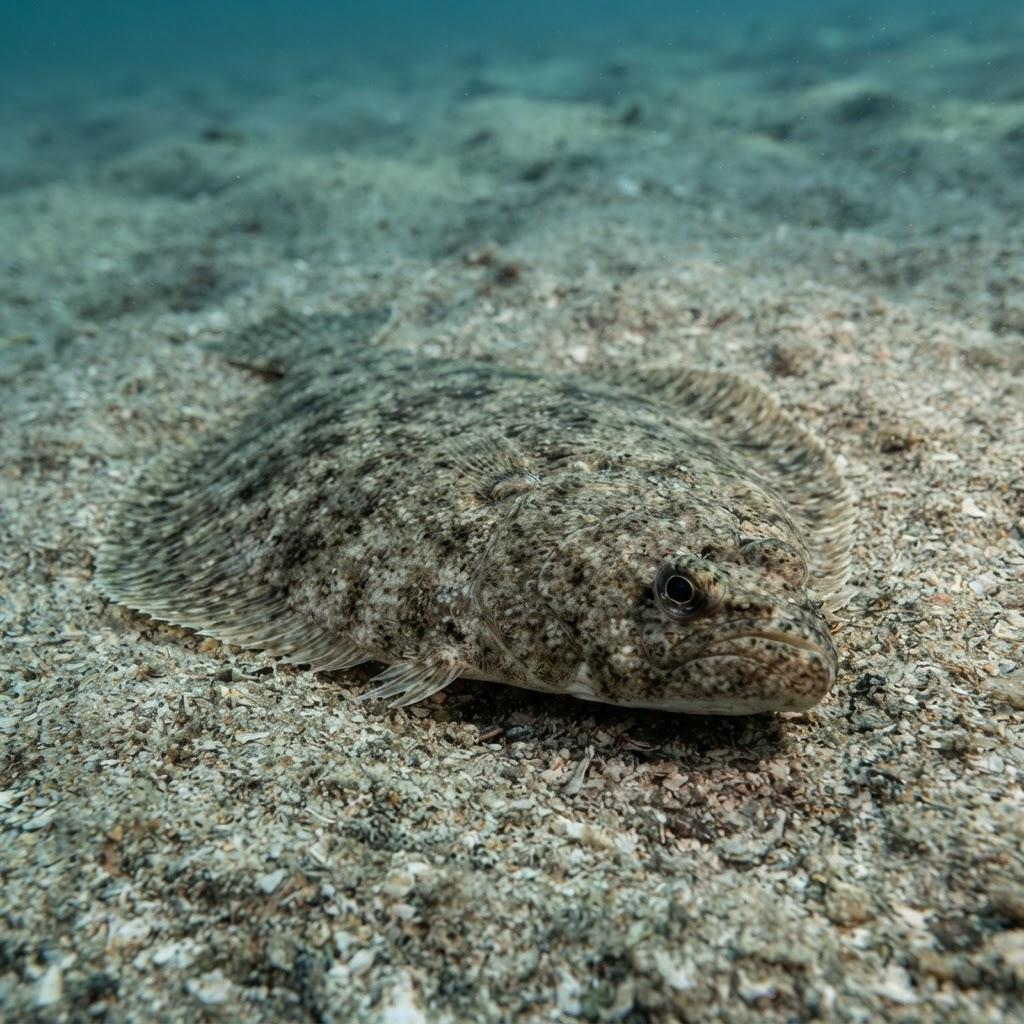
Paralichthys dentatus
Flounder (Summer)
The summer flounder is the ocean's ultimate shapeshifter, a flat-bodied ambush predator that looks like a tragic pancake gone wrong. Prepare to meet the fish that spent its entire life choosing a side—literally—and mastering the art of being a sentient piece of the seafloor.
Meet the Fish
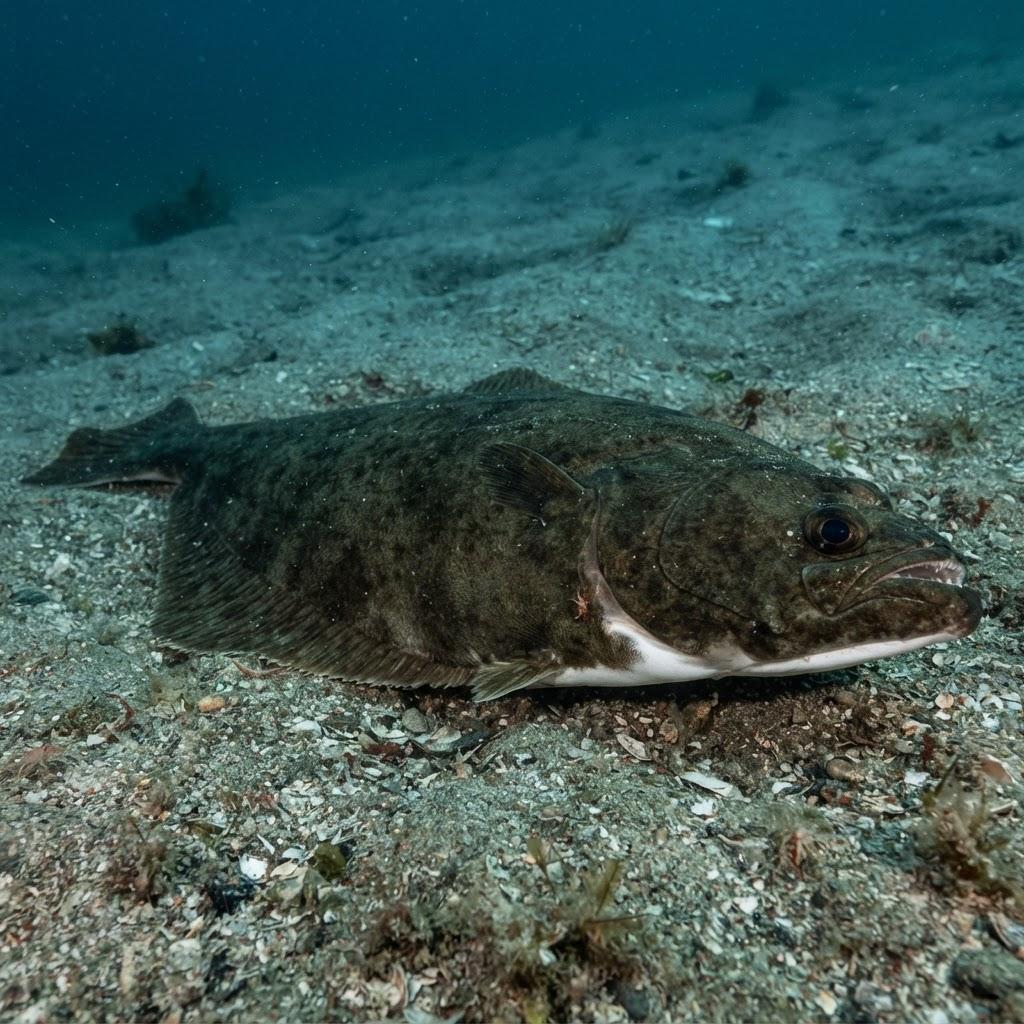
Imagine you are strolling through a crowded party, and suddenly, the floorboards start chewing on a sandwich. That is essentially the energy the summer flounder brings to the ocean. From the moment they hatch, these fish are engaged in a bizarre physical transformation that would make a plastic surgeon faint. They start out looking like normal, respectable little fishies, swimming upright like any self-respecting vertebrate. But then, they decide that life is just too exhausting when you have to stay vertical. They begin to tilt. They tilt until they are lying completely on their side on the sandy bottom, and then—the pièce de résistance—one of their eyes decides to migrate. Yes, that is right. One eye physically travels across the skull to meet its buddy on the other side. The result is a creature that looks like a discarded piece of wet cardboard with an attitude problem. They are the ultimate masters of the 'nothing to see here' vibe, perpetually pretending to be a patch of sand while waiting for something tasty to swim by.
Weird Biological Superpowers Explained Simply
The superpower of the summer flounder is something called active camouflage, but don't think for a second this is just some boring change in color. This fish is basically a living, breathing high-definition television. Their skin contains special cells called chromatophores that act like individual pixels. When the flounder settles onto a new patch of seafloor, its brain signals these cells to expand or contract, effectively painting a perfect imitation of the gravel, sand, or shell hash beneath it. It is not just about color; it is about texture and pattern. They can look like a dusty, speckled moonscape or a smooth, sandy beach in a matter of seconds. It is like having a cloak of invisibility that is powered by sheer nerve and chemistry. If you were a small, unsuspecting baitfish, you would not see a predator; you would simply see a perfectly normal patch of bottom, until the 'bottom' suddenly explodes upward with a set of razor-sharp teeth and ruins your entire afternoon.
Absurd Self-Defense Mechanisms
If you are a fish that is essentially a dinner plate waiting to happen, you need a plan for when things go south. For the summer flounder, the best defense is simply not being there. While other fish might rely on speed or poisonous spikes to deter attackers, the flounder relies on the power of being incredibly boring. When a predator like a shark or a seal comes sniffing around, the flounder stays perfectly still, blending into the mud like a pro. If the coast isn't clear, they have a burst of speed that is honestly surprising for something shaped like a flying saucer. They whip their flat, paddle-like body and create a massive cloud of silt, effectively throwing sand in the eyes of their attacker. It is the aquatic equivalent of the 'pocket sand' move. They create a chaotic, muddy fog, zoom away, and tuck themselves back into the bottom before the predator even realizes which way they went. It is messy, it is rude, and it is highly effective.
Fish Drama and Gossip
The social life of a summer flounder is exactly what you would expect from a bunch of loners who spend their days buried in the muck. There isn't much in the way of high-society galas or complex political alliances. In fact, flounder are notoriously anti-social. Think of them as the grumpy neighbor who never leaves their house and definitely doesn't want to borrow a cup of sugar. They are territorial, but in a very low-effort, lazy kind of way. If another flounder tries to move into their favorite sunny spot of seafloor, there might be some posturing, maybe a bit of a display of size, but mostly it is just a staring contest. They don't have the energy for massive battles. They are the reality TV stars who just want to stay in their dressing room, eat their snacks, and be left alone. If you see two flounders near each other, it is usually just because the hunting in that particular spot is just too good to share.
The 'Wait, That's Real?!' Deep-Sea Oddities
While our friend the summer flounder prefers the relatively shallow life of the continental shelf, it is worth looking at its deep-sea cousins to appreciate the weirdness of the flatfish family tree. In the deep dark, things get even more bizarre. Imagine the flounder’s cousin living in the 'midnight zone' where the pressure is enough to crush a submarine like a soda can. These fish don't have the benefit of blending in with sandy sunlight; they have to deal with creatures that generate their own light like neon-soaked disco balls. If a flounder were to visit the deep, it would probably be very confused by all the bioluminescent glowing. While the flounder uses its camouflage to hide from predators that can see, deep-sea dwellers use light to attract mates or trick prey into thinking they are a friendly snack. It is a world of darkness where a flat body wouldn't help you blend in, but being able to grow your own internal light show definitely would.
Myth Busting
There is a persistent myth that flatfish like the flounder are somehow 'lazy' because they spend all their time lying on the bottom. Let’s clear the air: that is not laziness; that is efficiency. Evolution doesn't reward unnecessary movement when you have a metabolism to maintain. People often think that because they move slowly when they are stalking prey, they are somehow sluggish or weak. This is simply not true. When they decide to strike, they move with a snap-like speed that is almost impossible to follow with the naked eye. Another myth is that flounder are just 'bottom feeders' that eat garbage. Wrong again. They are apex predators of the seafloor, actively hunting down crabs, shrimp, and smaller fish. They have a mouth full of sharp, conical teeth that are clearly designed for snatching up live, squirming prey. They are hunters, not scavengers. They aren't looking for scraps; they are looking for a meal that puts up a fight, which makes the hunt much more satisfying.
Humorous Historical Tales or Folklore
Throughout history, flatfish have held a strange place in human lore, often appearing in coastal myths as 'spirits of the sand' or omens for fishermen. There is an old maritime legend that if a fisherman caught a flounder with its eyes on the 'wrong' side—a rare genetic mutation—it was a sign of a coming storm. Sailors being a superstitious bunch, they would often toss these 'wrong-sided' fish back overboard with a quick prayer to appease the sea gods. It is a funny thought, imagining a grizzled sea captain trembling in his boots because a fish was looking at him from the opposite side of its face. They have also appeared in various folktales as creatures that tried to hide from the king of the sea and got flattened as punishment for their cowardice. Whether or not that is true, we know the truth is much cooler: they evolved to be flat because it is the ultimate way to survive in a world where everything wants to turn you into a filet.
Underwater Love Stories and Bizarre Romances
When summer rolls around, romance starts to bloom in the cold depths of the Atlantic. The courtship of the summer flounder is a masterclass in 'playing it cool.' Males will roam the seafloor searching for a female who looks like she might be interested in expanding the family tree. When they find one, they don't do elaborate dances; they perform a subtle, rhythmic swaying of their fins, showing off their speckled patterns to prove they are the most stylish flatfish on the block. It is basically the aquatic version of a guy in a club doing a very slow, slightly awkward shoulder shimmy. If the female is impressed—or perhaps just tired of being harassed—she will swim upwards into the water column. The male follows, and they release their eggs and sperm simultaneously in a cloud of hope and optimism, letting the ocean currents do the rest of the work. It is not romantic in the traditional sense, but it is effective enough to keep the population going.
Underwater Architecture and DIY Nesting
You might expect a fish that is so obsessed with the seafloor to build elaborate nests, but the summer flounder is a minimalist through and through. They don't have the patience for sand castles or structural engineering. Their 'nesting' strategy is remarkably low-tech: they rely on the vast, open water. By spawning in the water column and letting their eggs drift away on the tides, they avoid the need to guard a fixed location. This is brilliant because it means they don't have to defend a nest from hungry predators. Their architecture is internal and behavioral—they focus on choosing the right substrate to hide in rather than building something that could be destroyed. Why spend weeks building a fortress when you can just be a master of disguise in a pile of sand? They have realized that in a world of shifting tides and roaming predators, being a chameleon is far more valuable than being a mason.
The Chaos of Raising Tiny Swimmers
Once the eggs are fertilized and drifting, the parents immediately go back to their favorite hobby: being invisible. There is zero parental guidance involved here. The tiny larvae that hatch from these eggs are effectively on their own from second one. They drift with the plankton, eating tiny bits of microscopic food while trying not to get eaten themselves by everything from jellyfish to small crustaceans. It is a numbers game; by releasing thousands of eggs, the flounder ensures that even if ninety-nine percent of their offspring end up as a snack, a few will survive to reach the bottom and begin their own weird transformation. It is absolute chaos, and it is entirely typical for marine fish. No daycare, no bedtime stories, and no guidance counselor—just millions of tiny, transparent fish shapes trying to navigate the currents and find a sandy patch where they can eventually retire and grow their second eye.
How to Spot One & How It Is Doing
Spotting a summer flounder is a fun game for anyone with a sharp eye and a bit of patience. Look for them in shallow, sandy, or muddy bays during the summer months. You are looking for a slight disturbance in the sand, a shape that doesn't quite match the surrounding patterns. If you see a ripple that looks like a fish outline, stand perfectly still, and watch for that tell-tale twitch of an eye. The good news is that the summer flounder is doing quite well. Their populations are managed through sustainable fishing practices, meaning they aren't going anywhere anytime soon. You can help by supporting local, responsibly caught seafood and keeping our coastal waters clean. Next time you are at the beach, don't just stare at the horizon; look down at the shallows. You might just find a master of disguise looking back at you, waiting for the perfect moment to prove that being a flat, one-sided wonder is actually the coolest way to live.