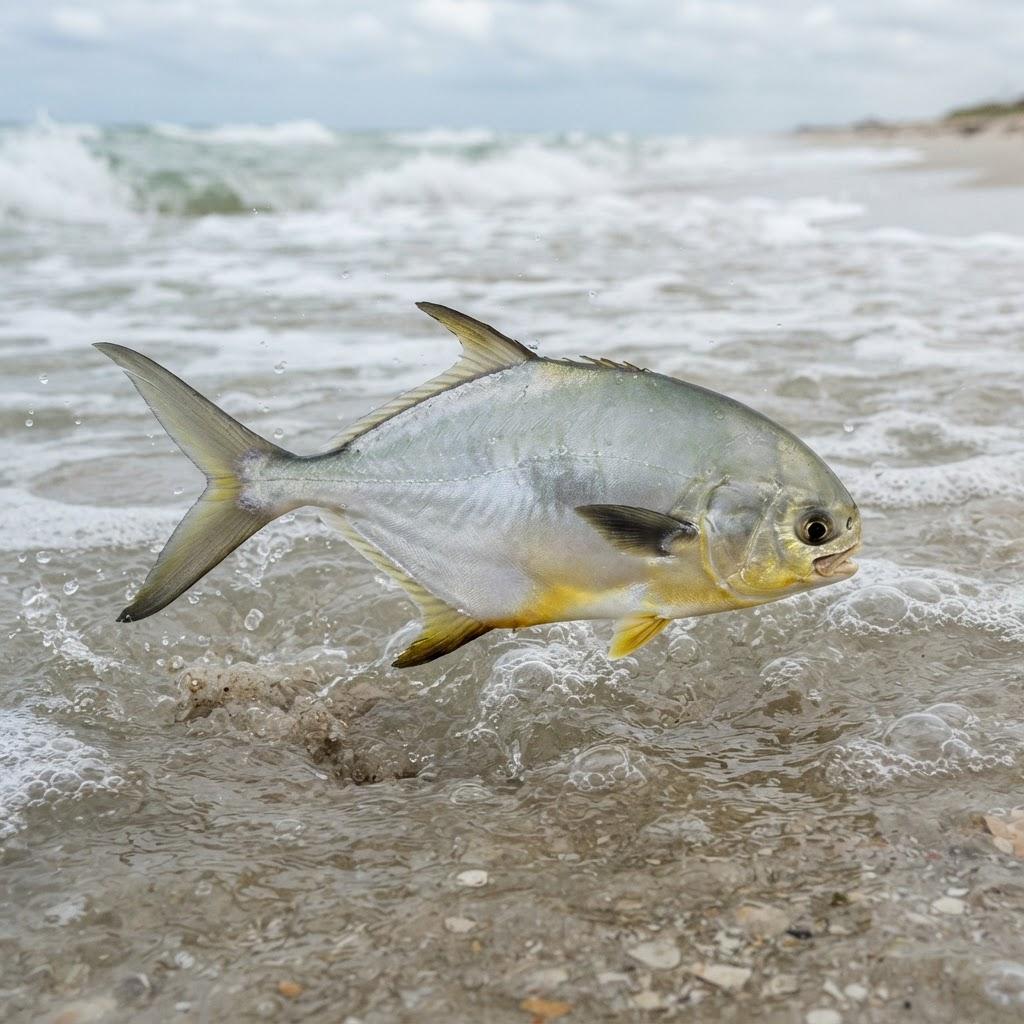
Trachinotus carolinus
Pompano (Florida Pompano)
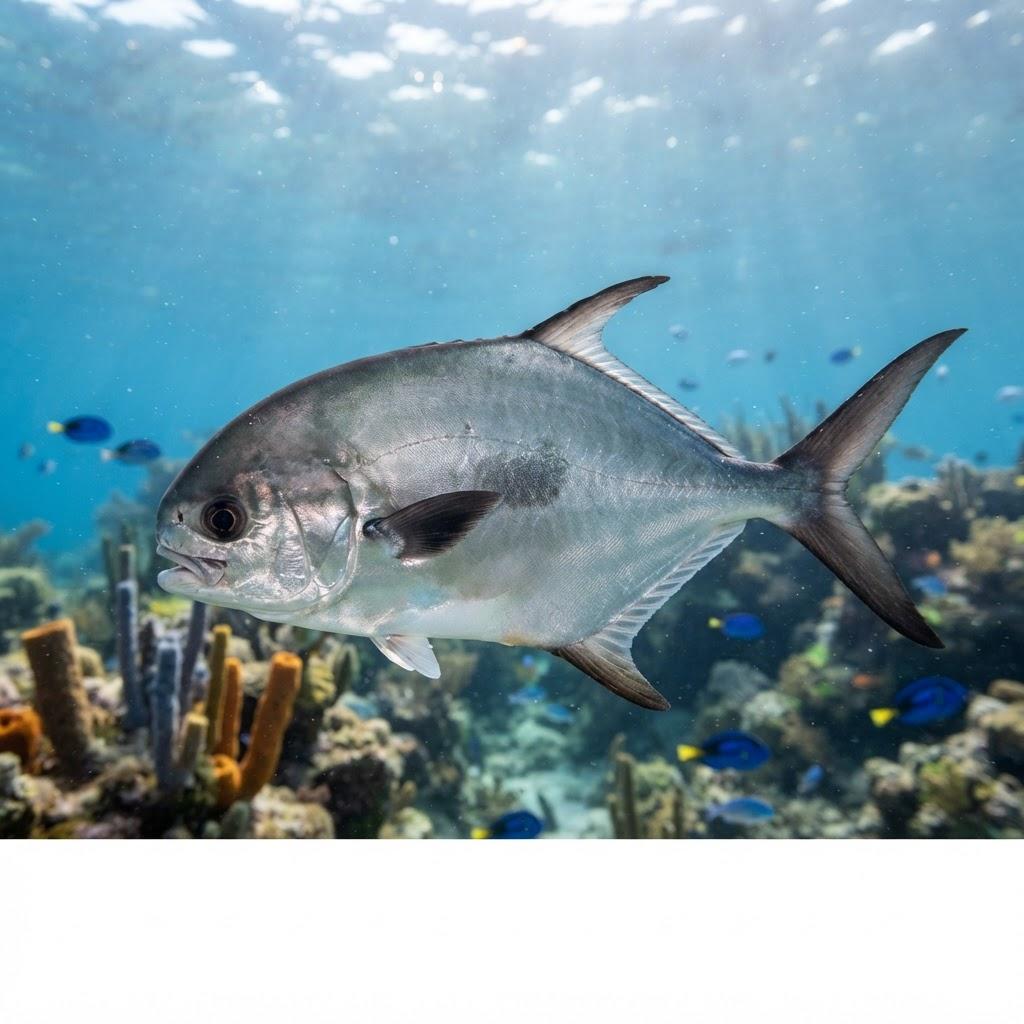
The Florida Pompano is the ocean's ultimate silver surfer, known for its high-speed antics in the surf and a taste that has made it a culinary legend. It is basically the charismatic, shiny superstar of the sandy beach party.
Meet the Fish
Imagine a fish that spent its entire formative years watching extreme sports videos and decided that the crushing, bubbly chaos of a breaking wave is the perfect place to hang out. Enter the Florida Pompano, a creature so streamlined and polished that it looks like it was designed by a high-end luxury car manufacturer. With a body shaped like a flattened, silvery oval, this fish is essentially the aerodynamic equivalent of a bullet traveling through a blender. Unlike its lazy relatives who prefer to hide under a rock and wait for takeout, the Pompano is a social butterfly of the surf zone. It has this frantic, high-energy vibe, darting through the foam of crashing waves as if it is perpetually late for a very important board meeting. They shimmer like a polished nickel tossed into the sunlight, making them one of the most stylish denizens of the shallow coastline. It is not just a pretty face; this fish is a master of the high-energy lifestyle, constantly on the move, eating like it is at an all-you-can-eat buffet, and looking like it just stepped out of a saltwater spa treatment.
Weird Biological Superpowers Explained Simply
The Pompano does not have lasers shooting from its eyes or the ability to turn invisible, but it does possess a biological superpower that is just as impressive in its own right: the ability to thrive in the 'washing machine' environment. Most fish would get pulverized in the turbulence of the surf zone, where sand, shells, and crashing water create a chaotic environment that would make a human gymnast nauseous. The Pompano’s body is laterally compressed, which is a fancy way of saying it is squashed from side to side. This shape allows it to slice through heavy currents and rough waves without losing its cool. Furthermore, their bodies are covered in incredibly small, smooth scales that reduce friction, basically giving them a full-body wax job that helps them hydroplane through the water. While other fish are struggling to keep their balance, the Pompano uses its deeply forked tail to generate bursts of speed that would put a modern jet ski to shame, allowing it to dart away from danger with the grace of a professional ballroom dancer.
Absurd Self-Defense Mechanisms
When you are a tasty, silver snack living in the shallow waters, you basically have a 'please eat me' sign painted on your sides for every predator in the sea. To combat this, the Pompano relies on the 'blur and confuse' strategy. When a predator like a hungry Jack or a predatory shark makes an appearance, the Pompano doesn't try to fight back. Instead, it relies on its schooling behavior, which acts like a massive, confusing disco ball. Thousands of these shiny, silvery fish suddenly dart in all directions, turning the water into a shimmering, strobe-light-filled nightmare for the attacker. It is incredibly hard to focus on one single meal when your vision is being assaulted by a million flickering silver flashes. It is the aquatic equivalent of throwing glitter everywhere to hide while you run away. They are also masters of the sudden stop-and-turn; they can pivot on a dime, leaving larger, clumsier predators staring at a patch of empty, sandy water while the entire school vanishes into the foam.
Fish Drama and Gossip
The social life of a Pompano is surprisingly intense for a group of fish that spends most of its time looking for lunch. If you were to peer into their schools, you would see a constant, high-stakes game of 'follow the leader' mixed with 'don't be the slow one.' Because food in the surf zone is often hidden beneath the sand, Pompano engage in a social hierarchy determined by who is the fastest to spot a fleeing clam. They move as a unified, twitchy entity, constantly vibrating with kinetic energy. There are no actual 'fish cliques' in the high school sense, but there is a clear distinction between the savvy, experienced older fish who know exactly where the best sand fleas are hiding and the young, impulsive scouts who often lead the school into awkward, dead-end currents. It is a reality show where the prize is not a rose, but a delicious little crustacean, and the penalty for being socially awkward is getting left behind for a hungry grouper.
The "Wait, That's Real?!" Deep-Sea Oddities
While the Pompano is a bright, sun-loving beach bum, it is worth noting how much of an alien life it avoids compared to its deep-sea cousins. If you go deep enough, you find fish that look like they were drawn by a toddler in a dark room—transparent, glowing with weird neon lights, and possessing teeth that take up half their face. Pompano are the exact opposite of these deep-sea monsters. While deep-sea fish have to evolve giant, buggy eyes just to catch a stray photon of light, the Pompano thrives in the bright, shallow sunlight where colors are vivid and shadows are sharp. It doesn't need to generate its own light or have a lure dangling from its head because it has the sun and its own incredible speed to rely on. The deep-sea creatures are living in a permanent, crushing midnight, while the Pompano is enjoying the beach life, which is a stark reminder of how specialized life is—one group built for the neon abyss, the other for the sunny, sandy runway.
Myth Busting
For years, people have claimed that Pompano are just 'dumb minnows' that swim around in circles until they run into a hook, but that is a load of codswallop. These fish are actually quite selective and exhibit something akin to situational awareness. Fishermen often complain that Pompano are 'finicky,' as if the fish is purposely turning up its nose at a particular bait, but in reality, these fish are just experts at recognizing what is natural and what is a cheap plastic imitation. They aren't just bumping into things; they are constantly scanning the bottom, sensing vibrations in the sand that betray the location of a buried meal. It is a myth that they are mindless wanderers. They are, in fact, tactical hunters that map their environment based on tide changes and current patterns. If you don't offer them exactly what the local menu requires, they will ignore you completely, showing that they are far from the simple-minded creatures of old legend.
Humorous Historical Tales or Folklore
The Pompano has a history that is almost as rich as its flavor. In the early days of coastal fishing in Florida, it was considered the 'fish of royalty' among anglers. There is a hilarious old tale from the early 1900s about a wealthy tycoon who traveled all the way from New York to catch a Pompano, only to be out-fished by a local boy with a bamboo pole and a piece of shrimp. The legend goes that the boy had named his favorite Pompano 'Sir Silver,' claiming the fish was the king of the surf and couldn't be caught by anyone who didn't respect the tide. While likely a tall tale meant to humble the wealthy, it cemented the Pompano as a local folk hero. In some older coastal communities, there was even a superstition that if you saw a Pompano jumping in the surf during a sunset, it meant the next day would be filled with good luck for your nets. It’s a classic case of humans attributing mystical powers to a fish simply because it’s hard to catch and tastes spectacular.
Underwater Love Stories and Bizarre Romances
Romance in the Pompano world is not about candlelit dinners or long walks on the beach; it is about synchronized swimming and high-velocity flirting. During the spawning season, the Pompano head offshore into deeper, clearer waters to participate in what can only be described as a frantic, watery mosh pit. Unlike animals that pick one partner for life, Pompano are quite chaotic. They gather in massive schools where the water essentially becomes a giant soup of reproductive cells. It is less of a romantic date and more like a crowded wedding reception where everyone is dancing at the same time. The males and females release their eggs and sperm into the open water simultaneously, hoping that the ocean currents will do the rest of the heavy lifting. There is no elaborate nest to protect or long-term bond; it is a high-stakes, numbers game where the goal is to produce as many tiny, potential Pompanos as possible before the local predators show up to crash the party.
Underwater Architecture and DIY Nesting
If you are looking for underwater architects, look elsewhere, because the Pompano is definitely not a 'do-it-yourself' kind of species. While some fish spend weeks building complex coral castles or meticulously excavating holes, the Pompano is a minimalist. Their 'nesting' strategy is essentially 'the entire ocean is my nursery.' They do not build structures because they do not stay in one place long enough to enjoy them. If you tried to build a house in the middle of a breaking surf wave, it would be gone in five minutes anyway, so the Pompano has the right idea. They rely on the vastness of the sea to protect their offspring. Instead of building, they invest their energy into creating massive amounts of eggs that float in the currents, which is a much smarter architectural choice if you are a fish that values being everywhere at once. They are the nomadic travelers of the sea, and they wouldn't have it any other way, as they refuse to be tied down by property taxes or coastal zoning laws.
The Chaos of Raising Tiny Swimmers
Being a parent as a Pompano is essentially an exercise in total abandonment. Once the eggs are fertilized in the open water, the parents check out immediately. There is no 'teaching them to hunt' or 'protecting the den'—the tiny, translucent larvae are left to fend for themselves from day one. These babies, which look like little more than tiny specks of animated jelly, are at the mercy of the wind, the tides, and the appetites of every hungry organism in the sea. It is a brutal, high-speed upbringing. Most of them will never reach adulthood, as they are a favorite snack for plankton-eaters, but the ones that do survive are the survivors of a genetic gauntlet. They grow with incredible speed, fueled by a voracious appetite that turns them from microscopic specks into the shimmering, surf-loving speedsters we see in the shallow water. It is a chaotic, Darwinian system that somehow keeps the population thriving despite the complete lack of parental supervision.
How to Spot One & How It Is Doing
If you want to catch a glimpse of this silver streak, head to your nearest sandy beach on a sunny day. Look for a fish with a deep, oval body, a high dorsal fin that looks like a little shark fin, and a color that glows like a fresh quarter. They like the 'trough'—the deeper area of water between the beach and the first sandbar—where they hunt for small crustaceans. Currently, the Florida Pompano is doing just fine. They are not endangered, and thanks to some smart fishing regulations that prevent them from being over-harvested, their numbers remain healthy. You can do your part by always following local fishing rules and respecting the beach environment by picking up trash. If you want to help, support local marine conservation groups that protect coastal habitats. By keeping the beaches clean and the water healthy, you are ensuring that the next generation of 'silver surfers' has plenty of room to dart through the waves and dazzle beachgoers for many years to come.