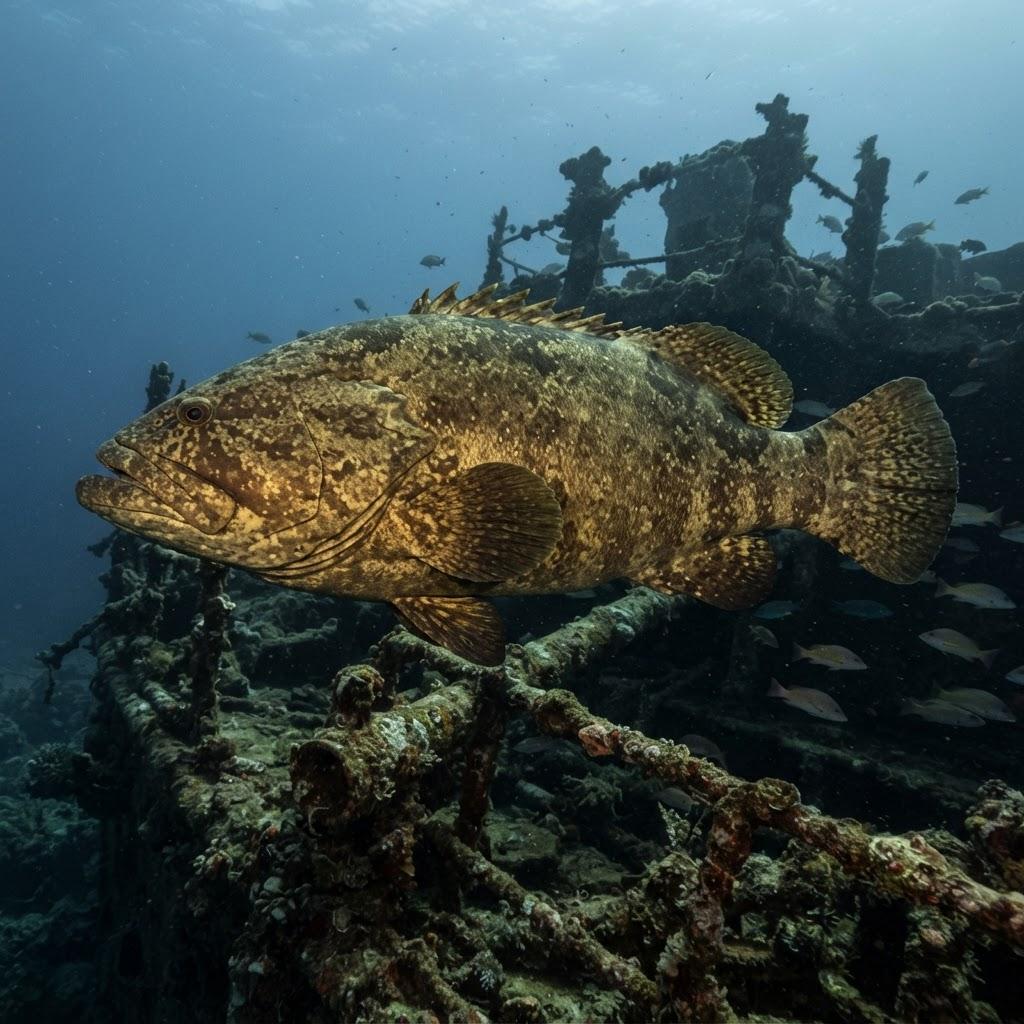
Epinephelus itajara
Goliath Grouper
Meet the Goliath Grouper, the ocean's equivalent of a grumpy, immovable living boulder that decided it wanted to be the king of the reef. This massive fish is a gentle giant with an appetite for drama and a personality that screams 'get off my lawn' while still somehow being a dive-buddy favorite.
Meet the Fish
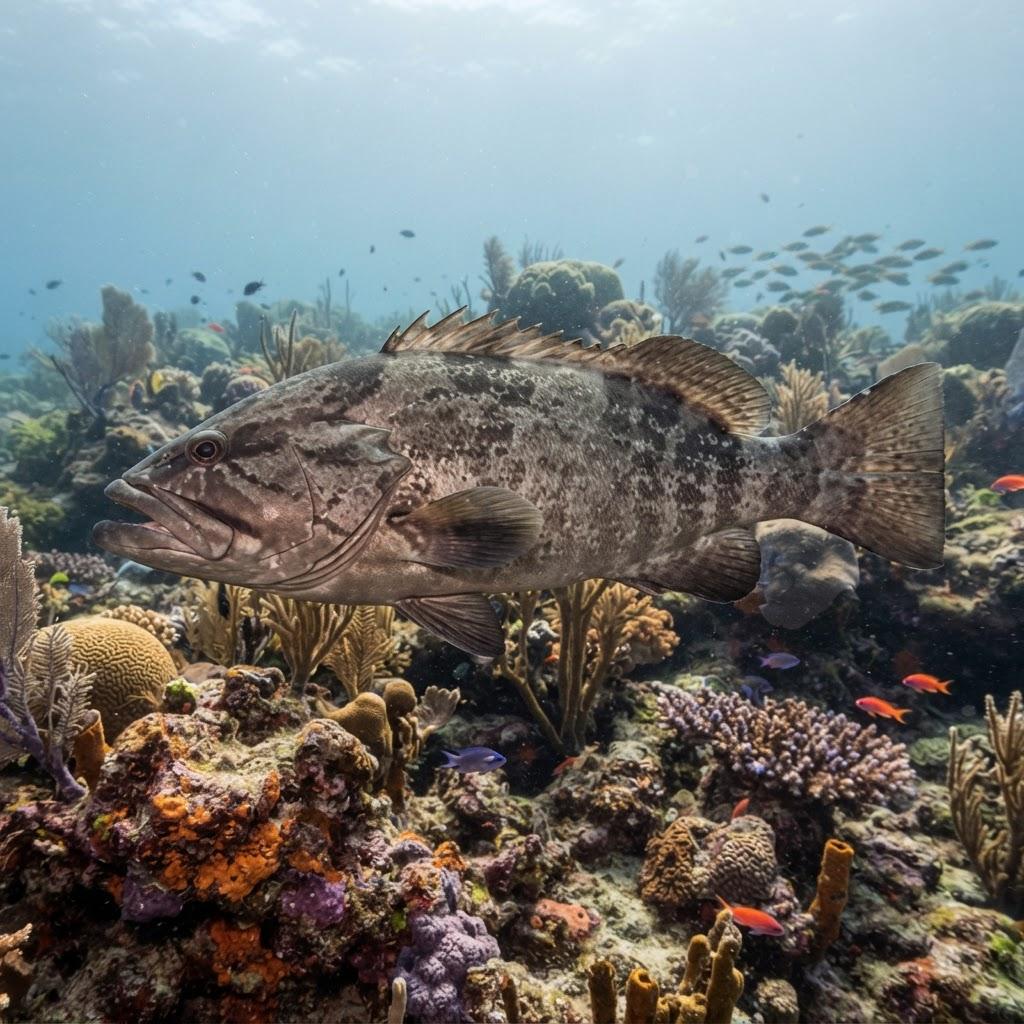
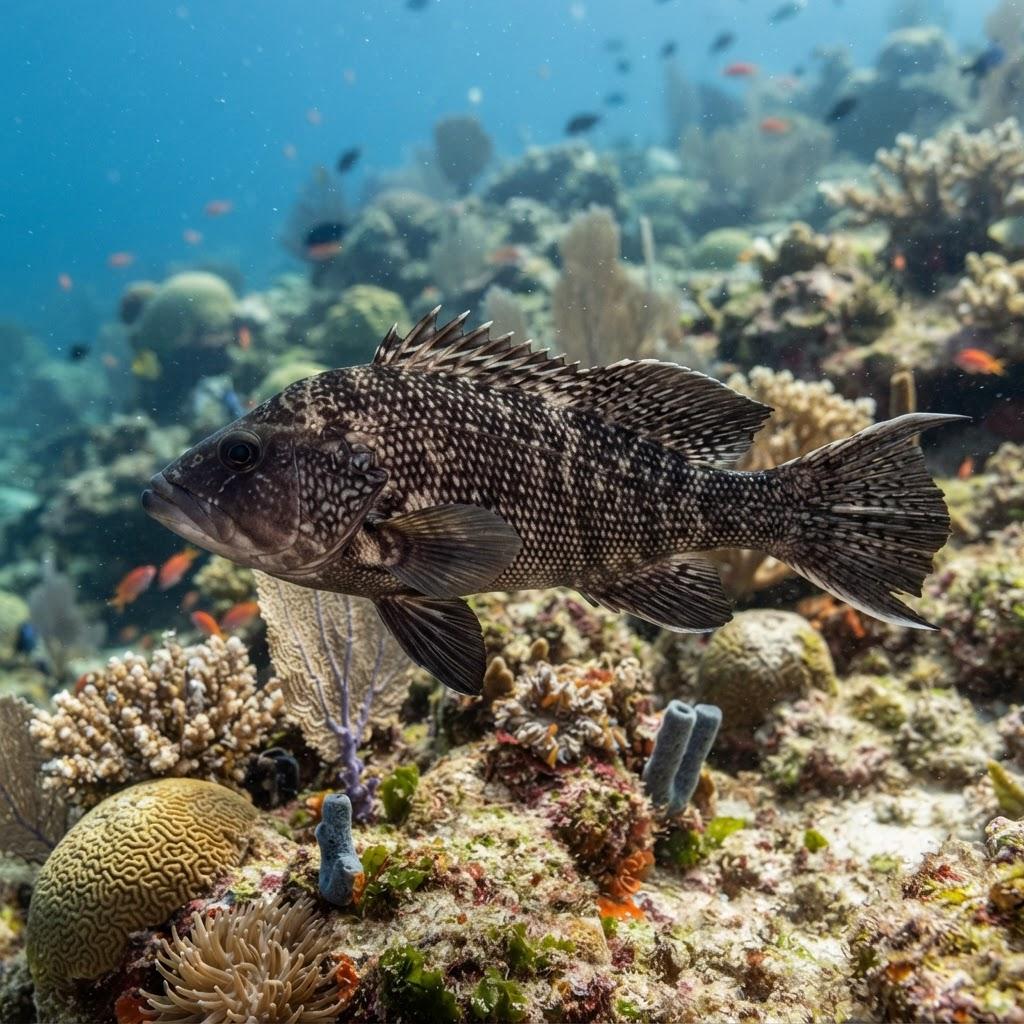
Imagine a 800-pound Volkswagen Beetle covered in scales and attitude, and you have the Goliath Grouper. This isn't just a fish; it is the absolute boss of the local reef neighborhood. With a mouth large enough to swallow a decent-sized beach cooler whole, this creature moves with the slow, deliberate swagger of a bouncer who knows exactly who is allowed in the club. It doesn't zip around like those jittery tropical fish that look like they’ve had too much caffeine. No, the Goliath is a champion of the 'slow life.' It spends most of its time hovering in caves or under ledges, watching the world go by with eyes that suggest it is silently judging your buoyancy control. It is essentially the underwater equivalent of a grandpa sitting on a porch in a recliner, except the porch is a coral shelf and the recliner is just pure muscle and saltwater menace. If you ever come face-to-face with one, prepare to feel incredibly small, because while you are struggling to keep your mask from leaking, this beast is just floating there, looking like a prehistoric tank that forgot to move on to extinction. It is truly the king of the underwater couch potatoes.
Weird Biological Superpowers Explained Simply
The Goliath Grouper has a superpower that makes it sound like a malfunctioning submarine: it makes a booming sound that can actually vibrate your chest if you are diving nearby. Think of it like a giant, underwater bass drum. When the Goliath wants to tell other fish to back off or to announce its presence, it contracts its swim bladder—a gas-filled balloon inside the fish that helps it stay buoyant—against its muscles to create a low-frequency 'boom.' It is essentially the ocean’s way of honking a horn, but much more intimidating. Beyond the sound, its mouth is a marvel of physics. It uses what is called suction feeding. When it decides to eat, it opens its massive mouth so quickly that it creates a localized vacuum, pulling in a huge volume of water along with whatever unlucky snack happened to be hovering in front of it. It is like being on the receiving end of a high-powered industrial vacuum cleaner, except you are a small fish and the vacuum has eyes, fins, and a very grumpy disposition.
Absurd Self-Defense Mechanisms
When you weigh as much as a small motorcycle, you generally don't need a complex escape plan. The Goliath Grouper’s primary defense is simply looking like it might eat you back. While most fish panic and scatter when a predator appears, the Goliath stays firm. If a shark gets a little too curious, the Goliath doesn't run; it stands its ground, flares its gills, and makes itself look like an insurmountable slab of rock. It’s the aquatic version of 'you want a piece of me?' The sheer mass makes it a difficult target, but its skin is also surprisingly tough and abrasive. It’s covered in thick, heavily armored scales that act like a suit of chainmail. If things get really heated, it retreats into the tightest, darkest crevice it can find, essentially jamming its massive bulk into a rock cave until it is wedged in so tightly that nothing on the reef can pull it out. It is a master of the 'I am not here' game, provided your definition of 'here' is a rock that is currently glaring at you with intense suspicion.
Fish Drama and Gossip
The social life of a Goliath Grouper is less of a sitcom and more of a tense standoff in a Wild West saloon. Because these fish are strictly territorial, the reef is essentially carved up into a series of imaginary property lines. If a fellow Goliath wanders into another’s favorite cave, the tension is palpable. They don't have fistfights, but they do engage in a series of posturing displays that involve darkening their colors and widening their gills. It is basically the underwater version of two neighbors arguing over whose hedge is encroaching on the fence line. Younger, smaller groupers are constantly trying to challenge the veterans, but usually, a single 'boom' sound or a slow, menacing swim-by from the dominant grouper is enough to settle the score. Gossip travels fast in the reef, and the other fish definitely know who runs the show. If you see a swarm of smaller fish hovering nervously around a crevice, you can be sure a Goliath is holding court inside, acting like the moody celebrity of the neighborhood.
The "Wait, That's Real?!" Deep-Sea Oddities
While the Goliath Grouper prefers the shallower, sun-drenched reefs rather than the dark, alien void of the deep sea, its existence makes you appreciate the weirdness of the abyss even more. Down in the twilight and midnight zones, fish look like they were designed by a team of artists who had access to too much neon paint and a love for transparent skin. The Goliath, by contrast, is a solid, sturdy, earthy creature, perfectly adapted to the chaotic world of surf and tides. If the Goliath were a deep-sea fish, it would probably be the one with a glowing lure hanging off its chin to trick people into coming closer. Instead, it relies on being large, solid, and immovable. When you look at the weird, gelatinous, glowing nightmares that call the deep ocean home, you realize how lucky we are that the Goliath looks like an actual fish rather than a creature from a fever dream. The Goliath is a reminder that you don't need to be bioluminescent or transparent to be the weirdest, coolest thing on the block; you just need to be big enough to command respect.
Myth Busting
There is a persistent myth that the Goliath Grouper is a man-eating monster that will drag unsuspecting divers into their caves for a midnight snack. Let’s put that to bed right now: they are much more interested in a crab or a slow-moving fish than they are in a person in a rubber suit. They are curious, yes, and they might follow a diver out of sheer boredom or to see if they are going to drop a snack, but the 'man-eater' label is pure Hollywood fantasy. Another myth is that these fish are mindless eating machines. In reality, they are surprisingly observant. Studies have shown they can learn to associate certain sounds or locations with food, and they exhibit enough individual personality that local dive guides often name the ones that hang around their favorite spots. They aren't just moving chunks of meat; they are smart, cautious, and incredibly aware of their surroundings. They have a memory for their territory and they know exactly who is a friend, a foe, or just a tourist with a camera.
Humorous Historical Tales or Folklore
Historically, the Goliath Grouper has been a central figure in maritime lore, often cast as the 'Jewfish'—a name that, while outdated, gave them a reputation as ancient, wise, and slightly spooky residents of the deep. Old-school sailors used to tell tall tales about groupers that had grown so large they could swallow an anchor or pull a small boat under if you hooked one the wrong way. While these stories were usually exaggerations fueled by rum and the darkness of the sea, they highlight how these fish have captured human imagination for centuries. They represent the untamed mystery of the ocean. In some coastal cultures, they were seen as guardians of the reefs, the silent sentinels that watched over the bounty of the sea. It is funny to think that a fish that spends most of its time sleeping under a rock could be the stuff of such epic legends, but when you are as big as a refrigerator, people tend to make up stories about you regardless of whether you actually do anything besides nap.
Underwater Love Stories and Bizarre Romances
When it is time for romance, the Goliath Grouper undergoes a transformation that is as chaotic as it is loud. During the spawning season, they gather in groups at specific, well-kept secret spots—like a high-stakes, underwater dating conference. The males begin to 'boom' at each other to prove who is the loudest and the biggest, essentially flexing their muscles and hoping to attract the attention of a female. It is a competition based on sound, size, and the ability to hold the best territory. Once a match is made, the pair releases their eggs and sperm into the water column in a grand, messy cloud. It is not romantic by human standards—there are no flowers or candlelit dinners—but for a fish, it is a high-energy, high-stakes affair. They aren't looking for a lifelong partner; they are looking for the best possible spot to ensure the next generation has a chance. The drama of the sound-off alone is enough to wake the entire reef, making it one of the most cacophonous events in the aquatic calendar.
Underwater Architecture and DIY Nesting
You won't find a Goliath Grouper carefully weaving a nest out of seagrass or building a sandcastle. Their version of 'nesting' is more about selecting the ultimate real estate. A prime piece of property for a Goliath is a cave with multiple exits, a sturdy roof, and, ideally, a view of the current. They spend a surprising amount of time 'cleaning' their homes, using their fins to fan away sand and debris, or sometimes even using their powerful jaws to clear out rocks that are cluttering up their living room. They aren't architects so much as they are intense renovation enthusiasts. A well-maintained Grouper cave is a thing of beauty in the reef world; it’s a fortress that provides protection from the elements and a strategic position for catching prey. It is all about location, location, location. If you can find a deep, dark, and perfectly sheltered ledge, you have found the local luxury condo of the reef, and you can bet a grumpy, house-proud Goliath has already claimed it for the next five years.
The Chaos of Raising Tiny Swimmers
If you thought having a toddler was hard, imagine being a Goliath Grouper parent. After the massive, chaotic spawning event where millions of tiny eggs are released into the currents, the parents basically say, 'good luck, kids,' and return to their caves. The eggs drift in the open ocean, turning into tiny, transparent larvae that look like little swimming specks of dust. These fry then have to navigate the perilous journey back to the mangroves or seagrass beds to hide from the millions of things that want to eat them. It is a numbers game. Only a tiny fraction of the thousands of eggs released will survive to become a Goliath, let alone a monster-sized adult. There is no coddling here; it is pure, survival-of-the-fittest chaos. The ones that do make it to the shallows spend their youth hiding in the shadows of mangrove roots, trying not to be eaten by everything from small snappers to hungry wading birds. It is a rugged childhood that turns them into the tough, cynical giants they eventually become.
How to Spot One & How It Is Doing
If you want to see a Goliath Grouper in the wild, you need to head to the Florida Keys or the Caribbean and find a dive site with a history of sightings. Look for the deepest, darkest cave on the reef—the kind you’d normally be afraid to stick your hand into. You will likely see a pair of large, wary eyes reflecting your flashlight beam from the shadows. Keep your distance, not just because they are massive, but because they are currently a protected species and they deserve their space. As for their status, they were once fished to the edge of collapse, but thanks to protections, their populations are making a slow, steady comeback. You can help by supporting healthy reef initiatives and, most importantly, by just being a respectful observer. If you are ever lucky enough to be in the water with one, don't try to feed it or poke it. Just hang there, float with the current, and appreciate the fact that you are sharing the ocean with one of its most legendary and grumpy characters. They are survivors, and they are worth protecting.