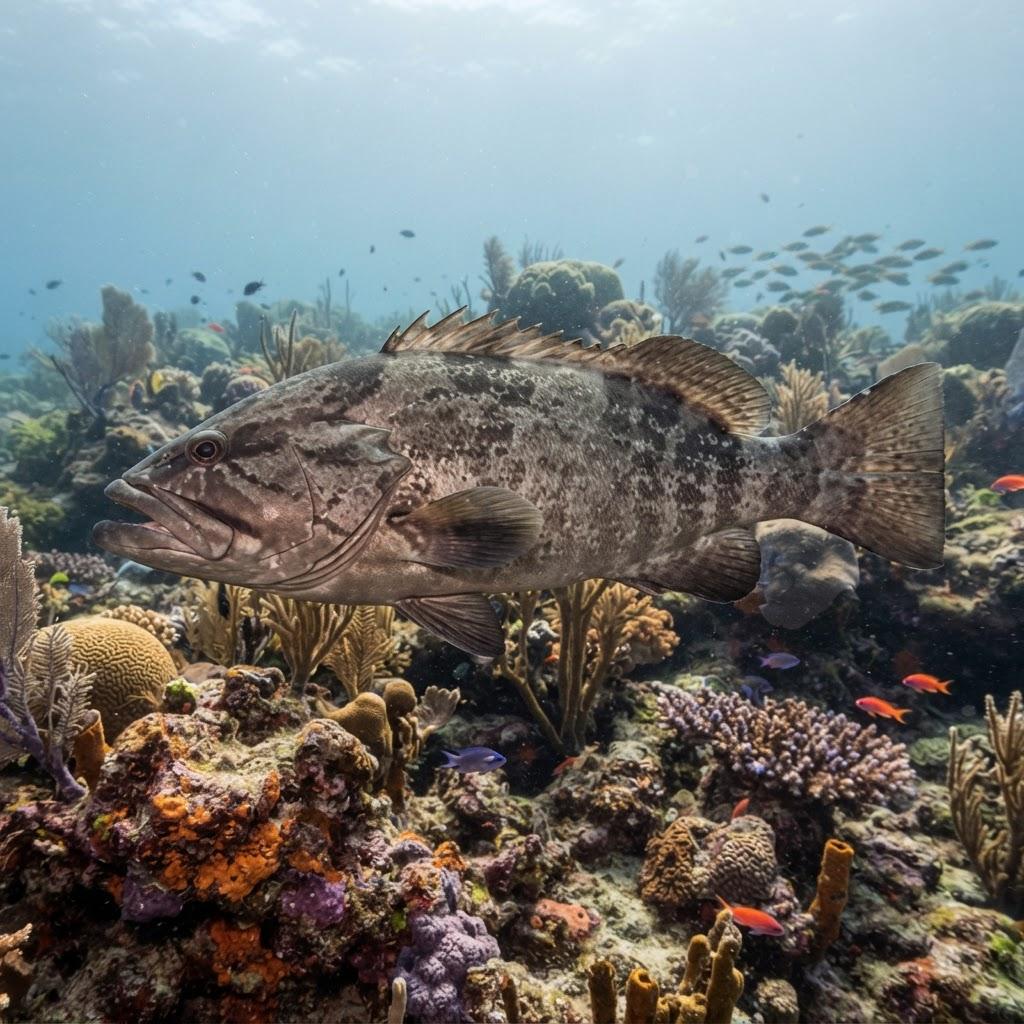
Mycteroperca microlepis
Gag Grouper
The Gag Grouper is the moody, couch-potato king of the reef that enjoys long, quiet stints in deep caves. Imagine a giant, grumpy bass with a sophisticated palate and a very surprising mid-life gender twist.
Meet the Fish
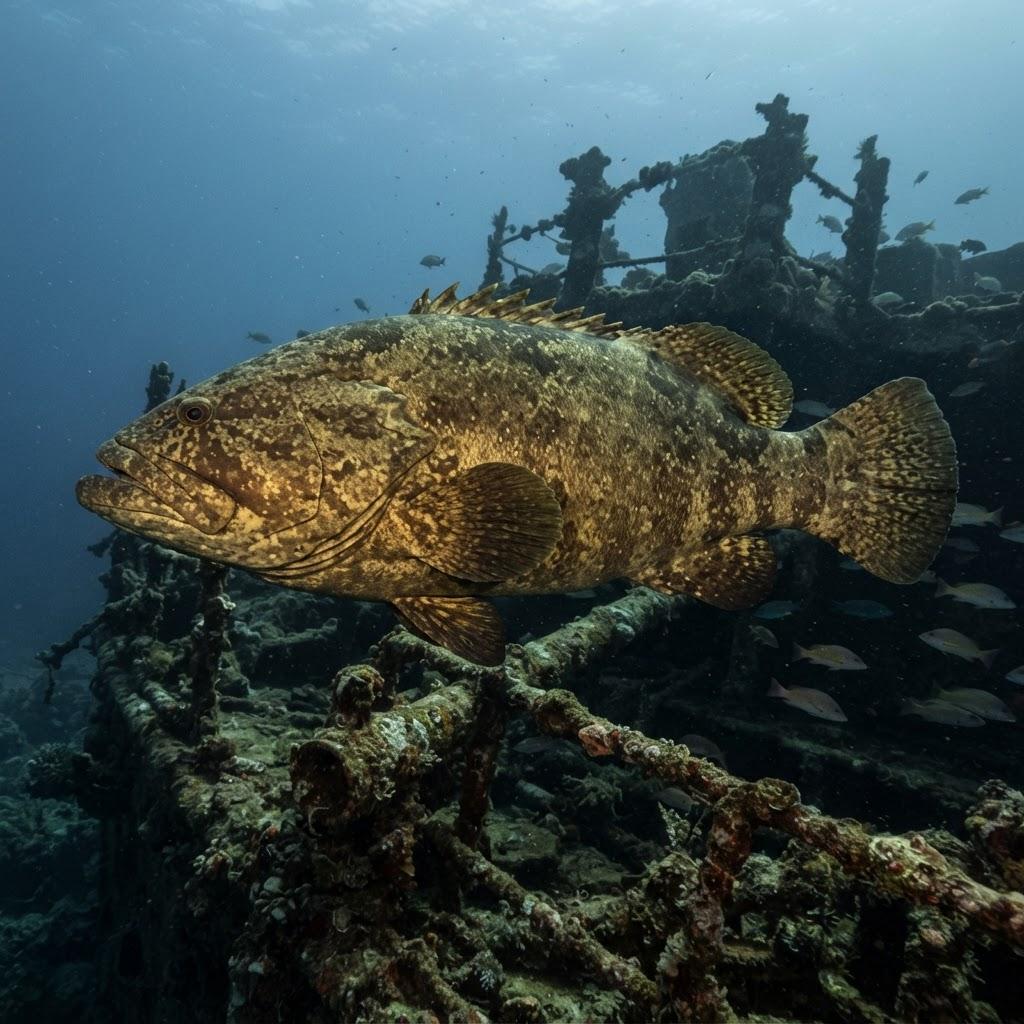
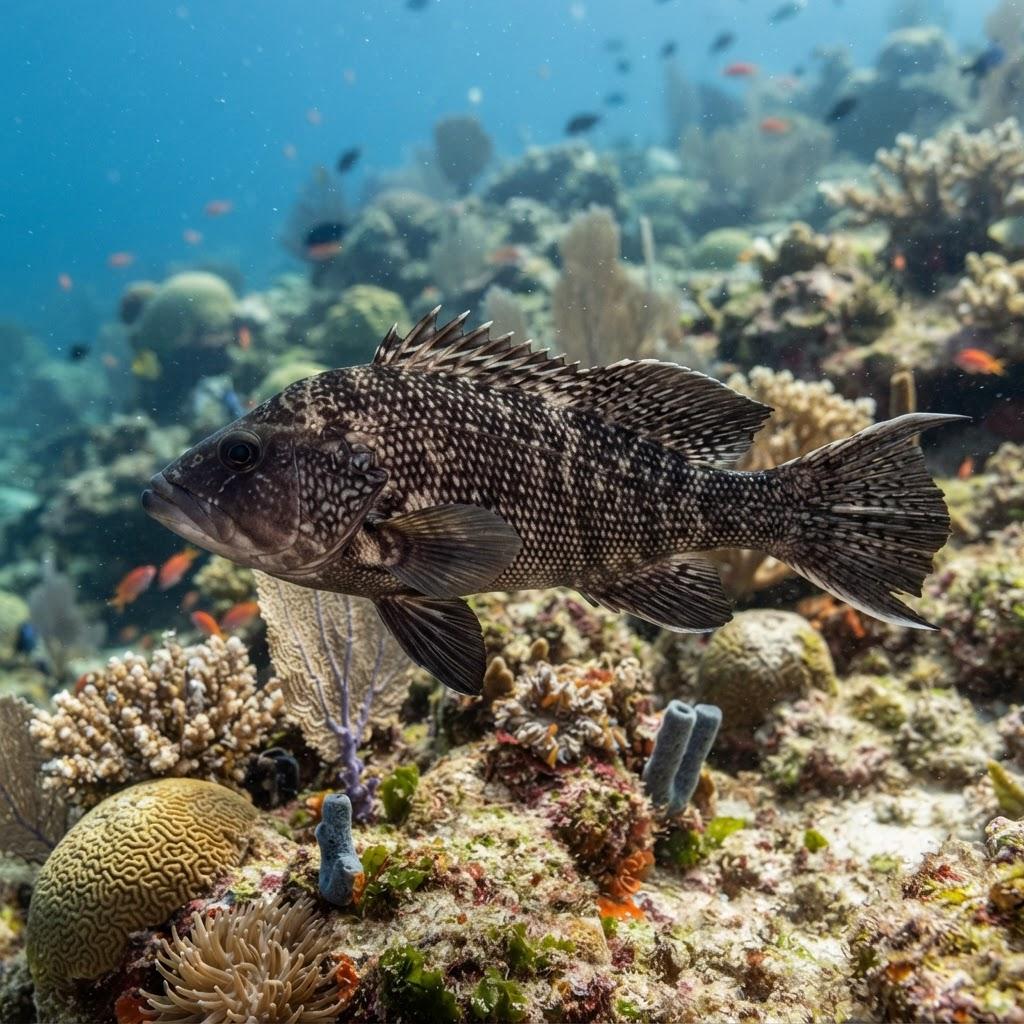
If the ocean had a neighborhood watch captain who was also the local town curmudgeon, it would undoubtedly be the Gag Grouper. This fish is not looking for fame, glamour, or a starring role in your vacation selfies; it is looking for a sturdy rock, a dark cave, and absolutely zero interruptions. With a face that can only be described as perpetually unimpressed and a physique that suggests it has been hitting the buffet line a little too hard, the Gag Grouper is the undisputed heavyweight champion of loafing around. While other fish dart about like caffeinated toddlers, the Gag hangs back, tucked into a deep-sea ledge, watching the world drift by with the weary eyes of a detective who has seen too much. They are the brooding anti-heroes of the reef, sporting a mottled gray camouflage that blends perfectly with the shadows of the seabed. Think of them as the grumpy grandpa of the Florida coastline, sitting on his porch, yelling at the little silver-sides to get off his lawn while he waits for a hapless crab or a wandering baitfish to make the fatal mistake of swimming just a little too close to his front door.
Weird Biological Superpowers Explained Simply
The Gag Grouper possesses a superpower that sounds like something pulled straight from a sci-fi B-movie script: the ability to change gender on a whim. That is right, every single Gag Grouper begins its life as a female. If you were to peer into a nursery full of baby Gags, you would be looking at an entire room full of future mommies. However, as they age and grow into massive, seasoned adults, a certain percentage of the population decides it is time to pivot, quite literally, to the male side of the ledger. This is not just a costume change; it is a full-blown biological overhaul triggered by social dynamics. If there is a shortage of 'gentlemen' in the neighborhood, the largest, most dominant females will undergo a chemical shift, transforming into males to take over the breeding responsibilities. It is the marine equivalent of a lead singer suddenly deciding they would rather play the drums because the band really needs a percussionist. This hormonal magic act ensures that the grouper population can maintain its numbers regardless of which gender is currently in short supply, effectively making them the most flexible socialites in the deep blue sea.
Absurd Self-Defense Mechanisms
When a Gag Grouper feels threatened, it does not rely on fancy speed or flashy colors. Instead, it employs the 'fortress of solitude' defense, which is as effective as it is lazy. The Gag is a master of the suction-cup maneuver. When it retreats into its preferred rocky crevice or cave, it can lock itself in place by extending its fins and bracing its body against the walls of the cave, essentially wedging itself so tightly that not even a hungry shark or an enthusiastic scuba diver could budge it. It is the fish version of a person sitting in a recliner and refusing to get up when the house is on fire. Beyond this unmovable-object routine, they have a set of gill covers that are razor-sharp. If a predator tries to grab a Gag by the head—a classic rookie mistake—they are going to end up with a mouth full of jagged, bony armor. It is a simple, no-nonsense defense: hide where they can’t reach, and if they do reach, make sure they regret the physical contact immediately.
Fish Drama and Gossip
Life on a deep-water reef is essentially a high-stakes soap opera where the lead roles are constantly changing. Because Gag Groupers are strictly territorial, the drama centers almost entirely on real estate. These fish are not the type to share a studio apartment; they believe in personal space with a religious fervor. You will see Gags engaging in elaborate standoffs, where they flare their gills and open their mouths wide to look as large and terrifying as possible, much like a pair of high school rivals puffing out their chests before a gym class fight. It is all about the status of your specific cave or ledge. If a new, younger Gag decides to move into a prime piece of reef real estate, the current tenant will not just move out; they will engage in a slow-motion stare-down that could last for days. They don't want to expend energy fighting if they don't have to, so they try to intimidate each other with posturing. It is basically the underwater version of two neighbors arguing over whose hedge is creeping onto whose driveway, except with more slime and sharper teeth.
The "Wait, That's Real?!" Deep-Sea Oddities
While the Gag Grouper prefers the rocky ledges of the continental shelf rather than the true abyssal midnight zone, it is constantly surrounded by weirdos. If the Gag is the guy at the office who actually does his work, the deep-sea inhabitants are the people who wear capes to brunch. Compare the Gag to something like the Anglerfish, which literally carries its own fishing pole attached to its face, or the Barreleye fish, which has a transparent head so you can see its brain and eyes working in real-time. The deep sea is a place where light is a luxury and pressure is a weight that would turn a submarine into a soda can. The Gag Grouper looks at these creatures and probably feels quite sensible. Being a grouper is about being sturdy and reliable in a world that is usually pitch black and freezing. While deep-sea fish have to evolve giant, telescope-like eyes to catch a single photon of light, the Gag keeps it simple with a pair of eyes that work just fine in the murky, mid-depth waters. It is proof that you don't need to be a neon-glowing alien to be a successful, long-term resident of the ocean floor.
Myth Busting
There is a persistent myth that fish are just mindless swimming machines with the emotional range of a teaspoon, but the Gag Grouper is here to prove that theory absolutely wrong. People often think that because they live in caves, they must be boring, but research into grouper intelligence suggests they are incredibly observant and capable of complex learning. For years, fishermen thought groupers were just dumb brutes that would bite anything moving, but anyone who has spent time observing them knows they are picky, calculating, and surprisingly patient. Another common myth is that they are constantly aggressive, when in fact, they are mostly just stressed out by overcrowding. They are not mindless predators; they are opportunistic hunters that monitor their environment for days before making a move. They recognize familiar faces, they learn which parts of the reef are dangerous, and they certainly know when a boat is lurking above. They are the 'Einstein' of the reef, just hidden behind a very thick, grouchy mask.
Humorous Historical Tales or Folklore
In the history of seafaring, the grouper family has often been painted as the 'dreaded sea monster' in local folklore, simply because they get absolutely massive and live in dark, scary holes. Imagine an ancient sailor, low on food and sanity, leaning over the side of his rickety wooden boat to see a 70-pound, mottled, prehistoric-looking fish staring back at him from the depths of a dark, underwater cavern. Naturally, this led to some wild exaggerations. Some early Mediterranean and Atlantic sailors believed that groupers were the guardians of the underworld, hiding in 'bottomless pits' where the souls of lost sailors were kept. They were the original 'sea devils' of the tavern stories. These myths were often used to explain why certain parts of the coast were dangerous for ships. Of course, the reality is much less supernatural—the grouper wasn't guarding souls; it was just guarding its favorite spot to nap. But it is fun to imagine a 300-year-old sailor telling his friends he barely escaped the clutches of a cave-dwelling demon, when he actually just hooked a very large, very confused fish.
Underwater Love Stories and Bizarre Romances
The love life of a Gag Grouper is essentially a massive, synchronized swimming event that looks like a chaotic dance party. Because they are broadcast spawners—meaning they release their eggs and sperm into the open water to let the ocean handle the rest—their romance is less about intimate candlelit dinners and more about massive group gatherings. During breeding season, these normally solitary, antisocial homebodies suddenly abandon their favorite caves and travel hundreds of miles to a specific 'gathering spot.' It is the ultimate fish music festival. Thousands of them show up in one area, creating a swirling, chaotic vortex of fish. The males, once they have finished their gender transformation, work hard to impress the females by flashing their colors and darting through the water. It is a high-stakes race to make sure their genetic material is the one that succeeds. Once the eggs are fertilized and floating away into the currents, the parents essentially say, 'Good luck with that,' and drift back to their lonely rocks to go back to being grumpy loners. It is the height of 'love them and leave them' efficiency.
Underwater Architecture and DIY Nesting
While some fish spend their lives building intricate sand castles or gluing together shells, the Gag Grouper is a firm believer in the 'if it ain't broke, don't fix it' school of architecture. Their nests are actually just existing geology. They are professional cave-scouters. They spend their time mapping out the most defensible, deep-water ledges they can find. If you were to look at a reef through their eyes, you wouldn't see a landscape; you would see a series of luxury condos ranked by how well they block the current and how many escape exits they provide. They don't do much construction, but they do perform 'maintenance.' They are constantly clearing sand and debris out of their preferred holes, fanning their fins to keep the entrance clean so they can retreat in a hurry. It is essentially the underwater version of a guy spending his entire weekend vacuuming his garage until it is perfect. The Gag Grouper treats its lair as a sacred space, ensuring that its fortress is always ready for a nap or a tactical retreat.
The Chaos of Raising Tiny Swimmers
If you are a fan of 'helicopter parenting,' you will be horrified by the Gag Grouper’s approach to child-rearing. There is zero parental involvement. In the world of the Gag, the kids are born into the wild, plankton-filled ocean and are basically told, 'Hope you can swim fast.' The eggs are tiny, transparent, and absolutely delicious to every single predator in the ocean. This is why the grouper strategy is pure, unadulterated numbers: if you produce enough eggs, a few of them are bound to make it. It is a biological gamble on a massive scale. When the fry hatch, they don't look like little grumpy groupers; they look like tiny, helpless specks of dust. They spend their youth drifting in the currents, hiding under floating seaweed or anything else that offers a shred of protection. It is a brutal, high-stakes game of survival where the only thing that matters is avoiding being turned into a snack. By the time one of these little guys actually makes it to a rocky reef and claims their own cave, they have survived odds that would make a stuntman faint. It is a tough childhood, but it is exactly what builds character in a fish.
How to Spot One & How It Is Doing
If you want to catch a glimpse of the elusive Gag Grouper, you need to be looking at the right gear. They are most commonly spotted by divers exploring ledges and drop-offs along the Atlantic coast, particularly where the water is deep enough to offer some shadow. Look for a fish with a 'wavy' pattern on its sides and a face that looks like it is judging your diving technique. They are notoriously hard to sneak up on, as they are essentially the ninjas of the reef. In terms of their health, they are listed as Near Threatened, largely because they are slow to reach maturity and their big, social spawning parties make them easy targets for overfishing. However, there is hope! Conservation efforts, like catch limits and designated 'no-take' zones where they can gather and spawn in peace, are helping them bounce back. Ordinary people can help by supporting sustainable seafood choices and respecting protected reefs. When you choose to protect these grumpy, cave-dwelling icons, you are ensuring that the reef's neighborhood watch captain can keep yelling at the kids to get off his lawn for generations to come.