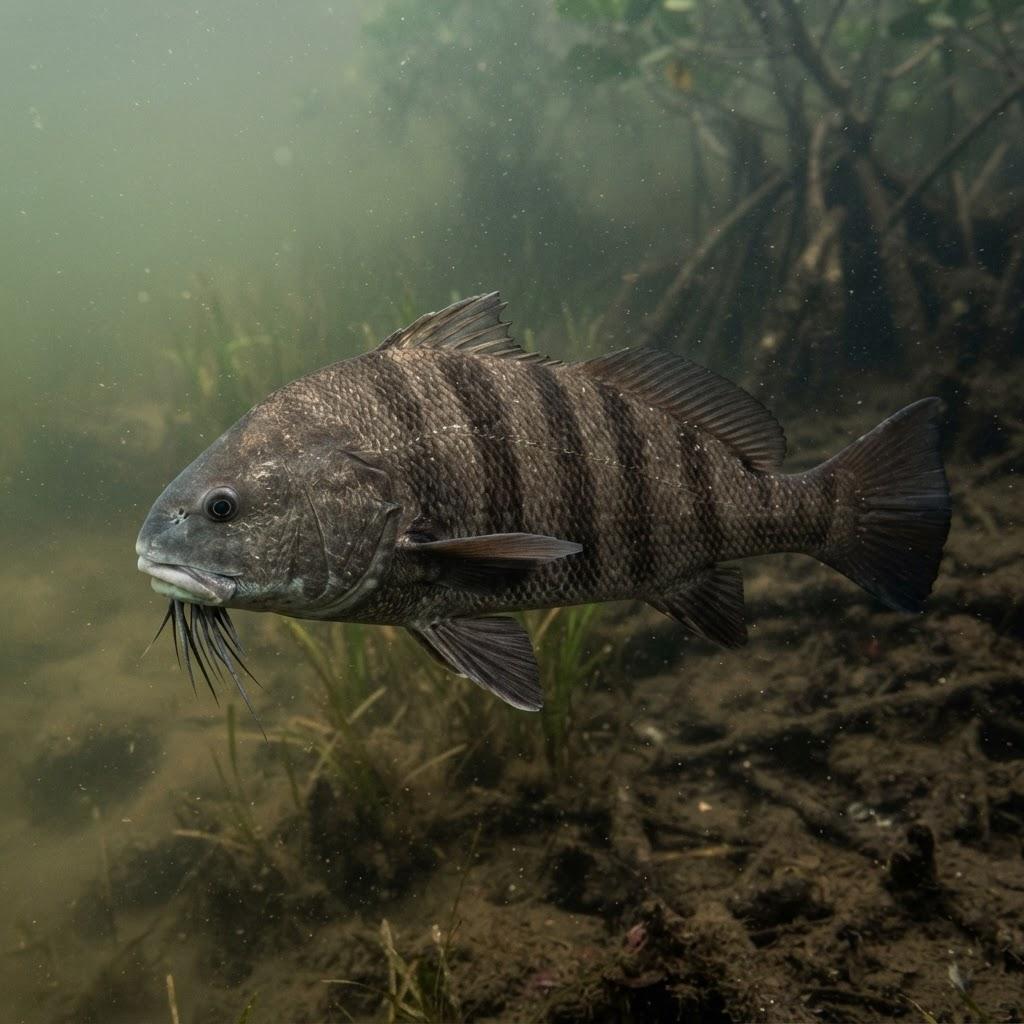
Pogonias cromis
Black Drum
Meet the Black Drum, the ocean's heavy-hitting jazz musician that literally hums its way through life. With a face only a mother could love and a set of teeth meant for crushing boulders, this fish is the undisputed king of the coastal nightlife scene.
Meet the Fish
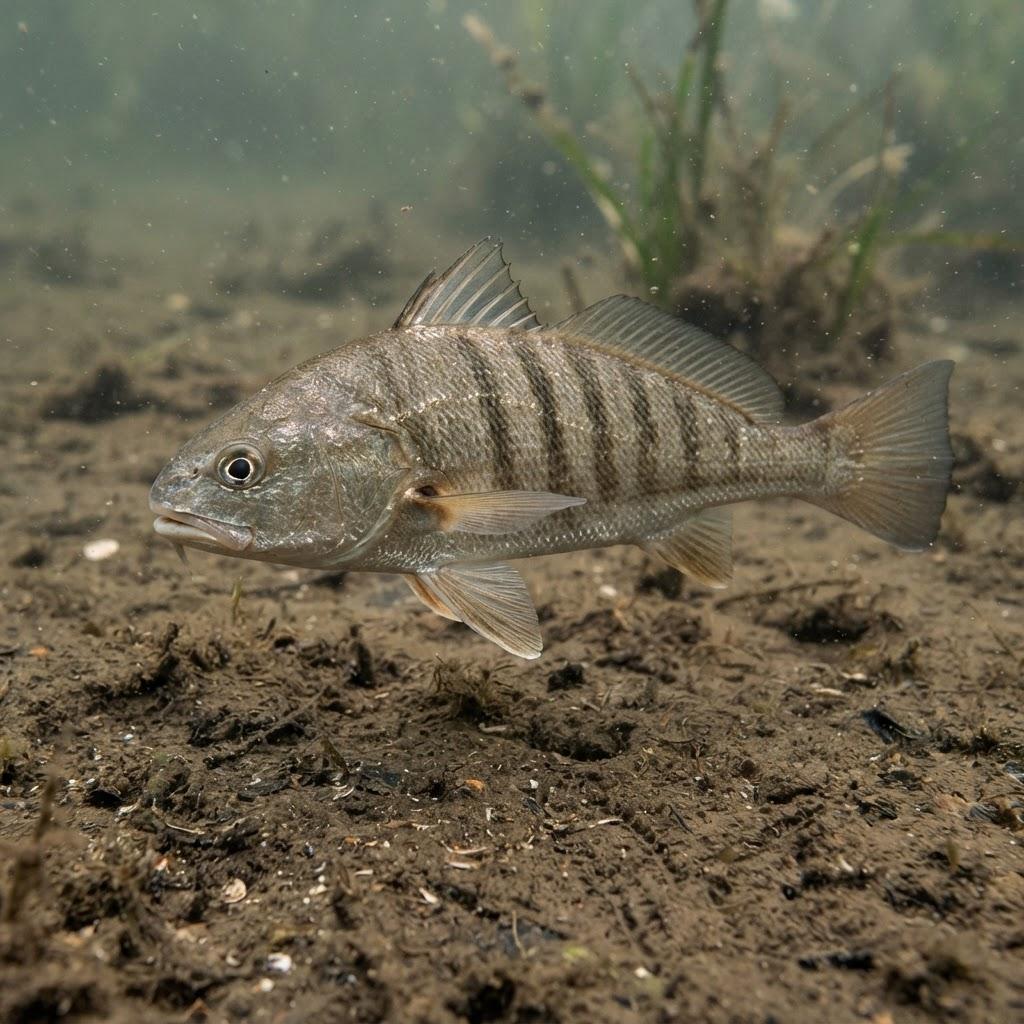
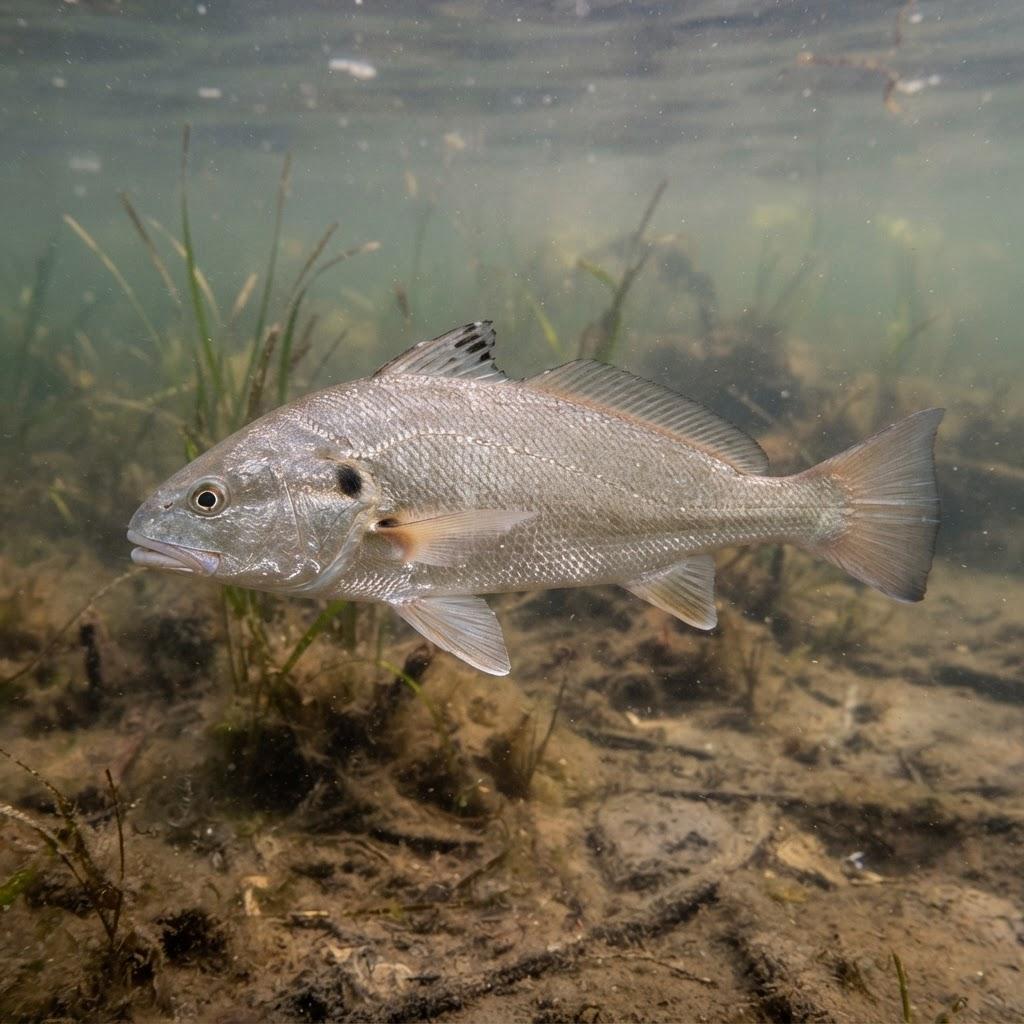
Imagine a fish that looks like it just walked out of a 1920s jazz club wearing a tuxedo, but then someone decided to flatten its forehead and give it a beard made of fleshy whiskers. That is the Black Drum. This is not your sleek, aerodynamic marlin or your neon-colored tropical reef dandy. The Black Drum is the bouncer of the estuary, a stout, hulking creature that commands respect simply by occupying space. Its vibe is essentially that of a grumpy grandfather who just wants to find a nice patch of mud and have a solid snack. While younger versions of the species have flashy vertical stripes that look like they are trying to be a fancy zebra-fish, the adults go for a more mature, monochromatic look, turning a dull, bronze-gray color that blends perfectly into the murky coastal shadows. They are essentially the armored tanks of the shallow water world, built for durability rather than winning any beauty pageants. If you saw one at a bar, it would definitely be the guy in the corner silently crushing oysters without even blinking, looking entirely unimpressed by the frantic pace of the smaller, twitchier fish darting around it. Their signature look is rounded off by their chin barbels—those fleshy little sensory noodles hanging off their lower jaw—which give them the distinct appearance of a fish that might start offering sage advice or complaining about the price of gas at any moment.
Weird Biological Superpowers Explained Simply
So, how does a fish that is essentially a floating brick communicate in a world where sound travels five times faster than in air? It drums. Literally. These fish have evolved specialized muscles called 'sonic muscles' that are attached directly to their swim bladder—the internal balloon that helps them float. By vibrating these muscles against the swim bladder, they produce a low-frequency drumming or thumping sound that resonates through the water. It is effectively a built-in bass guitar. When an entire school of these guys gets together, they can produce a sound so deep and pervasive that it can actually vibrate the hulls of boats, earning them a reputation as the underwater equivalent of a neighbor playing loud techno music at 3:00 AM. It is not just for show, though; this sonic prowess is a multi-purpose tool used for finding mates and keeping the group together in dark, murky water. Think of it like high-tech sonar combined with a stadium-sized speaker system. This ability is so unique that it separates them from the high-pitched chirping of other fish; the Black Drum is all about that deep, structural bass that moves through your very bones. It is a biological miracle that a creature with such a sturdy, ungraceful exterior can create a symphony of thumps that echoes through the entire estuary, proving that you do not need to be pretty to be loud and impactful.
Absurd Self-Defense Mechanisms
When you are a slow-moving, chunky fish that isn't exactly built for a high-speed chase, you have to get creative with how you avoid becoming someone else’s lunch. The Black Drum’s strategy is essentially based on 'don't even try it, buddy.' They have evolved into absolute masters of armor. Their scales are tough, but their real secret weapon is their sheer bulk and the fact that their teeth are literally capable of crushing rocks. Well, maybe not boulders, but they possess a set of crushing plates in their throat that would make a nutcracker jealous. Predators that usually look for a quick, soft bite—like sharks or larger rays—often think twice when they encounter a Black Drum because swallowing one is like trying to gulp down a spiked heavy-duty mailbox. Furthermore, their habitat selection serves as a passive defense mechanism. By hanging out in oyster reefs and murky, sediment-heavy shallows, they become visually indistinguishable from the background. They are basically nature's camouflage experts, hiding in plain sight by blending into the sandy, muddy chaos of the bottom. When they feel threatened, they don't dart; they sink. They utilize the low-light, high-turbidity conditions of their environment to become ghosts, using their weight to anchor themselves firmly into the substrate until the danger passes. It is a 'hunker down and wait it out' style of defense that has served them well for millions of years.
Fish Drama and Gossip
If the estuary were a high school, the Black Drum would be the seniors who have been there since the dawn of time and definitely know where the bodies are buried. Their social lives are not necessarily about petty squabbles over territory like the flashy, temperamental clownfish, but they do have their own internal hierarchy. During the spawning season, the drama kicks into high gear. You have massive schools of these giants congregating in specific 'party zones' to do their version of the Cupid Shuffle. It is not exactly high-stakes romance; it is more like a massive, crowded mosh pit where everyone is trying to make as much noise as possible to attract a partner. The gossip—or rather, the vibrations—in these schools is intense. You can hear them from the surface, a constant hum of competition. Males use their drumming to out-compete one another, basically turning the ocean floor into a giant battle of the bands. Younger, smaller fish stay on the periphery, watching the big, experienced adults with a mix of awe and annoyance. There is a clear sense of seniority here; the massive, silver-scaled veterans occupy the prime 'drumming spots,' while the youngsters spend their time scavenging and hoping they don't get accidentally crushed by a middle-aged, two-foot-long grouch who is just trying to find a snack.
The "Wait, That's Real?!" Deep-Sea Oddities
While the Black Drum isn't a deep-sea creature—it prefers the shallow, sandy life—its existence serves as a perfect foil to the absolute insanity of the deep ocean. If the Black Drum is the blue-collar worker of the fish world, deep-sea creatures are the avant-garde performance artists. Deep-sea fish, like the barreleye with its transparent head and eyes that rotate like a submarine periscope to look for prey above, exist in a world where light is a rare commodity. They rely on bioluminescence—biological glow-in-the-dark light—to communicate, hunt, and confuse predators. The Black Drum doesn't need to glow because it lives in the daylight world, but the contrast is wild. In the midnight zone, creatures have to grow bizarre, oversized teeth or mouths that can unhinge to eat prey larger than themselves because food is so scarce. In contrast, the Black Drum just rolls up to an oyster bed, uses its powerful throat muscles to pulverize the shell, and feasts on the contents. It is a reminder that while the deep sea is a place of alien evolution and high-concept adaptations, the shallow waters are just as complex, relying on sound, brute force, and sheer resilience rather than neon lights and transparent body parts. Both groups have mastered their environments in ways that defy our human expectations of what a 'normal' animal should look like.
Myth Busting
Let’s clear the air: people often think that fish are mindless automatons that can't remember anything past the last five seconds. If you ever watched a Black Drum navigate a complex, changing estuary, you would immediately realize how wrong that is. These fish are actually quite smart. They demonstrate distinct site fidelity, meaning they have a 'favorite' spot and they remember how to get back to it. They aren't just bumping into rocks until they find food; they have a mental map of their environment, including where the best oysters are and where the danger zones are located. Another myth is that they are 'trash fish' because they eat things like crabs and mollusks off the bottom. People often assume that bottom-feeders are 'dirty.' On the contrary, these guys are the cleanup crew of the estuary. They keep the invertebrate population in check and help recycle nutrients back into the ecosystem. They aren't 'trash'; they are the essential waste management engineers of the coastal world. Furthermore, the idea that their drumming is just a random sound is a myth; it is highly structured, species-specific, and intentional. They are not just noisy; they are articulate, at least in the language of vibration. Don't believe the 'dumb fish' trope—the Black Drum is a calculated, map-following, habitat-managing professional.
Humorous Historical Tales or Folklore
Humanity has had a long, strange relationship with the Black Drum. In the early days of coastal fishing, the loud, resonant drumming was often confused by superstitious sailors with ghostly voices or, better yet, the groans of mythical sea monsters living deep in the mud. There are old coastal legends of families living in cabins on the water who would hear the 'singing' of the drums and claim the house was haunted. It became a favorite piece of folklore to tell visitors, blaming the restless spirits of the bay for the nocturnal thumping coming from beneath the floorboards. In some regions, the large, ear-bone-like structures inside the fish's head, known as 'otoliths,' were historically kept as lucky charms. These small, white, stone-like objects were thought to ward off bad luck or help with earaches, a bit of pseudo-medical folk wisdom that persists in some old-timer circles even today. There is something deeply satisfying about the idea that a giant, grumpy-looking fish, through nothing more than its own anatomy, became the source of local ghost stories and a provider of 'magic' charms for generations of coastal residents. It is the ultimate testament to the fish's ability to leave a mark on human culture, simply by being too loud for us to ignore.
Underwater Love Stories and Bizarre Romances
Dating, if you are a Black Drum, is all about volume. There is no subtle 'hello,' no delicate 'wanna grab a bite.' The males go to a specific area and start their sonic competition, drumming away in a massive, chaotic chorus. It’s essentially a competitive concert where the female gets to choose the guy who can maintain the most consistent, low-frequency hum. Once a female is impressed, the pair doesn't exactly go off into the sunset; they release their eggs and sperm into the water column in a massive, synchronized broadcast. It is not romantic in the traditional sense, but it is undeniably impressive in terms of sheer biological effort. The water becomes a cloud of genetic potential. There is no 'til death do us part' because the interaction lasts seconds, but it happens on such a massive scale that the entire ecosystem gets involved. The 'romance' is a communal, high-energy event that turns the quiet bay into a booming, buzzing, underwater nightclub for one night only. You have thousands of fish vibrating in unison, creating a wall of sound that can shake the water itself. It is intense, it is fleeting, and it is a marvel of efficiency, turning the act of reproduction into a full-scale auditory performance that defines the success of their species.
Underwater Architecture and DIY Nesting
Black Drum aren't the types to build elaborate sand castles or weave complex nests out of sea grass. Their 'architecture' is much more practical and frankly, a lot more impressive: they build entire reefs—not intentionally, perhaps, but through their diet. By crushing millions of oyster and clam shells throughout their long lives, they contribute significantly to the breakdown and restructuring of the seafloor. They are the construction workers who take the existing landscape and grind it down into the fine, soft sediment that many other smaller species rely on for their homes. While they don't have a 'den' in the way a squirrel has a tree hole, they do claim specific 'resting territories' within the estuary. You will often find them in the same deep pockets or under the same bridges year after year. They are creatures of habit. They view the entire bay as their domain, moving between different 'projects' based on the tide and the availability of their favorite shellfish. They are effectively the stewards of the mud, moving mountains of grit and debris. If they ever decided to start charging for their landscaping services, the local crab population would definitely be out of business, given that the Black Drum is essentially the top-tier contractor of the shallow bottom.
The Chaos of Raising Tiny Swimmers
When it comes to parenting, the Black Drum takes a 'release and pray' approach that would give a modern human parent a complete nervous breakdown. After that massive, vibrating, high-energy wedding of a spawn, the adults completely check out. There is no guarding the nest, no teaching the kids to hunt, and absolutely no bedtime stories. The eggs are left to drift in the currents, completely at the mercy of every hungry mouth in the ocean. The survivors that manage to hatch start their lives as tiny, transparent specks, struggling to avoid becoming plankton snacks. It is a numbers game; you release millions of eggs, and if a few make it to adulthood, you have won. This chaotic, high-stakes childhood means that the small fish learn to be tough, fast, and incredibly stealthy from day one. They spend their early years hiding in the dense, protected seagrass beds, moving cautiously until they are big enough to join the big leagues. It is a brutal, sink-or-swim reality, but it is one that has worked for them for millions of years. The sheer resilience of these tiny swimmers, who start as nothing and eventually turn into fifty-pound armored giants, is a reminder that you don't need a nursery to raise a successful adult—you just need a lot of persistence.
How to Spot One & How It Is Doing
So, you want to find a Black Drum? You need to head to the coastal bays, look for a bridge, a pier, or a nice, deep oyster reef, and bring some patience. They love soft, muddy bottoms and are often found in water that looks like chocolate milk—which is exactly where they hide best. Keep an eye out for those distinct chin barbels, which look like little goat whiskers. If you catch a younger one, look for those vertical, dark stripes; if you find an older one, look for that solid, chunky, bronze-gray body. As for how they are doing: they are, thankfully, in great shape. They are currently listed as 'Least Concern,' meaning they are not at risk of disappearing anytime soon. They are incredibly resilient, adaptable to different water temperatures, and their population is well-managed. You can help keep it that way by being a good steward of the coast: keep the water clean, follow local fishing regulations, and make sure that you leave the habitat as you found it. We have enough 'ghosts' in the ocean; let's make sure the Black Drum stays loud, proud, and thumping for the next sixty years. Keep your eyes on the water and your ears open—if you hear a deep, bass-like hum while you're standing on the dock, you’ve found your rockstar.