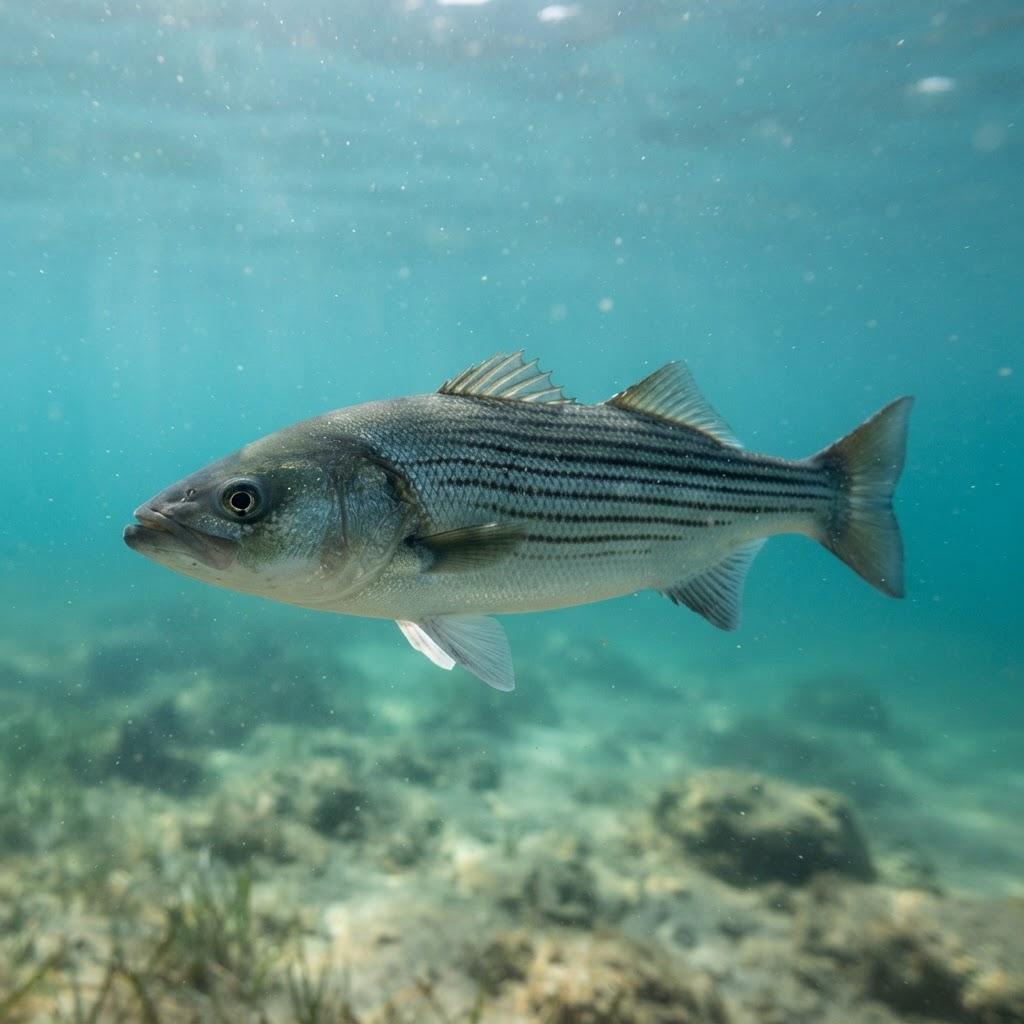
Morone saxatilis
Striped Bass
Meet the Striped Bass, the ultimate wanderer of the Atlantic coast that treats every river like a personal buffet. This silver-sided speedster is part shark, part marathon runner, and entirely obsessed with showing off its stripes.
Meet the Fish
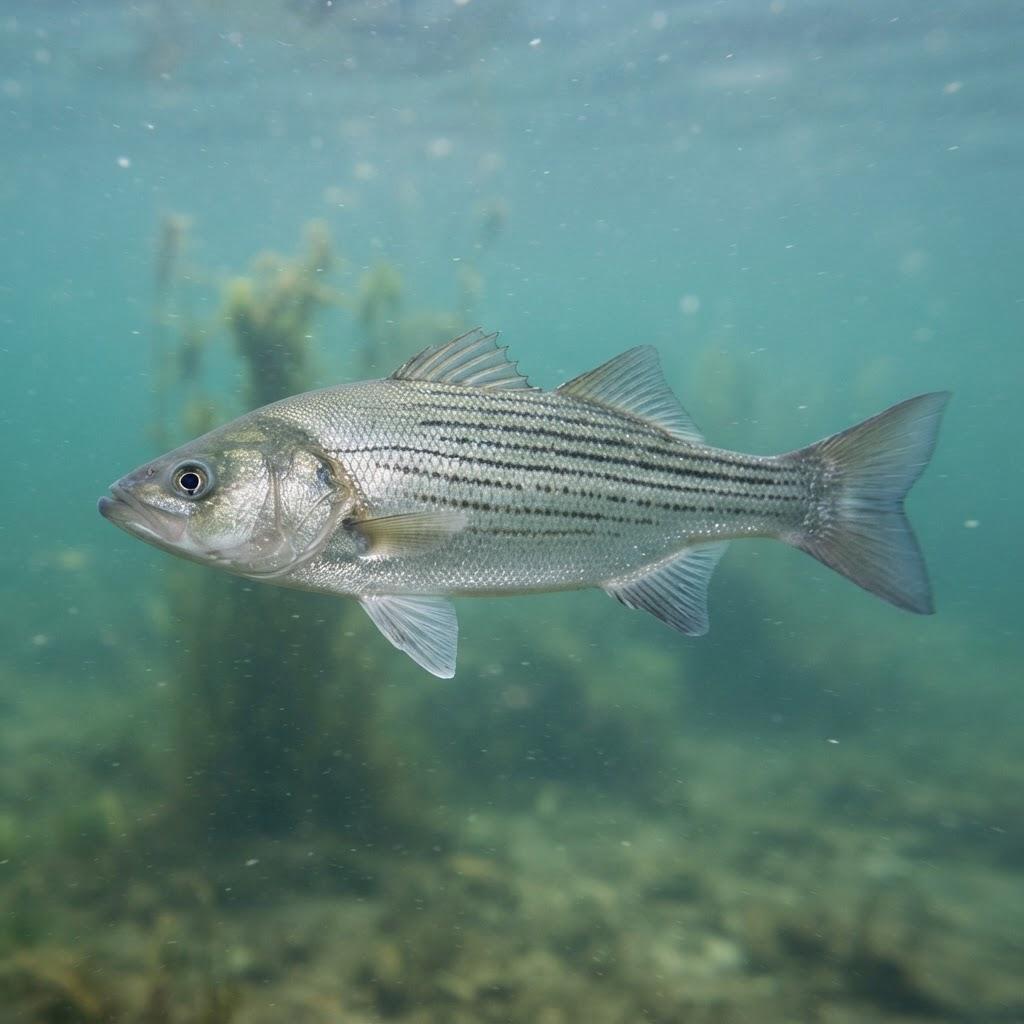
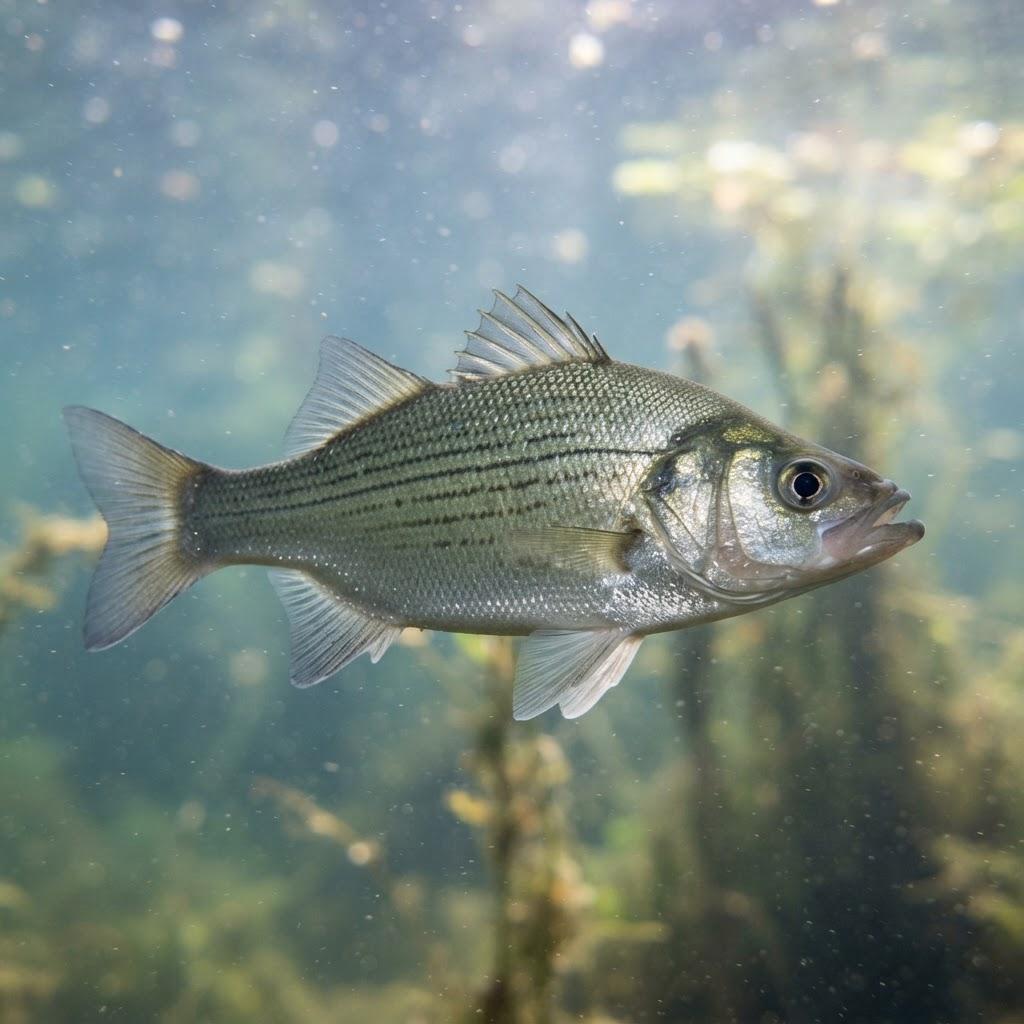
Imagine a fish that spent its entire youth training for an Ironman competition and then decided to spend the rest of its life as a jet-setting celebrity. Meet the Striped Bass, or 'Stripers' to their legion of obsessed fans. This fish is the quintessential cool kid of the North American coastline, sporting a sleek, silver suit accented by a series of distinct, horizontal black lines that look like they were applied by a very precise pinstriper. While other fish are content to loiter in the same puddle for their whole lives, the Striped Bass is a wanderer, a traveler, and a master of both fresh and saltwater environments. It has a vibe that screams, 'I own this beach, but I might be in a river three states away by Tuesday.' They are muscular, aggressive, and possess a certain swagger that only comes from knowing you are at the top of the food chain in the estuaries. Unlike the shy, retiring types of the deep reef, the Striper is a high-energy predator that acts like it is constantly running late for a very important board meeting.
Weird Biological Superpowers Explained Simply
The Striped Bass is a biological marvel thanks to its ability to be an 'anadromous' athlete. That is a fancy scientific word for a fish that basically holds a dual citizenship between salt and fresh water. Most fish would shrivel up or explode if they suddenly swapped ocean brine for river water, but the Striper has a set of gills and kidneys that are essentially high-tech water treatment plants. They can perform an internal chemistry overhaul on the fly, regulating their salt content so their cells don't get soggy or dehydrated when moving between environments. Think of it like a submarine that can magically switch its hull density depending on whether it is swimming in a deep trench or a shallow canal. They also possess a lateral line, which is essentially a sixth sense running down their sides that detects even the tiniest vibration in the water. It is like having high-definition sonar built directly into their skin, allowing them to hunt in total darkness or murky water with the precision of a heat-seeking missile.
Absurd Self-Defense Mechanisms
The Striped Bass isn't one for hiding in a cloud of ink or puffing up like a beach ball, because it doesn't really have to. When you grow to be the size of a human teenager, your best defense is simply being too big to mess with. However, they do have a built-in 'tough guy' armor consisting of sharp gill covers—the flaps that protect their gills. If a predator tries to bite them, those flaps flare out like jagged blades. It is a subtle but effective way of saying, 'Back off, or you will regret it.' Additionally, their silver scales are evolution's version of a funhouse mirror. When sunlight hits them while they are cruising near the surface, they practically turn invisible, blending into the shimmering waves. It is nature's ultimate camouflage suit, turning the fish into a flash of light that predators can't quite track. If you cannot see it, you cannot eat it, and the Striped Bass masters this game of optical illusion every single day.
Fish Drama and Gossip
If the ocean had a reality television show, the Striped Bass would be the lead contestant that everyone loves to hate. Their social lives are essentially a perpetual game of 'who can eat the biggest fish.' Stripers are highly competitive and live in schools that are less of a 'cooperative team' and more of a 'frenemy' group. During feeding frenzies, it is total chaos. They coordinate to trap schools of smaller fish, pushing them up against the surface of the water in what is known as a 'blitz.' It is pure pandemonium, with massive splashes and birds diving from above. But once the food is gone, the teamwork evaporates. They are notoriously territorial, and older, larger females—known as 'cows'—rule the school with an iron fin. It is a constant hierarchy of size. If you are small, you are the bait. If you are big, you are the boss. They don't have time for social pleasantries when there is a migrating school of bunker to hunt down and consume.
The "Wait, That's Real?!" Deep-Sea Oddities
While our friend the Striped Bass prefers the shallow, chaotic action of the coastline, it has some distant cousins that inhabit the bizarre twilight zones of the ocean. In the deep sea, fish often look like they were designed by an artist on a fever dream. While the Striper relies on its muscles and speed to catch lunch, deep-sea dwellers rely on bioluminescence—glowing in the dark like a neon sign in a dark alley. Imagine the Striped Bass compared to the barreleye fish, a creature with a transparent, liquid-filled head that lets you see its glowing green eyes working inside its skull. While the Striper uses its lateral line to feel the world, deep-sea fish often use giant, exaggerated fins to feel their way through the pitch-black void. It is a different kind of survival. The Striper is built for speed and power in the sunlit shallows, while the deep-sea fish is built for patience and weird, glowing chemistry in the crushing pressure of the abyss.
Myth Busting
There is a long-standing myth among casual beachgoers that Striped Bass are strictly 'saltwater' fish that only visit rivers by accident. This is totally wrong; these fish actually consider fresh water their ancestral homeland for breeding. Another myth is that they are 'dumb' brutes that will eat anything that moves. While they are voracious eaters, they are actually quite picky and intelligent. Studies have shown that Stripers can learn to associate specific sounds or movements with food, meaning they aren't just bumping into snacks by luck. They possess memory and can return to the same spawning grounds with high precision year after year. There is also the rumor that they are invincible and can survive any level of pollution. This is unfortunately a dangerous myth, as they are actually quite sensitive to water quality and oxygen levels. They need clean, healthy waterways to survive their epic migrations, so don't be fooled by their rugged reputation; they are actually quite demanding tenants of our rivers and bays.
Humorous Historical Tales or Folklore
The Striped Bass has been a local legend since before the pilgrims even arrived. Indigenous peoples knew these fish as the 'silver ghosts' of the river, using them as fertilizer for their crops and a primary food source for their villages. There is a funny historical account from colonial times where people were so obsessed with the abundance of Stripers that they claimed the fish were so thick in the rivers that you could walk across the water on their backs. Obviously, that is a bit of a fish story, but it shows just how legendary they were. In the 1800s, they were so revered that they were one of the first fish species to be intentionally transported across the continent to the Pacific Coast, where they thrived so well that they became a permanent fixture of the West Coast fishing scene. They basically went on a cross-country road trip and decided to stay forever, becoming a piece of American history that just happens to have fins and gills.
Underwater Love Stories and Bizarre Romances
When it comes to romance, the Striped Bass approach is less of a candlelit dinner and more of a chaotic, public mosh pit. When spring arrives, the 'cows' and the smaller males head up into the freshwater rivers. It isn't a delicate affair; they gather in massive, turbulent groups. The females release millions of eggs into the moving current, and the males, acting like enthusiastic fans at a stadium, surround them to fertilize the eggs in the water column. There is no nesting, no cuddling, and no long-term commitment. It is a game of numbers. By releasing millions of eggs, the parents hope that at least a few will survive the gauntlet of predators, currents, and environmental hazards. It is not romantic by human standards, but it is an incredibly effective strategy. They are playing the long game, betting that if they create enough life, the next generation will be virtually unstoppable.
Underwater Architecture and DIY Nesting
If you are looking for intricate sand castles or elaborate tunnels, you are looking at the wrong fish. The Striped Bass is a firm believer in the 'minimalist aesthetic.' They do not build nests, fortresses, or dens. Instead, they treat the entire river current as their nursery. They rely on the water flow to keep their eggs suspended and oxygenated. It is a high-stakes architectural strategy: if the water stops moving or if it drops too low, the eggs fall to the bottom and get smothered in muck. It is a 'floating or failing' situation. Because they do not spend time building a house, they have more energy to spend on travel and growth. They are the nomads of the aquatic world, constantly on the move, preferring a life on the open current to the constraints of a fixed home. Who needs a house when the whole river is your backyard and your bed?
The Chaos of Raising Tiny Swimmers
Parental leave is not a concept for the Striped Bass. Once those eggs are released and fertilized, the parents effectively bid them farewell and swim off to catch a snack. The tiny fry that hatch are left to fend for themselves in a world where almost everything is bigger than them and hungry. It is a rough start for any baby fish. They start off as tiny, translucent specks that have to navigate the hazards of the river without a map. Most of them get eaten by everything from insects to other fish in the first few weeks of life. It is nature's version of a baptism by fire. However, the ones that do survive are the fastest and the smartest of the bunch. They grow rapidly, turning from tiny targets into predatory teenagers. It is a brutal, chaotic process, but it ensures that only the strongest, most resilient fish reach adulthood to carry on the family name.
How to Spot One & How It Is Doing
If you want to spot a Striper, look for water that is moving fast, especially around bridge pilings, rocky jetties, or points where the tide is rushing through. They love areas with a bit of a current where they can hide and ambush prey. Look for the classic silver body with those distinct horizontal black stripes. If you see a school of small fish erupting out of the water like popcorn, there is a good chance a Striper is underneath the chaos. As for their health, they are currently classified as 'Least Concern,' which is great news! But they aren't bulletproof. Because they move between rivers and oceans, they are incredibly sensitive to habitat destruction, dams that block their migration, and water pollution. Ordinary people can help by supporting clean water initiatives and following local fishing regulations, which are designed to let the big 'cows' spawn and keep the population booming. They are a national treasure, so let's make sure they keep swimming for generations to come.