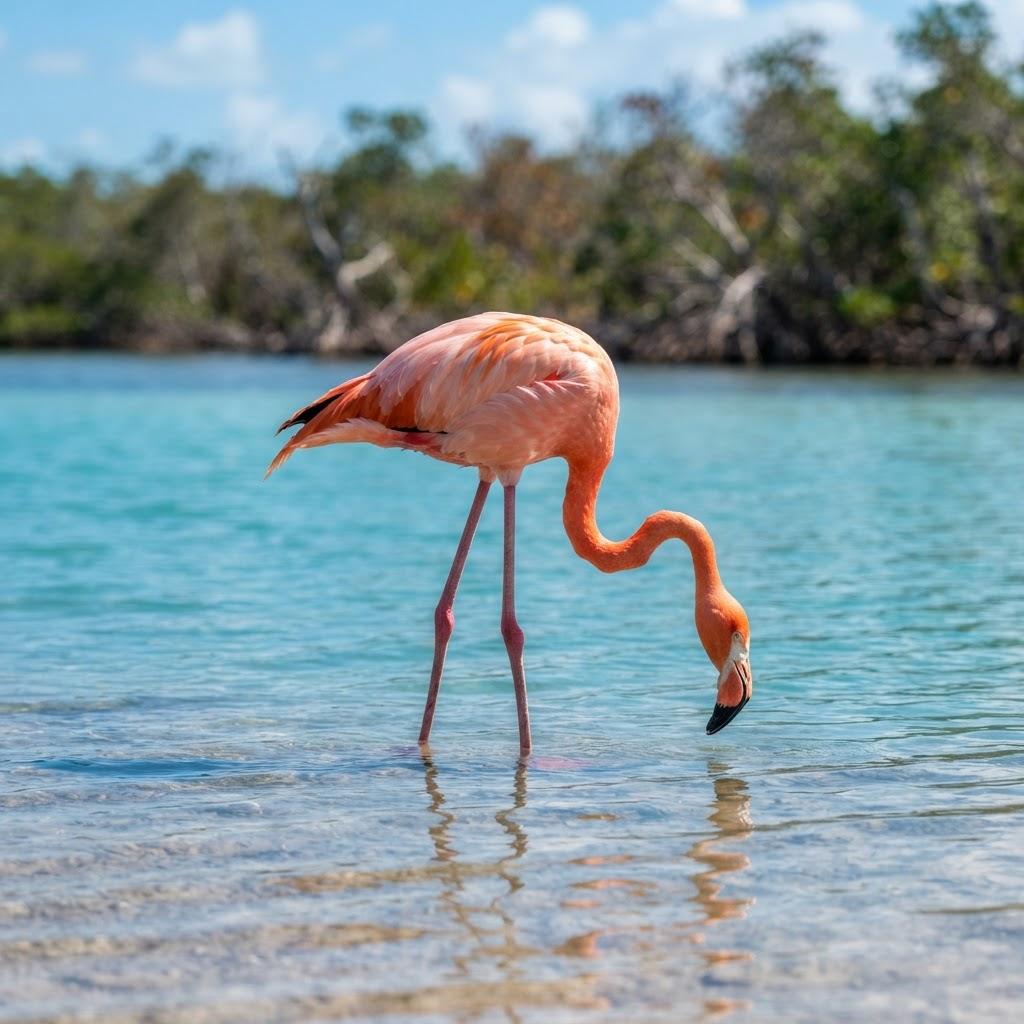
Phoenicopterus ruber
American Flamingo
The American Flamingo is nature's ultimate show-off, standing tall in hot pink while sipping cocktails of salt-crust shrimp. This isn't just a bird; it is a flamboyant, filter-feeding fashion icon that turns the world into its personal runway.
Meet the Bird
Imagine walking into a high-society gala wearing a neon-pink tuxedo while standing on one leg, just to see if anyone notices. That is the daily mood of the American Flamingo. This bird is the ultimate eccentric of the avian world, looking less like a creature of nature and more like a discarded lawn ornament that suddenly gained sentience and a serious attitude. With a long, S-curved neck that seems to defy gravity and legs that go on for days, the flamingo is the supermodel of the wetlands. Their vibe is strictly 'vacation mode 24/7.' They don't walk so much as they strut with a rhythmic, slightly bobbing hip-swing that says they know exactly how good they look. Despite their intimidating height, they are surprisingly chill, preferring to spend their days huddled in groups, gossiping in a series of honks and growls that sound remarkably like a busy city intersection during rush hour.
Superpowers & Weird Abilities
The flamingo’s secret weapon isn't a superpower like flight or speed; it’s basically an industrial-grade food processor built into its face. Their beaks are specialized upside-down hydraulic filters. When they submerge their heads to feed, they aren't just dipping for snacks; they are actively pumping water through a complex series of internal bristles called lamellae. Think of it as a biological sieve that captures tiny shrimp and algae while dumping the silt and sand back into the water. The pink pigment that makes them famous? That is a direct result of the beta-carotene in their diet. If they didn't eat these specific carotenoid-rich organisms, they would fade to a sad, dusty gray color. They are literally what they eat, transforming their food into a vibrant, glowing wardrobe. It is like if you ate enough carrots and suddenly turned into a giant, walking orange popsicle.
Drama, Personality & Feathered Chaos
If you think the Real Housewives bring the drama, you clearly haven't witnessed a colony of flamingos during the breeding season. These birds are absolute fanatics about social hierarchy. They live in massive, noisy groups where every individual is constantly trying to stake out their claim. You will see them engaging in 'head-flagging,' which is essentially a flamingo version of aggressive power-posing. They stretch their necks high, turn their heads side to side, and march in tight formations, showing off their plumage to whoever is looking. It is a never-ending cycle of posturing and jostling for the best position in the pond. If someone steps on someone else’s toes—or rather, paddles on their webbed feet—the squabbling begins immediately. They are loud, obnoxious, and utterly convinced that they are the most important creatures in the lagoon, which, to be fair, is pretty much true.
Bizarre Rituals & Quirky Habits
One of the most perplexing mysteries of the flamingo lifestyle is the 'why on earth do they stand on one leg?' phenomenon. You might think it is to show off their ballet skills, but it is actually a clever trick for body heat conservation. By tucking one leg into their feathers, they reduce the amount of heat lost through their bare, scaly skin. But here is the weird part: they don’t just use one leg because the other gets tired; they often switch legs completely unaware that they are doing it while they sleep. It is like a biological autopilot. They also engage in 'preening parades,' where groups of them will suddenly stop what they are doing to oil their feathers and groom each other in perfect synchronization. It looks like a high-fashion photoshoot where everyone suddenly realized they all have a smudge of mascara on their beaks.
Legends, Folklore & Human Stories
Flamingos have been haunting human imagination since the ancient Egyptians, who associated them with the fire-god Ra because of their bright red and pink colors. In the Andes, they were once believed to be guardians of the mountains, their silhouettes appearing in petroglyphs left by indigenous cultures. In modern times, the flamingo has become a kitschy icon of backyard Americana. We’ve turned them into plastic lawn ornaments, mailbox decorations, and the unofficial mascot of Florida retirement communities. There is something inherently funny about a bird so elegant that it has been reduced to a piece of pink plastic stuck in a suburban flowerbed. Despite this mockery, the flamingo remains a symbol of resilience, often seen in folklore as a creature that navigates the difficult balance between earth, water, and sky, standing firm even when the ground is nothing but squishy, unstable mud.
Mating: The Ridiculous World of Avian Dating
Dating for a flamingo is a high-stakes, group-choreographed musical number. A male doesn’t just walk up to a female and offer her a worm; he has to prove his worth in front of a thousand of his closest friends. The entire colony will initiate a 'mating march,' where hundreds of flamingos walk in a tight, synchronized phalanx, heads bobbing and wings snapping open to reveal stunning, hidden black-and-pink patterns. It is basically the avian version of a flash mob. The males and females assess each other based on the intensity of their color—the brighter the pink, the healthier the bird. If a female isn't impressed, the male is left standing alone in the middle of a mudflat, his dance moves forgotten and his pride slightly wounded. The rejection is swift and public, which makes the successful pairings all the more triumphant.
Nesting: Master Architects and Lazy Slumlords
When it comes to home construction, the flamingo doesn't mess around with sticks or grass. They are mud-stacking engineers. They build tall, cone-shaped mounds of thick, sticky mud, pressing them into shape with their beaks and feet to create a stable pedestal that keeps their single egg well above the rising water level. It is essentially a high-rise apartment built from the swamp floor. Once the mound is dry and hard, the female lays her egg right on top. It’s a very minimalist aesthetic—no curtains, no bedding, just a smooth, hardened dirt pillar. The risk, of course, is that the mud needs to be just right; too dry and it crumbles, too wet and the whole nursery collapses. It is an architecture style that screams 'I built this with my own beak,' and frankly, it is more impressive than most of the DIY projects you will find on the internet.
Raising Babies: The Screaming Food Disposals
Flamingo chicks are the ultimate surprise. They hatch looking nothing like their parents—they are fluffy, gray, awkward little gremlins with straight, stubby beaks. They do not have the signature 'filter' beak yet, so for the first few months, they are entirely dependent on their parents. But here is the kicker: both the mother and father produce 'crop milk.' This isn't milk like a mammal produces; it is a nutrient-rich, red-colored fluid regurgitated from the upper digestive tract. It is basically a high-protein energy smoothie that looks terrifyingly like blood. The parents will stand over the chick, literally vomiting up sustenance into the baby’s waiting gullet. The chicks, naturally, are completely ungrateful, spending their days squawking, running in circles, and trying to trip their parents. It is a grueling, messy process that lasts until the youngster develops its own hook-shaped beak and learns the fine art of shrimp-filtering.
Bird-Watching Travel & Local Hotspots
If you want to see these pink wonders in the flesh, pack your sunscreen and head to the Yucatan Peninsula in Mexico. Specifically, the Celestún Biosphere Reserve is a flaming paradise. During the winter months, thousands of flamingos congregate in the shallow, mineral-rich waters. You can take a boat tour through the mangroves, and seeing a massive, rosy cloud of them take flight is a life-changing experience. Another great spot is the Bonaire salt pans in the Caribbean. Because the birds are protected, they are relatively bold and will often allow you to observe them from a respectful distance. Just remember: these birds live in hypersaline environments. Do not go wading out to get a better selfie, or you will end up stuck in knee-deep mud while the birds judge your lack of survival skills from across the lagoon.
Food, Feeder Hacks & DIY Projects
Trying to attract a flamingo to your backyard is a losing battle unless you happen to live in a tropical, hypersaline lagoon. However, you can honor their memory by creating a 'shrimp-safe' environment for other wildlife. Since you can’t exactly put out a bag of dried shrimp for a wild flamingo, focus on bird-friendly water features. Installing a solar-powered fountain or a shallow, wide birdbath in your yard mimics the shallow water habitat they love. Keep the water clean and moving; birds are attracted to the sound of splashing water like moths to a porch light. If you want a flamingo-themed DIY project, create a 'pink' garden. Plant native, bright flowers like hibiscus, firebush, or salvia to provide nectar for local birds. It won't get you a real flamingo, but it will bring in hummingbirds and butterflies that provide the same kind of colorful, chaotic energy.
Seasonal Guides & "Crisis" Management
Flamingos are remarkably consistent, but they do have a 'fledging' period where the juveniles go through an awkward teenage phase. During this time, they lose their gray down and start growing their first set of pink feathers, which makes them look like a messy, color-blocked jigsaw puzzle. If you happen to be visiting a habitat during this time, you might see them falling over or struggling to coordinate their long limbs. It is not a crisis—they are just figuring out how to manage their growing bodies. If you encounter a bird that seems stuck or injured in the wild, do not try to 'rescue' it yourself. Flamingos have surprisingly powerful kicks and sharp, crushing beaks. Always call the local wildlife authorities. The best way to help is to keep your distance, minimize noise, and let the professionals handle any bird that seems to be having a bad day.
Backyard Tech & Gadget Reviews
While AI feeders like Bird Buddy are amazing for your local chickadees and cardinals, they aren't going to help you with flamingos. However, if you are planning a trip to a flamingo hotspot, invest in a decent monocular or a pair of 8x42 binoculars. You don't need a massive telescope; you need something that can handle glare from water and sand. A weather-sealed camera with a decent zoom lens is also a must. If you want to monitor your own backyard, skip the AI bird identification for a moment and look into a simple, motion-activated trail camera. Set it up near a pond or a large birdbath. You will be amazed at what wanders through your yard when you aren't looking. It is the best way to turn your property into a small-scale wildlife refuge, and capturing a crisp photo of a visiting heron or kingfisher is just as satisfying as a selfie with a flamingo.
How to Spot One & How It Is Doing
Spotting an American Flamingo is easy: just look for the thing that doesn't look like anything else. Their bright pink color is unmistakable, and their silhouette—a jagged line of neck and leg—stands out against the blue horizon. Listen for their calls, which are a mix of goose-like honks and grunts. They are currently doing quite well, with populations stable and protected in many parts of the Caribbean and Mexico. The biggest threat to their future is habitat loss and pollution in the shallow coastal areas they rely on for food. You can help by supporting wetland conservation groups and being a conscious tourist—don't litter, stay on designated paths, and respect their space. Seeing a flamingo in the wild is a privilege, so keep the experience wild and help ensure that future generations can also witness these ridiculous, beautiful, pink party-birds of the swamp.