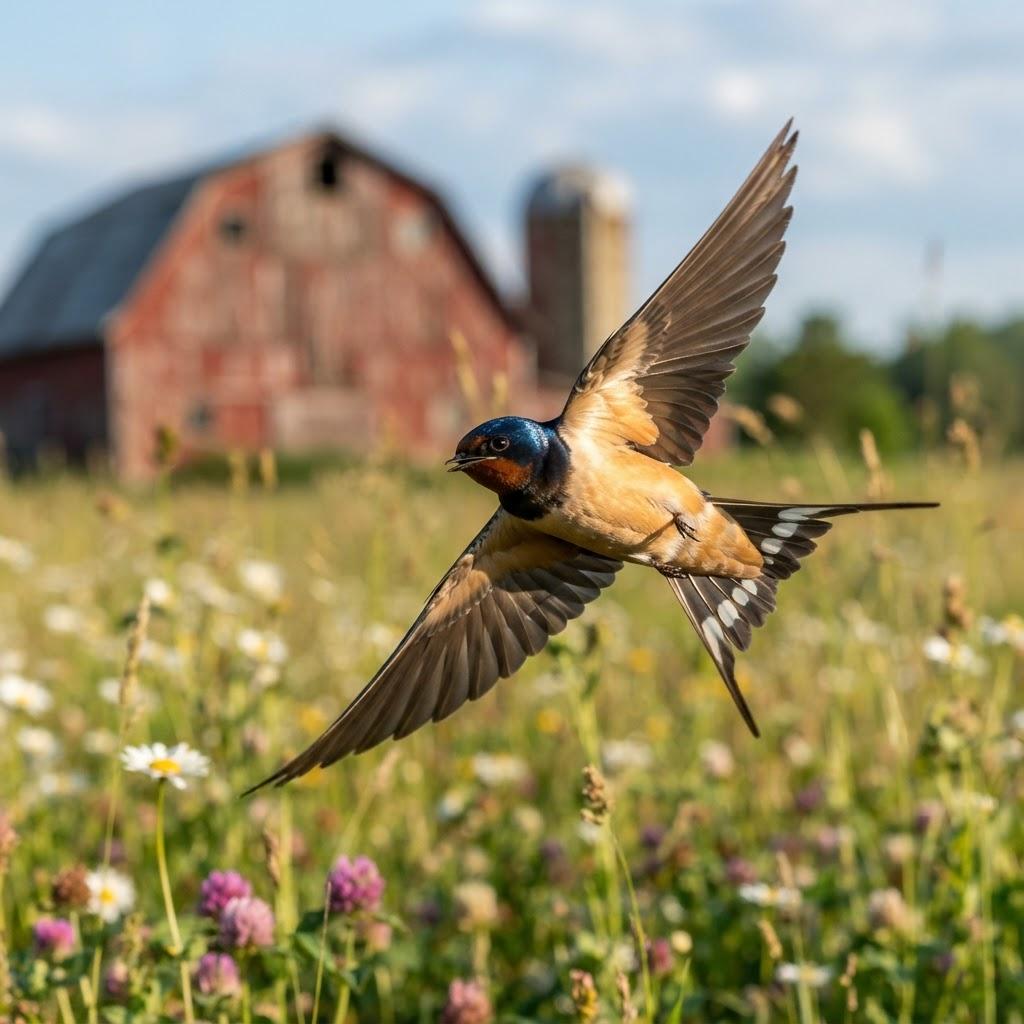
Hirundo rustica
Barn Swallow
Meet the Barn Swallow, the aerial acrobat of the bird world! This feathered daredevil is a master of the sky, a builder of mud mansions, and a social butterfly with a penchant for drama. Get ready to fall in love with this common yet extraordinary bird.
Meet the Bird
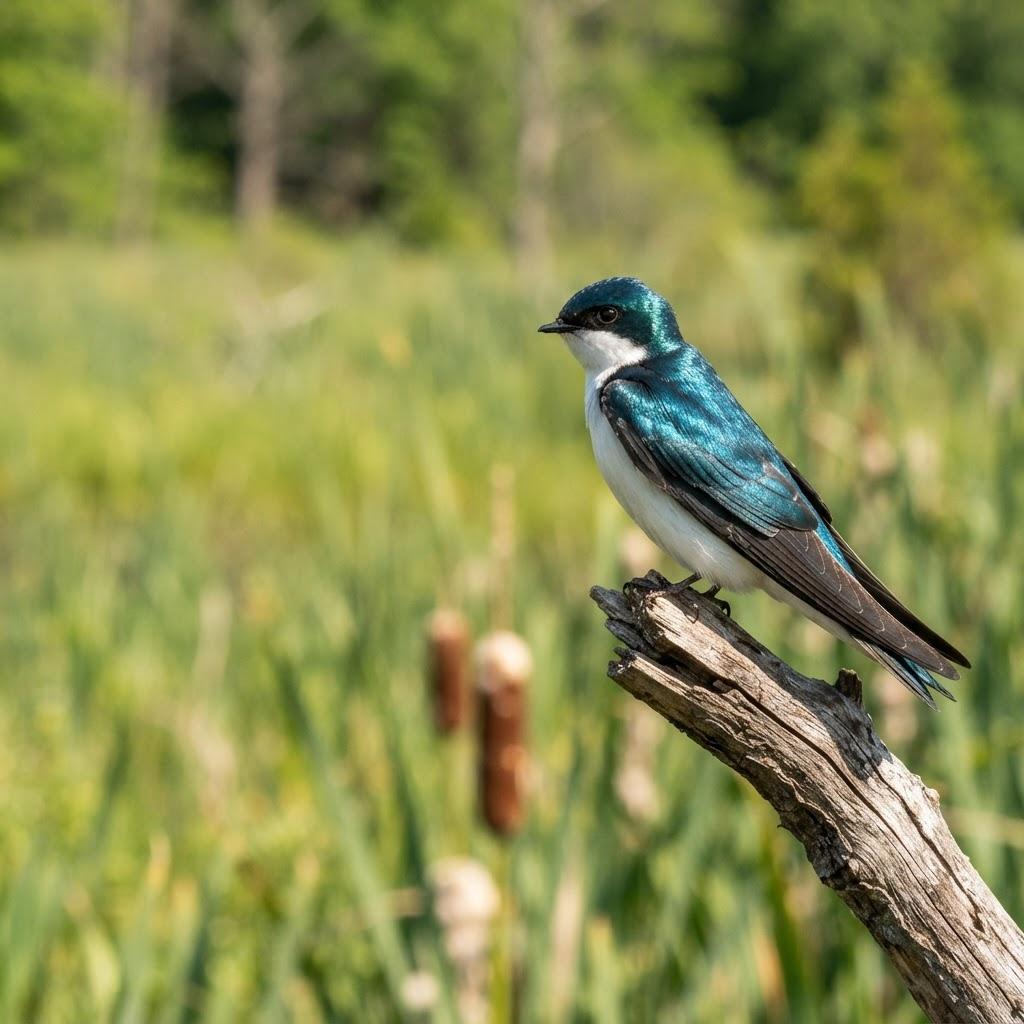
Picture this: a tiny rocket ship, powered by sheer sass and aerodynamic genius, zipping through the air with tail feathers streaming like a superhero's cape. That’s the Barn Swallow for you. This isn't just any bird; this is the aviator’s aviator, the daredevil of the dawn chorus, the feathered equivalent of a race car driver who also moonlights as a construction mogul. Its arrival in spring isn’t just a sign of warmer weather; it’s the start of the aerial ballet season. With its sleek, iridescent blue-black back, creamy white belly, and a distinctive deeply forked tail that looks like it’s perpetually doing a split, the Barn Swallow is an instant classic. It's got an attitude that’s both breezy and business-like, flitting from aerial maneuver to mud-collecting mission with impressive efficiency. You’ll often see them dancing on the wind, performing aerial acrobatics that would make a Cirque du Soleil performer weep with envy. They're the kind of bird that makes you stop, look up, and just marvel at the sheer audacity of life happening right above your head. They’re the avian equivalent of that effortlessly cool friend who somehow manages to do everything with flair.
Superpowers & Weird Abilities
Forget capes and laser eyes; the Barn Swallow's superpowers are way cooler and, frankly, more practical. First up: the 'Bug Zapper Supreme' ability. These birds are like living, flying vacuum cleaners for insects. They have an incredible ability to snatch tiny flies, mosquitoes, and gnats right out of the air with their mouths open, a technique known as aerial insectivory. Imagine trying to eat a popcorn kernel thrown at you while running a marathon – that’s essentially what they do, but with way more precision and way fewer dropped kernels. Their vision is also top-notch, allowing them to spot a mosquito from a good distance, even while performing a triple somersault. Then there’s their navigation system. Barn Swallows are long-distance migrants, some traveling thousands of miles between their summer breeding grounds and wintering areas. How do they do it? Scientists suspect they use a combination of cues: the Earth's magnetic field (like a built-in compass), the position of the sun (a celestial clock), and visual landmarks (remembering the world map like a seasoned traveler). It’s like having GPS, a sextant, and Google Maps all rolled into one, powered by instinct and sheer determination. And let's not forget their incredible maneuverability. That deeply forked tail isn't just for show; it acts like a rudder, allowing them to make incredibly sharp turns, dive, and weave through the air with unparalleled agility. They can change direction on a dime, making them masters of aerial pursuit.
Drama, Personality & Feathered Chaos
While they might look graceful, Barn Swallows are not immune to the drama that plagues many social creatures. They're generally known for being relatively peaceful and cooperative, especially when it comes to sharing nesting sites, but don't mistake that for a lack of personality. These birds are social butterflies, often nesting in colonies where they coexist in a bustling, sometimes noisy, avian metropolis. Think of it as a feathered apartment complex where everyone knows everyone else's business. They can be fiercely protective of their immediate nesting space, chasing away anything that looks remotely like a threat, from a curious cat to a particularly persistent dragonfly. There's a certain 'busybody' vibe they can exude, constantly flitting back and forth, keeping an eye on their territory and their neighbors. If a predator gets too close, expect a chorus of alarm calls and a coordinated aerial mobbing, where multiple swallows dive-bomb the intruder. It’s a feathered flash mob of righteous indignation. While they don't typically engage in the kind of petty squabbles you see at a feeder (they’re not exactly jays or grackles), they do have their moments. Young swallows, in particular, can be a bit of a handful, learning the ropes of aerial hunting and sometimes appearing comically clumsy as they misjudge a turn or two. It's a charming kind of chaos, a reminder that even these aerial masters had to start somewhere.
Bizarre Rituals & Quirky Habits
Birds, as a rule, are a quirky bunch, and Barn Swallows are no exception. One of their most fascinating habits, shared with many other swallow species, is their dedication to mud-based architecture. They don't just pick up a few twigs; oh no. Barn Swallows gather mud, often from the edges of ponds or puddles, mix it with their saliva, and then painstakingly plaster it into cup-shaped nests. Imagine building your house with snot and dirt – it’s an odd but incredibly effective strategy. They also have a peculiar habit of congregating on telephone wires before they migrate, looking like a string of feathered beads. This pre-migration gathering is thought to be a time for social bonding, practicing flight formations, and perhaps exchanging travel tips (if birds could talk). Another less understood quirk is their tendency to sometimes roost in large numbers in reeds or marshy areas during the non-breeding season. This mass roosting behavior offers protection from predators and might help them conserve heat. And then there’s the sheer delight they seem to take in flight itself. They perform aerial acrobatics not just for hunting or escaping danger, but seemingly for pure joy. A flock of Barn Swallows playing in the wind, diving and swooping, is like watching a ballet of pure, unadulterated freedom. It's a spectacle that makes you wish you had wings, or at least a really good kite.
Legends, Folklore & Human Stories
Barn Swallows have woven themselves into the tapestry of human culture for centuries, often seen as symbols of good luck, home, and loyalty. In many European cultures, it was considered good fortune to have swallows nest in or around your home. They were seen as protectors, bringing luck and chasing away evil spirits. There’s a saying in some regions that 'a house without swallows is a house without a soul.' This belief likely stemmed from their association with humans, their beneficial practice of eating insects, and their reliable return each year, symbolizing constancy and renewal. In the Bible, the swallow is mentioned as a bird that mourns. In ancient Greece, they were associated with Aphrodite, the goddess of love, and it was believed that if you killed a swallow, you would be cursed. The deeply forked tail, which we now appreciate for its aerodynamic qualities, was sometimes seen in folklore as being a result of the swallow’s attempt to retrieve a lost lover or a stolen jewel, adding a romantic and tragic element to their appearance. Their incredible migratory journeys also inspired awe and wonder. Before the science of migration was understood, people speculated wildly about where the swallows went, with some even suggesting they hibernated underwater or flew to the moon! It’s a testament to how much these birds have captured our imaginations, linking our lives to their incredible journeys and familiar presence.
Mating: The Ridiculous World of Avian Dating
Forget cheesy pickup lines and expensive dinners; Barn Swallow mating rituals are a masterclass in performance art and architectural prowess. When a male Barn Swallow is ready to find a mate, he doesn't just stand around looking pretty; he gets to work. His first move? Building a pristine mud nest. This isn't just any mud hut; it's a finely crafted, structurally sound abode that showcases his dedication and engineering skills. Think of it as his personal real estate listing, complete with a 'sweeping aerial views' and 'proximity to insect buffets.' But the nest is only half the battle. The male also needs to impress the discerning female with his plumage and, crucially, his tail. The longer and more symmetrical his tail streamers are, the more attractive he's considered. These streamers are like feathered ties that signal his health and genetic quality. He’ll strut around, puff out his chest, and perform aerial displays, often involving synchronized swoops and dives that look like a coordinated dance routine. He'll even engage in 'wing-fluttering' and 'purring' vocalizations. The female, meanwhile, plays the role of the ultimate critic. She’ll fly by, inspect the nest with a keen eye, check out the male’s tail, and assess his flying skills. If she’s not impressed – if the nest is lopsided, the tail is a bit frayed, or his aerial maneuvers are more clumsy than captivating – she’s likely to fly off and leave him to try again with someone else. It’s a high-stakes game of 'love is in the air,' where only the most skilled builders and best-looking fliers get to pass on their genes.
Nesting: Master Architects and Lazy Slumlords
Barn Swallows are unequivocally in the 'Master Architects' category. These birds are the Frank Lloyd Wrights of the avian world when it comes to nest building. They don’t just fling a few stray pieces of grass together; they are meticulous mud architects. The process begins with a trip to the nearest source of good, sticky mud – think riverbanks, puddles, or even freshly tilled fields. They gather this mud, often beakful by beakful, and transport it back to their chosen site. This site is usually a sheltered spot, often under the eaves of a barn, porch, or bridge, providing protection from rain and predators. The mud is mixed with their saliva and bits of straw or grass, acting like cement, creating a durable, cup-shaped structure. It’s an intricate process that can take days, even weeks, with countless trips for mud and materials. They then line the inside with softer materials like feathers, animal hair, or fine grass to create a cozy nursery. The result is a sturdy, mud-caked bowl that can withstand the elements and house a whole brood of hungry chicks. Unlike the notoriously lazy pigeon, which might just toss a few bent twigs onto a ledge and call it a day, the Barn Swallow takes pride in its construction. They are so dedicated that they often reuse and repair their nests year after year, adding to them each time, essentially building a multi-story mud mansion over time. This dedication to their craft is what makes their nests so remarkable and essential for raising their young.
Raising Babies: The Screaming Food Disposals
The arrival of baby Barn Swallows transforms the mud nest into a chaotic, high-demand fast-food joint that never closes. A typical clutch size is around four to five eggs, and once they hatch, the parents are in for a whirlwind. These tiny, featherless beings have one primary directive: EAT. And they are LOUD about it. As soon as a parent approaches with a beak full of insects, the nest erupts in a cacophony of chirps and peeps, a symphony of demands that can be heard from a surprising distance. The parents, who have likely just flown miles to catch insects, are immediately thrust into the role of exhausted delivery drivers. Their days consist of an endless cycle of catching insects, flying to the nest, delivering the goods, and then immediately heading out again. They are constantly on the move, their tiny bodies working overtime to keep up with the insatiable appetites of their offspring. You might see a parent fly in with a single fly, and within seconds, another parent is there with a beetle. They work in tandem, a well-oiled (or perhaps, well-mudded) machine. The chicks, initially quite helpless, grow rapidly. Within a couple of weeks, they'll have developed their fluffy down and then their first true feathers, starting to look like miniature versions of their parents. They’ll begin to jostle for position at the nest rim, their hunger never truly satisfied. It’s a testament to the parents' tireless efforts that these demanding little creatures grow strong enough to eventually fledge, leaving the nest to begin their own aerial adventures.
Bird-Watching Travel & Local Hotspots
If you're eager to witness the aerial acrobatics of the Barn Swallow firsthand, you're in luck – they are incredibly widespread! During the breeding season, which typically runs from spring through summer, you can find them across most of North America and Europe, and much of Asia. They have a strong preference for open country, so think farmlands, meadows, marshes, and savannas. Crucially, they need artificial structures for nesting, which is why they are so often found near human settlements. Look for them around barns, sheds, bridges, culverts, and even open-air buildings. A fantastic place to see them is anywhere with accessible water sources like ponds, lakes, or slow-moving rivers, as this is where insects are abundant. In North America, places like the prairie pothole region in the Dakotas and Manitoba are excellent, offering vast open spaces and numerous wetlands. The Mississippi Flyway, a major migratory route, also provides ample opportunities. In Europe, you’ll find them abundant in rural areas across the UK, France, Germany, and Eastern Europe. Consider visiting national parks or wildlife refuges that feature a mix of open fields and water, like the Horicon Marsh in Wisconsin or the Camargue in France. The best time is generally from late spring, when they've returned and are busy nesting and feeding young, through mid-summer. Keep an eye on open fields and barnyards, and you're almost guaranteed to spot these aerial masters.
Food, Feeder Hacks & DIY Projects
Barn Swallows are highly specialized aerial insectivores, meaning their diet consists almost exclusively of insects caught on the wing. Think mosquitoes, flies, gnats, beetles, and even small moths. They are not typically seed-eaters, so don't bother filling your feeders with millet or sunflower seeds for them – that's like offering a gourmet chef a bowl of dry cereal. While you can't directly feed them insects on a typical backyard feeder (they're just too fast and agile!), you can create an environment that attracts them by encouraging insect populations. Planting native wildflowers and flowering shrubs in your garden is a fantastic way to attract pollinators like bees and butterflies, which in turn attract insect-eating birds like swallows. Native plants provide a natural food source for a wide variety of insects, creating a buffet for your feathered friends. If you're feeling crafty, you can create a 'mud puddle' by digging a shallow depression in your garden and keeping it moist. This provides them with the essential building material for their nests. For a more direct (though labor-intensive) approach, some dedicated individuals have had success with 'mealworm feeders' that dispense live mealworms, but this requires consistent effort. Remember, the best way to attract Barn Swallows is to support their natural ecosystem: provide water sources, minimize pesticide use, and plant native species that support insect life. They are nature's pest control, and the best way to get them to visit is to provide them with a healthy environment full of their favorite treats – bugs!
Seasonal Guides & "Crisis" Management
The life of a Barn Swallow is a well-choreographed dance with the seasons. In **spring**, their return is a cause for celebration. As soon as they arrive, usually from March to May depending on your location, it's time to ensure nesting sites are available. If you have a barn, shed, or even a sturdy porch, leave it accessible. Clean out old nesting material from the previous year, but leave a small amount of the old structure if possible, as they often reuse and repair. Now is also a good time to create that mud puddle if you haven't already, as they’ll need both nesting material and food. **Summer** is peak nesting and parenting season. You'll see them constantly flitting back and forth, hunting for insects. This is also the time for the 'fledgling panic.' You might find young swallows, often looking a bit clumsy and fluffy, on the ground near the nest. **DO NOT PANIC and DO NOT RESCUE unless absolutely necessary.** The parents are almost always nearby, watching and waiting for you to leave so they can feed their young. The best action is usually to do nothing – observe from a distance and let the parents do their job. If a fledgling is in immediate danger (e.g., in the middle of a road or being stalked by a cat), you can gently move it a short distance to safety under a bush, but keep it as close to where you found it as possible so parents can locate it. As **autumn** approaches (September-October for many in the Northern Hemisphere), swallows begin to gather in large flocks, often seen resting on wires before migrating south. By late fall, they've departed, heading for warmer climes. **Winter** for Barn Swallows means life in South America or Africa, where they continue their insect-hunting lives. In freezing climates, they simply wouldn't survive due to the lack of flying insects, so migration is their critical survival strategy. Keeping water sources available and avoiding pesticides are year-round ways to support them.
Backyard Tech & Gadget Reviews
While you can’t exactly install a tiny disco ball for Barn Swallows, there are some neat gadgets and techy approaches that can enhance your enjoyment of these birds. **Smart Bird Feeders** like the popular Bird Buddy can be intriguing, but for Barn Swallows, they're not the most relevant tech. These feeders are designed for seed-eating birds and often use AI to identify species. Since swallows eat flying insects and nest on structures, a standard smart feeder won't attract them. However, if you're interested in a *different* bird using a smart feeder, they can be fun for identifying common visitors. For Barn Swallows, consider **trail cameras** or **wildlife cameras**. Mount a motion-activated camera near their nesting site (from a respectful distance to avoid disturbance!) or near a water source. This can capture incredible footage of their nest-building, chick-rearing, and hunting behavior, especially if you can set it up to capture dawn or dusk activity. **Window collision solutions** are crucial if you live in an area with swallows. While they are agile flyers, they can still collide with windows, especially when hunting insects near reflective panes. Simple, effective solutions include window decals (birds can see them), applying special UV-reflective tape, or using external screens. Avoid placing feeders or bird baths too close to windows, as this encourages them to fly at full speed near the glass. Finally, while not 'tech' in the modern sense, **nest boxes designed for swallows** (essentially, sheltered shelves) can be a great DIY project. Placing one under an eave can provide a more stable foundation for their mud nest, making their construction job a little easier. It's about observing and supporting, not necessarily about high-tech gadgets for these particular birds.
How to Spot One & How It Is Doing
Spotting a Barn Swallow is usually a delight, as their presence often signifies pleasant weather and a healthy environment. Look for them in open country, over fields, meadows, water bodies, and around agricultural areas or human settlements. Their flight is their most distinctive feature: they are incredibly agile, with rapid wingbeats interspersed with glides, and they perform amazing aerial maneuvers like dives, swoops, and quick turns. Their deeply forked tail is a key visual cue, especially when they are in flight. When perched, they tend to be on wires or fence lines. Physically, they are sleek and streamlined with iridescent bluish-black upperparts, a rich chestnut throat and forehead, and pale, creamy underparts. Listen for their cheerful, chattering song, a mix of liquid notes and Twitter-like chirps, often delivered in flight. If you hear a rapid, cheerful warble coming from above, it might just be a Barn Swallow. Conservation-wise, Barn Swallows are doing pretty well overall, currently listed as **Least Concern**. Their widespread distribution and adaptability to human-altered landscapes have helped them persist. However, like many species, they face challenges. Habitat loss, particularly the decline of traditional farming practices that leave open fields and nesting structures, can impact local populations. Pesticide use also reduces the insect prey they rely on. The good news is that anyone can help! Creating habitat in your yard by planting native flowers that attract insects, providing a water source, and leaving nesting structures like barns or sheds accessible makes a big difference. Simply appreciating these amazing aerialists and sharing their story helps keep them in our collective consciousness.