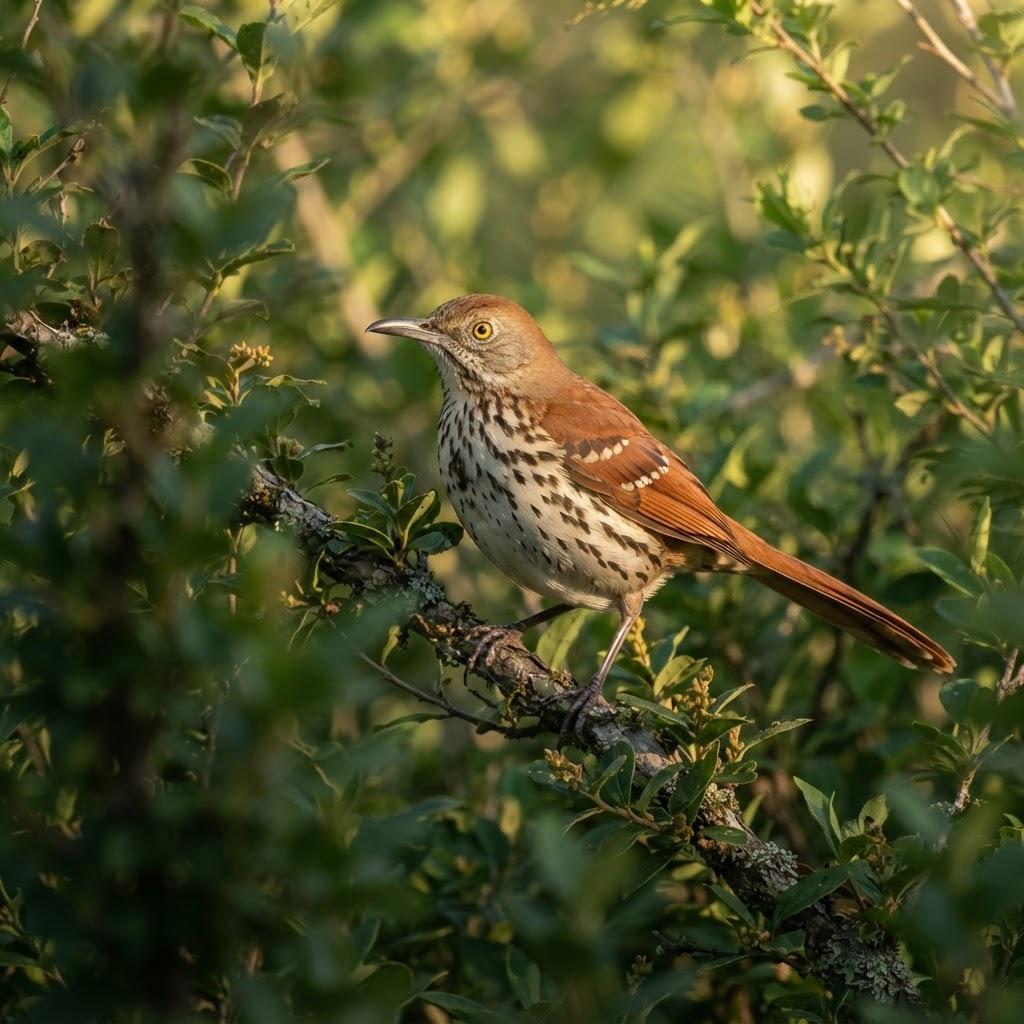
Toxostoma rufum
Brown Thrasher
Meet the Brown Thrasher, the backyard’s toughest detective with a song repertoire that would put a Broadway star to shame. This bird is a master of the underbrush who treats every garden scrap like a crime scene waiting to be investigated.
Meet the Bird
Imagine a bird that looks like it just stepped out of a gritty film noir detective movie, wearing a sleek, rusty-brown trench coat and sporting a stare that suggests it knows exactly where you hid the spare key. The Brown Thrasher is the rugged, antisocial cousin of the Mockingbird, possessing an intensity that is honestly quite intimidating for something that weighs less than a standard smartphone. With its piercing, golden-yellow eyes and a long, slightly curved beak that looks like a miniature scimitar, this bird isn't interested in your morning coffee chatter. It is a creature of the shadows, a ground-dwelling specialist that prefers the chaotic tangle of a bramble patch over the pristine manicured lawns that humans seem so obsessed with. While most backyard birds are busy posing for photos on high branches, the Brown Thrasher is lurking down low, kicking up dirt, and judging everyone with a silent, steely gaze. It is the undisputed king of the 'messy' corner of the yard, and it wouldn't have it any other way.
Superpowers & Weird Abilities
If you think the Brown Thrasher is just another brown bird, you are missing out on the fact that it is basically an avian sound system with infinite storage capacity. These birds have a vocal repertoire that consists of over 1,000 distinct song types. To put that in perspective, while most birds learn a few tunes and stick to the script, the Thrasher is out here improvising like a jazz legend on an espresso bender. They don't just mimic others; they create complex, repetitive phrases that they double-up for emphasis. It is like they are constantly shouting, 'I am here, I am large, and my life is more exciting than yours!' Furthermore, their foraging strategy is a masterclass in biomechanical efficiency. They have evolved specialized muscles that allow them to sweep their heavy bills side-to-side through leaf litter with the power of a tiny, feathered snowplow. They are essentially biological metal detectors designed specifically for finding hidden beetle snacks beneath the autumn debris.
Drama, Personality & Feathered Chaos
The Brown Thrasher is the equivalent of that one neighbor who calls the HOA the second a blade of grass grows a millimeter too high. They are notoriously territorial and possess a personality that can only be described as 'aggressive homebody.' If a cat, a dog, or even a hapless human dares to wander too close to their nesting shrub, they will launch into a high-pitched, screeching alarm call that sounds like a mechanical toy having a nervous breakdown. They aren't afraid to throw hands—or wings—either. These birds are known to stand their ground against creatures much larger than themselves, including snakes. Watching a Thrasher dive-bomb a predator is like watching a feisty bantamweight boxer square off against a heavyweight. They are not bullies in the typical sense of stealing from others; they are just deeply, painfully protective of their personal bubble. If you own a garden, you are essentially just a landlord, and the Brown Thrasher is the tenant who is constantly filing noise complaints.
Bizarre Rituals & Quirky Habits
Perhaps the most delightful, if slightly gross, habit of the Brown Thrasher is the art of 'anting.' You might occasionally see one of these birds posturing in an anthill, looking like it has lost its mind, while it allows ants to crawl over its wings and tail. It isn't a tragic mistake; it is a spa treatment. The ants release formic acid, which acts as a natural pesticide and mite-remover for the bird's feathers. It is essentially nature’s version of a deep-tissue insecticidal rubdown. Beyond their hygiene routines, they are also obsessed with consistency. If you provide a reliable food source, they will return to the exact same spot with the punctuality of a Swiss train. They also have a strange tendency to hop around on the ground with their wings drooping slightly, which makes them look like they are perpetually sulking or hiding a secret stash of stolen shiny objects. They are the weird, eccentric uncles of the bird world.
Legends, Folklore & Human Stories
In the folklore of the American South, the Brown Thrasher is often seen as a guardian of the forest floor, a silent witness to the changes in the landscape. Because of their affinity for thick, impenetrable brush, they have long been associated with mystery and the 'unseen' world. There are stories from early settlers describing the birds as messengers of the changing seasons; when the Thrasher began its loud, boisterous singing, it was time to put away the winter tools and start breaking ground for spring. They have been featured in folk songs and regional poetry, often depicted as a symbol of resilience and the wild, untamable spirit of the countryside. Unlike the flashy cardinal or the angelic bluebird, the Thrasher never demanded to be a symbol of beauty. Instead, it became a symbol of grit. They have earned their place in our stories not by being pretty, but by being stubbornly, undeniably present in our daily lives.
Mating: The Ridiculous World of Avian Dating
Courtship for a Brown Thrasher is a high-stakes performance that would make a Broadway director sweat. When a male decides he is ready to settle down, he starts by finding a very high, very exposed perch—a total departure from his usual shifty, ground-level behavior. He then begins to sing his heart out, cycling through every single sound in his database. He sings for hours, testing out different arrangements, hoping that some passing female is impressed by his musical range. If a female lands nearby, the performance gets even more absurd. The male will fluff up his feathers to look as large as possible, perform a little jittery, side-to-side dance, and perhaps carry around a stick or leaf as a sign that he is a 'capable' provider. It is essentially a bachelor trying to prove he is ready to move out of his parents' basement by showing off his ability to hold a twig. If she isn't buying it, she leaves, and he starts his solo concert all over again.
Nesting: Master Architects and Lazy Slumlords
When it comes to building a nest, the Brown Thrasher is an industrial worker. They don't mess around with flimsy, minimalist designs; they build structures that are fortress-like. Tucked deep within a dense, thorny shrub or a tangled hedge, they construct a bulky platform made of twigs, leaves, and bits of bark. The interior is a cozy, rounded cup lined with finer materials like rootlets and grass. These nests are meant for serious business, designed to keep eggs safe from predators that struggle to navigate the prickly gauntlet of the Thrasher’s home. It’s not an elegant, Instagram-worthy masterpiece; it’s a rugged, functional bunker. They will occasionally go to great lengths to hide these nests, sometimes adding extra 'camouflage' materials until the nest is practically invisible. While other birds might leave their nests exposed, the Thrasher is the ultimate prepper, ensuring that their future offspring are shielded by the most inconvenient, thorny walls of vegetation imaginable.
Raising Babies: The Screaming Food Disposals
Once the eggs hatch, the Brown Thrasher parenting experience enters a phase of pure, caffeinated chaos. Both the mother and father are on the clock, operating as a highly coordinated, high-speed delivery service. The chicks are essentially pink, vibrating mouth-units that demand protein on a schedule that defies physics. It is not uncommon for the parents to make hundreds of trips a day to gather worms, beetles, and larvae. They are constantly on the move, skittering across the lawn with the intensity of an Olympic sprinter. The babies grow at an alarming rate, and soon the nest feels like a small, crowded locker room where everyone is shouting for lunch at the exact same time. It’s a loud, frantic, and exhausting month. Once the fledglings finally leave the nest, they spend a few awkward days hopping around in the brush, looking perpetually confused, while the parents frantically track their movements and try to teach them the fine art of avoiding the family cat.
Bird-Watching Travel & Local Hotspots
If you are on a quest to see a Brown Thrasher in its natural glory, you need to head to the dense, scrubby habitats of the Eastern United States. During the spring migration, they are incredibly vocal and thus much easier to track down. A fantastic place to start is the Great Smoky Mountains National Park, specifically along the lower-elevation trails where the forest gives way to open, shrubby gaps. If you prefer something a bit more urban, the edges of large public parks in the Midwest often have the perfect tangle of wild growth that these birds crave. Keep your ears peeled for that explosive, double-note song. Look for them in areas where brambles and thickets remain unpruned; if a park ranger looks at a hedge and says, 'That needs trimming,' that is exactly where the Thrasher is hiding. Bring a pair of binoculars, because even if they are singing right in front of you, they have an uncanny ability to disappear into the shadows the moment you reach for your phone.
Food, Feeder Hacks & DIY Projects
To turn your backyard into a Brown Thrasher paradise, stop buying the cheap, dusty 'filler' seeds from the hardware store. They want the good stuff, and they want it on the ground or on a platform feeder. Thrashers love suet, but they prefer a crumbly version they can easily pick at. A fun, cheap DIY project is the 'Log Feeder': take a small piece of untreated firewood, drill a few large holes into it, and pack those holes with a mixture of peanut butter, high-quality birdseed, and dried mealworms. Hang this log near a dense shrub, and you have essentially created a five-star dining experience for a bird that usually subsists on ground-crickets. If you really want to attract them, plant native shrubs like serviceberry or wild plum. These provide natural food sources and, more importantly, the kind of dense, safe cover that makes a Brown Thrasher feel like it’s in a five-star resort. Don't worry about keeping the ground clean; they will take care of the fallen seeds for you.
Seasonal Guides & "Crisis" Management
Spring is the peak time for Brown Thrasher activity, as their territorial songs signal the start of the breeding season. This is when you should have your feeders stocked with fresh sunflower hearts and mealworms to help them maintain their energy levels during the intense nesting cycle. Winter is the time for survival; if you live in a colder region, keep your suet blocks fresh and consider placing a heated birdbath in your yard. The most common 'crisis' happens in early summer, when fledglings begin hopping on the ground, looking like abandoned, flightless balls of fluff. Please, resist the urge to 'rescue' them! This is a normal stage of development. The parents are almost certainly nearby, watching from the brush. Unless you see an obvious injury or the baby is in immediate danger of being eaten by a lawnmower, leave it alone. The best thing you can do for a fledgling is to be a ghost and keep your pets inside until the little troublemaker learns to fly.
Backyard Tech & Gadget Reviews
Smart bird feeders like the Bird Buddy are absolute game-changers for identifying your local Thrasher population. Because these birds are so cryptic and spend so much time in the shadows, catching a clear photo can be a nightmare. An AI-powered camera feeder will snap a high-resolution portrait the second they land, allowing you to appreciate those incredible yellow eyes up close. For those who want to get serious about studying local wildlife, a motion-activated trail camera placed near a brush pile is a low-cost, high-reward investment. You will be amazed at what these birds get up to when they think no one is watching. As for window safety, if you have a Thrasher that likes to zip through your yard, install external window films or decals. These don't just protect the birds; they provide you with a clearer, more peaceful view of your feathered neighbors without the constant worry of a high-speed collision ruining your morning.
How to Spot One & How It Is Doing
To identify a Brown Thrasher, look for the 'long and lean' profile: a long tail, a long curved bill, and a reddish-brown back with heavy, dark streaks on its creamy-white belly. They move with a skittish, erratic hopping gait, often tossing leaves over their shoulders with their beaks. If you hear a series of double-noted chirps and trills coming from a hedge, stand perfectly still and wait. The bird is likely doing its own 'spotting' of you. Currently, the Brown Thrasher population is considered a species of 'Least Concern,' which is great news, but their numbers do fluctuate based on the availability of the shrubby, overgrown habitats they depend on. You can help them thrive by advocating for 'wilder' gardening practices in your neighborhood—convince your neighbors that a messy brush pile isn't an eyesore, but a vital piece of local wildlife architecture. Every tangled corner you preserve is a victory for these amazing, feisty detectives.