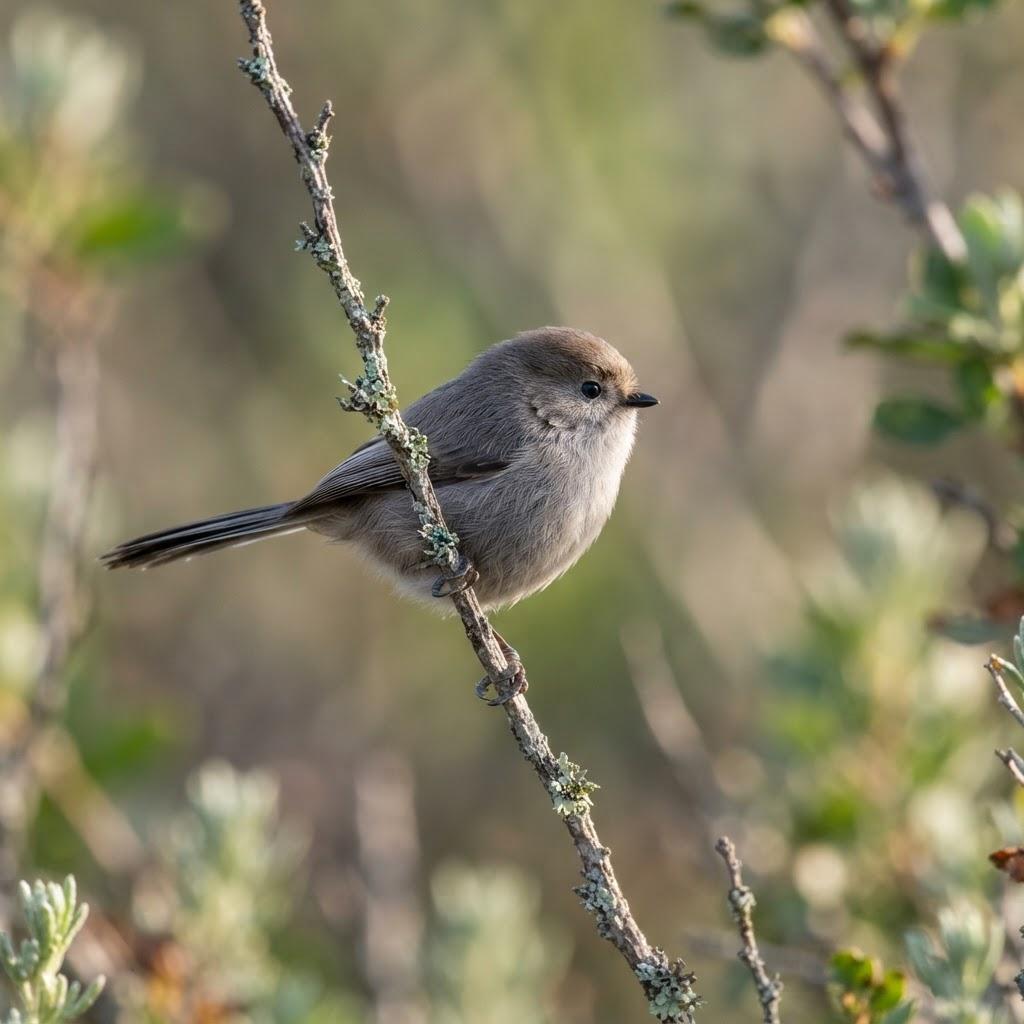
Psaltriparus minimus
Bushtit
Meet the Bushtit, a tiny, hyperactive fluff-ball that lives its life in a constant state of chaotic, synchronized group energy. These pint-sized acrobats are the ultimate team players of the bird world, turning every branch into a bustling community center.
Meet the Bird
Imagine a feathered ping-pong ball that has consumed ten cups of high-octane espresso and decided to take up gymnastics. That is the Bushtit. This bird is arguably the most energetic character you will ever encounter in your backyard, behaving less like a dignified avian and more like a jittery, nervous wreck that just realized it is late for its own wedding. With their oversized heads, tiny bodies, and tails that look like they were attached as an afterthought, they are undeniably cute. They do not do anything halfway; if they are foraging, they are moving at the speed of light, swarming a branch like a tiny, feathered flash mob. They are the social butterflies of the woodland, rarely seen alone and always whispering in soft, high-pitched chirps to their companions. If life were a movie, the Bushtit would be that fast-talking, hyperactive sidekick who keeps the plot moving while accidentally tripping over its own feet. They are perpetually vibrating with intensity, making them one of the most delightful, if slightly overwhelming, birds to watch as they perform their frantic dance through your garden shrubs.
Superpowers & Weird Abilities
While they lack the dramatic flair of a peregrine falcon or the endurance of an albatross, the Bushtit possesses a superpower that puts most lone-wolf species to shame: the sheer, unbreakable physics of group movement. Bushtits are essentially a single collective organism trapped in several tiny bodies. When they move through the trees, they behave like a school of fish, reacting to external stimuli with a speed that defies individual decision-making. Scientists call this flocking behavior, but it looks more like telepathy. They can navigate through dense thickets at high speeds without a single mid-air collision, a feat that would leave a human parkour expert weeping in the dirt. Their ability to maintain contact through constant, soft vocalizations while in motion ensures the group never loses a member. It is the avian equivalent of an encrypted Wi-Fi network, allowing them to share location data and predator warnings in real-time. This collective intelligence keeps them safe, as even the hungriest hawk struggles to pick out one tiny, jittery target when a whole, shifting cloud of them is darting in every direction at once.
Drama, Personality & Feathered Chaos
If you enjoy high-stakes social drama, just hang out near a Bushtit nest. These birds are the antithesis of the stoic, lone-ranger species; they are codependent to a fault. However, do not mistake their friendliness for weakness. Within the flock, there is a constant, subtle hierarchy of bickering and competition for the best spots in the middle of the crowd. While they are not known for being 'backyard bullies' like the aggressive hummingbirds or the territorial blue jays, they are masters of collective annoyance. When a predator—or a confused cat—approaches, the Bushtit flock turns into a mob of tiny, screeching activists, swarming and scolding the intruder until it decides that the effort of catching a five-gram snack is simply not worth the psychological warfare. They share everything: food, gossip, and even nesting duties. It is a world of total communal reliance where the 'us against the world' mentality is not just a slogan, but a literal, survival-driven lifestyle that makes every other bird in the forest seem like a lonely, antisocial hermit.
Bizarre Rituals & Quirky Habits
The Bushtit is essentially the bird equivalent of a teenager who refuses to let go of their friends, even for a moment. One of their most bizarre habits is the 'huddle.' When the temperature drops—and let’s be honest, being five grams of feathers in a winter breeze is a recipe for disaster—Bushtits have been known to squeeze together into a tight, shivering ball of fluff, often sharing a single roosting spot. Imagine twenty tiny birds stuffed into a space meant for one, all chirping and jostling for the warmest spot in the middle. It is a survival strategy, but it looks like a scene from a bird-themed comedy about a crowded elevator. They also have a strange obsession with their own cleanliness, spending an inordinate amount of time preening, which in the bird world, is not just about vanity. It is a social ritual. They will sit side-by-side, carefully nibbling on their neighbors' feathers in a process called 'allopreening.' It creates a bond that is tighter than any bird-based glue, ensuring that the flock remains a cohesive unit even when the wind tries to blow them off course.
Legends, Folklore & Human Stories
Because Bushtits are so small, fast, and constantly obscured by leaves, they have spent much of history being the 'ghosts' of the garden. In various North American traditions, these little birds were often seen as messengers of the forest, representing the importance of community and the idea that even the smallest voices can create a massive amount of noise. They are rarely the protagonists of big, epic myths, but they appear in local tales as the tiny keepers of the thicket. There is a common sentiment among seasoned birders that seeing a large, bustling flock of Bushtits is an omen of a well-balanced, healthy ecosystem. If the Bushtits are thriving, it means the insects are plentiful and the canopy is thick, which is a good sign for everyone involved. Humans have long looked at them with a mixture of amusement and respect, mostly because it is impossible to watch a group of twenty of them navigate a fence line without feeling a little more connected to the chaotic, wonderful pulse of nature.
Mating: The Ridiculous World of Avian Dating
In the world of Bushtit romance, the 'bachelor pad' is not just a suggestion; it is the entire personality of the male. While other birds might rely on a flashy display of colors or a complex song to impress a mate, the male Bushtit wins hearts through architectural genius. The mating ritual is less about dance moves and more about proving that he is capable of constructing a home that is sturdy enough to withstand the pressures of both the elements and the relentless, screaming appetites of a dozen hungry babies. The courtship process involves a fair amount of aerial chasing, with the male showing off his flight precision to a prospective partner. If she is unimpressed, she simply flies off, and the male is left hanging in mid-air, metaphorically dusting off his ego and looking for the next opportunity. It is a high-pressure environment where construction skills are the ultimate turn-on, and the female is the toughest critic in the avian housing market.
Nesting: Master Architects and Lazy Slumlords
If you want to see an engineering marvel, look at a Bushtit nest. It is a long, pendulous sock-like structure that hangs from a branch, looking like a discarded gym sock left out in the rain by a particularly careless giant. But don't let the exterior fool you; this is a masterclass in structural engineering. They weave spider silk, moss, lichen, and plant down into a flexible, stretchy tube that can accommodate a rapidly growing family of chicks. It is soft, incredibly insulated, and camouflaged so well that you could stand five feet from one and never realize it was there. Unlike the lazy pigeons who treat sticks as a mere suggestion, the Bushtit spends weeks crafting this masterpiece. They use the spider silk to act as a structural binding agent, making the nest strong enough to hold up to a dozen tiny, wiggly bodies without tearing. It is a cozy, dark, and protective sanctuary that proves these little birds are the elite construction workers of the forest.
Raising Babies: The Screaming Food Disposals
Raising children is exhausting for any species, but for a pair of Bushtits, it is akin to running a catering service for a stadium of hungry fans. A single nest can contain up to a dozen eggs, which means when they hatch, the parents are essentially dealing with a dozen microscopic, feathered piranhas. The chicks are blind, naked, and born with only one ambition: to consume every insect that dares to exist within a half-mile radius. The parents spend their entire day in a blurred cycle of hunting and feeding, returning to the nest so frequently that it looks like they are simply commuting to a job that pays exclusively in noise. The 'screaming food disposal' phase lasts about two weeks, during which the parents look increasingly ragged, their feathers rumpled from the constant labor of love. It is a chaotic, frantic, and slightly hilarious process that tests the limits of avian stamina, proving that the Bushtit is not just a pretty face—it is a tireless, multitasking machine.
Bird-Watching Travel & Local Hotspots
If you want to see a Bushtit, you don't need a safari. You need a pair of decent binoculars and a willingness to stand still for five minutes. They are ubiquitous across the Western United States. For a truly memorable experience, head to the coastal scrublands of California or the bushy riparian zones in Arizona during the early morning hours. If you are in the Pacific Northwest, look for them in the dense shrubbery near forest edges in state parks like Silver Falls or Henry Cowell Redwoods. The trick is to listen for their contact calls—a series of high, soft, rapid-fire notes—before you try to spot them. Once you hear them, stop moving. They are notoriously curious and will often swarm into the branches right next to you, providing a masterclass in avian gymnastics. They are the perfect bird for the casual traveler because they are everywhere, yet they make you feel like you are witnessing a secret, high-speed meeting that you were lucky enough to stumble upon.
Food, Feeder Hacks & DIY Projects
Bushtits are primarily insectivores, meaning they are the best pest-control agents you could possibly invite to your yard. They have an insatiable appetite for aphids, scale insects, and other tiny garden invaders. To attract them, skip the cheap, dusty millet—that is just bird junk food—and focus on suet and high-quality, oil-rich seeds like sunflower hearts. A DIY suet log is a fantastic way to turn your yard into a Bushtit hotspot. Take a small, fallen log, drill several holes into it, and pack those holes with high-quality, nut-based suet. Hang it near a dense, bushy area, and wait. Because they are social, once one finds it, it will tell all its friends, and you will suddenly have a dozen tiny acrobats hanging upside down from your log. Planting native shrubs that provide cover and attract insects is the best long-term investment. If you build it—and specifically, if you fill it with fat and protein—they will come in droves, providing endless entertainment.
Seasonal Guides & "Crisis" Management
The change of seasons for a Bushtit is mostly about the 'huddle.' In the winter, your primary job as a bird host is to keep the birdbath from freezing and keep that suet feeder topped off with high-fat, energy-dense options. They are not migratory, so they rely on your yard to survive the cold. Spring brings the 'fledgling panic' season. If you find a tiny, fluffy, slightly uncoordinated bird on the ground, take a breath. It is almost certainly a fledgling that is just learning the ropes. If it has feathers, can hop, and looks alert, it is fine. The parents are usually watching from a branch above, whispering instructions and waiting for you to leave so they can bring it a snack. Unless it is obviously injured or in immediate danger, leave it alone. The best thing you can do is keep your distance, watch from afar, and appreciate the fact that you are witnessing the next generation of acrobats learning how to conquer the canopy.
Backyard Tech & Gadget Reviews
Modern birding technology is a game-changer for someone wanting to document the lightning-fast life of a Bushtit. A smart feeder, like those that use AI to identify species, is a great tool for catching their brief visits, though you will need to set the camera to a high frame rate to actually capture them in focus. They move so quickly that standard motion detectors might miss them entirely. Window collisions are a major issue for all small birds, especially in fast-moving groups. The most practical solution is to apply UV-reflective decals or simple external screens to your glass. These break up the reflection, signaling to the flock that they are approaching a barrier rather than a clear path. A motion-sensor camera trap placed near a suet feeder will give you hours of hilarious footage, revealing the complex, jostling social dynamics of the group as they wait their turn for a bite of high-energy suet.
How to Spot One & How It Is Doing
Recognizing a Bushtit is easy once you know what to look for: look for the movement first. They are the tiny, hyperactive grey-brown balls of energy that never stay still for more than a second. They have relatively long tails compared to their small bodies, and they are usually accompanied by ten of their closest friends. If you hear a soft, constant chirping coming from a bush, stop and wait. They are doing quite well in terms of conservation status, being listed as Least Concern, mostly because they are incredibly adaptable to suburban environments that provide the right kind of dense shrubbery. To help them continue to thrive, prioritize planting native, dense bushes in your yard and avoid using heavy pesticides. Every time you support a healthy patch of habitat, you are supporting a whole community of these tiny, frantic, and incredibly endearing birds. They don't need much, just a little cover, a little food, and the freedom to act like the hyperactive, gossiping socialites of the avian world.