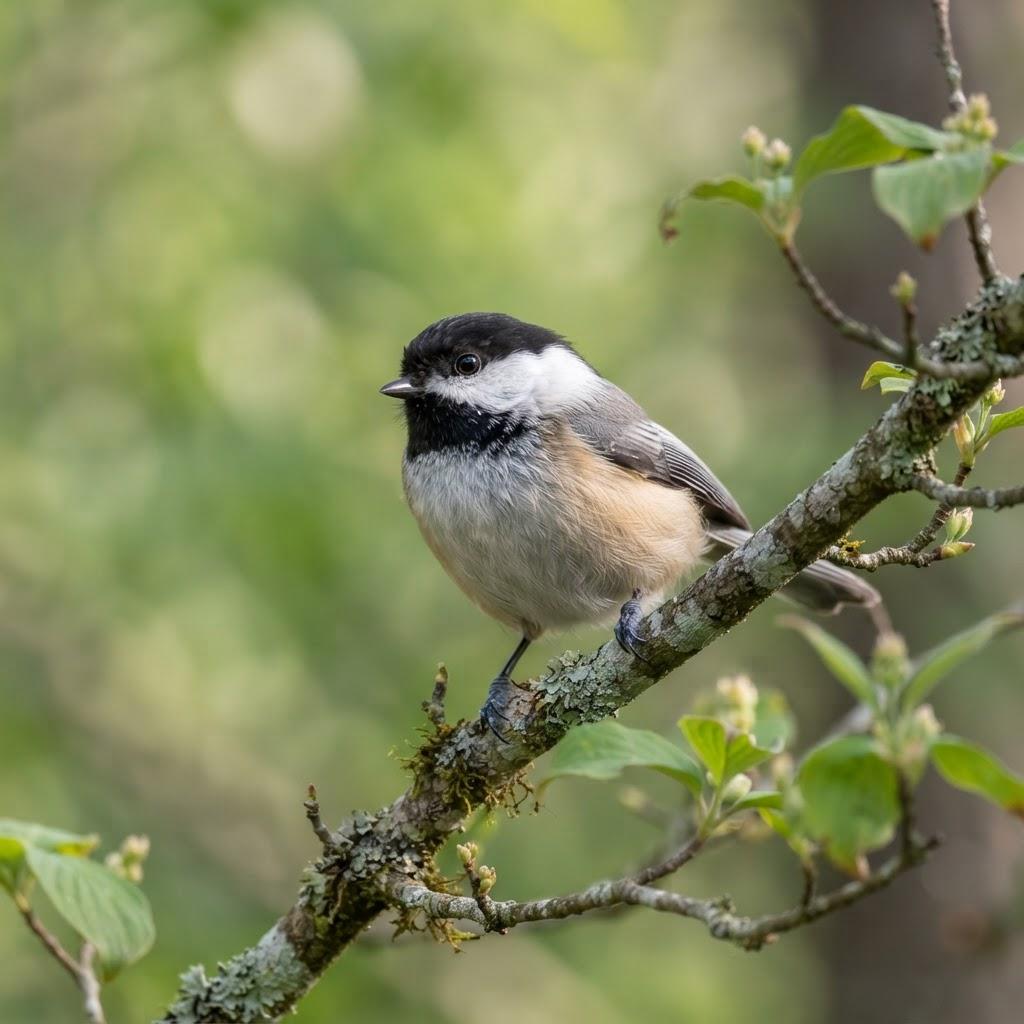
Poecile carolinensis
Carolina Chickadee
The Carolina Chickadee is a feathered acrobat with the confidence of a raptor and the appetite of a teenage athlete. This pint-sized powerhouse turns every backyard into a high-stakes arena of clever antics and charming social drama.
Meet the Bird
If the bird world had a protagonist in a classic sitcom, it would be the Carolina Chickadee. Imagine a tiny, perpetually caffeinated acrobat wearing a tuxedo-inspired cap and bowtie, fluttering through the canopy with the focus of a laser-guided missile. Measuring only a few inches long, these birds are the definition of big energy in a small package. They don't just exist; they vibrate. While other birds might move with grace or stealth, the Chickadee operates on a system of rapid-fire pulses, twitching from branch to branch like a glitch in a video game. They are the quintessential backyard companions—bold, curious, and utterly fearless. A Chickadee will often hang upside down from a twig just to get a better look at you, tilting its head with a gaze that suggests it is either contemplating the mysteries of the universe or judging your choice of garden accessories. They are the scrappy underdogs of the forest, proving that you do not need to be big to be the most important bird in the neighborhood.
Superpowers & Weird Abilities
The Carolina Chickadee possesses a cognitive superpower that would make a graduate student weep with envy: spatial memory that functions like a high-definition GPS. Every autumn, these birds engage in a behavior known as 'scatter-hoarding,' where they hide thousands of individual seeds across a sprawling landscape. Now, here is the kicker: they do not just hide these treasures in a random pile; they remember the specific location of every single one of them. To facilitate this, their brain actually expands in size during the winter months, growing new neurons to accommodate the extra data storage. It is essentially the biological equivalent of downloading a massive hard drive update just to remember where you parked your car in a ten-mile-wide parking lot. They are also masters of the 'chick-a-dee-dee-dee' alarm system, a complex language where the number of 'dees' at the end of the call indicates the level of threat. A higher number of 'dees' essentially translates to 'this is a high-danger zone, abort mission immediately,' effectively communicating the size and speed of a predator to their feathered friends.
Drama, Personality & Feathered Chaos
Do not let the cute, puffy-cheeked exterior fool you; the Carolina Chickadee is a backyard brawler with a Napoleonic complex. They operate in social hierarchies that would put a high school cafeteria to shame. When a group of Chickadees arrives at a feeder, there is a distinct pecking order—literally. Dominant individuals get the prime sunflower seeds, while the lower-ranked members are forced to wait their turn or settle for the dusty, discarded bits. They are not afraid to square off against birds twice their size, often puffing out their feathers to look bigger and uttering aggressive calls to ward off intruders. However, their social life is not just conflict. They are incredibly communicative, engaging in a constant stream of chatter that keeps the social circle updated on weather, food, and danger. They are the neighborhood watch, the gossip column, and the local tough guys all rolled into one four-ounce package. Watching them interact is like watching a soap opera where every character is a jittery, hungry, and incredibly dramatic tiny acrobat.
Bizarre Rituals & Quirky Habits
Chickadees are creatures of intense habit, but they also indulge in some genuinely weird behaviors that defy simple explanation. One of their most fascinating quirks is their reaction to temperature. During cold nights, these birds undergo a process called 'regulated hypothermia.' They allow their body temperature to drop significantly—sometimes by as much as 15 degrees—to conserve energy while they sleep in tight, protected cavities. It is a calculated act of freezing to stay alive. They also engage in a behavior that looks remarkably like shivering, using their muscles to generate heat during the worst of winter. But it’s their curiosity that is the truly quirky trait. Chickadees are famously 'tame' by nature. If you stand perfectly still in a woods known for heavy Chickadee traffic, these birds will often fly down to within inches of your face, hovering briefly to inspect your eyebrows or glasses as if wondering if you are a viable source of snack-time crumbs. It is a strange, intimate ritual that makes every encounter feel like a tiny, feathered handshake.
Legends, Folklore & Human Stories
In the grand tapestry of human storytelling, the Chickadee has long been seen as a harbinger of change and a symbol of resilience. Many indigenous cultures viewed the Chickadee as a wise guide or a messenger of the forest, appreciated for its ability to thrive when other creatures retreated or perished. In the modern era, the Chickadee holds a special place in the hearts of backyard birders who view them as the 'gateway bird.' For many people, their first real interest in birding began with a Chickadee landing on a feeder or taking a seed from a hand. There is a specific, widely reported human experience of 'hand-feeding' these birds. Because of their natural inquisitiveness, it is possible for a patient human to train a Chickadee to land on their palm to take a sunflower seed. This ritual has spawned countless photographs and stories, creating a sense of connection between human and nature that is rare in our increasingly digitized world. They aren't just birds; they are the ambassadors of the wild, showing us that nature is right outside our window, waiting for an invitation.
Mating: The Ridiculous World of Avian Dating
Dating for a Carolina Chickadee is a high-stakes, musical affair that would make a Broadway producer proud. The process begins with the male 'singing'—a sharp, clear 'fee-bee' call that echoes through the trees. But this is not just about singing; it is about performance. A male Chickadee will perform elaborate flight displays, fluttering and swooping around a potential mate to show off his vitality and fitness. If the female is impressed, she might join in, creating a synchronized duet that feels like a choreographed dance routine. However, if the male’s song is off-key, or if his display flight lacks the necessary panache, the female is notoriously dismissive. She will simply fly off, leaving the male to find a new perch and start his performance all over again. It is a brutal, honest system where only the most energetic and persistent suitors earn the right to pair up. Once they do bond, they are surprisingly faithful, often remaining as a pair throughout the year, even when other birds abandon their mates for the winter season.
Nesting: Master Architects and Lazy Slumlords
When it comes to nesting, Carolina Chickadees prefer a cozy, custom-built home over a sprawling suburban estate. They are cavity nesters, meaning they look for hollows in trees, abandoned woodpecker holes, or, in the modern age, specifically sized nesting boxes. Once they find a suitable 'property,' the real work begins. The female is the lead contractor, and she will meticulously line the cavity with soft, insulating materials like moss, feathers, hair, and plant down. She creates a tiny, cup-shaped bed that is designed to trap as much heat as possible for the future brood. While the male does not do much of the heavy lifting during the construction phase, he is tasked with the critical role of guarding the perimeter, chirping out warnings if any predators—or nosy neighbors—get too close to the construction site. It is a collaborative effort that balances architecture with security, ensuring that the next generation has a safe, warm, and sturdy bunker to start their journey into the world.
Raising Babies: The Screaming Food Disposals
The moment the eggs hatch, the peace and quiet of the Chickadee home is replaced by a non-stop, high-volume demand for calories. The chicks are born as tiny, naked, and incredibly vocal bundles of hunger. For the parents, it is a test of endurance. They become machines, making hundreds of trips per day to bring back spiders, caterpillars, and seeds to satisfy the endless appetites of their brood. The babies, meanwhile, do nothing but open their mouths and scream until they are fed, showcasing an utter lack of social graces. It is exhausting work, and as the chicks grow, they start to crowd the nest, pushing and shoving until the entire box is filled with flapping, feathered, and constantly hungry energy. After about two to three weeks, the fledgling stage begins—a chaotic, uncoordinated attempt at flight that usually results in a few belly-flops onto the forest floor before they find their rhythm. It is a messy, beautiful, and slightly hysterical process that demonstrates the sheer willpower required to be a parent in the wild.
Bird-Watching Travel & Local Hotspots
If you are on a quest to see a Carolina Chickadee, you are in luck: you probably do not need to travel further than your nearest park or patch of woods. They are ubiquitous across the Southeastern United States, thriving from the pine forests of the Carolinas to the deciduous stands of Tennessee and the suburbs of the Gulf Coast. If you are looking for a prime birding destination, consider the Great Smoky Mountains National Park, where the vertical change in elevation creates a smorgasbord of habitats that these birds love. Another fantastic spot is the various national wildlife refuges scattered along the Atlantic Flyway. The best way to see them is to look for 'mixed-species flocks.' During the winter, Chickadees often lead groups of Titmice, Nuthatches, and Kinglets. If you find one Chickadee, you have usually found the entire party. Simply find a quiet spot, keep your binoculars ready, and listen for their distinct 'fee-bee' song or the rapid-fire 'dee-dee-dee' alarm call. They are always active, so you rarely have to wait long.
Food, Feeder Hacks & DIY Projects
To turn your backyard into a Chickadee paradise, you need to understand their palate. These birds are not picky, but they do have favorites. Black-oil sunflower seeds are the gold standard for Chickadees; they have a high-fat content and are easy to crack open. Avoid cheap 'grocery store' mixes that are mostly milo or wheat, as Chickadees will simply kick these to the ground. For a fun DIY project, try making a 'nature-based suet log.' Take a small section of a fallen log, drill a few holes into the side, and stuff them with a mix of lard and peanut butter. Hang this from a branch, and watch as your resident Chickadees perform high-speed landings to grab a bite. If you want to go the extra mile, plant native berry-producing shrubs like dogwood or serviceberry. These plants provide natural food that sustains the birds when seeds are scarce. By providing a combination of high-energy fats and native shelter, you will guarantee that your yard becomes the most popular restaurant in the local Chickadee network.
Seasonal Guides & "Crisis" Management
Managing the Chickadee lifecycle requires a seasonal mindset. In spring, your goal is to provide nesting material—consider leaving a bit of dog hair or sheep's wool in a mesh bag for them to collect. As summer turns to autumn, shift your focus to high-energy feeders to help them 'fatten up' for the winter. When the first frost hits, keep your birdbath clean and consider a heater if the water tends to freeze solid, as birds need to drink and groom even in freezing temps. The biggest 'crisis' for most homeowners is finding a 'lost' baby bird on the ground in May. Before you panic and scoop it up, know this: this is likely a 'fledgling.' It is at the awkward, teenage stage of its life, and its parents are almost certainly watching from a nearby branch, ready to swoop down with food. Unless the bird is visibly injured or in immediate danger from a cat, leave it alone. The best thing you can do is stand back, keep your pets inside, and give the bird the space it needs to find its wings.
Backyard Tech & Gadget Reviews
For the modern bird enthusiast, technology can bridge the gap between just watching and truly understanding these tiny dynamos. AI-powered feeders, like the popular Bird Buddy or similar camera-equipped devices, have revolutionized the hobby. These gadgets allow you to capture high-definition close-ups of your Chickadees, making it easy to identify individual birds or catch hilarious, split-second expressions you would otherwise miss. However, technology should also focus on safety. Window collisions are a major issue for active, fast-moving birds like Chickadees. The best 'tech' you can invest in is simple window film or external UV-reflective stickers. These are invisible to us but highly visible to birds, helping them avoid the glass entirely. If you want to monitor the nocturnal goings-on, a cheap, motion-activated trail camera pointed at a feeder or nesting box can reveal a whole world of nighttime visitors that you would never see during the day. Keeping it simple is often the best route to enjoying the birds without letting the equipment overshadow the magic.
How to Spot One & How It Is Doing
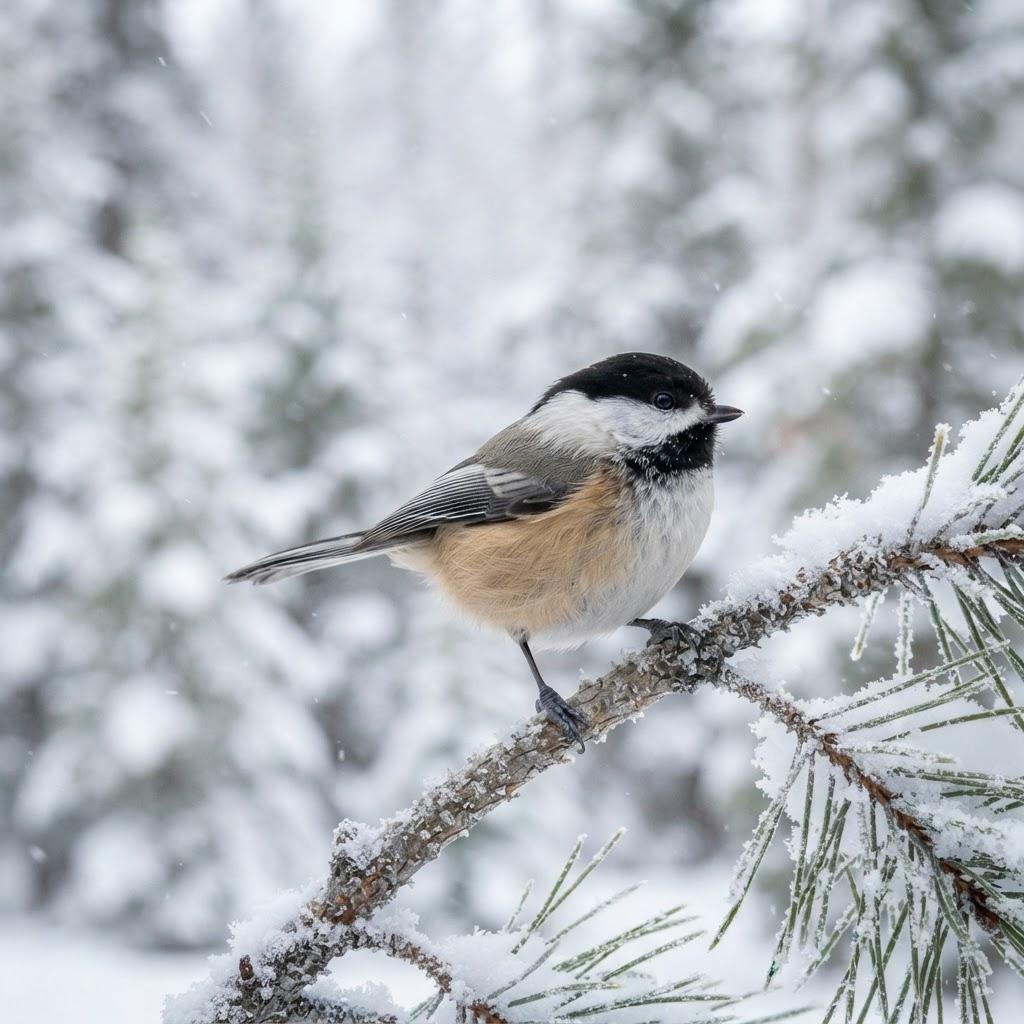
Identifying the Carolina Chickadee is all about the details: look for the solid black cap and the black 'bib' under the chin, contrasted against white cheeks. They have grayish backs and wings with a buffy, light-colored belly. They move with an erratic, jittery motion that is unlike the more deliberate hopping of a sparrow or the heavy flight of a cardinal. If you hear a high-pitched, clear 'fee-bee' whistle, or a frantic 'chick-a-dee-dee-dee' coming from the shrubs, you have found them. Fortunately, the Carolina Chickadee is thriving. Their conservation status is 'Least Concern,' largely because they are masters of adaptation and are perfectly happy living in the neighborhoods we build. They are a true success story of a species that bridges the gap between the wild forest and the human home. To keep them doing well, the best thing you can do is maintain a bird-friendly yard: plant native trees, keep your feeders clean, and advocate for pesticide-free gardening. The world is a better, more vibrant place with these tiny, feathered comedians around, and keeping them fed is the easiest way to ensure their future.