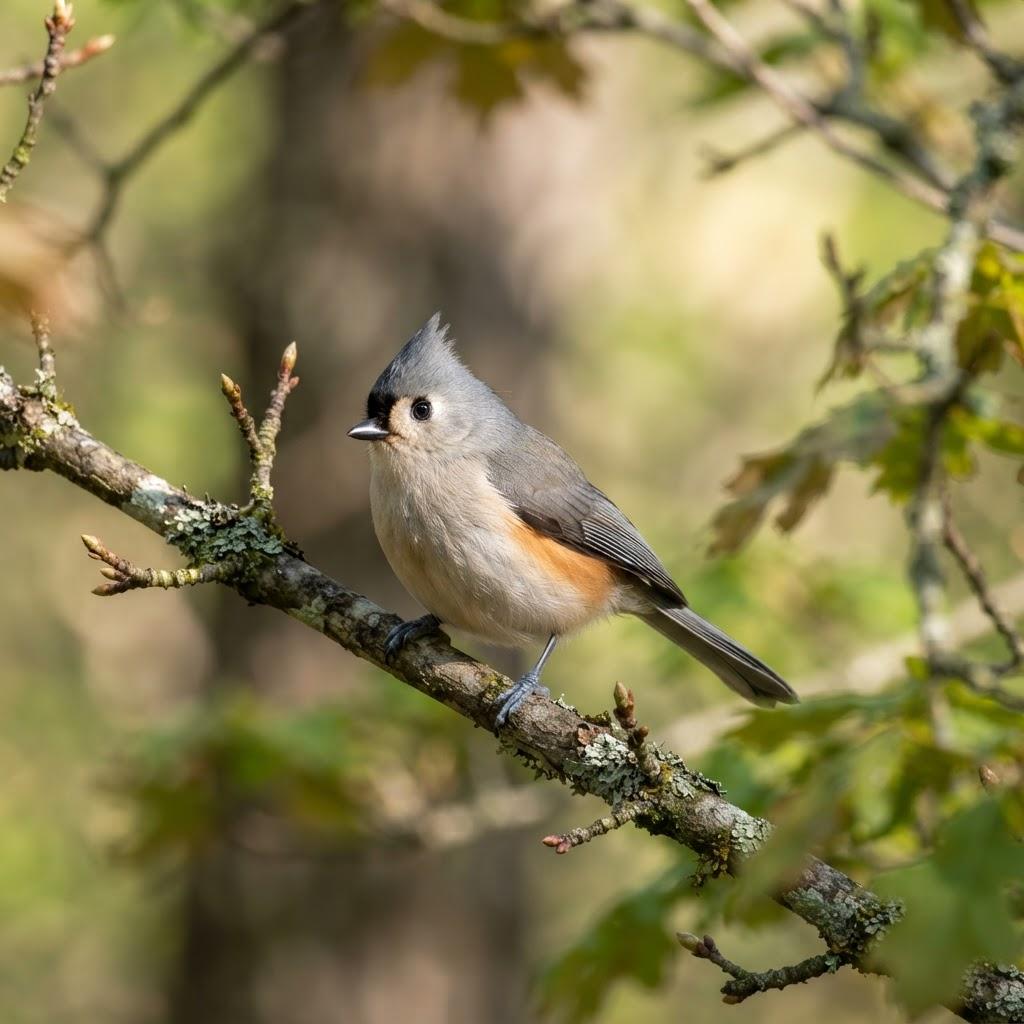
Baeolophus bicolor
Tufted Titmouse
The Tufted Titmouse is the backyard's spirited, crest-headed acrobat with an attitude far bigger than its tiny body. This energetic little bird is a master of the feeder and a constant companion for nature lovers across the eastern United States.
Meet the Bird
Imagine a bird that walked out of a tiny, feather-clad punk rock concert with a perfectly gelled mohawk, then decided to become the self-appointed landlord of your entire backyard. That is the Tufted Titmouse. With a sleek gray suit, a splash of rusty-orange paint on its flanks, and a prominent crest that acts as a mood ring, this bird is the ultimate charmer. They are small, roughly the size of a very round tennis ball, but they carry the bravado of a raptor. While many birds are shy or elusive, the Titmouse is an inquisitive extrovert, often darting down from the canopy to inspect your shoelaces or investigate your bird feeder with the audacity of a neighborhood busybody. They possess an endless curiosity, constantly flitting between branches, their dark, intelligent eyes tracking every movement in the garden. They are not merely birds; they are the spirited, feathered protagonists of the forest understory, always ready for their next adventure.
Superpowers & Weird Abilities
The Titmouse is essentially a biological marvel disguised as a backyard puffball. One of their most impressive, yet often overlooked, superpowers is their ability to hold onto food with their feet while they hammer it open with their beaks. While we might struggle with a jar lid, the Titmouse tackles a stubborn sunflower seed with the precision of a master carpenter. They possess a high metabolism that would put any Olympic athlete to shame, allowing them to remain active in the bitterest winter cold. Furthermore, they are masters of acoustic communication. They don't just tweet; they have a complex vocabulary. Their signature 'peter-peter-peter' call is a rhythmic, multi-note masterpiece that cuts through dense forest foliage. Scientists have discovered that these birds can even decode the alarm calls of other species, turning their environment into a sophisticated neighborhood watch network where they can understand the warnings issued by chickadees or nuthatches, essentially eavesdropping on the avian news cycle to stay safe.
Drama, Personality & Feathered Chaos
If the Titmouse were a character in a sitcom, it would undoubtedly be the sharp-witted, slightly bossy neighbor who knows everyone’s business. They are famous for their dominant personality at the feeder, often swooping in and scattering larger, more timid birds just because they want the choicest seed. Unlike the wallflower species that hide in the bushes, the Titmouse will stand its ground, even against larger birds, with a flick of its crest that screams, 'Move along, I was here first.' They are the kings of the suet cake, acting as if they own the entire buffet. However, this drama is usually short-lived. They have a comedic timing to their aggression—a quick flurry of wings, a stern look, and then back to business as usual. They aren't malicious, just incredibly focused on their dietary priorities, making them one of the most entertaining birds to watch for anyone who enjoys a little bit of backyard soap opera.
Bizarre Rituals & Quirky Habits
The Tufted Titmouse engages in a behavior known as 'caching,' which is essentially a very sophisticated hoarding habit. They spend a significant portion of their day tucking seeds into the crevices of tree bark, beneath shingles, or under loose leaves. If you see a Titmouse fly to a branch, inspect it intently, and then dash away, it is likely hiding a winter snack for later. This is their retirement plan. But that is not even the weirdest habit. They are also known to participate in 'anting,' where they rub ants across their feathers. While it looks like a bizarre massage, it is actually a clever way to use the formic acid from the ants to get rid of mites and parasites. They essentially use nature's own bug spray. It is a strange, messy, and undeniably genius way to maintain their plumage, showing that they are not just smart, but also master chemists of the avian world.
Legends, Folklore & Human Stories
While they haven't been featured in many epic ancient myths, the Tufted Titmouse has carved out a place in the hearts of early settlers and modern birders alike. Because they are often seen year-round in the same areas, they were seen as symbols of stability and domestic joy. Many older generations considered the presence of a Titmouse near the window to be a sign of a 'busy' day ahead, perhaps because the bird itself is never still. They have also appeared in regional folklore as little protectors of the trees, often associated with the health of the orchard. In some circles, their arrival in winter was viewed as a cheerful harbinger of the coming spring, a small, persistent voice telling the world that life continues even when the ground is frozen. They have become the quintessential backyard bird, the one that makes you feel connected to the wild even when you are just sitting on your back porch.
Mating: The Ridiculous World of Avian Dating
Avian dating for a Tufted Titmouse is less like a candlelit dinner and more like a high-speed, high-stakes game of tag. As spring approaches, the male Titmouse becomes an acoustic superstar, singing his 'peter-peter' song with relentless enthusiasm to catch a lady's attention. Once a potential mate shows interest, the courtship involves a series of dramatic aerial chases and synchronized flitting through the branches. The male will often perform a 'wing-flutter,' a display where he bows his head and flutters his wings to show off his best features. If the female is impressed, they bond for the season—or sometimes longer, as these birds are often monogamous. However, if she is not interested in his performance, she will fly off, leaving the male to continue his frantic singing routine. It is a grueling, competitive, and entirely exhausting process that leaves no room for the faint of heart.
Nesting: Master Architects and Lazy Slumlords
When it comes to home building, the Tufted Titmouse takes a surprisingly cozy approach. They are cavity nesters, which means they prefer to move into a pre-existing hole in a tree or a birdhouse rather than building a house from scratch. Once they have found the perfect spot, they get to work on the interior design. They line their homes with an eclectic mix of moss, feathers, spiderwebs, and—most famously—tufts of animal fur. If you leave a dog or cat brush out on your porch, don't be surprised if a Titmouse swoops down to 'borrow' the discarded hair for their nest. They are the ultimate scavengers of soft materials. The end result is a plush, insulated sanctuary that would make any human interior designer jealous. They aren't trying to build a fortress; they are building a velvet-lined cradle, proving that they have a serious talent for interior comfort.
Raising Babies: The Screaming Food Disposals
Once the eggs hatch, the Tufted Titmouse enters a state of perpetual motion. The parents are suddenly transformed into high-speed food delivery pilots, making hundreds of trips back and forth from the nest to the forest canopy. The chicks are essentially bottomless pits, demanding protein in the form of caterpillars, spiders, and insects. They grow at an alarming rate, and within just a few weeks, they go from blind, featherless blobs to miniature versions of their parents. The drama intensifies as the fledglings prepare to leave the nest. They are notoriously loud, and their constant 'feed me' chirping can be heard from a distance. The parents show incredible dedication, ignoring their own hunger to ensure their noisy brood reaches maturity. It is a frantic, chaotic, and heartwarming show of endurance that reminds us how much energy is packed into these tiny, determined parents.
Bird-Watching Travel & Local Hotspots
If you are on a quest to see these charming acrobats, you do not need to travel to the end of the world; they are likely right in your backyard. However, for a truly immersive Titmouse experience, head to the Great Smoky Mountains National Park or the wooded trails of Shenandoah National Park. During the fall and winter, these birds are highly active as they forage in mixed-species flocks. Look for mature deciduous woodlands where the trees are tall and the understory is rich with insects. If you are in the Midwest, the Morton Arboretum in Illinois is an exceptional place to spot them during the morning hours. The key is to look for the movement—Titmice rarely sit still, so if you see a gray blur hopping through the branches with a distinctive crest held high, you have found your target. Early mornings are best, as the birds are most vocal and hungry.
Food, Feeder Hacks & DIY Projects
Titmice are absolute fanatics for black oil sunflower seeds. If you want to be the most popular person in the bird world, this is the seed to buy. Avoid cheap mixes filled with red milo or wheat; the Titmice will simply kick those to the ground, creating a mess that mostly just attracts mice and unwanted pests. For a fun DIY project, take a pinecone, coat it in high-quality peanut butter, and roll it in black oil sunflower seeds or crushed peanuts. Hang it in a sturdy tree and watch the Titmice go to work. They also love suet, especially during the cold winter months when they need extra calories to keep their tiny bodies warm. Planting native trees like oaks or serviceberries will provide them with natural food sources throughout the year, making your yard an oasis that they will return to season after season, year after year.
Seasonal Guides & "Crisis" Management
The Titmouse is a year-round resident, but its needs change with the rhythm of the seasons. In winter, focus on keeping your birdbath from freezing by using a simple heater, as they need water even when the world is white with snow. During the spring, you may stumble upon a fledgling bird sitting on the ground, looking confused and slightly disheveled. Don't panic! This is likely a 'fledgling panic' moment where the bird is learning to fly but hasn't quite mastered the landing. The parents are almost certainly nearby, watching from a distance and waiting for you to leave so they can feed it. Unless the bird is clearly injured, leave it alone. The best thing you can do is keep pets inside and let nature take its course. These birds are resilient, and with a little bit of patience, you will see them flourishing in your yard once again.
Backyard Tech & Gadget Reviews
If you want to get closer to the action, the new generation of AI-powered feeders is a game-changer. Devices like the Bird Buddy are perfect for tracking Titmice, as they can capture high-resolution photos every time a visitor lands to grab a seed. This helps you get a clear look at their personality and even identify individual birds based on their crest shape or behavior. To protect them, consider using window decals or UV-reflective films on your windows. Birds often hit glass because they mistake the reflection of the sky or trees for a clear path. These simple, low-cost solutions can prevent accidents without blocking your view. For the nocturnal crowd, a simple motion-activated trail camera pointed at your feeders can reveal if these diurnal birds are roosting nearby or what other creatures share their domain after the sun goes down.
How to Spot One & How It Is Doing
Identifying a Tufted Titmouse is a breeze once you know what to look for. Look for the ash-gray upperparts, white belly, and that iconic, pointed crest on their head. They often hang upside down from twigs, a move that is a dead giveaway of their identity. Their call is unmistakable: a clear, whistled 'peter-peter-peter.' Conservation-wise, the news is excellent—the Tufted Titmouse is thriving. Their population is stable and even expanding, thanks in part to the way we have planted trees in suburban areas. To keep them thriving, focus on keeping your yard 'messy'—leave some leaf litter, maintain dead trees if they are safe, and keep those feeders stocked with high-quality seeds. By creating a habitat that mimics their natural forest home, you are doing your part to ensure this charismatic, mohawked neighbor continues to entertain us for generations to come.