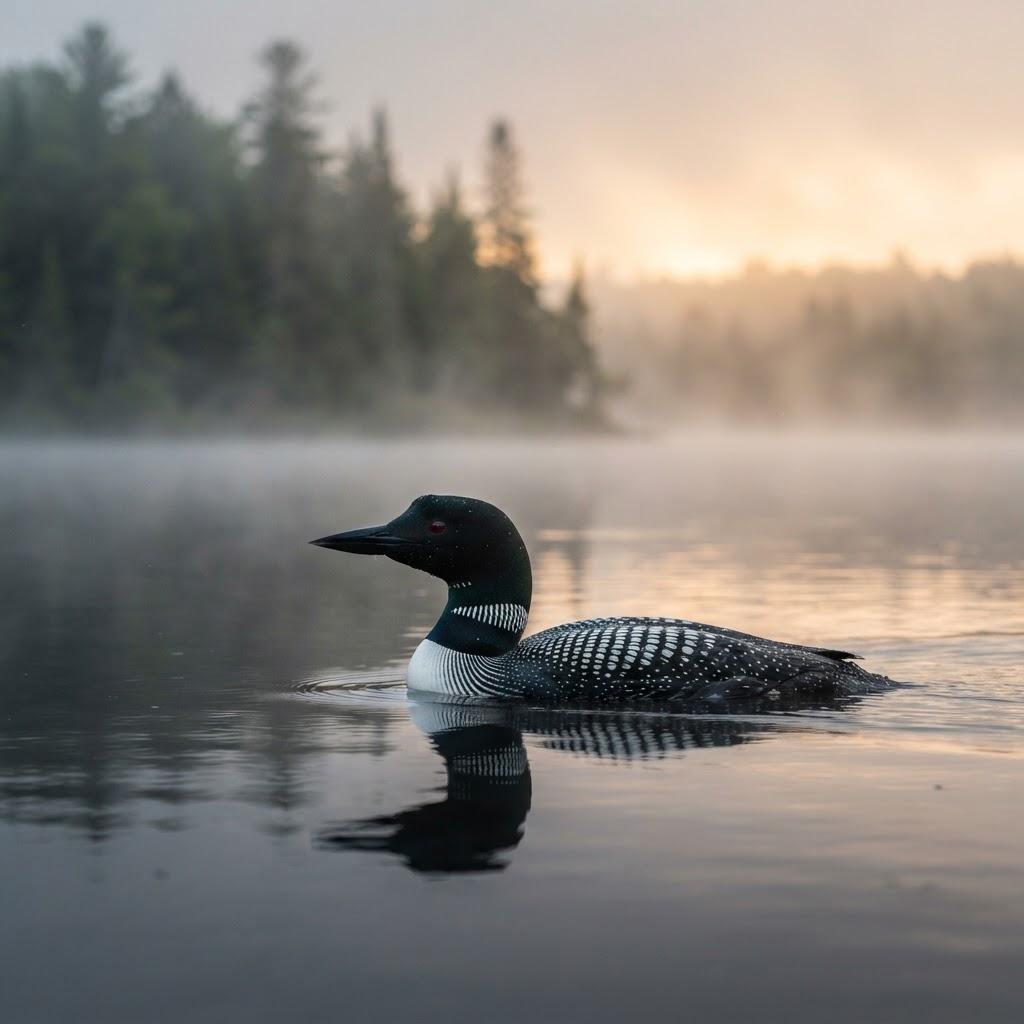
Gavia immer
Common Loon
The Common Loon is the tuxedo-clad icon of the North Woods, famous for its haunting, ghost-like wails that echo across moonlit lakes. Part high-speed torpedo, part dedicated parent, this bird is a living legend of the northern wilderness.
Meet the Bird
Imagine a bird that looks like it just stepped off the red carpet in a perfectly tailored charcoal and white tuxedo, only to realize the party is actually in a freezing cold lake. That is the Common Loon. They are the brooding, enigmatic heartthrobs of the aquatic world. With their piercing red eyes that look like they have seen the secrets of the universe and their elegant, dagger-like bills, they carry an aura of mystery that most birds lack. While your average backyard sparrow is frantically hopping around for a crumb, the Loon is busy being the ultimate introvert, floating serenely on a glass-calm lake, occasionally letting out a maniacal laugh that sounds like a banshee having an existential crisis. They are masters of the 'cool factor,' but don’t be fooled; underneath that stoic exterior is a creature that is basically a professional diver trapped in a body built for efficiency rather than land-based grace.
Superpowers & Weird Abilities
Loons are the submarines of the bird kingdom. Their bones are not hollow and light like most birds—which helps others take flight—but instead dense and heavy, acting like natural ballast to keep them submerged. They can dive to depths of 200 feet, which is essentially the avian equivalent of free-diving into the abyss without an oxygen tank. To manage this, their bodies can collapse their air sacs, reducing buoyancy so they can propel themselves through the water with their webbed feet, which are positioned way back on their bodies. It is an engineering marvel. They also have an incredible ability to filter out salt from their systems, which is how they survive on the ocean during the winter months after leaving their freshwater breeding grounds. Think of them as high-tech, salt-shredding, deep-sea exploration vessels that just happen to have feathers and a really loud voice.
Drama, Personality & Feathered Chaos
Don’t let their peaceful look on the water fool you; the Common Loon is a territorial powerhouse. When it comes to real estate, they are the neighbors from hell if you are another loon. They engage in intense, high-speed water battles, flapping their wings and running across the surface to intimidate rivals. They are fiercely protective of their lakes and will not hesitate to pick a fight to keep their territory secure. It is pure soap-opera drama played out on the water. They have also been known to hold deep-seated grudges against other loons, leading to boundary disputes that last for days. They aren’t interested in your backyard feeder or your birdbath; they want the whole lake, and they are willing to put on a theatrical display of aggression to make sure every other loon knows exactly who owns the prime fishing spots in this neck of the woods.
Bizarre Rituals & Quirky Habits
The behavior of the Common Loon is a masterclass in strange aquatic etiquette. Take, for example, their signature 'penguin dance,' where they rise up out of the water, balancing on their tails while flapping their wings. It looks like they are trying to perform an interpretive dance routine in the middle of a lake. Then there is the 'winnowing' or 'tremolo' call, which isn't just noise; it is a complex communication tool used to signal alarm or location. They also exhibit a bizarre habit called 'rafting,' where they gather in large groups on the water, almost like they are attending a neighborhood block party to gossip about the local fish supply. They spend an inordinate amount of time preening, carefully oiling their feathers to ensure they remain waterproof, which is a vital ritual for any bird that spends the majority of its life floating or swimming in cold, harsh water.
Legends, Folklore & Human Stories
For centuries, the Loon has been a cultural cornerstone for Indigenous peoples of North America. In many legends, the Loon is portrayed as a messenger, a bringer of rain, or a spiritual guide connecting the surface world with the deep mysteries beneath the water. Their haunting calls have inspired countless ghost stories and campfire legends, fueling the human imagination with their eerie, mournful tones. In European folklore, the loon has sometimes been viewed as a harbinger of rain, and its sudden disappearance from a familiar lake was often seen as a sign that the water was losing its vitality. Humans have long felt an inexplicable pull toward these birds, viewing them as symbols of the pristine, untouched wilderness. Even today, hearing a loon call across a misty morning lake is considered a 'soul-cleansing' experience, a moment where the human connection to the wild feels deeper and more profound than any other bird encounter.
Mating: The Ridiculous World of Avian Dating
Dating for a Loon is less about candlelit dinners and more about coordinated aerobics. During courtship, both the male and female participate in an elaborate dance that involves swimming in circles, diving in unison, and performing synchronized rushes across the water. If the male wants to impress his lady love, he has to prove his stamina and his ability to hold his breath longer than the competition. If the choreography is off, the female is not afraid to swim away, leaving the male to rethink his life choices and start his training montage all over again. They also engage in vocal duets, singing complex melodies that signal their compatibility. It is an intense, high-stakes game of 'who can be the most athletic and rhythmic.' Once they find a partner, they are famously loyal, often returning to the same nesting site year after year to rekindle their bond and raise a new family.
Nesting: Master Architects and Lazy Slumlords
When it comes to home design, the Loon is a functional minimalist. They do not bother with high-rise luxury or complex weaving projects. Instead, they find a nice patch of vegetation near the water's edge, maybe a small island or a hidden nook in the reeds, and build a simple mound of mud, sticks, and moss. It is basically the architectural equivalent of a pile of damp laundry, but for a loon, it is prime real estate. The nest needs to be close to the water because, let’s face it, these birds are not built for walking. They basically belly-flop from the water onto the nest site. It is a humble setup, but it keeps their precious cargo safe from land predators while providing an easy exit strategy back into the water if things get too spicy. They aren't trying to win an interior design award; they are just trying to get the job done.
Raising Babies: The Screaming Food Disposals
Raising loon chicks is a test of patience that would break a saint. Once the fuzzy, chocolate-colored chicks hatch, they are immediately expected to be water-ready, often hitching rides on their parents' backs to stay warm and protected from hungry pike lurking below. The chicks are bottomless pits of hunger, screeching incessantly at their parents for fresh fish. The parents are the ultimate delivery drivers, constantly diving for prey and returning to present the catch to their demanding offspring. The chicks don't say thank you; they just vibrate with hunger until their bellies are stuffed. Watching a parent carry a chick on its back while the little one chirps demands for snacks is both adorable and exhausting. It takes about 11 weeks for these little fluff-balls to become independent, during which time the parents provide a masterclass in relentless dedication and fish-catching proficiency.
Bird-Watching Travel & Local Hotspots
If you want to catch a glimpse of these tuxedoed icons, you need to head north. Acadia National Park in Maine is a goldmine for loon spotting, with its deep, crystal-clear ponds that offer perfect viewing opportunities. For those in the Midwest, the Boundary Waters Canoe Area Wilderness in Minnesota is the absolute holy grail of loon habitat; paddling a canoe there is basically guaranteed to result in a face-to-face encounter with a loon family. In Canada, Algonquin Provincial Park is another world-class destination. The key is to get out on the water early in the morning, around dawn, when the lake is perfectly still and the birds are most active. Always pack a good pair of binoculars and respect their personal space—these birds have a long day of fishing ahead of them and don't appreciate boaters drifting too close to their nesting sites.
Food, Feeder Hacks & DIY Projects
Here is the reality check: you are not going to attract a Common Loon to a bird feeder in your backyard. They are strictly fish-eaters, and they need a fairly large body of water to facilitate their takeoff and landing. If you tried to offer them millet or black-oil sunflower seeds, they would look at you like you were trying to feed a tiger a salad. However, you can support loons by keeping your local lakes clean and free of lead fishing sinkers, which are incredibly toxic to them if ingested. If you want to show your love for loons, skip the seed and focus on habitat preservation. Join a local lake association or help with shoreline cleanup projects. Protecting the water quality means protecting the fish, and protecting the fish means keeping the loon population thriving. It is a simple, non-DIY way to be a hero for your favorite aquatic diver.
Seasonal Guides & "Crisis" Management
Loons are seasonal travelers. In the spring, they rush back to their northern breeding lakes as soon as the ice melts, eager to secure their territory. If you see a lone, disoriented-looking bird on a small pond in the spring, it might just be a traveler stopping for a rest. During the summer, they are all business: nesting, feeding, and keeping the chicks alive. As autumn arrives, they molt their fancy black-and-white plumage for a duller, grey-and-white winter coat and head to the coasts. If you ever find a loon on land that can't move, this is a legitimate emergency—they are physically incapable of taking off from solid ground. Do not try to help them yourself; call a professional wildlife rehabilitator immediately. They are sturdy birds, but they are completely out of their element when they are not in the water.
Backyard Tech & Gadget Reviews
Since you cannot bring the loon to the backyard, you have to bring the technology to the lake. If you are a serious loon enthusiast, investing in a high-quality spotting scope is a game-changer. Unlike binoculars, which are great for birds in trees, a spotting scope allows you to observe the loons from a respectful distance without intruding on their space, capturing those minute details like the way they blink or how they manipulate a fish before swallowing. For the tech-savvy, a waterproof GoPro or an underwater camera rig mounted to a boat can provide incredible, candid footage of their diving behavior. Just make sure to use non-invasive mounts and always follow local boating regulations. The goal is to capture their beauty without disturbing their life, making your observations a scientific contribution rather than just a distraction.
How to Spot One & How It Is Doing
Spotting a loon is easy if you know what to look for: look for that unmistakable profile, sitting low in the water like a submarine. In the summer, they are sharp, black-and-white checkers; in the winter, they are a muted, silvery grey. Their call—the 'yodel' or the 'wail'—is the ultimate identifier. Conservation-wise, they are currently in the 'Least Concern' category, which is fantastic news, but they are sensitive to climate change and lake pollution. The best way to help is to use lead-free fishing gear, reduce motorboat noise in nesting areas, and support organizations that monitor water quality. Every time you advocate for a clean lake, you are ensuring that the haunting, beautiful cry of the loon continues to be the soundtrack of the wilderness for generations to come. Be a guardian of the lake, and the loons will continue to be the stars of the show.