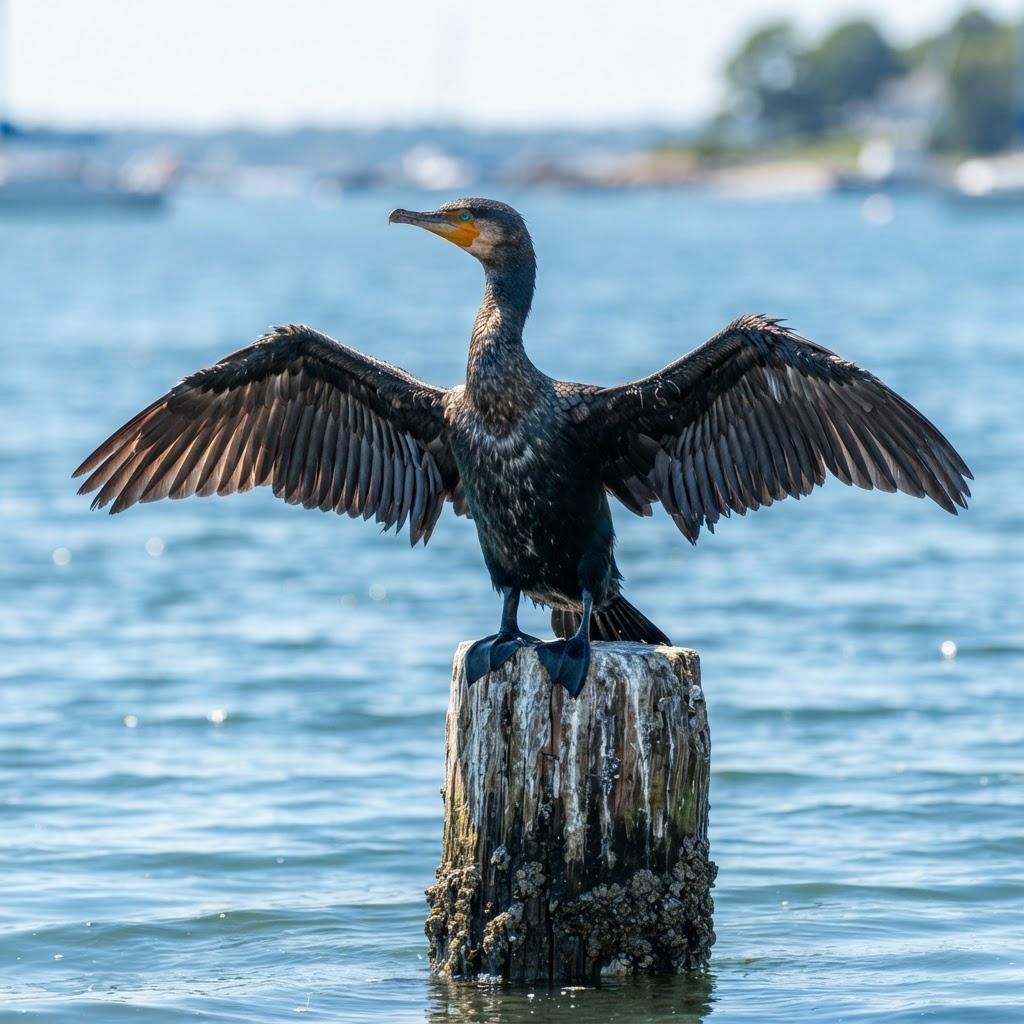
Nannopterum auritum
Double-crested Cormorant
Meet the Double-crested Cormorant, nature's very own underwater jet-fighter that trades flight efficiency for submarine mastery. With a punk-rock crest and an attitude to match, this bird is the ultimate wet-feathered survivor of the aquatic world.
Meet the Bird
The Double-crested Cormorant is the avian equivalent of that one friend who refuses to leave the pool party even after the sun has gone down and their lips are turning blue. With their sleek black feathers, serpentine necks, and piercing, icy-blue eyes, they carry the vibe of a Victorian-era villain dressed for a yacht outing. They possess a distinctive, somewhat hunched posture that makes them look like they are perpetually lurking, waiting for a chance to snatch an expensive piece of jewelry from a dock. Unlike your average fluffy songbird that spends its day chirping about the weather, the cormorant is a specialist. It is built for a life of high-stakes diving and intensive fish hunting. If this bird were in an action movie, it would be the underwater demolition expert, calmly slipping beneath the surface to cause chaos before surfacing with a slippery, confused trout in its beak. They are not graceful in the traditional sense; they are efficient, calculated, and just a little bit weird, which is exactly why they are the most interesting character in the watery corners of our landscape.
Superpowers & Weird Abilities
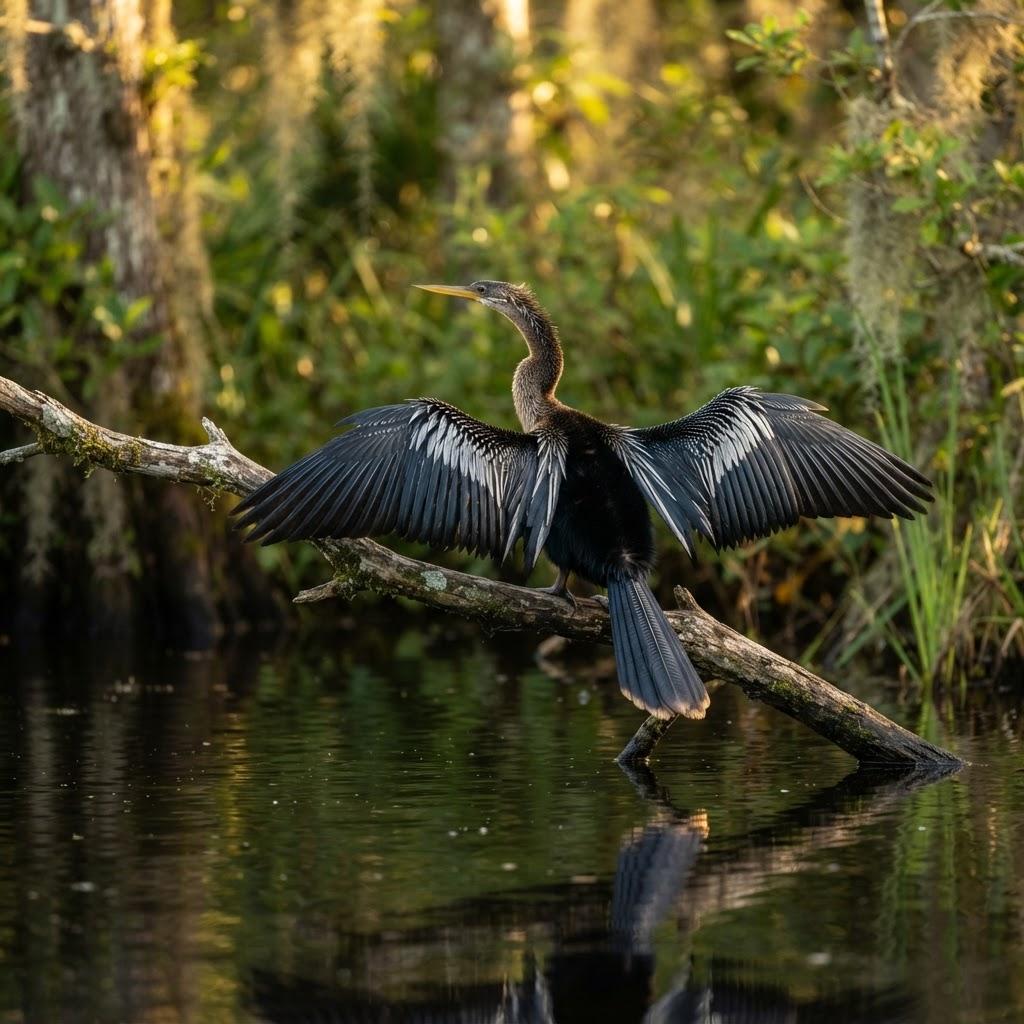
If you have ever wondered why cormorants look like they are posing for a statue in the middle of a lake, you are witnessing their most bizarre superpower: the water-logged wing trick. Most birds have oil-coated, waterproof feathers that keep them buoyant and dry, but the cormorant has feathers that are intentionally porous. This allows them to absorb water, which makes them sink like a stone when they dive. This is not a design flaw; it is a feature. By being less buoyant, they can dive up to 100 feet deep and stay underwater for over a minute, paddling with their webbed feet like a furry-footed submarine. The science behind this is fascinatingly tactile; when they come up, they are heavy and soaked, so they stand around with their wings spread out like a tuxedo-clad fan to dry off in the sun. It is a biological trade-off that turns them into one of the most capable aquatic hunters in the world. They effectively turn their entire body into a ballast tank, sacrificing the ability to stay fluffy and dry for the sake of becoming an underwater apex predator.
Drama, Personality & Feathered Chaos
Socially speaking, the Double-crested Cormorant is the rowdiest neighbor you could ever have. They are highly colonial, which is code for 'they love a massive, noisy house party that never ends.' If you find one cormorant, you are likely about to find five hundred of them, all jockeying for the best spot on a dead tree or a man-made pylon. They are not particularly known for their politeness; they are loud, aggressive, and prone to stealing nesting materials from their neighbors the second someone turns their back. Think of them as the feathered version of the mob in a slapstick comedy, constantly squabbling over who gets the best branch and who gets to poop on the dock next. They carry an air of unearned arrogance, often looking down their long, hooked beaks at other water birds as if they are the only ones who truly understand how the lake should be managed. It is pure, unfiltered avian chaos, and honestly, they seem to enjoy every second of the noise and drama they create.
Bizarre Rituals & Quirky Habits
Aside from their sun-bathing wing-spread, cormorants engage in a variety of quirky behaviors that keep ornithologists scratching their heads. One of their most entertaining habits involves the way they swallow their prey. Unlike most birds that delicately peck at their meals, the cormorant catches a fish and then engages in a violent, jerky game of 'toss and catch' to position the fish head-first down their throat. Watching them manage a fish that is clearly too large for their esophagus is like watching a human try to swallow a whole baguette without using their hands. They also have a habit of engaging in 'gular fluttering'—a process where they vibrate their throat pouch rapidly to stay cool. It looks exactly like someone trying to shake a cold out of their system, but it is actually a vital thermoregulation technique. They are essentially walking, swimming, flapping bundles of eccentric behaviors that defy the standard bird-like behavior we expect from the backyards of the world.
Legends, Folklore & Human Stories
Humans have had a complicated relationship with cormorants for centuries, largely because these birds are terrifyingly good at their jobs. In parts of Asia, the cormorant’s fishing prowess has been harnessed by humans for thousands of years through a practice called 'cormorant fishing.' Fishermen would tie a loose cord around the bird's throat so it couldn't swallow the big fish, forcing it to bring its catch back to the boat. It is a strange, ancient partnership that has turned the cormorant into a symbol of both resourcefulness and servitude. In Western folklore, they have sometimes been viewed as 'devil birds' or bad omens by fishermen who saw them as competition. You can hear the resentment in the old stories—men cursing the birds as they watched them expertly pluck the best fish from the river. Whether as a golden tool for an emperor or a sinister shadow on a dock, the cormorant has always been a bird that forces humans to pay attention to them, either out of admiration for their skill or annoyance at their efficiency.
Mating: The Ridiculous World of Avian Dating
The courtship ritual of the Double-crested Cormorant is a performance art piece that would make a Broadway director weep. It begins with the male finding a prime piece of real estate and then performing a series of 'wing-waving' displays, where he flaps his wings in a rhythmic, trance-like state while showing off his colorful throat patch. If a female wanders by, the male will offer her a twig or a pebble as a 'gift,' which is basically the bird version of showing up for a date with a bouquet of weeds. If she finds his dance moves acceptable and his twig collection sufficiently impressive, they move to the next stage of the relationship. It is a high-stakes performance; if the male flubs his steps or fails to look sufficiently intimidating, the female simply swivels her head away and moves to the next bachelor pad. It is cold, it is calculated, and it is endlessly entertaining to witness from a distance through a pair of binoculars.
Nesting: Master Architects and Lazy Slumlords
When it comes to nesting, cormorants are the slumlords of the avian world. They are not interested in the delicate, woven masterpieces of a robin or the sturdy cup-shaped homes of a cardinal. Instead, they favor a 'quantity over quality' approach. They drag sticks, weeds, and occasionally bits of trash—fishing line, plastic, or debris—into a massive, messy heap. Over time, as the birds continue to add to the nest year after year, these structures can become quite large, but they are rarely what you would call elegant. The nest usually ends up looking like a pile of sticks that someone dropped from a great height and left there. This communal slumming also has a downside; these nests often become infested with parasites, which is just part of the charm of living in a colony of thousands. Despite their architectural failures, the nests get the job done, and the sheer volume of them concentrated in one area is a testament to their persistence as parents.
Raising Babies: The Screaming Food Disposals
Raising cormorant chicks is an exercise in parental endurance that would test the patience of a saint. When the eggs hatch, the chicks are not exactly cute, fuzzy bundles of joy; they are naked, rubbery-looking things that resemble miniature dinosaurs. Once they start growing, they quickly turn into high-velocity food disposal units. The parents must spend every waking hour diving into the water to secure fish, which they then bring back to the nest to regurgitate for their demanding offspring. The chicks, for their part, show their love by shrieking constantly and stabbing at the parents' throats until they cough up lunch. It is a loud, chaotic, and perpetually smelly environment. Watching a parent try to feed four growing chicks is like watching a chef try to serve a banquet to a group of hungry, shouting monsters. It is exhausting work, and yet, the parents perform this duty with a devotion that is both admirable and slightly harrowing to behold.
Bird-Watching Travel & Local Hotspots
If you are ready to witness the majesty of the cormorant in person, you need to head toward the water. Any major harbor, coastal pier, or large freshwater lake in North America is likely to have its own colony. For those in the Eastern United States, the shores of Lake Ontario or the rocky coasts of Maine are prime viewing territory. If you find yourself in the Pacific Northwest, look for them perched on the pilings of the Seattle waterfront or the rocky crags of the Olympic Peninsula. The best time to see them is in the spring and summer when they are actively nesting and fishing for their families. Bring your spotting scope, find a public pier or a quiet trail along a reservoir, and look for the black birds sitting motionless on the buoys. You don't need to go deep into the wilderness to find them; they are remarkably comfortable around humans, provided you give them their space to dry their wings and go about their noisy business.
Food, Feeder Hacks & DIY Projects
Here is the honest truth about cormorants and backyard birding: you do not want to attract them to your bird feeder. Seriously, do not even try. These are large, piscivorous—that is just a fancy way of saying 'fish-eating'—predators that would find a bag of sunflower seeds absolutely insulting. If you want to enjoy them, you have to go to where they live. However, if you want to support the ecosystem that sustains them, consider planting native trees along the water's edge of your property if you have a pond. Native vegetation provides the structure that small fish need to hide and thrive, which in turn feeds the larger fish that cormorants rely on. Instead of building a feeder for the birds, build a habitat for their food. Your role as a backyard enthusiast is to keep the water clean and the edges of your property natural, rather than trying to invite a two-foot-tall diving bird onto your back porch for a snack of suet.
Seasonal Guides & "Crisis" Management
Cormorants are highly migratory in northern climates, meaning they disappear when the ice moves in and return like clockwork when the lakes thaw. During the 'fledgling panic' season, which happens in mid-summer, you might see young cormorants that look like they have lost their way. If you see a young, floppy-looking bird near the shore, please keep your distance. Often, these youngsters are just having a 'teenager moment'—they are learning how to fish, they are tired, and they are clumsy. They do not need to be 'rescued' or put back in a nest. The parents are likely watching from a nearby piling, waiting for the bird to get its energy back. If the bird has a clear injury, like a wing dragging or a fishing line tangled around its leg, contact a local wildlife rehabilitator immediately. Otherwise, the best thing you can do is observe from a distance and let them navigate their awkward transition to adulthood in peace.
Backyard Tech & Gadget Reviews
For birders who want to keep track of their local colony without standing on a pier for hours, a good set of binoculars is worth more than any fancy gadget. However, if you are looking to document your local water birds, a long-range trail camera placed near a known perching spot can yield incredible results. AI-powered feeders are great for songbirds, but they aren't going to help you here—instead, invest in a decent smartphone adapter for your scope. It turns your phone into a high-powered telephoto lens, allowing you to capture those hilarious moments of gular fluttering or fish-tossing from a distance that won't spook the colony. As for windows, if you live near the water, ensure your windows are marked with UV-reflective decals or patterns. Cormorants can get disoriented during migration, and a bird that large hitting a window is a disaster for everyone involved. Keep the view clear for you, but visible for them.
How to Spot One & How It Is Doing
Spotting a Double-crested Cormorant is rarely a challenge if you know what you are looking for. Scan the surface of the water for a long, thin neck and a small, pointed head. When they are not diving, they are almost always perched in an upright, statuesque pose, often with their wings held out. If you see a black bird in the water that seems to spend more time below the surface than above it, you have found your quarry. They are thriving, and their conservation status is 'Least Concern' for a reason—they are survivors. The best way to help them is to advocate for clean water and reduced plastic pollution in your local lakes and bays. Seeing a colony of these birds is a sign of a healthy, productive aquatic environment. Keep watching them, keep laughing at their antics, and ensure the waterways stay clean enough for them to keep doing their weird, wonderful, and absolutely necessary work as the masters of the deep.