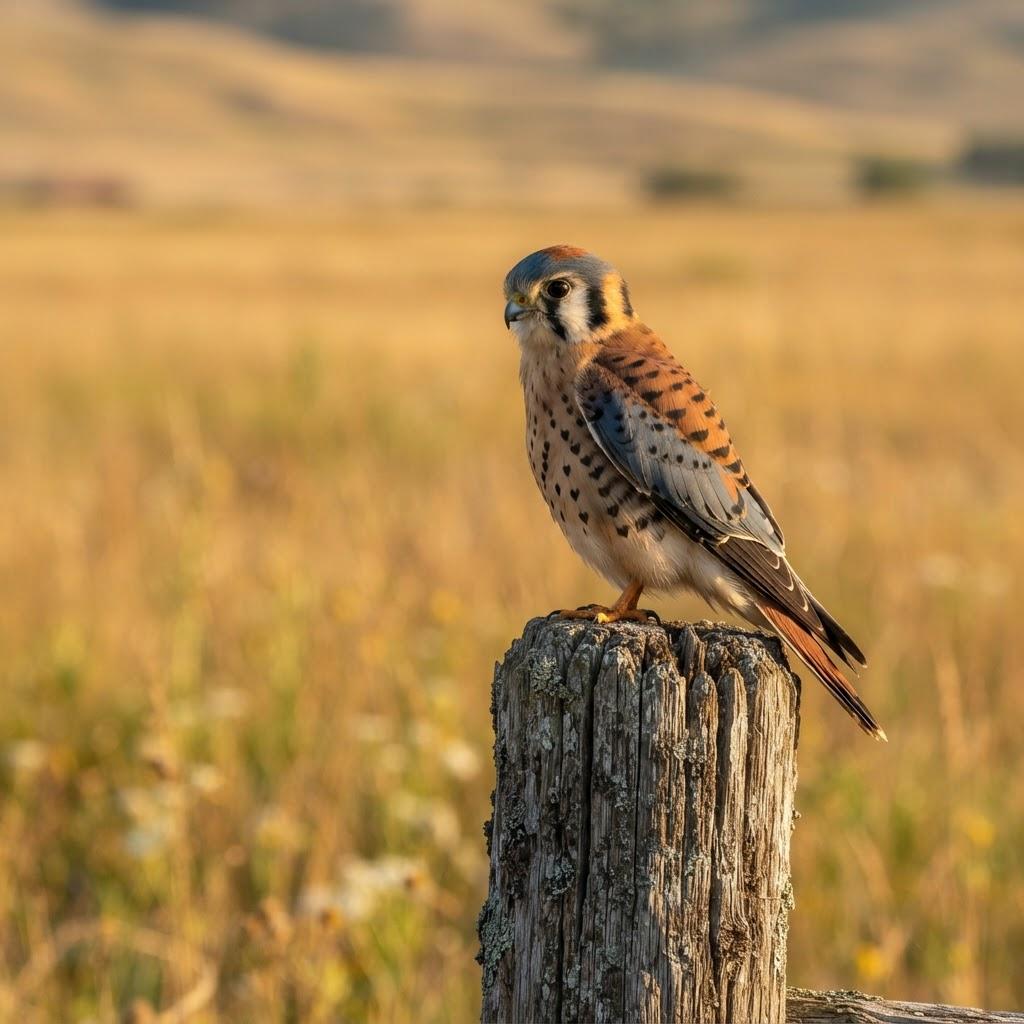
Falco sparverius
American Kestrel
Meet the American Kestrel, a pint-sized powerhouse that packs the attitude of a dragon into a body smaller than a mourning dove. This colorful raptor is the ultimate backyard superhero, proving that you do not need to be big to be the most fearsome hunter on the telephone wire.
Meet the Bird
Imagine a raptor that looks like it was painted by an artist who had too much espresso and a very specific affinity for neon patterns. That is the American Kestrel. Standing barely taller than a robin, this little falcon is the smallest, most colorful bird of prey in North America. It possesses the confidence of a heavyweight boxer and the agility of a professional gymnast. With its rusty back, slate-blue wings in the males, and a face that looks like it is wearing a permanent mask of theatrical makeup, the Kestrel is the undisputed rockstar of the power line. While other hawks are busy soaring high in the clouds, the Kestrel prefers a lower altitude, often seen bobbing its tail with rhythmic intensity as it scouts the grass for an unsuspecting beetle or mouse. It is the only raptor that consistently hovers in place while hunting, a feat that makes it look like a feathered helicopter hovering over the neighborhood. You have likely seen one without even realizing it, perhaps thinking it was just another pigeon until it suddenly took off with the speed and precision of a jet fighter.
Superpowers & Weird Abilities
If human eyes functioned like those of an American Kestrel, we would be able to spot a dropped contact lens from the top of the Empire State Building. Kestrels possess ultraviolet vision, which is essentially a superpower that lets them see things invisible to the human eye. Most small rodents like voles and mice leave behind trails of urine that reflect ultraviolet light. To us, a meadow is just a patch of grass, but to a Kestrel, the world is glowing with high-contrast, neon-lit navigation maps that point directly to their next snack. It is like living in a world where the floor is covered in glowing GPS markers. Furthermore, their ability to hover is a masterpiece of aerodynamic physics. By locking their wings at just the right angle and fluttering their primary feathers, they can stay perfectly still in mid-air even in a stiff breeze. This takes immense energy and precision, but for the Kestrel, it is just a standard Tuesday afternoon commute to the dinner table.
Drama, Personality & Feathered Chaos
Do not let the adorable size fool you; the American Kestrel is a tiny tyrant with zero respect for personal space. When it comes to the social hierarchy of the telephone pole, the Kestrel is the one throwing its weight around. They are fiercely territorial, often seen chasing off much larger Red-tailed Hawks just for the audacity of flying too close to their favorite hunting post. It is essentially a bar fight between a chihuahua and a Doberman, and somehow, the Kestrel usually wins because it is just too fast and too annoying for the larger bird to deal with. They are the ultimate adrenaline junkies of the avian world, constantly diving, banking, and shrieking at anything that looks remotely like a threat. They are not mean, per se, they just have an incredibly high opinion of themselves and an even lower tolerance for neighbors who do not respect their boundaries. It is high-octane drama served on a wire.
Bizarre Rituals & Quirky Habits
One of the most peculiar things you will see a Kestrel do is the 'tail bob.' Whenever they land on a perch, they immediately bob their tails up and down like they are keeping time to an invisible beat. Scientists believe this helps them adjust their balance and focus their incredible vision on the shifting ground below, but it certainly looks like they are constantly getting ready to break into a tap-dancing routine. Another quirk is their tendency to store leftovers for later, much like a college student hiding pizza in the fridge. They will often wedge prey into the fork of a tree or a cactus spine, effectively turning their territory into a makeshift pantry. This is called 'caching.' They do not always remember where they put these snacks, which is both hilarious and mildly tragic. Seeing a Kestrel diligently working to shove a grasshopper into a fence post is a reminder that even the most elite predators have their share of awkward, slightly forgetful moments.
Legends, Folklore & Human Stories
The Kestrel has long been a symbol of keen sight and swift action, though it rarely gets the thunderous spotlight given to the Bald Eagle. In various Indigenous cultures across the Americas, the Kestrel is often depicted as a clever, quick-witted trickster. Because they were so frequently seen hunting in agricultural fields, they were seen as partners to the farmer, keeping the rodent populations in check. Unlike the owls, which are sometimes associated with the supernatural or death in various folklore traditions, the Kestrel is consistently viewed as a bright, diurnal force of nature—a bird that heralds the day with speed and color. There are stories of falconers throughout history who were so impressed by the 'Sparrow Hawk'—a common, albeit incorrect, nickname for the bird—that they spent months training them to hunt insects or small birds, marvelling at how such a small creature could show such intense, unwavering focus during a hunt.
Mating: The Ridiculous World of Avian Dating
Dating for a Kestrel is a high-speed, death-defying stunt show. The male Kestrel has to prove his worth through an elaborate 'dive display' that looks like a choreographed airshow. He will climb to a dizzying height and then execute a screaming, spiraling dive, often punctuated by sudden, jerky turns that would make a fighter pilot weep with envy. If the female is not sufficiently dazzled by his ability to survive high-G maneuvers, she will simply ignore him, forcing him to climb back up and do it all over again. He also has to show off his 'bachelor pad'—a hollow in a tree or a nesting box—by fluttering around it and calling out to her. If she likes the property, she will inspect it with the critical eye of a home flipper. If she approves, they bond. If not, the male is back on the market, likely wondering if he should have added more spirals to his dive routine.
Nesting: Master Architects and Lazy Slumlords
When it comes to home building, the American Kestrel is a total slacker. They refuse to build their own nests from scratch, which would be like someone refusing to build a house and instead just demanding to move into an empty apartment building. They are 'cavity nesters,' meaning they rely on natural hollows in trees, abandoned woodpecker holes, or even crevices in man-made structures like barns or nesting boxes. They do not bring in twigs or grass to line the home in any meaningful way; they basically just show up and declare the hole 'theirs.' This makes them highly dependent on local real estate. If the woodpeckers have not done their job, or if the humans have removed all the dead trees, the Kestrel is left without a place to call home. This is why putting up a Kestrel box is the single best thing you can do for them—you are essentially becoming their landlord and providing a luxury condo in a market with very limited inventory.
Raising Babies: The Screaming Food Disposals
Once the eggs hatch, the Kestrel nest becomes a cacophony of high-pitched shrieks and nonstop motion. The female stays with the chicks, acting as the ultimate protector, while the male becomes the primary breadwinner, bringing in grasshoppers, beetles, and the occasional unlucky mouse. The babies, or 'eyasses,' grow at an astonishing rate. Within a few weeks, they are nearly as large as their parents, crowded together in the small hollow like a group of teenagers stuck in a tiny elevator. They spend their days begging for food with intense, rhythmic screaming that sounds like a chorus of squeaky toys. The parents show remarkable patience, flying dozens of trips a day to keep the 'food disposals' quiet. By the time they are ready to 'fledge'—the fancy term for leaving the nest—they are clumsy, oversized versions of their parents, often missing the grace of the adults and instead tumbling awkwardly out of the hole for their first flight.
Bird-Watching Travel & Local Hotspots
If you are dying to see a Kestrel, do not waste your time staring into the dark, deep forest where they simply do not live. Instead, grab your binoculars and head for the 'edges'—the border between open grassland and light tree cover. In North America, the grasslands of the Great Plains are prime Kestrel real estate. For a guaranteed sighting, visit any large wildlife refuge in the Midwest during the fall or spring migration. The Quivira National Wildlife Refuge in Kansas or the various prairie preserves in Oklahoma are absolute hotspots. They are often spotted sitting on the fence lines of country roads, making them the easiest raptor to find from the comfort of your car. Just keep your eyes on the wires and the fence posts, and look for that unmistakable tail-bobbing silhouette. If you see one hovering, stop the car; you have hit the jackpot, as that is the peak of Kestrel performance art.
Food, Feeder Hacks & DIY Projects
Let’s be honest: you cannot put a Kestrel in a regular bird feeder. They are not interested in your black oil sunflower seeds, and they certainly will not be lured by cheap millet, which is basically just landfill filler for birds. Kestrels are carnivores—they want meat. To attract them, you have to turn your yard into a buffet for their food, not them. Plant native grasses to encourage insects like dragonflies and crickets, which are the main course for a Kestrel. If you really want to make their day, install a Kestrel nesting box. These are easy to build with some untreated plywood and a hole saw. Mount it on a pole about 10 to 20 feet high in an open area, facing away from prevailing winds. It is the ultimate DIY project for the backyard birder. By providing the home, you are effectively hiring a tiny, feathered security guard to patrol your lawn for pests, which is a fair trade for the price of a few screws and some elbow grease.
Seasonal Guides & "Crisis" Management
Kestrels are adaptable, which is a polite way of saying they are survivors. In the spring, they are hyper-focused on nesting and territory. If you see a baby bird hopping around on the ground in early summer, stop. Do not panic. Do not pick it up. This is likely a 'fledgling'—the bird equivalent of a toddler learning to walk. It is supposed to be on the ground, and its parents are watching from the trees, ready to swoop down and defend it. Only intervene if the bird is clearly injured or if there is a cat nearby. In the winter, Kestrels may migrate south or move to lower elevations. If you live in an area where they stay for the winter, they are much harder to spot because they are trying to conserve energy. Keeping a water source open with a heated birdbath can be a lifesaver for all birds during the frozen months, and even a small predator like a Kestrel appreciates a place to grab a drink.
Backyard Tech & Gadget Reviews
Technology has made birding incredibly fun, but keep your expectations realistic. AI-powered smart feeders are great, but they are designed for songbirds, not raptors. Do not expect your Bird Buddy to catch a Kestrel unless you are mounting a camera trap specifically on a nest box. Speaking of which, trail cameras are the best tech investment for a Kestrel enthusiast. By mounting a weather-resistant motion-activated camera near your nesting box, you can watch the drama of the brood-rearing process without ever disturbing them. As for window collisions, it is a serious issue. If you are attracting birds, you must make your windows visible. Use external window film, tape, or screens to break up the reflection. A Kestrel is a fast flier, and it will not hesitate to chase a smaller bird right into a glass pane if it does not see the barrier. Keep your glass safe, and keep your birds in the air.
How to Spot One & How It Is Doing
To spot an American Kestrel, look for the 'teardrop' markings on the side of their face—it looks like they have been crying soot. Watch for that distinct hover and the twitchy, rhythmic tail-bobbing. Their call is a rapid, high-pitched 'killy-killy-killy,' which is the soundtrack of a sunny, open field. While their populations have faced some declines due to the loss of large dead trees and habitat fragmentation, they remain a common sight across much of the Americas. You can help them by advocating for the preservation of open meadows and by putting up nesting boxes in suitable areas. They are a resilient, adaptable species that has learned to live alongside humans quite well. As long as we keep providing the boxes and leaving a little bit of wild space in our backyards, these tiny falcons will continue to be the charismatic stars of the skyline, providing us with endless entertainment and a daily dose of wild, winged drama.