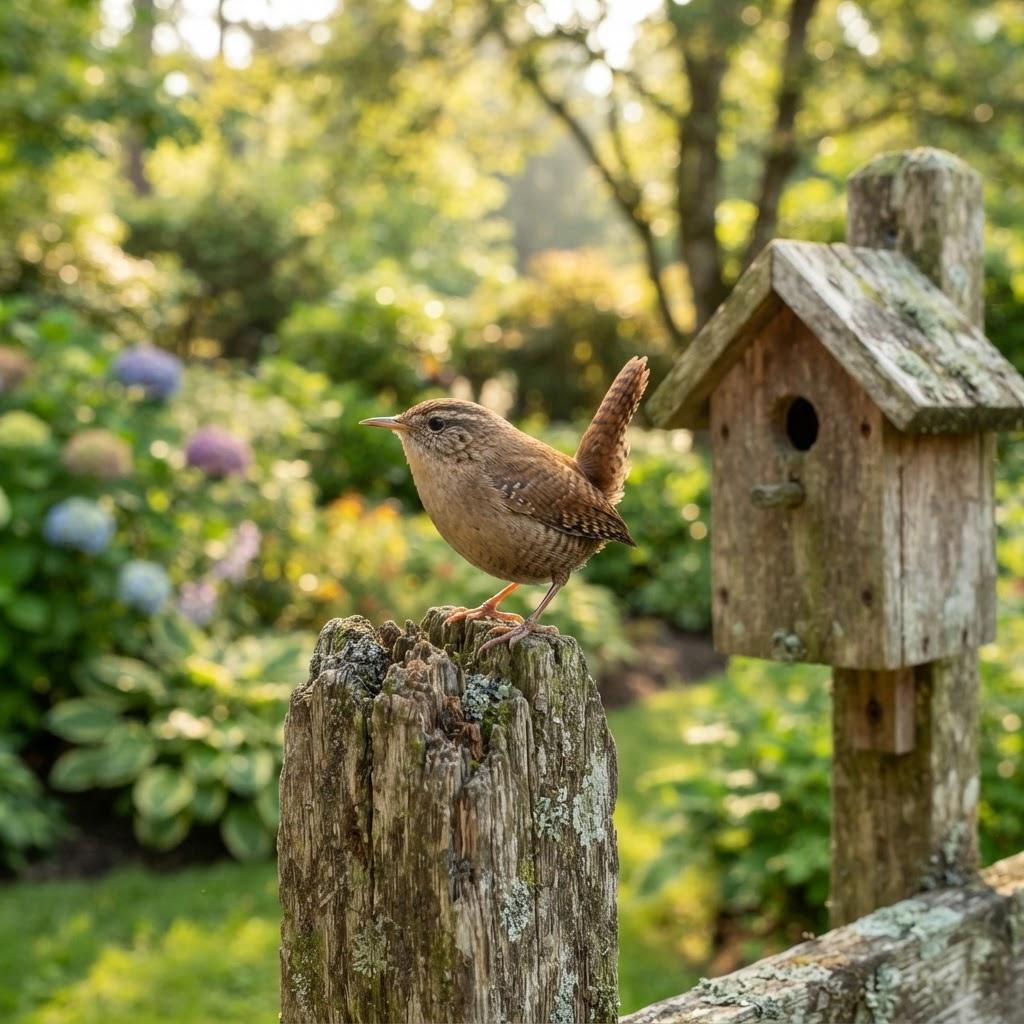
Troglodytes aedon
House Wren
Meet the House Wren, a tiny, high-octane powerhouse of a bird that packs the ego of an eagle into the body of a thimble. This pint-sized bundle of energy is the backyard equivalent of a caffeinated toddler who just discovered how to sing opera at 5:00 AM.
Meet the Bird
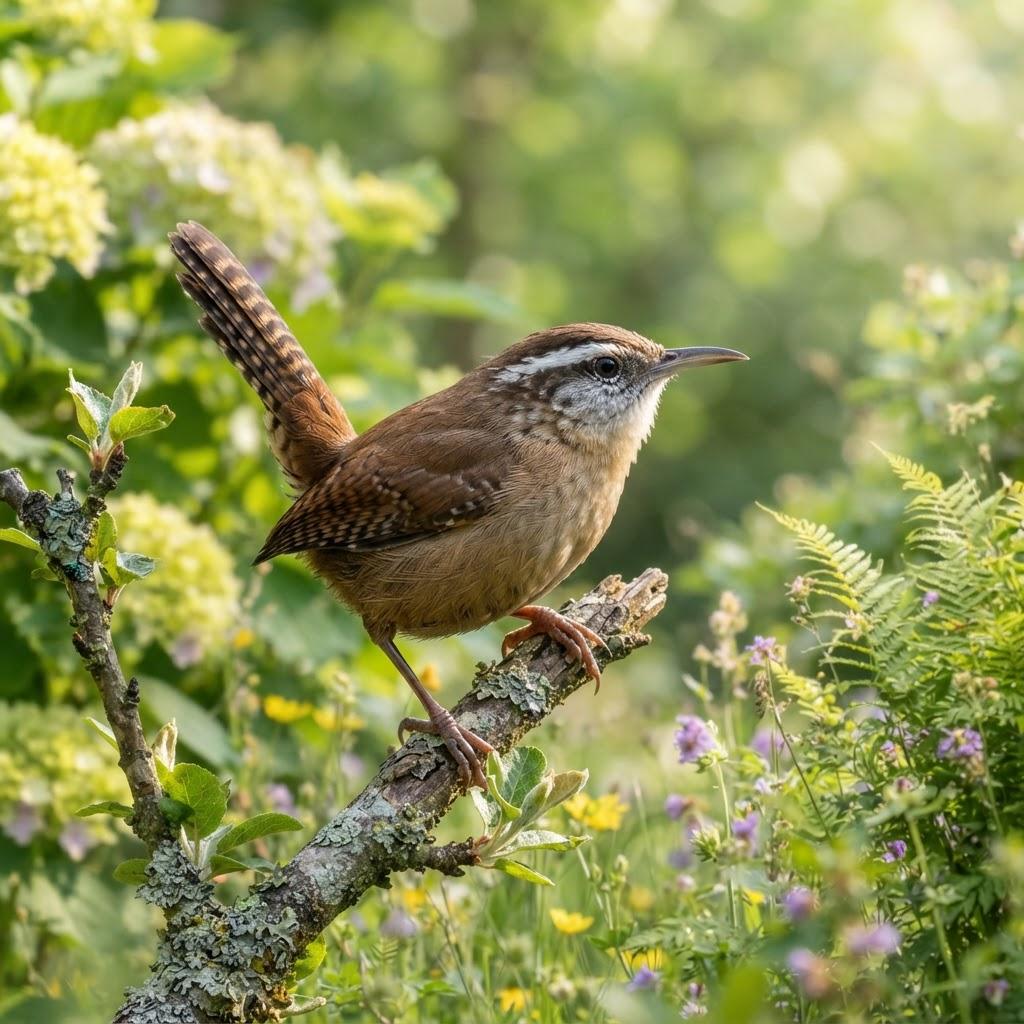
Imagine a bird that has decided its primary purpose in life is to complain loudly about the structural integrity of every fence post in the neighborhood. That is the House Wren. If you were to cast this bird in a high school movie, it would be the hyperactive, overachieving student who is secretly planning a coup against the principal. They are tiny—barely the size of a lemon—and possess a brown-and-tan color palette that screams 'I am camouflage, but I refuse to stay quiet about it.' Despite their diminutive stature, they carry themselves with the swagger of a bird twice their size. They are twitchy, bubbly, and constantly in motion, darting through hedges like they are running an obstacle course. Most birds like to keep a low profile, but the House Wren acts like it has a megaphone strapped to its beak. It is the quintessential character actor of the bird world: small, unassuming, but guaranteed to steal every single scene they are in with sheer, unadulterated personality.
Superpowers & Weird Abilities
The House Wren’s greatest superpower is its acoustic endurance. Most songbirds sing for a few minutes in the morning and then call it a day, but the House Wren is a relentless, nonstop jukebox. They possess an incredibly complex vocal apparatus that allows them to rattle off a cascading, bubbly song that sounds like water pouring over a jagged rock. Scientists have found that these birds can sing at speeds and durations that would make a human opera singer collapse from exhaustion. But that is not all—they have a specialized 'memory' for real estate. Because they are cavity nesters, they have developed an uncanny ability to map every single potential hollow space in their territory, from abandoned woodpecker holes to that old, forgotten watering can you left on the porch. Their spatial intelligence is essentially a biological GPS that allows them to track dozens of potential homes simultaneously, ensuring they never run out of places to hide, forage, or start a fight.
Drama, Personality & Feathered Chaos
If there were a reality television show for songbirds, the House Wren would be the undisputed villain and the fan favorite all at once. These birds are absolute tyrants when it comes to territory. They do not just defend their space; they act like they have a landlord’s complex, regularly destroying the eggs and nests of other birds in their vicinity to prevent competition. It is a ruthless, cutthroat world inside a suburban hedge, and the House Wren is the kingpin. They have been known to systematically trash the hard work of chickadees and bluebirds just because those birds had the audacity to exist on the same street. They are the neighborhood bullies with a Napoleon complex, and they will chirp insults at you if you dare walk too close to their nesting box. It is not malice; it is high-stakes real estate management, and they play the game with a level of intensity that is frankly terrifying.
Bizarre Rituals & Quirky Habits
One of the most peculiar habits of the House Wren is the art of the 'dummy nest.' Before a female even decides to grace a male with her presence, he will fill every single available hole in his territory with sticks. And when we say sticks, we mean every twig he can find. It looks like a chaotic, haphazard pile of garden debris, but it is actually a strategic maneuver. By filling every single potential nest site with 'junk,' he is signaling his physical prowess to potential mates while simultaneously making it impossible for rivals to move in. He is essentially a real estate developer who buys up all the property in the neighborhood and then fills the houses with literal sticks to keep his competition out. It is a strange, messy ritual that seems like a disaster to human eyes, but to the female wren, it looks like a male who is ambitious, productive, and ready to dominate the local rental market.
Legends, Folklore & Human Stories
Throughout history, the wren has been viewed as a symbol of cleverness and bravery, largely because it is such a small bird standing up to much larger threats. In many European traditions, the wren is dubbed the 'King of the Birds'—the legend goes that when all the birds competed to see who could fly the highest to become king, the eagle soared above them all, but the sneaky little wren had been hitching a ride on the eagle's back. At the last second, the wren popped up, flew just a few inches higher, and claimed the crown. While this legend usually refers to the Winter Wren, the spirit of the 'small but mighty' champion fits the House Wren perfectly. Humans have long admired the wren's ability to live in such close proximity to our homes, often viewing their constant singing as a joyful greeting rather than the aggressive territorial warning it actually is.
Mating: The Ridiculous World of Avian Dating
Dating for a House Wren is a marathon of misery and triumph. The male spends his days singing his heart out, hoping to catch the attention of a passing female. When a female finally shows up to inspect the 'real estate,' the male doesn't just show her one house; he gives her the grand tour of every single stick-filled cavity he has claimed. The female then performs an inspection that would make a home-buying human nervous. She pokes around, checks the structural integrity of the twigs, and occasionally throws some out if the decor is not to her liking. If she likes the potential, she might stay. If she decides the male is a total disaster, she flies off, and he is left alone in his pile of sticks, chirping at the silence. It is a high-pressure, high-stakes audition where the prize is a safe place to lay eggs and the cost of failure is the loss of a prime piece of real estate.
Nesting: Master Architects and Lazy Slumlords
Nesting is where the House Wren’s 'stick-stuffing' habit reaches a crescendo. These birds are not delicate weavers; they are brutalist architects. They stuff a cavity—whether it is a birdhouse, a hollow tree, or the grill of your parked car—with a dizzying array of coarse twigs. It is less about aesthetic beauty and more about filling the space so that predators cannot easily reach the nest. The interior of the nest is then lined with softer materials like spider webs, feathers, and hair, creating a surprisingly cozy sanctuary buried deep within a fortress of wood splinters. Because they are so aggressive, they often take over existing holes, making them less of a 'builder' and more of a 'squatter with a home improvement obsession.' They don't mind living in someone else’s space as long as they can reinforce the walls with enough twigs to satisfy their paranoia about intruders.
Raising Babies: The Screaming Food Disposals
Once the eggs hatch, the nest becomes a feeding frenzy of epic proportions. House Wrens typically lay between five and eight eggs, and once they hatch, the nest turns into an assembly line of insects. The parents are absolute machines, zipping back and forth hundreds of times a day to deliver protein to the screaming, featherless void that is the nest. The chicks are constantly vibrating with hunger, demanding food with high-pitched, insistent peeps that can be heard from across the yard. This phase is short, lasting only about two weeks before the chicks fledge, but it is intense. The parents are clearly running on autopilot, losing weight and feathers in their quest to keep their brood alive. It is a chaotic, messy, and exhausting period that defines the wren experience, turning these usually antisocial birds into the most devoted, albeit frantic, parents in the avian kingdom.
Bird-Watching Travel & Local Hotspots
If you are itching to see a House Wren, you really do not have to travel far. Because they are so comfortable with human architecture, they are one of the most accessible birds in the Western Hemisphere. You can find them in almost any park, garden, or woodland edge. If you want a guaranteed sighting, visit places like the Great Smoky Mountains National Park during the summer months; the dense undergrowth and abundant trees provide the perfect environment for their nesting antics. In the city, search for suburban neighborhoods with plenty of mature hedges and native gardens. The best time to go is during the early morning hours in late spring, when the males are singing their heads off to claim their turf. Just stand near a dense shrub, stay very quiet, and wait for the frantic, buzzing song to erupt. They are almost always there; you just have to tune your ears to their frequency.
Food, Feeder Hacks & DIY Projects
House Wrens are strictly insectivorous, which means they are not going to show up for your typical seed-heavy feeder. If you want to attract them, skip the millet and sunflower seeds. Instead, focus on creating an 'insect restaurant' in your yard. The best way to do this is by planting native shrubs and avoiding pesticides. A garden that supports caterpillars, spiders, and beetles is a five-star hotel for a wren. If you want to get creative, try a DIY suet feeder using a pinecone coated in a mixture of lard and crushed nuts; while they prefer live insects, they may occasionally sample suet if it is high quality. Even better, pile up some brush in a corner of your yard. That little stack of clippings serves as a natural buffet of decaying organic matter, crawling with the tiny insects that House Wrens adore. It is cheap, sustainable, and makes your garden look like an ecological masterpiece.
Seasonal Guides & "Crisis" Management
Seasonal changes dictate the life of a House Wren. Spring is for territorial battles, while summer is for the relentless pace of chick-rearing. As the fall approaches, they start preparing for their migration to warmer climates, but their departure is rarely dramatic. The real crisis occurs in late spring when fledgling wrens start leaving the nest. People often find these little, fluffy, uncoordinated balls of feathers sitting on the grass and immediately think they are abandoned. They are not! They are just 'branch-testing.' These teenagers are going through a clumsy phase, and their parents are almost certainly watching from a nearby branch, ready to swoop in with a caterpillar. Unless a bird is clearly injured—like having a drooping wing or being covered in ants—just leave it alone. The best thing you can do for a fledgling is to keep your cat inside and give the bird space to find its wings.
Backyard Tech & Gadget Reviews
Technology has made observing House Wrens more fun than ever. If you are struggling to keep track of these erratic little fliers, a smart bird feeder or a motion-activated camera can be a game-changer. While wrens might ignore the seed-based smart feeders, putting a camera near a nesting box is a masterstroke. You can get cheap, weatherproof action cameras that capture the daily drama of a nesting family in high definition. For window safety, which is crucial given how much time wrens spend darting through foliage near buildings, avoid plain glass. Use UV-reflective decals or simple external screens to break up the reflection. It keeps the birds from flying into the 'sky' that appears in your glass, and it prevents you from having to deal with the heartbreak of a collision. Tech should be used to protect, not just to capture content, and a simple bird-friendly window film is the best investment you can make.
How to Spot One & How It Is Doing
Spotting a House Wren is all about listening before you look. Look for a tiny, plain brown bird with a slightly upturned tail that looks like it is held on by a spring. They are always twitching, rarely sitting still for more than a second. Their song is a long, stuttering, and bubbly trill that rises and falls in pitch. If you hear what sounds like a frantic sewing machine running in the bushes, that is your bird. Conservation-wise, the House Wren is thriving. They are incredibly adaptable, which is a rare and lucky trait in the modern world. Their biggest threat is habitat loss, but as long as we keep planting native shrubs and leaving a little bit of 'messy' nature in our backyards, they will continue to rule the neighborhood. You are helping them simply by being a good host, providing shelter, and letting nature do its thing in your own private patch of wilderness.