Trogon elegans
Elegant Trogon
The Elegant Trogon is the flamboyant runway model of the bird world, sporting neon-green feathers and a belly red enough to stop traffic. This elusive forest icon turns every casual hike into a high-stakes scavenger hunt for the lucky and the patient.
Meet the Bird
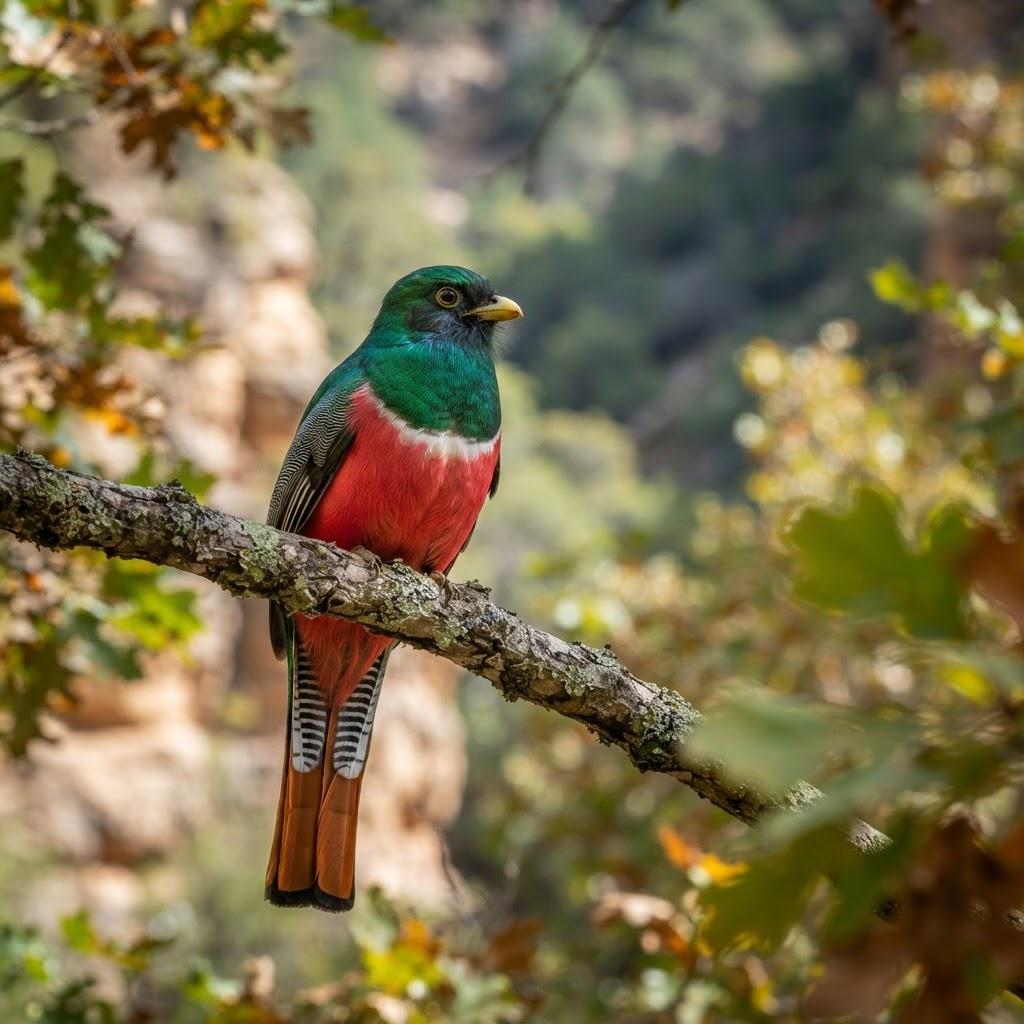
If you were to imagine a bird designed by a high-fashion stylist with a penchant for 1970s disco, you would get the Elegant Trogon. This isn't your average backyard sparrow that blends into the fence; this is an avian diva that demands a spotlight. The male of the species is a masterpiece of evolution, sporting a metallic, iridescent green head and chest that shifts in the sunlight like a fancy luxury car paint job. Below that chest, he features a belly of vibrant, punchy red that looks like he dipped himself in a bucket of paint. He’s the bird equivalent of someone showing up to a hiking trip wearing a velvet tuxedo—utterly impractical but undeniably impressive. When you spot one perched motionless in a sycamore tree, it feels less like birdwatching and more like catching a glimpse of a woodland sprite that hasn't quite realized it's supposed to be blending in. They are the quintessential 'target bird' that keeps seasoned birders awake at night, clutching their binoculars and hoping for a flash of that unmistakable crimson belly in the thick canopy.
Superpowers & Weird Abilities
While most birds are busy twitching around like they’ve had four espressos, the Elegant Trogon has a superpower that borders on the Jedi: the ability to remain perfectly, hauntingly still. Their plumage isn't just for show; it is an incredible tool for camouflage. In the dappled light of the riparian canyons they call home, their green feathers mimic the interplay of leaves and shadows so perfectly that you could be staring directly at one and see nothing but foliage. Furthermore, they possess what biologists call 'heterodactyl' feet. If that sounds like a complicated science term, think of it as a specialized gear configuration. While most birds have three toes pointing forward and one back, the Trogon has two forward and two back. This gives them a grip like a professional rock climber. It’s an essential adaptation for a bird that spends its life clinging to vertical branches in the middle of dense, misty forests. They essentially turn themselves into part of the tree, waiting for the perfect moment to snatch a lizard or a berry without ever breaking their cool, calculated composure.
Drama, Personality & Feathered Chaos
Don't let the dapper suit fool you; the Elegant Trogon is a bit of a recluse with a flair for the dramatic. They aren't the local playground bullies like Blue Jays; they are more like the mysterious, brooding poet who sits in the back of the coffee shop, observing everyone but rarely speaking. However, their social life is built entirely around their voice. They possess a call that sounds like a series of low, rhythmic croaks—'co-ah, co-ah, co-ah'—that can echo through a canyon and drive birders absolutely bananas. They are notorious for being ventriloquists; the sound travels in a way that makes it seem like the bird is fifty feet away when it is actually sitting directly above your head. This leads to a unique kind of avian chaos where a group of grown adults will wander in circles, staring up into the branches, wondering why this bird is playing such cruel tricks on their hearing. It’s a sophisticated level of gaslighting that only a bird with this much natural elegance could pull off.
Bizarre Rituals & Quirky Habits
The Trogon has a habit that would make any modern food critic jealous: they are connoisseurs of the fruit world. While they eat insects, they are most famous for their acrobatic consumption of small fruits, particularly those from the Madrone or Manzanita trees. They don't just grab a berry like a normal bird; they perform a little hover-pluck maneuver that looks like they are snatching a grape from a floating platter. It is a graceful, delicate motion that involves a fluttering stop mid-air, a quick grab, and a return to their perch. But the weirdest part? They often swallow these fruits whole, acting like little forest vacuum cleaners. They’ve been observed spending long stretches of time just sitting, digesting, and looking like they are contemplating the meaning of existence. It is a meditative, strange behavior that reminds us that, sometimes, the best way to live is to grab your snack and sit perfectly still for an hour while you think about literally nothing.
Legends, Folklore & Human Stories
In the regions where the Elegant Trogon resides, it has long been viewed as a creature of mystery. In many indigenous cultures throughout Mexico and Central America, the Trogon family (which includes the famous Resplendent Quetzal) is held in high regard as a symbol of life, liberty, and deep forest magic. While the Elegant Trogon is a smaller, more modest cousin to the Quetzal, it shares that same aura of sacredness. Local legends often weave these birds into stories about the guardians of the mountains. People tell tales of hunters who, upon hearing the resonant call of the Trogon, take it as a sign of rain or a reminder to respect the boundaries of the forest. They aren't just birds; they are the soundtrack of the canyons, and their presence is often seen as a hallmark of a healthy, thriving ecosystem. For humans living near their habitat, the Trogon is the forest’s shy, colorful spirit, and spotting one is considered a stroke of pure, unadulterated luck that warrants a celebration.
Mating: The Ridiculous World of Avian Dating
Dating for an Elegant Trogon is less about a romantic candlelit dinner and more about proving that you have the best real estate in town. The male starts his campaign by finding a hole in a tree—a cavity, to be specific—that he thinks is worthy of a princess. He then sits near this hole and begins his persistent, rhythmic calling, essentially shouting his availability to the entire canyon. If a female wanders by, he will perform an aerial display, showing off those vibrant colors and his sheer flying ability. It is a high-stakes audition. The female is notoriously unimpressed by flash alone; she inspects the nest site with the scrutiny of a building inspector checking for structural integrity. If she finds the hole drafty or poorly positioned, she will fly off without a backward glance, leaving the male to continue his croaking performance, perhaps wondering where he went wrong. It is a brutal, cold-hearted process, but one that ensures only the most prepared, cavity-finding males get to pass on their genes.
Nesting: Master Architects and Lazy Slumlords
When it comes to nesting, Trogons are not the type to weave intricate cups of spider silk or build complex mud fortresses. They are cavity nesters, meaning they prefer to move into existing real estate. They look for rotted-out sections in sycamore or oak trees, often taking advantage of holes that woodpeckers abandoned years ago. Once they find a suitable 'fixer-upper,' they don't do a whole lot of remodeling. They might do a little interior decorating by clearing out loose debris, but they aren't going to be featured on any home design magazines for their efforts. It’s a minimalist approach. The safety of the cavity is the real draw—it keeps the eggs away from prying eyes and hungry squirrels. However, because these trees are often decaying, it’s a gamble. A heavy storm can take out a nesting tree, turning a cozy home into a pile of sawdust in seconds. It’s a precarious life for an avian architect who refuses to build from scratch.
Raising Babies: The Screaming Food Disposals
Once those eggs hatch, the Trogon parents trade in their elegant, stoic personas for a life of frantic, exhausting service. The chicks are born as naked, helpless, and incredibly demanding little blobs of hunger. For the first few weeks, the canyon is filled with the high-pitched chirps of baby birds demanding more lizards, more insects, and more fruit. The parents are absolute workhorses, zipping back and forth to keep the food supply flowing. It is fascinating to watch how the 'stoic' adults turn into hyper-attentive bodyguards. If a predator gets too close to the nest, the parents will use distraction displays, flying around and calling to draw attention away from the babies. Once the chicks finally fledge—or leave the nest—they look like messy, scaled-down versions of their parents, clumsily hopping through the trees while the parents continue to hover over them like nervous stage moms, ensuring their little fashion icons don't trip over their own oversized feet.
Bird-Watching Travel & Local Hotspots
If you are ready to check the Elegant Trogon off your bucket list, you need to head to the 'Sky Islands' of southeastern Arizona. Places like Madera Canyon, Cave Creek Canyon, and Ramsey Canyon are the holy grails for Trogon seekers. The best time to go is from May through July, when the birds are breeding and their territorial calls are ringing out through the canyons. You’ll want to arrive before dawn—these birds are early risers, and the morning light is perfect for seeing that metallic green plumage pop against the brown bark of the sycamore trees. Bring a pair of high-quality binoculars and a lot of patience. You aren't just walking; you are hunting for a ghost. Check the local birding forums or the eBird portal for recent sightings in the area, as these birds can move around based on the fruit crop for the year. It’s an adventure that requires hiking boots, plenty of water, and the ability to stand perfectly still for long periods of time while fighting off the urge to check your phone.
Food, Feeder Hacks & DIY Projects
Trying to attract an Elegant Trogon to your backyard feeder is, quite frankly, a tall order. These aren't your typical sunflower-seed-munching visitors. They are specialized foragers that prefer native fruits and insects. If you want to make your yard Trogon-friendly, you need to focus on habitat restoration rather than store-bought birdseed. Plant native trees like the Arizona Sycamore, Madrone, or Manzanita. These trees provide the natural food sources that keep these birds coming back. Skip the cheap bags of milo and millet from the big-box store; the Trogon won't touch them, and you’ll just end up with a buffet for the local house sparrows and aggressive pigeons. If you really want to help, build a 'natural buffet' by leaving dead wood or snags in your yard—with safety in mind, of course—to host the insects that these birds love to feast upon. It’s about creating a miniature version of their canyon habitat, not a plastic bird restaurant. You are the gardener, they are the guests, and if you provide the right trees, they might just decide to stop by for a visit.
Seasonal Guides & "Crisis" Management
The seasonal cycle for the Trogon is all about the monsoon. In the arid Southwest, the summer rains transform the canyons, bringing an explosion of insects and ripening fruit, which is the dinner bell for these birds. If you are birding during this time, keep an eye on the weather—the monsoon can bring sudden, intense storms that make the canyons slick and unpredictable. As for the 'fledgling panic' season, people often find young Trogons that look like they’ve fallen out of the nest and are helpless on the ground. Please, resist the urge to 'rescue' them! In most cases, these birds are just going through a 'branching' phase where they are learning to fly. The parents are usually nearby, watching from the canopy, bringing food to their grounded baby. Unless the bird is clearly injured or in immediate danger from a pet, back away and give them space. Your job is to be an observer, not a helicopter parent. The best thing you can do for a young bird is to keep your distance and let nature run its course.
Backyard Tech & Gadget Reviews
While smart feeders are a fun way to capture photos of common backyard birds, they are generally not very effective for catching a glimpse of a Trogon. These birds don't hang out at feeders; they hang out in the deep, shaded canopy of old-growth trees. If you want to use tech to your advantage, consider investing in a high-quality trail camera. Set it up near a known fruiting tree or a natural water source within their habitat. With a motion-sensor camera, you can capture the elusive behavior of a Trogon without having to stand in a bush for ten hours straight. As for window collisions, which are a major threat to all birds, use UV-reflective window film. It allows you to see out but creates a pattern that birds can see as a solid object, preventing them from flying into your home. It’s a simple, cheap, and effective way to turn your windows from death traps into safe barriers, allowing you to enjoy your home without the fear of a feathered visitor accidentally flying into the glass.
How to Spot One & How It Is Doing
Spotting an Elegant Trogon comes down to three things: eyes, ears, and patience. Listen for that rhythmic, hollow 'co-ah' call and look for a bird that doesn't move. If you see a shape that looks like a stuffed toy sitting on a branch, keep your focus on it—that’s your guy. They are doing relatively well, but like all species tied to specific riparian (riverbank) habitats, they are vulnerable to water loss and climate change. Protecting these canyon ecosystems is the number one way to ensure that future generations can witness the sheer brilliance of the Trogon. If you want to help, support local conservation efforts that focus on restoring native plant life and maintaining water flow in our mountain canyons. It is a simple message: preserve the habitat, and the inhabitants will follow. The Elegant Trogon is a living piece of art, and it is our job to make sure the gallery stays open for business, one canyon and one tree at a time.