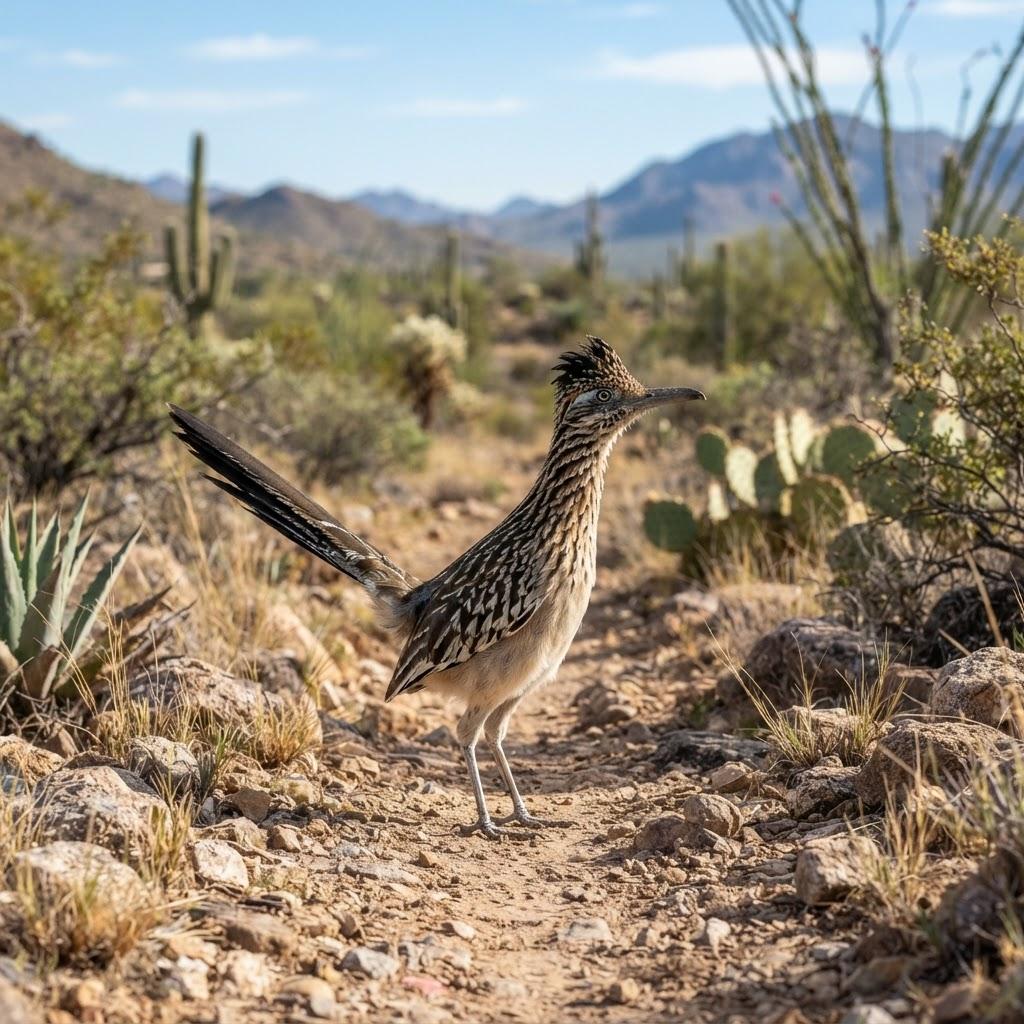
Geococcyx californianus
Greater Roadrunner
The Greater Roadrunner is a desert-dwelling speed demon that treats the ground like a racetrack and hunts like a tiny, feathered dinosaur. It is the original outlaw of the American West, blending high-speed drama with a serious attitude problem.
Meet the Bird
Imagine a bird that decided flying was just too much effort and opted to become the fastest pedestrian in the desert. That is the Greater Roadrunner. He looks like a cross between a frantic private investigator and a prehistoric raptor that forgot to go extinct. With a sleek, aerodynamic body, a jaunty crest of feathers that says 'I mean business,' and a long, rudder-like tail, the roadrunner struts across the desert floor with the confidence of a rock star walking onto a stage. He is not just wandering; he is patrolling. If you ever find yourself in the Mojave or the dusty plains of Texas, you might spot this bird bolting past you at fifteen miles per hour, likely eyeing a lizard with pure, predatory intent. He is the punk rocker of the avian world, eschewing the grace of a swan for the sheer grit of a creature that knows how to outrun trouble and outsmart his lunch.
Superpowers & Weird Abilities
The roadrunner is essentially a biological solar panel on legs. Because he spends his nights in the chilly desert, his body temperature drops significantly to save energy. When the sun comes up, he doesn't just stand around; he deploys a secret weapon. Hidden under his dark back feathers is a patch of black skin that acts like a heat-sink. He turns his back to the sun, ruffles his feathers to expose this dark skin, and essentially 'recharges' his batteries using solar energy. It is like plugging your phone into a wall charger, but the wall is the sun and the phone is a bird. Furthermore, their running ability isn't just about fast legs; it is about their unique zygodactyl feet—two toes forward and two toes back—which provide incredible traction on loose sand, acting like off-road tires on a rally car. He is literally built for speed, stability, and high-efficiency thermal management.
Drama, Personality & Feathered Chaos
If you are looking for a bird that keeps its cool, look elsewhere. The roadrunner is a total drama queen with a violent streak that would make a raptor proud. They are notoriously territorial and will spend hours chasing away intruders—be it another roadrunner or a snake that dared to cross their path. They are the neighborhood bullies of the scrubland, often seen aggressively posturing with lowered heads and fanned tails to let everyone know who owns this specific patch of dirt. They don't just hunt for survival; they hunt with style. If they catch a large prey item, they will bash it against a rock over and over until it stops struggling, a bit like a cartoon character trying to fix a faulty toaster. There is no subtlety here, just pure, unadulterated feathered chaos that turns the desert floor into an action movie set every single morning.
Bizarre Rituals & Quirky Habits
One of the most hilarious things about the roadrunner is his penchant for rattling his beak. When he is excited, threatened, or just feeling chatty, he makes a sound that mimics a wooden clapperboard. It is an abrupt, mechanical 'clack-clack-clack' that sounds entirely too artificial to be coming from a living creature. Beyond the beak-clacking, they are also prone to strange, twitchy movements, shifting their crest up and down like a moody teenager adjusting a hat. They aren't particularly interested in group dynamics either; these birds are solo operators. You will rarely see two of them hanging out unless they are in the heat of a courtship chase or a territorial dispute. They have this strange, jerky way of walking that looks like a dance move gone wrong, but in the heat of the desert, it is just their way of keeping an eye on the shifting shadows and potential threats.
Legends, Folklore & Human Stories
The roadrunner holds a legendary status in the folklore of various Indigenous peoples of the American Southwest. Many tribes viewed the bird as a sacred protector, often noting that its unique X-shaped footprint helped confuse evil spirits because they couldn't tell which direction the bird was heading. It is the ultimate vanishing act. In Mexican folklore, the bird was often associated with good luck and healing properties, though some tales warned that encountering one could also signal a coming change in weather. People have lived alongside these birds for centuries, marveling at their ability to tackle rattlesnakes—a feat so bold it earned them a place in campfire stories as the brave warrior of the desert. Unlike other birds that hide away from human expansion, the roadrunner has maintained a stoic presence, watching from the brush as our world changes, remaining an unchanging icon of the rugged West.
Mating: The Ridiculous World of Avian Dating
Avian dating for a roadrunner is less about romance and more about proving you have the best stamina and the shiniest gift. When a male spots a female he fancies, he doesn't just sing a song; he launches into a full-blown performance piece. He will strut, fan his tail, and offer her a 'gift'—usually a nice, juicy lizard or a fat grasshopper. If the female accepts the offering, the dance continues with a series of low, mournful coos that sound like a tiny foghorn. He will perform a 'bow-dance,' dropping his head and tail simultaneously while vibrating his feathers. If she is unimpressed, she walks off, and he is left standing there with his snack, looking like a discarded romantic lead in a play that closed on opening night. It is brutal, it is high-stakes, and it requires a high level of physical coordination that would leave most humans winded after ten seconds.
Nesting: Master Architects and Lazy Slumlords
While some birds spend weeks weaving delicate, ornate nests, the roadrunner takes a more 'industrial' approach to architecture. They build their nests in the thickest, thorniest bushes they can find—usually yucca, prickly pear, or low-hanging tree branches—to keep predators at bay. The nest itself is a sturdy, albeit slightly messy, platform of sticks, leaves, and sometimes even bits of snakeskin or cow dung to act as insulation. It is not exactly high-end interior design, but it is highly functional. They prioritize security over aesthetics, creating a fortress that is difficult for coyotes or snakes to breach. They aren't parasitic like the cowbird; they build their own homes, but they are not winning any awards for style. It is a solid, practical bunker that reflects their personality: tough, utilitarian, and perfectly suited for a life in the harsh, unpredictable desert environment where survival is the only thing that matters.
Raising Babies: The Screaming Food Disposals
Once the eggs hatch, the parents are essentially trapped in an endless cycle of hunting. A roadrunner nest contains between three and five eggs, and the chicks emerge as hungry, fuzzy little monsters. Feeding them is a frantic, high-speed endeavor. The parents bring back everything from scorpions and lizards to beetles and small birds. The chicks are ravenous and will hiss and scramble over each other just to get the first bite of a fresh lizard tail. Parenting here is a test of endurance; the parents must cover vast distances to collect enough biomass to keep their brood alive. It is loud, it is messy, and it is exhausting. The chicks reach 'fledging'—the stage where they leave the nest—in about three weeks, at which point the parents likely deserve a very long vacation away from their hungry, screaming offspring.
Bird-Watching Travel & Local Hotspots
If you want to catch a glimpse of this desert icon, you need to head to the arid landscapes of the Southwest. Big Bend National Park in Texas is practically the roadrunner capital of the world; hike any of the lower-elevation trails in the morning, and you are almost guaranteed a sighting. In Arizona, the Saguaro National Park near Tucson is another world-class hotspot where the birds are quite habituated and often seen patrolling the parking lots. For a California experience, the Anza-Borrego Desert State Park is an excellent choice. When you go, bring high-quality binoculars and plenty of water. Look for them early in the morning when the sun is low, as they are most active during the cooler parts of the day. They aren't shy, but they are fast; keep your camera settings ready, because once they decide to move, they disappear into the brush in a blur of brown and white feathers.
Food, Feeder Hacks & DIY Projects
Trying to attract a roadrunner to a standard bird feeder is an exercise in futility. They are carnivores, pure and simple. They want protein, not sunflower seeds. Forget the millet, and definitely forget the corn. If you want to make your yard a roadrunner paradise, stop using pesticides so the local lizard and grasshopper populations can thrive—that is their favorite buffet. You can encourage them by providing a 'lizard lounge'—a pile of flat rocks in a sunny part of the yard that creates nooks and crannies for insects and reptiles to hide. They will visit your yard to patrol these hunting grounds regularly. A birdbath is also a major draw, especially in the desert heat; keep it shallow, clean, and placed on the ground, as they prefer to walk up to their water rather than fly to a hanging basin. It is the cheapest and most effective feeder hack you will ever find.
Seasonal Guides & "Crisis" Management
The roadrunner's year is dictated by the extreme heat and cold of the desert. In the spring, they are busy and territorial, so give them space. In the winter, they endure the freezing desert nights by tucking themselves into dense cover; you can help by keeping your garden's brush piles intact rather than raking everything into a sterile lawn. If you find a 'fledgling' roadrunner on the ground during the summer, don't panic! It is likely just learning to navigate the world. As long as it is feathered and moving around, leave it alone. The parents are almost certainly nearby, watching from the brush. If it looks injured—dragging a wing or unable to stand—that is when you call a local wildlife rehabber. Otherwise, keep your distance, put your cat inside, and let the little speedster learn the ropes of desert life on his own terms.
Backyard Tech & Gadget Reviews
If you really want to see what your local roadrunner is up to, forget high-tech bird feeders with cameras—those are built for songbirds. Instead, invest in a motion-activated trail camera. You can strap these to a fence post or a low tree branch at knee height in a part of the yard where you’ve seen them patrolling. Because these cameras use infrared sensors, they are perfect for catching the roadrunner's early morning 'solar charging' sessions. Regarding window collisions, the best solution for a roadrunner-friendly yard is to use external window screens or bird-safe UV decals that are visible to birds but subtle to humans. Since roadrunners spend most of their time on the ground, they aren't the primary victims of window strikes like smaller songbirds, but it is still a smart, proactive move to make your home safe for all the feathered visitors you hope to host.
How to Spot One & How It Is Doing
Spotting a roadrunner is all about looking at the ground. Keep your gaze low, scanning the edges of trails and the base of bushes. Look for that distinct, jerky walking motion and the long tail that acts as a balance beam. Listen for the 'clack-clack' of their bill or the low-frequency cooing that travels surprisingly far. Currently, the Greater Roadrunner is doing quite well; they are listed as 'Least Concern' because they are incredibly adaptable. They don't mind humans, and as long as there is desert scrub and a healthy supply of lizards, they will be fine. To help them, preserve native desert landscaping, advocate for dark-sky initiatives, and keep your yard as natural as possible. By maintaining a wild corner in your backyard, you are supporting a creature that has survived millions of years of evolution to become the true, feathered outlaw of the American frontier.