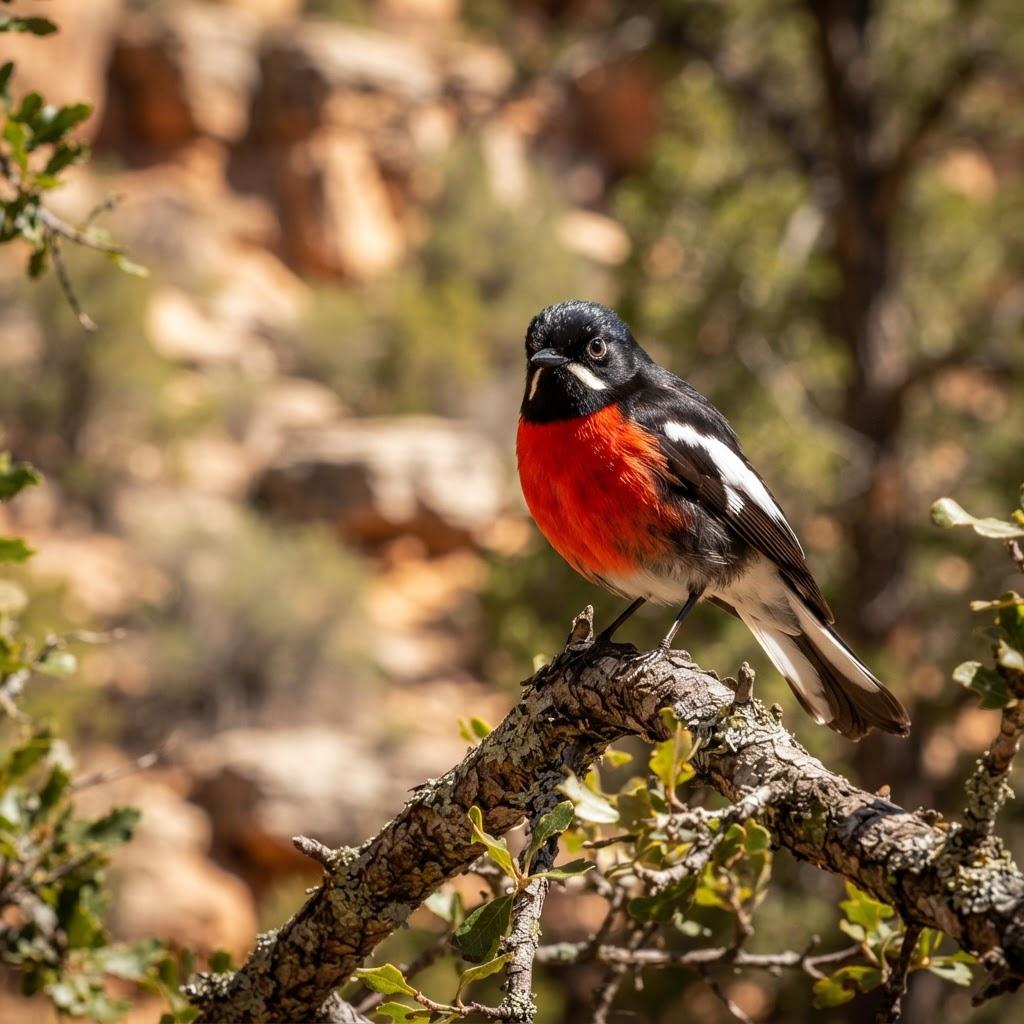
Myioborus pictus
Painted Redstart
The Painted Redstart is the tuxedo-clad rockstar of the canyon, known for its high-energy dance moves and striking contrast. It turns every branch into a stage, making it a must-see for anyone wandering through the high-elevation forests of the American Southwest.
Meet the Bird
Imagine a bird that decided to dress for a formal black-tie gala but accidentally stumbled into a frantic high-energy music video shoot instead. That is the Painted Redstart. With a coal-black body that would make a raven jealous, a stark white patch on its wing that glows like a beacon, and a belly of fire-engine red, this bird is impossible to ignore. It does not just fly; it flutters, pivots, and performs aerial gymnastics as if it is constantly auditioning for a spot on a reality dance competition. While other warblers are content to quietly forage for bugs like respectable citizens, the Painted Redstart is the chaotic showman of the high-elevation woodlands. It is a bird that demands attention, constantly twitching its wings and fanning its tail, almost as if it is mocking the sluggish pace of the rest of the forest. If you encounter one, expect a performance that leaves you wondering if you accidentally stepped into a feathered Broadway production.
Superpowers & Weird Abilities
The Painted Redstart possesses an aerial agility that borders on the impossible. Think of it as the ultimate parkour master of the avian world. Most birds stick to a routine of hopping or straightforward flight, but this species utilizes its wings and tail in a specialized way to flush out unsuspecting insects. By flashing those brilliant white wing patches and tail feathers in rapid, nervous flickers, it basically uses a strobe-light effect to startle prey. When a tiny moth or beetle panics and bolts, the Redstart is already there, having calculated the escape vector with the precision of a fighter pilot. It essentially uses its own body as a psychological weapon, creating a sensory overload for the insect world. It is not just about flying; it is about manipulating the environment through speed and visual distraction, turning a quiet forest walk into a high-stakes hunt where the prey never stands a chance against a flash of monochrome magic.
Drama, Personality & Feathered Chaos
In the social hierarchy of the forest, the Painted Redstart is the hyperactive kid who drank too much soda at a birthday party. It simply cannot sit still. This personality makes it a bit of a drama queen, but in the best way possible. While other birds are busy being territorial about their seeds or hiding from hawks, the Redstart is busy investigating everything. It is incredibly inquisitive and prone to following other species, sometimes even tagging along with mixed-species foraging flocks just to make sure it doesn't miss out on any buffet-style action. However, do not mistake its curiosity for friendliness. If another bird encroaches on its specific branch, the Redstart will go from zero to sixty in a heartbeat, erupting into a flurry of ruffled feathers and sharp, chirping protests. It is a total diva, convinced that the entire canyon belongs to its own private stage, and it will let every other creature within earshot know exactly how it feels about intruders.
Bizarre Rituals & Quirky Habits
One of the most peculiar habits of the Painted Redstart is its obsession with the ground. Unlike many other warblers that prefer the safety of the leafy canopy, these birds are frequently spotted dancing on the forest floor, scratching through leaf litter like miniature, tuxedo-clad turkeys. This is not just a food-finding mission; it is a full-body workout. They will dart from a tree limb to the ground, perform a quick series of pivots, flush out a spider, and then immediately zip back to a branch. This constant movement is thought to keep predators off-balance. If you are a cat or a hawk trying to track a bird that is constantly changing its silhouette and location every two seconds, you are going to have a very frustrating day. They seem to enjoy the confusion, often returning to the same area repeatedly to make sure they have completely cleared out every available insect, a behavior that proves they are as methodical as they are manic.
Legends, Folklore & Human Stories
While they do not carry the heavy mythological baggage of eagles or owls, the Painted Redstart holds a special place in the lore of Southwestern birders. In the high deserts of Arizona, there is a long-standing tradition that if you see a Redstart dancing in a dry canyon, water is nearby. This isn't just superstition; it’s a bit of practical wisdom. Because these birds thrive in oak-lined riparian zones—areas bordering streams—they are effectively nature's own trail markers. Generations of hikers and explorers have viewed the appearance of this bird as a signal that the hard, thirsty trek is coming to an end. It has become a symbol of relief and vitality. To many, the flash of red and black is a beacon of hope in the arid landscape, a reminder that life finds a way to flourish even in the deepest, most shadowed crevices of the mountains. It is the bird you are happy to see, not just for its beauty, but for what it promises at the end of a long trail.
Mating: The Ridiculous World of Avian Dating
When it comes to courtship, the Painted Redstart male believes that if you aren't doing a interpretive dance, you aren't trying hard enough. The mating ritual is a sight to behold, featuring the male puffing out his chest to emphasize his vibrant red plumage while fluttering in a zigzag pattern around the female. He will sing a high-pitched, bubbly melody that sounds like a bubbling brook mixed with a digital synthesizer. The female, ever the professional critic, will watch from a distance, head tilted in judgment. If she is unimpressed—or if the male's wing-flashing rhythm lacks that certain pizzazz—she will simply fly away, leaving him to perform for an empty audience. If she stays, she will mimic his movements, and the two will engage in a synchronized dance that looks like a miniature ballet performed in the dappled light of the forest floor. It is intense, it is competitive, and it is entirely focused on proving that he has the best genes for the job.
Nesting: Master Architects and Lazy Slumlords
While some birds are happy with a pile of sticks that looks like it was assembled by a toddler during a hurricane, the Painted Redstart is a stickler for detail. They usually tuck their nests away in hidden nooks on the ground, often under the shelter of a bank, a rock ledge, or an overhanging shrub. This is a brilliant strategy for keeping their brood cool in the intense heat of the mountain sun. They construct a neat, cup-shaped home using fine strips of bark, grass, and rootlets, and they line it with soft animal fur to ensure the chicks have a luxury experience. It is a masterpiece of concealment, designed to blend perfectly with the surrounding dirt and dried leaves. By building on the ground rather than in the trees, they avoid the prying eyes of canopy-dwelling predators, showing that they are far more calculating than their frantic, dancing behavior on the branches would suggest.
Raising Babies: The Screaming Food Disposals
Raising a brood of Redstarts is essentially a two-week-long sprint run at breakneck speed. Once the eggs hatch, the parents are transformed into robotic food-delivery drones. The chicks are born as tiny, naked, and perpetually hungry blobs that demand to be fed every few minutes. The amount of insects these parents drag back to the nest is staggering; they are basically clearing out the entire local bug population to keep their brood alive. The chicks, in turn, contribute to the operation by being as loud as possible. Even before they have feathers, they are stretching their necks, opening their beaks wide, and emitting high-pitched screeches that can be heard from several feet away. It is a noisy, messy, and exhausting period that tests the endurance of both parents. By the time the chicks fledge and begin to explore the world, the parents look like they have aged a decade, but the job is done with impressive, high-speed efficiency.
Bird-Watching Travel & Local Hotspots
If you are ready to witness the Redstart show, you need to head toward the sky islands of the American Southwest. Southern Arizona is the undisputed capital of Painted Redstart activity. Specifically, locations like Ramsey Canyon, Cave Creek Canyon, and Madera Canyon are essentially meccas for birders. These places are lush, mountainous, and humid, which is exactly how our feathered friend likes it. Late spring through early summer is the golden window; the birds are active, singing, and very busy with their territorial displays. If you go to these canyons, look for areas where the forest meets the water. Stay quiet, be patient, and keep your eyes focused on the lower branches and the forest floor. You don't have to look for them for long; if you are in their habitat, their constant, frantic motion will eventually catch your eye. It is the kind of experience that ruins other birding trips because you start expecting every bird to have the same amount of personality as the Redstart.
Food, Feeder Hacks & DIY Projects
Attracting a Painted Redstart to your own backyard is a challenge because they are not your typical seed-eaters. They are insectivores through and through. If you want to impress them, forget the bags of cheap, filler-heavy seed mixes that just attract house sparrows. You need to focus on native plants. Planting local trees and shrubs that host native caterpillars and spiders is the ultimate DIY project for attracting these birds. Think of it as a backyard buffet for bugs, which in turn acts as a gourmet restaurant for the Redstart. If you must use a feeder, try a suet feeder filled with high-quality insect-based suet. They sometimes enjoy the protein boost during the colder months or early migration. Creating a shallow water feature or a dripping birdbath is also a massive win; they love to dart through the mist and dance near the edge. Water is the key to their heart, and a clean, reliable source will keep them coming back to your garden.
Seasonal Guides & "Crisis" Management
Seasonal changes shift the Redstart's focus from breeding to survival. In the spring, they are hyper-territorial, so if you see them chasing each other around, don't worry—it is just the usual neighborhood drama. As summer cools down, they prepare for the shift in insect populations. One common 'crisis' for humans is finding a 'fledgling' on the ground. You might see a fluffy, awkward-looking bird sitting on a rock, looking lost. Do not kidnap it! Unless it is clearly injured or in immediate danger from a cat, it is just in the 'teenager' phase of learning to fly. The parents are almost certainly nearby, watching from the trees and coming down to feed it. Just step back, keep your pets indoors, and let nature take its course. If you keep a clean, frost-free water source during the transition to autumn, you will ensure they have the resources they need to either migrate or tough it out in their favored canyons.
Backyard Tech & Gadget Reviews
If you want to document the antics of the Painted Redstart, traditional birding gear is great, but modern tech offers a new perspective. Smart feeders with built-in cameras, like the ones that use motion sensors to snap photos, are incredible for catching the 'blink-and-you-miss-it' speed of these birds. Because the Redstart is so twitchy, a high-shutter-speed camera is a must. If you are worried about them bumping into your windows, don't just put up a sticker and call it a day. Use window film or patterned decals that break up the reflection, as these birds can get distracted while darting after insects. If you want to get creative, set up a motion-activated trail camera near a reliable water drip in your yard. You will catch hours of footage of them splashing, bathing, and performing their signature tail-flicks. It is like having a private wildlife documentary playing on your phone, and it is far more entertaining than anything on cable TV.
How to Spot One & How It Is Doing
Spotting a Painted Redstart is less about having eagle eyes and more about paying attention to movement. You are looking for a flash of black, white, and red that refuses to stay in one place. Its song is a series of sweet, ringing notes that accelerate toward the end, a distinct sound in the often-quiet canyons. If you hear it, stop, stand still, and wait. The bird will eventually reveal itself as it dances along a branch or flutters through the undergrowth. Conservation-wise, the Painted Redstart is currently doing well, but they rely heavily on healthy riparian habitats. Protecting the water sources in their canyons is the single best thing you can do for them. By supporting organizations that focus on habitat conservation and keeping our own backyards filled with native plants, we ensure that this tuxedoed dancer keeps performing for generations to come. It is a resilient, beautiful bird that deserves our help to keep its stage clean and accessible.