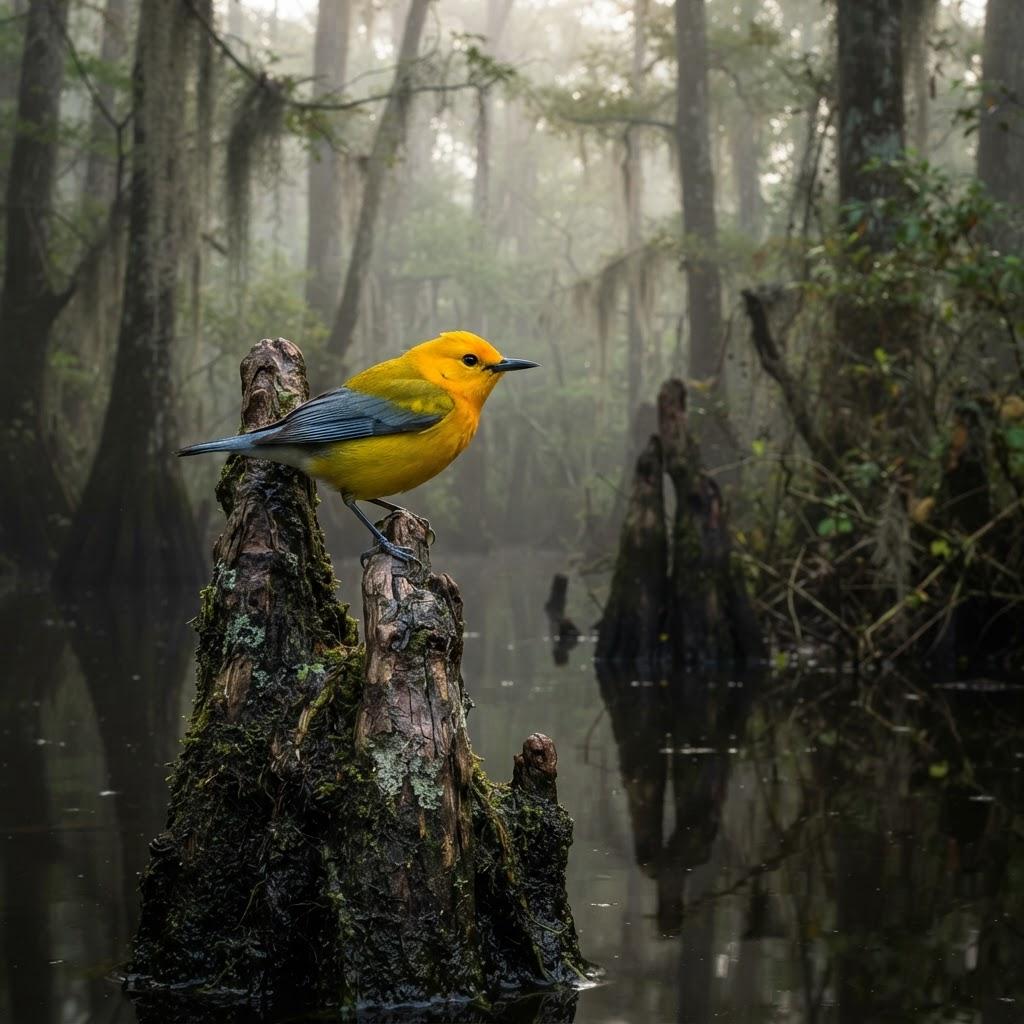
Protonotaria citrea
Prothonotary Warbler
Meet the Prothonotary Warbler, a tiny, dazzling dynamo that looks like it flew straight out of a jewel box and into a swamp! This golden marvel is a cavity-nester with a taste for adventure and a knack for charming its way into old woodpecker holes. Get ready to fall in love with this vibrant, wetland-dwelling wonder.
Meet the Bird
Imagine, if you will, a tiny, flying nugget of pure sunshine dropped into the murky, mysterious world of a cypress swamp. That, my friends, is the Prothonotary Warbler. This bird isn't just yellow; it's *radiant*. It’s the kind of bird that makes you question if you accidentally wandered onto the set of a Disney animated movie, and then, just as you’re contemplating asking for an autograph, it flits away, leaving a trail of golden iridescence and a profound sense of wonder. The Prothonotary Warbler, or 'swamp yellowbird' as some might affectionately (and accurately) call it, is a true gem of the wetlands. It’s like the eccentric, dazzling aunt who shows up at family reunions wearing a sequined jumpsuit and telling hilariously inappropriate jokes. Its vibe is pure, unadulterated fabulousness, a burst of tropical color in an often-overlooked American landscape. Forget your drab sparrows and your common chickadees for a moment; this bird is here to make a statement, a loud, bright, golden statement that says, 'I've arrived, and I look fabulous doing it.' Prepare yourself, because once you meet this feathered firefly, you’ll be smitten.
Superpowers & Weird Abilities
The Prothonotary Warbler might be small, but it’s got some seriously cool tricks up its tiny, golden sleeves. Forget capes and laser eyes; this bird’s superpowers are all about survival and adaptation. For starters, they’re cavity nesters, which sounds simple, but it means they’re basically bird real estate agents, constantly scouting for prime, pre-existing holes in trees. Think of them as the ultimate urban dwellers of the avian world, always looking for a condo that’s already been built. But here’s where it gets interesting: they are incredibly adaptable when it comes to choosing these homes. While they love natural holes drilled by woodpeckers, they are also experts at hijacking nest boxes, and if a suitable hole is too high, too low, or just generally inconvenient, they've been known to find nesting spots in anything from old cans to abandoned rubber boots! It's like finding a tiny, plush apartment in a discarded Wellington boot. This flexibility is a superpower in disguise, allowing them to thrive in habitats where other birds might struggle. They’ve also mastered the art of the aerial insect catch, darting and weaving through the humid swamp air with acrobatic precision. They don’t just fly; they perform aerial ballets, snatching unsuspecting insects mid-flight. It’s a display of agility that would make a fighter pilot jealous, all powered by a metabolism that’s probably faster than your morning espresso.
Drama, Personality & Feathered Chaos
Let's be honest, most birds are not exactly staging Shakespearean dramas in your backyard. But the Prothonotary Warbler? It’s got layers. While not typically a feeder bully like a feisty Blue Jay or a territorial cardinal, its drama is more subtle, woven into the fabric of its wetland existence. One of the most dramatic tales involving this species (and many other small songbirds) is the constant threat of brood parasitism, most famously by the Brown-headed Cowbird. Imagine meticulously building your dream nest, decorating it just so, and then some shady character sneaks in and lays an egg that looks nothing like yours, expecting you to raise a chick that will outcompete your own offspring! The Prothonotary Warbler, being a cavity nester, actually has a slight advantage. They can sometimes abandon a nest if they detect a cowbird egg, or if the nest cavity is too large for them to adequately defend, making them seem quite savvy. They’re not just passive victims; they’re making calculated decisions. And then there’s the territorial disputes. While not as vociferous as some larger birds, males will absolutely defend their chosen nesting territories with song and chases. It’s less a WWE smackdown and more a frantic, aerial game of tag with very high stakes. The competition for prime nesting real estate—those perfectly sized, perfectly located holes—can get surprisingly intense. It’s a constant hum of activity, a delicate balance of competition and cooperation that plays out in the hushed, humid air of the swamp. They're not exactly plotting world domination, but they're definitely not here to be pushed around, especially when it comes to securing the best real estate for their family.
Bizarre Rituals & Quirky Habits
Birds, bless their tiny feathered hearts, are full of bizarre rituals that make us humans scratch our heads. The Prothonotary Warbler is no exception. One peculiar habit, shared by many warblers and other songbirds, is something called 'anting.' This isn't about liking ants; it's about using them. Birds will pick up live ants and rub them on their feathers. Why? The prevailing theory is that the ants' formic acid acts like a natural pesticide, helping to clean their plumage and perhaps even deter parasites. Imagine giving yourself a spa treatment with a side of mild chemical exfoliation. It’s like using a fancy French soap, but instead, it’s a wriggling ant. It looks incredibly strange to watch a bird deliberately 'playing' with ants, seemingly enjoying the sensation or the benefit. Beyond anting, Prothonotaries have a fascinating quirk related to their nesting habits. They are what we call 'obligate secondary cavity nesters,' meaning they *must* nest in holes already excavated by other animals, typically woodpeckers. But they are incredibly resourceful. If a perfectly good, but slightly inconvenient, hole is available, they might even try to modify it. They’ve been documented stuffing moss or other materials into an entrance hole to make it a more snug fit, effectively resizing their pre-owned abode. It's like a renter who insists on adding their own custom shelving to a landlord's property. They also have a peculiar fondness for singing from within their nest cavities, creating a muffled, resonant sound that’s quite distinct. It’s their way of proclaiming ownership and attracting a mate, all from the cozy confines of their chosen hole-in-the-wall.
Legends, Folklore & Human Stories
While the Prothonotary Warbler might not have ancient myths woven around it like eagles or ravens, its vibrant presence in the often-mysterious wetlands has certainly inspired human connection and admiration. In many Native American cultures, the wetlands themselves were seen as places of power, transformation, and potent natural forces. Birds that inhabited these watery realms, like the brilliant Prothonotary, were often viewed as messengers or symbols of these powerful natural energies. Their sudden appearance, like a flash of pure gold against the muted greens and browns of the swamp, could easily have been interpreted as a sign or an omen. For early European settlers, encountering such a dazzling bird in the dark, foreboding swamps would have been a striking contrast. It might have been seen as a bit of nature’s treasure, a jewel hidden away in an often-dangerous landscape. There are no widespread, ancient legends specifically about the Prothonotary Warbler that have survived into mainstream folklore, but its sheer beauty has made it a beloved subject for bird artists, photographers, and writers. It features prominently in regional birding guides and nature essays celebrating the unique biodiversity of American wetlands. The stories surrounding it are less about ancient prophecy and more about the modern-day wonder and joy it brings to those who seek it out. It represents the hidden beauty of places we might otherwise overlook, proving that even the most 'unassuming' habitats can hold the most spectacular treasures. Its story is one of modern appreciation, a testament to its visual splendor and its vital role in its ecological niche.
Mating: The Ridiculous World of Avian Dating
Forget candlelit dinners and cheesy pick-up lines; bird mating is where the real drama, and sometimes the sheer absurdity, happens. For the Prothonotary Warbler, it’s a high-stakes game of real estate and song. The male Prothonotary’s primary strategy for attracting a mate isn’t a flashy dance or a brightly colored crest; it’s about having the best bachelor pad. He’ll scout out and claim potential nest cavities, often more than one, and then he’ll start singing his heart out. His song, a loud, clear whistle, is his way of shouting, 'Ladies, check out my digs! Prime swamp-front property, all holes included!' He’ll often sing from these prospective nest sites, trying to lure females in. It’s less about his own dazzling looks (though he is pretty dapper) and more about his interior decorating skills – or rather, his ability to find a well-situated, pre-existing cavity. When a female is interested, she’ll investigate his chosen spots. She’s the ultimate discerning buyer, inspecting every nook and cranny. She might visit several potential males and their territories before making her choice. It's a critical decision, as the nest site is paramount to the survival of her future offspring. If she’s not impressed with the location, the proximity to food, or the general vibes of the male’s territory, she’ll simply fly off, leaving him to continue his solo real estate pitch. The male’s role here is less about wooing with charm and more about providing a desirable living situation. It's a very practical form of avian dating: 'Here’s a safe place to raise our kids. Like it? Great. No? Well, back to the drawing board, pal.' It’s a system that values security and location above all else, which, let’s face it, is not that different from human dating in some major cities.
Nesting: Master Architects and Lazy Slumlords
When it comes to building a home, some birds are like avian Frank Lloyd Wrights, crafting intricate masterpieces from twigs and moss, while others… well, they’re more like college students who’ve been told to clean their room. The Prothonotary Warbler falls into a fascinating category: they're not builders, but they are incredibly discerning renters. They are secondary cavity nesters, which means they don't construct a nest from scratch. Instead, they seek out pre-existing holes in trees, often those excavated by woodpeckers. Think of them as the savvy homebuyers who avoid the hassle of construction and just look for a place with good bones and a solid foundation. They are incredibly particular about the size and location of these cavities. Too big, and they can’t keep it warm or defend it; too small, and it’s a tight squeeze. They prefer cavities near water, which is, of course, their preferred habitat. Once they find a suitable hole, the female does the heavy lifting, building a cup-shaped nest inside. This nest is typically made of moss, rootlets, and fine grasses, lined with even finer materials like animal hair or pine needles. It’s not a sprawling mansion, but a cozy, well-insulated bachelor pad or nursery. Sometimes, if the entrance to a cavity is a bit too large, they’ll even try to block it up with moss to make it smaller and more secure. It’s like a renter deciding to add a custom door draft stopper to save on heating bills. They are masters of making the most of what’s already available, transforming a rough hole into a safe haven for their eggs and chicks. They are the ultimate DIYers of the cavity-nesting world, turning someone else's excavation into their own cozy abode.
Raising Babies: The Screaming Food Disposals
The moment those tiny eggs hatch, the Prothonotary Warbler parents transform into an elite, non-stop, 24-hour fast-food delivery service. And their customers? They’re essentially tiny, feathered lumps with insatiable appetites and lungs that could rival a jet engine. A clutch typically consists of 4 to 7 eggs, and once they hatch, it’s Go Time. These little guys are born blind, featherless, and utterly helpless, but they come equipped with an innate talent for making noise. Oh, the noise! Their parents will spend nearly all their waking hours foraging for insects, spiders, and other small invertebrates, flying back and forth to the nest cavity dozens, sometimes hundreds, of times a day. Imagine a tiny commuter train, running on a constant loop, fueled by sheer parental devotion and a desperate need to silence those piercing, hungry chirps. The chicks, upon seeing an adult approach, will erupt into a frenzy of gaping mouths and high-pitched calls, all vying for the precious morsel. It’s a chaotic symphony of hunger. The parents, exhausted but determined, must keep up this grueling pace for about 10 to 12 days, which is how long it takes for the chicks to become 'fledglings' – young birds ready to leave the nest. Even after fledging, the parents continue to feed and protect them for a while longer. It’s a period of intense vulnerability for the young birds, as they are clumsy, unable to fly well, and still heavily reliant on their parents. The entire process is a whirlwind of activity, a testament to the incredible energy and dedication of bird parents. It’s a miracle of nature that these tiny creatures can sustain such an arduous task, all to ensure the next generation of golden swamp dwellers makes it into the world.
Bird-Watching Travel & Local Hotspots
So, you’ve been captivated by the vision of a flying golden jewel and now you’re itching to see one in person? Excellent choice! The Prothonotary Warbler is a bird that rewards the dedicated seeker, especially if that seeker is willing to venture into its preferred, slightly damp, and wonderfully wild habitats. The prime time to catch them is during their breeding season, roughly from April to July, though their exact arrival and departure depend on your latitude. Your best bet is to head to the southeastern United States, where their breeding grounds are most concentrated. Think expansive river bottoms, cypress swamps, and flooded deciduous forests. Locations like the Mississippi River Delta, the Great Dismal Swamp National Wildlife Refuge in Virginia and North Carolina, and numerous state parks and wildlife management areas across states like Louisiana, Arkansas, Tennessee, Alabama, and Georgia are prime territory. For example, exploring the bottomland hardwood forests of the Mississippi Alluvial Valley is practically a guarantee of finding them if you’re there at the right time. During migration, they can be found along the Gulf Coast, and occasionally inland. When you go, look for areas with dense undergrowth near slow-moving water or flooded areas. They often forage along the water's edge or in the lower canopy. Patience is key; they can be a bit shy and are experts at blending into the dappled light of the swamp. But the effort is more than worth it when you finally spot that brilliant flash of gold against the backdrop of the wild. It's a true treasure hunt, with the prize being one of North America's most stunning avian inhabitants.
Food, Feeder Hacks & DIY Projects
Attracting the dazzling Prothonotary Warbler to your yard requires understanding their natural foraging habits, as they aren't typically the kind of bird that will flock to a standard seed feeder. Their diet is primarily insectivorous, meaning they feast on insects, spiders, and other small invertebrates. They’re particularly fond of foraging for these goodies in wet environments, often gleaning prey from leaves, twigs, and the water’s surface. To entice them, your best bet is to create a habitat that mimics their natural environment. Planting native shrubs and trees that attract insects, especially those that thrive in moist conditions like willows, alders, or buttonbush, is your number one strategy. Think of it as building them a five-star all-you-can-eat insect buffet. If you’re feeling ambitious and want to offer supplementary food, live insects are the way to go. Mealworms or waxworms can be offered in specialized feeders or even scattered on a platform feeder in a damp area of your yard. Avoid standard seed mixes, as these won’t appeal to the Prothonotary Warbler and will likely just attract less desirable visitors like squirrels and pigeons. For a DIY project, consider creating a 'wetland oasis' in a corner of your yard. This could involve a shallow water feature with native bog plants, which will naturally draw in the insects the warblers love. Another simple DIY is to hang a small suet feeder with a high-quality, insect-based or fruit-based suet blend, especially during migration or cooler months. While they may not be seed-eaters, they appreciate the protein and fat that quality suet provides. Remember, the goal is to make your yard an attractive insect-rich environment, and the Prothonotary Warbler will likely pay you a visit, treating your garden like its own private, all-you-can-eat swamp buffet.
Seasonal Guides & "Crisis" Management
The Prothonotary Warbler’s life is a cycle of epic journeys and dedicated nesting, and understanding their seasonal rhythm is key to enjoying them. In **spring** (typically April-May for much of their breeding range), they’re returning from their wintering grounds. This is the crucial time to get your habitat ready. Ensure any nest boxes you’ve put up are clean and accessible. If you're trying to attract them, put out live mealworms or waxworms and maintain any water features. As **summer** progresses, they’ll be busy nesting and raising young. This is when you might hear their distinctive song echoing through the wetlands. They are generally less active around feeders during the peak of nesting but will appreciate insect-rich environments. Then comes **fall** migration (August-September). As they depart, they might pass through areas outside their typical breeding range, offering a chance for observers further afield to spot them. Keep feeders stocked with live insects if you’re in a migration corridor. **Winter** finds them in Central America and northern South America, so they’re far from our North American backyards. Now, about that 'fledgling panic.' Every spring and summer, people find fluffy baby birds on the ground and immediately assume they’re orphaned or injured. Most of the time, this is not the case! Fledglings often leave the nest before they can fly well. Their parents are almost certainly nearby, keeping a watchful eye and bringing them food. **Unless the fledgling is in immediate danger** (like in the middle of a road or being stalked by a cat), the best course of action is to leave it alone. If it is in danger, gently move it a short distance to a safer, sheltered spot under a bush. The parents will find it. Interfering too much can do more harm than good. For the Prothonotary Warbler, this means ensuring the ground around their preferred nesting areas is relatively free of human disturbance during nesting season.
Backyard Tech & Gadget Reviews
In today's bird-watching world, technology can add a whole new layer of engagement, and there are some fun gadgets perfect for appreciating birds like the Prothonotary Warbler, even if you can't get one to your feeder reliably. Let’s talk about **smart feeders**. Devices like the 'Bird Buddy' are gaining popularity. These feeders have built-in cameras that snap photos or short videos of birds visiting. They can identify the species (usually with pretty good accuracy) and send notifications to your phone. Imagine getting an alert: 'A Prothonotary Warbler just visited your feeder!' It’s like having a personal bird paparazzi. While a Prothonotary might not frequent a seed feeder, if you're offering live insects on a platform feeder, a smart feeder could capture some incredible close-ups. Just be aware they can be pricey, and battery life can vary. For stopping birds from flying into windows—a serious hazard—there are many solutions. Window decals are common, but sometimes birds ignore them. More effective, and often more aesthetically pleasing, are **window films**. Some are clear but distort the reflection, while others have subtle patterns. For a DIY approach, you can create a grid pattern on your windows using tempera paint (which washes off easily) or specialized window markers. If you’re curious about what nocturnal visitors might be sneaking around your yard, a **trail camera** or a simple motion-activated wildlife camera can be a fantastic, relatively inexpensive investment. Mount it near a water source or a potential insect buffet area, and you might be surprised by the visitors you capture, perhaps even a late-night insectivore. While these gadgets won't necessarily attract the Prothonotary Warbler directly, they enhance the experience of observing whatever feathered friends grace your outdoor space.
How to Spot One & How It Is Doing
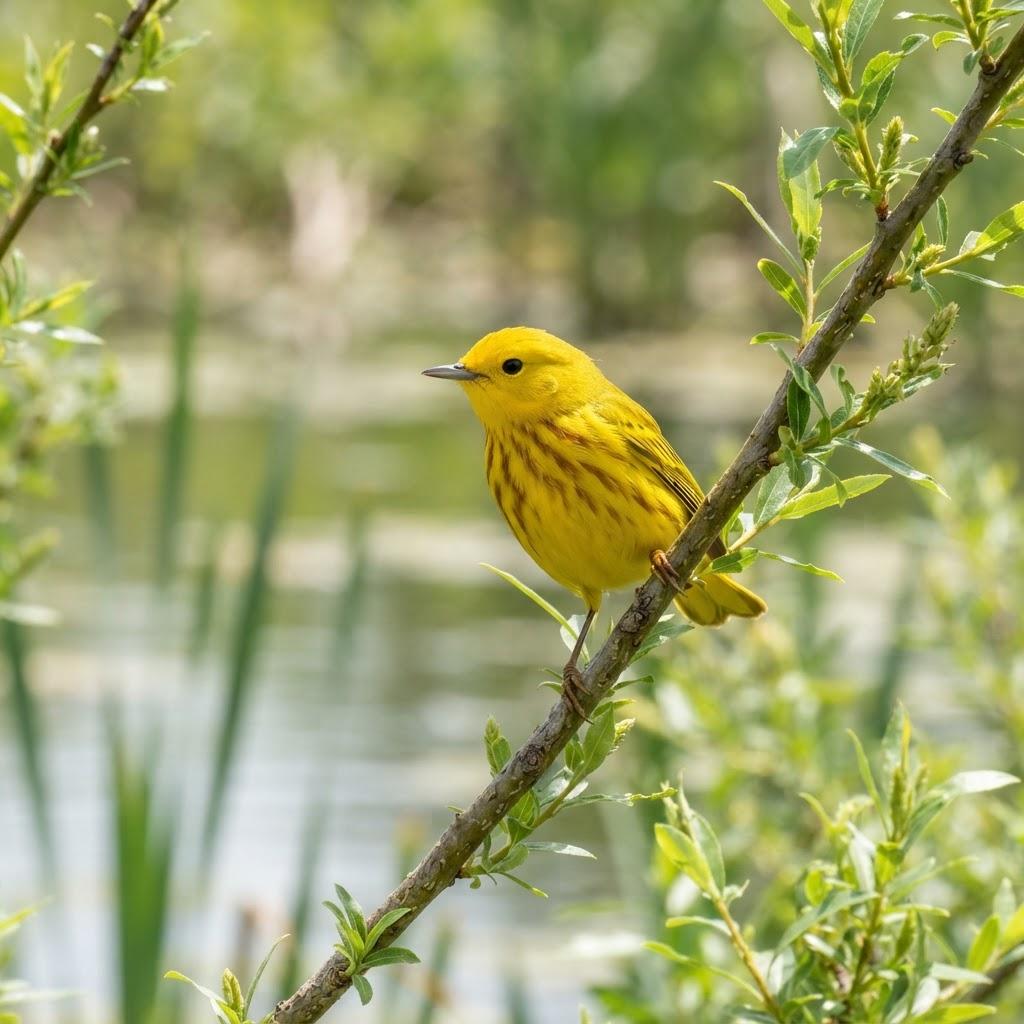
Spotting a Prothonotary Warbler is an exercise in keen observation and a bit of luck, especially if you're outside its core breeding habitat. The key is its striking appearance: it's about the size of a chickadee but much more vibrantly colored. The adult male is an almost uniformly brilliant golden-yellow on its head, chest, and belly, with dark gray or black wings and a darker tail. The female is similar but usually a bit duller yellow, sometimes with an olive tinge on her back. Their bill is pointed, typical of insect-eaters. You’ll find them in, or very near, wet environments – swamps, marshes, flooded forests, and along slow-moving rivers. They often forage in the lower levels of vegetation, sometimes even creeping along fallen logs or probing cavities and under leaves right at the water’s edge. Listen for their song: a loud, clear whistle, often described as a series of ringing notes that ascend slightly, something like 'sweet, sweet, sweet, tsu-tsu-tsu.' The call note is a sharp 'chik.' Now, for the good news: the Prothonotary Warbler is currently listed as **Least Concern** by the IUCN. While populations can fluctuate and specific wetland habitats face threats, their overall numbers are stable, and they are quite widespread across their breeding range. Their reliance on mature trees for nest cavities and healthy wetlands means that habitat conservation is crucial. What can you do to help? Support organizations that work to protect wetlands. If you live in their breeding range, consider putting up nest boxes specifically designed for cavity-nesting birds in appropriate wetland habitats (ensure they are predator-proof and properly spaced). And most importantly, appreciate these shimmering jewels by exploring their habitats responsibly, leaving them to thrive in their watery kingdoms. Their continued presence is a vibrant indicator of a healthy wetland ecosystem.