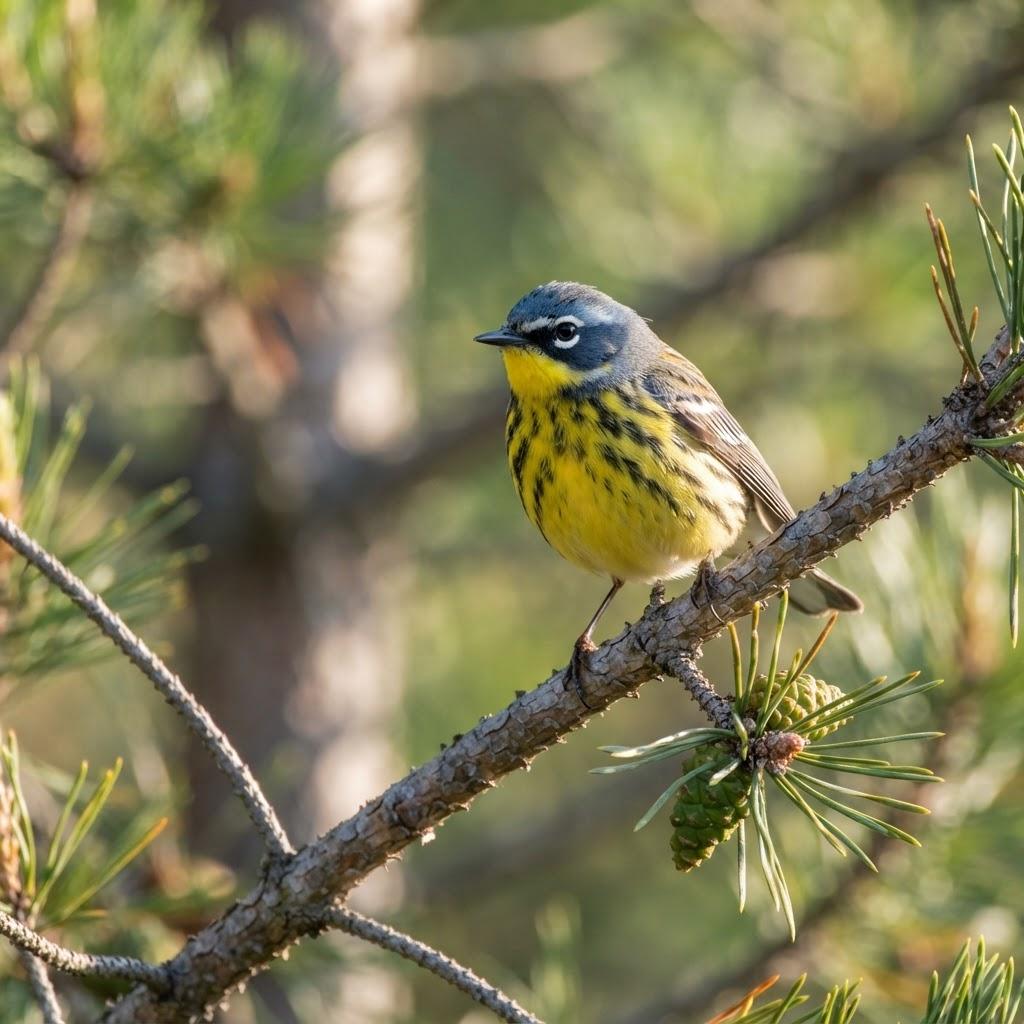
Setophaga kirtlandii
Kirtland's Warbler
The Kirtland's Warbler is a picky, high-maintenance superstar that refuses to live anywhere but specific, fire-dependent pine forests. Join us as we explore the life of this blue-gray diva and discover why its comeback is the biggest success story in bird conservation.
Meet the Bird
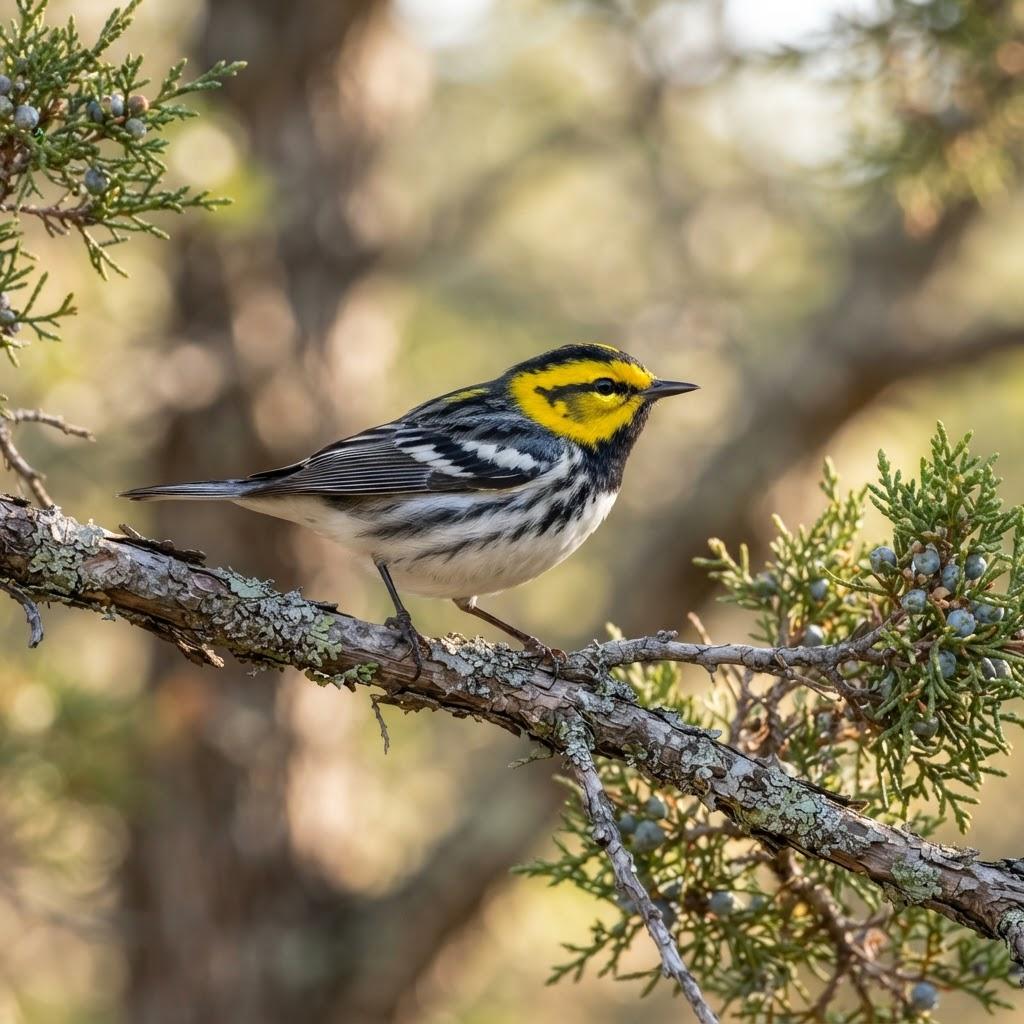
Imagine a bird that is essentially the ultimate hipster of the avian world: it only hangs out in very specific, trendy neighborhoods, dresses in a sharp blue-gray and yellow ensemble, and absolutely refuses to change its lifestyle for anyone. The Kirtland's Warbler is a small, energetic songbird that looks like it just stepped out of a high-fashion runway show for wood-warblers. With a bright yellow belly that looks like it was dipped in sunshine and a confident, wagging tail, this bird has serious main-character energy. While many birds are content to live in your average backyard hedge or local park, the Kirtland's Warbler is a total snob about its real estate. It only wants the young, scrubby jack pine forests of Northern Michigan, and it wants them to be at exactly the right stage of growth. If the trees are too tall or too short, the Kirtland's Warbler checks out. It is a feathered diva with very specific tastes, and that is exactly why it is so endlessly fascinating to the humans who trek through miles of sandy soil just to catch a glimpse of one.
Superpowers & Weird Abilities
If you think your GPS is impressive, try navigating across thousands of miles without a smartphone or a highway map. The Kirtland's Warbler possesses an internal biological compass that would put a master navigator to shame. These tiny creatures spend their summers in Michigan and then magically find their way down to the Bahamas for the winter. They achieve this through a combination of sensing the Earth's magnetic field and utilizing celestial navigation, essentially reading the stars like a cosmic roadmap. Think of it like having an invisible tether to the magnetic north pole that guides you through storms, clouds, and darkness. Furthermore, they are masters of high-speed metabolic control, allowing them to transform their tiny bodies into long-distance endurance machines. They burn fat reserves with the efficiency of a high-end sports car, allowing them to cross massive stretches of ocean without refueling. It is less like flying and more like performing a feat of biological engineering that makes human aerospace technology look like a child's paper airplane hobby.
Drama, Personality & Feathered Chaos
Life in the jack pine forest is not all sunshine and pine needles; it is a high-stakes soap opera. The Kirtland's Warbler faces a classic villain in the form of the Brown-headed Cowbird. These cowbirds are the ultimate freeloaders of the bird world. They do not build their own nests; instead, they act like mischievous house-crashers, sneaking into a Warbler's nest, dumping out an egg, and laying their own. The poor, unsuspecting Warbler then ends up raising a giant, demanding cowbird chick that often pushes the Warbler's actual babies right out of the nest. It is a real-life horror movie. The Kirtland's Warbler has had to become a bit of a security guard, constantly watching for these intruders. Because their population was once so fragile, humans have stepped in to act as the ultimate bouncers, managing cowbird populations to ensure our blue-gray friends do not get bullied out of existence. It is a dramatic, high-tension existence that would make any reality show producer proud, filled with territorial disputes and the constant battle for survival.
Bizarre Rituals & Quirky Habits
When you are a Kirtland's Warbler, you spend a lot of time doing things that seem entirely ridiculous to the average observer. For instance, they have this charming habit of tail-wagging. It is not just a nervous tick; it is a specific social signal, a way of saying 'I am here, and I am the boss of this pine tree.' They also possess a song that is so loud and distinct it sounds like they are shouting at the world from the treetops. During the winter in the Bahamas, their personality shifts from a high-energy defender of the Michigan scrub to a more relaxed, fruit-munching island tourist. They switch their diet from insects to the fruits of the black torch shrub, showing a level of dietary flexibility that contradicts their picky breeding habits. It is truly hilarious to imagine this intense, territorial bird relaxing on a tropical island, trading its aggressive defense strategies for a relaxed, sun-soaked lifestyle where the most important thing to do is find the next juicy berry.
Legends, Folklore & Human Stories
The story of the Kirtland's Warbler is not just a biological fact; it is a human epic. For a long time, the bird was considered one of the rarest creatures on the planet, and the mystery surrounding its disappearance kept scientists up at night. People searched high and low, from the Great Lakes to the deep South, before finally realizing that the birds were hiding in the middle of a specific type of fire-managed forest in Michigan. This realization sparked a massive conservation movement that brought together government agencies, private citizens, and birders from all over the world. There is a certain local folklore in Michigan that considers the sighting of a Kirtland's Warbler a mark of a 'true' birder. If you have seen one, you have passed the initiation. It has become a symbol of ecological hope, proving that even when we are on the verge of losing something beautiful, we have the power to turn things around if we are willing to work hard enough.
Mating: The Ridiculous World of Avian Dating
Dating for a Kirtland's Warbler is basically an Olympic sport with high-stakes theater. The male arrives at the breeding grounds first, staking out a territory with a song so loud and repetitive it could wake the dead. When a female finally shows up, he has to perform a song-and-dance routine that demonstrates he has the best real estate in town. He puffs up his feathers, displays his bright yellow plumage, and pursues her through the young pine trees with the speed of a fighter pilot. If she is not impressed by his vocal range or his ability to protect the perimeter, she simply flies away, leaving him to start the whole process over with a new candidate. It is a cruel, beautiful cycle of rejection and persistence. The stakes are high because if the male cannot find a mate, his entire season is a wash. He is basically competing in a talent show where the prize is not a trophy, but the survival of his legacy.
Nesting: Master Architects and Lazy Slumlords
When it comes to building a house, the Kirtland's Warbler is a master of blending in. They are ground nesters, which is a bold choice for a bird, but they make it work by tucking their nests into the base of young jack pine trees, hidden under a blanket of grasses and blueberries. They build a deep, cup-shaped nest lined with fine grasses and hair, creating a cozy little bunker for their future offspring. It is not a flashy palace, but it is a masterclass in camouflage. They essentially turn their home into a 'nothing to see here' zone, blending perfectly with the sandy floor of the Michigan woods. It is quite the contrast to the flashy aerial displays of their courtship. While they are loud and proud when they are looking for love, they turn into silent, stealthy ninjas the moment they start raising a family, knowing full well that a stray cat or a curious fox would love to find their hidden little nursery.
Raising Babies: The Screaming Food Disposals
Once the eggs hatch, the Kirtland's Warbler parents basically sign up for a non-stop, high-intensity catering job. The chicks are blind, naked, and incredibly demanding. They are essentially tiny, gaping maws that exist solely to turn caterpillars into energy. The parents are absolute machines, flying back and forth from dawn until dusk, delivering an endless stream of insects to their hungry brood. The chicks have a unique way of communicating: they scream at the top of their lungs whenever a parent returns, creating a chaotic cacophony that sounds like a tiny, chirping alarm system. The parents show zero sign of stress, despite the fact that they are essentially running a marathon every single day to feed these little monsters. In about two weeks, the chicks are ready to fledge, which is a chaotic, flapping mess of a departure. Watching them learn to fly is like watching a toddler take their first steps—lots of stumbling, wing-flapping, and accidental collisions with the low branches of the jack pines.
Bird-Watching Travel & Local Hotspots
If you are ready to check the Kirtland's Warbler off your birding bucket list, you need to head to the Northern Lower Peninsula of Michigan in late May or June. The Kirtland's Warbler Festival and the organized guided tours in the Huron-Manistee National Forest are your best bets. Because these birds are sensitive to disturbance, the government actually runs official, expert-led tours to make sure you get a peek without bothering them. Do not try to go rogue; looking for them off-trail is a great way to get lost and accidentally crush a nesting site. Instead, book a spot on a tour. There is something truly special about standing in a quiet, sandy pine forest at dawn, waiting for the distinct, clear song of the Warbler to break the silence. When you finally spot that flash of yellow and blue against the dark pine bark, you will understand why people travel from across the globe just to stand in a bug-infested forest for a few hours.
Food, Feeder Hacks & DIY Projects
Here is the reality: you are almost never going to see a Kirtland's Warbler at your backyard feeder. They are not interested in your store-bought sunflower seeds or your plastic tube feeders. They are strict insectivores during the breeding season and fruit-eaters during the winter. If you want to help them, the best thing you can do is support native habitat conservation or plant native shrubs like blueberries or serviceberries that attract the insects they love. If you are desperate to attract other warblers, skip the cheap, filler-heavy 'wild bird mix' from the grocery store. It is basically empty calories that attract rats and starlings. Instead, look into a suet cage with high-quality insect-based suet, or better yet, cultivate a native garden. By providing a diverse range of native plants, you create a natural buffet that brings in moths, beetles, and caterpillars—the absolute gourmet dinner for any warbler passing through your neck of the woods.
Seasonal Guides & "Crisis" Management
Migration is the hardest time of the year for any bird, but especially for the Kirtland's Warbler, which has to navigate the treacherous path between the Great Lakes and the tropics. In the spring, when they arrive back in Michigan, they are exhausted and ready to fight for territory. If you find a 'fledgling'—a fluffy, awkward baby bird on the ground—resist the urge to play hero and pick it up. Most of the time, the parents are watching from a nearby branch, screaming at you to leave their kid alone. The bird is just going through its 'teen phase,' learning to fly. Unless it is clearly injured or in immediate danger from a pet, back away and give it space. If you are dealing with winter, ensure your birdbaths are kept clean and ice-free with a heater. High-fat suet is a lifeline for local winter birds, even if the Warblers have already left for the Bahamas, and keeping your yard bird-friendly year-round is the best way to support the entire ecosystem.
Backyard Tech & Gadget Reviews
If you love tech, you might have seen those smart feeders with cameras that use AI to identify birds. They are fantastic for your backyard regulars like Cardinals and Blue Jays, but do not expect them to catch a Kirtland's Warbler. However, if you are looking to document the wildlife that does visit your home, a simple trail camera is a much better investment. You can strap a cheap motion-sensor cam to a tree or a deck post and catch all sorts of nocturnal or shy visitors that you would never see with your naked eye. For window safety, which is a massive issue for migrating birds, look into ultraviolet window decals or screen overlays. They are nearly invisible to humans but look like a massive 'Keep Out' sign to birds. It is a small, easy fix that saves thousands of birds a year and lets you enjoy your view without worrying about the dreaded 'thump' against the glass.
How to Spot One & How It Is Doing
To identify a Kirtland's Warbler, look for the 'three B's': Blue-gray upper parts, Black streaks, and a Bright yellow chest. They also have a very distinct, broken eye-ring that gives them a surprised look. When you are out in the field, listen for that loud, ringing, repetitive song—it is often the first thing you will notice. As for their status, the story is one of the most successful conservation tales in North America. By managing fire-prone forests and controlling cowbird populations, we have seen their numbers climb from the brink of extinction to a much healthier level. They are still 'Near Threatened,' which means we cannot get lazy now. The best thing you can do is support habitat preservation organizations and keep your local environment pesticide-free. Every healthy patch of forest, whether it is a massive national park or a protected local preserve, is a victory for the Kirtland's Warbler. It is a bird that proves humanity can actually fix what it breaks.