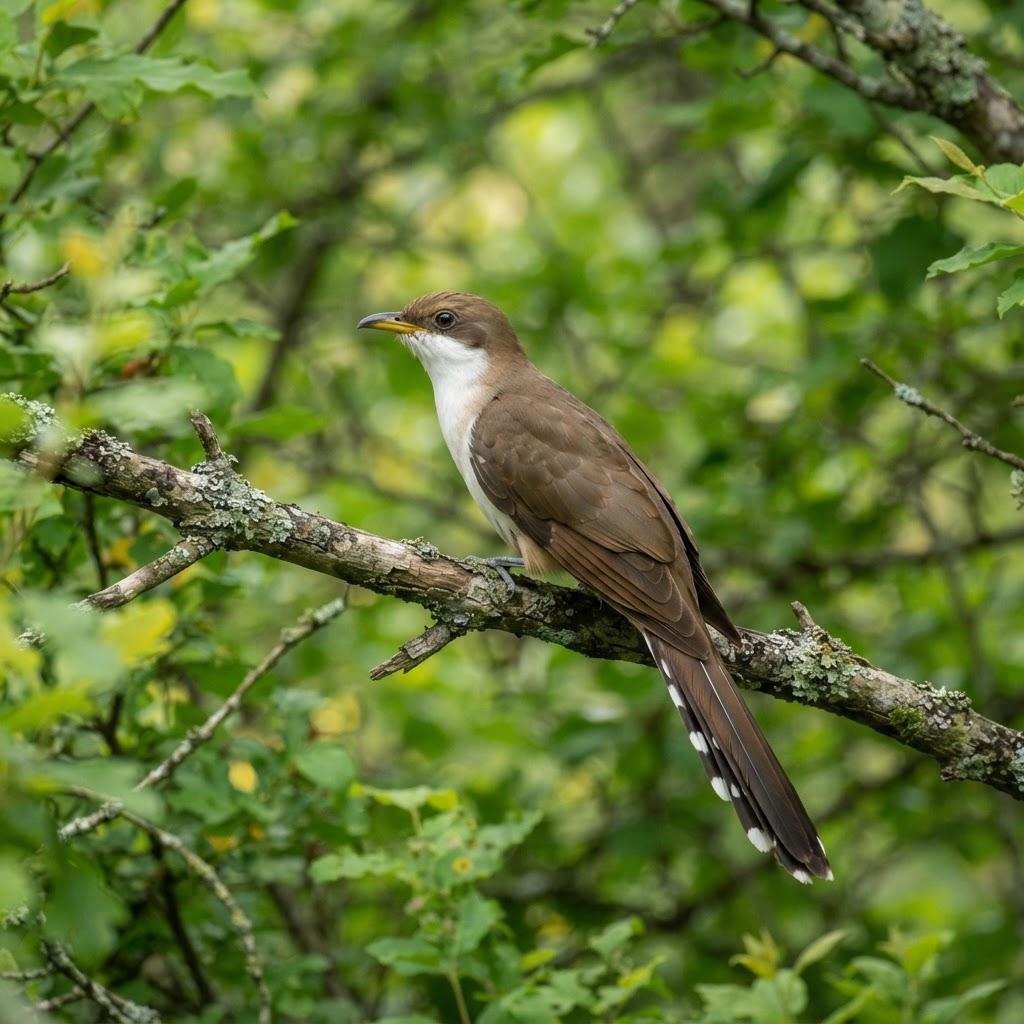
Coccyzus americanus
Yellow-billed Cuckoo
The Yellow-billed Cuckoo is the mysterious, caterpillar-loving ninja of the North American woods. Known for its haunting call and sneaky, secretive lifestyle, this bird is the ultimate 'if you see it, you're lucky' avian celebrity.
Meet the Bird
Imagine a bird that treats life like a high-stakes game of hide-and-seek and refuses to be the 'it' player. The Yellow-billed Cuckoo is a master of stealth. While many birds announce their presence with loud, annoying songs on top of your mailbox, this sleek, long-tailed speedster prefers the shadows of the canopy. With a striking rusty patch on its wings and that signature yellow beak, it looks like a refined, elegant woodland aristocrat that has decided to drop out of society to live in the deepest parts of the thicket. It is not interested in your social media photos or your bird feeders; it is here for one thing only: an all-you-can-eat caterpillar buffet. Its vibe is pure, unadulterated 'I am doing my own thing, and you probably won't even notice I am here.' If you ever catch a glimpse of its white-spotted tail feathers flashing through the trees, consider yourself inducted into a very exclusive, very elusive club.
Superpowers & Weird Abilities
The Yellow-billed Cuckoo possesses a superpower that would make a horror movie monster jealous: the ability to detect a caterpillar infestation from miles away. They are essentially biological pest-control machines with a specialized radar for 'tent caterpillars.' Most birds are picky eaters, but Cuckoos have evolved to handle the fuzzy, spiny caterpillars that would give other birds an upset stomach. They possess a unique gut lining that can actually shed its outer layer periodically to remove the toxic, irritating hairs that these caterpillars accumulate. Imagine having a stomach that you can essentially 'peel' like a piece of fruit to get rid of the garbage! This evolutionary hack allows them to feast on protein sources that literally no other bird will touch. They are the garbage disposals of the forest, turning toxic, fuzzy garden pests into high-octane energy for their long, arduous migrations across the hemisphere.
Drama, Personality & Feathered Chaos
Do not let the elegant, slender appearance fool you; the Yellow-billed Cuckoo is the brooding goth kid of the avian world. They are famously known for being dramatic, secretive, and occasionally a bit of a deadbeat parent. While they aren't as notoriously lazy as their European cousins who drop eggs into nests of unsuspecting victims, North American Cuckoos have been known to engage in occasional 'nest dumping.' This is when they decide that building a nest is beneath them and opt to leave their eggs in the nests of other species, like American Robins or Wood Thrushes. It is the ultimate backyard drama: the host bird wakes up one day to find a strange, blueish-green egg in the nursery, leading to a confusing few weeks of raising a foster child. This parasitic behavior is rare but hilarious when it happens, injecting a level of suburban soap opera chaos into the otherwise quiet woods.
Bizarre Rituals & Quirky Habits
If you ever hear a call in the woods that sounds like a repetitive 'ka-ka-ka-kow-kow-kow' that slows down at the end, you have found the Cuckoo. It sounds like a rhythmic, wooden clicking, which has led to them being called 'Rain Crows' in some rural folk circles. Old-timers used to believe that if a Yellow-billed Cuckoo started calling incessantly, it was a guarantee that rain was on the way. While there is no meteorology degree hidden in their DNA, the humidity that precedes a storm often makes insects more active, which in turn gets the Cuckoos excited. They also engage in a weird habit called 'anting,' where they allow ants to crawl over their feathers. The ants spray formic acid, which acts like a natural parasite repellent. It is basically the bird version of a trip to a high-end spa, complete with a chemical treatment to keep the bugs away.
Legends, Folklore & Human Stories
The Yellow-billed Cuckoo has been wrapped in mystery for centuries. Because they are so hard to see, early settlers often heard them but couldn't identify the source of the strange, guttural croaking. This led to a folklore tradition across the American South where the bird was considered an omen. Some said the 'Rain Crow' was a harbinger of storms; others thought it was a spirit of the woods that could predict the fate of the harvest. In some regions, hearing the cuckoo in early spring was considered lucky, provided you had money in your pocket—an old-fashioned way of ensuring financial health for the coming year. Whether you believe in the folklore or not, the mystery of the bird’s near-invisibility has kept people telling stories for generations. There is something profoundly human about needing to assign a purpose or a prophecy to a creature that refuses to be known.
Mating: The Ridiculous World of Avian Dating
Avian dating for the Cuckoo is not about flowers or fancy songs; it is about proving you can keep a secret. When a male wants to impress a female, he doesn't just sing. He presents her with a gift—usually the biggest, fattest, hairiest caterpillar he can find. It is the avian equivalent of showing up to a first date with a three-course meal you caught yourself. He will fly down, pose with his wings slightly spread to show off those lovely white spots, and let out his best, most rhythmic vocalizations. If she accepts the caterpillar, they enter a phase of synchronized 'display flying,' where they chase each other through the dense leaves at breakneck speeds. If she is not impressed by his flight path or his gift, she vanishes into the foliage, leaving him to eat the caterpillar in solitude and wonder where he went wrong.
Nesting: Master Architects and Lazy Slumlords
The nesting strategy of the Yellow-billed Cuckoo can best be described as 'minimalist industrial.' They don't want a mansion; they want something that blends in with the twigs. They build a loose, flat platform of sticks that looks like it might fall apart if a strong breeze rolls through, but it is actually quite sturdy once it is woven into a fork of a tree. They line the inside with bits of lichen, moss, and soft leaves. However, they are not always the most committed parents. Sometimes, a female will lay her eggs in a neighbor’s nest. When they do build their own, the construction process is hurried. They are not interested in curb appeal; they are interested in getting the eggs laid and getting back to their primary hobby: lurking in the shade and eating caterpillars until they can barely stay awake.
Raising Babies: The Screaming Food Disposals
Once the chicks hatch, the 'caterpillar buffet' goes into overdrive. A pair of Cuckoos is essentially a frantic catering company that never closes. The babies are born nearly naked and incredibly hungry. They grow at an astronomical rate, often doubling in size every few days. The parents become shadows, constantly zipping back and forth, delivering mouthfuls of squirming, fuzzy caterpillars to beaks that are always open. The noise level in the nest is surprisingly low, as these birds prefer to maintain their stealthy reputation, but the amount of food consumed is staggering. By the time the chicks are ready to leave the nest—which happens in an impressive 7 to 10 days—they are fully feathered and ready to start their own lives of secret caterpillar hunting. It is a rapid, intense, and remarkably efficient period of growth that turns a tiny egg into a functional predator in less than two weeks.
Bird-Watching Travel & Local Hotspots
If you want to see a Yellow-billed Cuckoo, you have to go where the trees are thick and the water is near. Think bottomland hardwood forests, large parks with mature trees, or orchards that haven't been sprayed with pesticides. During the spring and summer migration, head to hotspots like the Point Pelee National Park in Ontario, or the sprawling woodlands of the Cuyahoga Valley National Park in Ohio. In the South, any major wildlife refuge with swampy, dense corridors is a prime location. The secret to finding them is to stop looking for a bird and start listening for a rhythm. The 'kow-kow-kow' call is your compass. Go early in the morning when the humidity is high, as the insects are most active then. If you find a patch of trees that seems quiet but holds a lot of tent caterpillars, keep your eyes on the upper canopy. Be patient; the Cuckoo will eventually reveal itself.
Food, Feeder Hacks & DIY Projects
Here is the cold, hard truth: the Yellow-billed Cuckoo is a snob. They are not coming to your plastic tube feeder filled with sunflower seeds, and they definitely aren't interested in your cheap millet or cracked corn. These are specialized predators of soft-bodied insects. To attract them, your yard needs to be a habitat, not just a feeding station. The best DIY project is a 'native caterpillar sanctuary.' Stop spraying your oak, willow, and dogwood trees with insecticides. These trees are the primary host plants for the caterpillars that the Cuckoos crave. If you provide the habitat, they will come. If you want a fun project, create a 'dead-wood zone' in the corner of your yard—a pile of old branches and leaves that encourages insect biodiversity. It is the cheapest and most effective feeder you will ever build, and it supports the entire ecosystem, not just the birds.
Seasonal Guides & 'Crisis' Management
Yellow-billed Cuckoos are migratory travelers. They arrive in the northern parts of their range in late spring, usually just as the caterpillar populations are booming. By autumn, they head back toward the warmer regions of the tropics. During the 'fledgling panic' season, people often find young, awkward Cuckoos on the ground and assume they have been abandoned. In reality, they are usually just 'branchlings'—birds that are exploring the world just outside the nest. Unless a bird is clearly injured, bleeding, or being menaced by a cat, leave it alone! The parents are watching from the trees, likely screaming at you to back away. If you find a sick bird, contact a local wildlife rehabilitator. Do not try to feed it baby formula or bread, as you might inadvertently cause more harm than good. Respect the wildness; let the babies find their way.
Backyard Tech & Gadget Reviews
If you want to monitor your property for Cuckoos, forget the standard bird feeder cameras. You need motion-activated wildlife trail cameras. These rugged, weatherproof gadgets can be strapped to the trunk of a tree where you suspect nesting activity, and they will capture high-definition footage of birds that a normal feeder cam would miss. For the tech-savvy, a parabolic microphone is a game-changer. These specialized microphones allow you to 'zoom in' on audio from a distance, letting you hear the faint, guttural calls of a Cuckoo buried deep in the foliage. As for window collisions, which are a major threat to migrating birds, use UV-reflecting window film. It looks like a simple grid to human eyes but appears as a solid warning to birds. It is an easy, non-intrusive way to ensure your yard remains a sanctuary rather than a hazard for our feathered friends.
How to Spot One & How It Is Doing
To identify a Yellow-billed Cuckoo, look for that long, slender body, the brownish-grey back, and the underside that glows bright white. When it flies, look for the 'flashing' white spots on the underside of its tail feathers; this is the dead giveaway. It is a quiet, meditative bird that prefers to sit still, so binoculars are essential. Regarding their conservation, they are currently listed as Least Concern, but they are vulnerable to habitat loss. As wetlands and old-growth forests disappear, so do their favorite caterpillar spots. You can help by planting native trees—specifically oaks, which support hundreds of species of caterpillars. Every time you plant a native tree, you are planting a future meal for a Cuckoo. They are a vital part of the woodland health, and protecting them is as simple as letting your garden be a little wilder, a little messier, and a lot more natural.