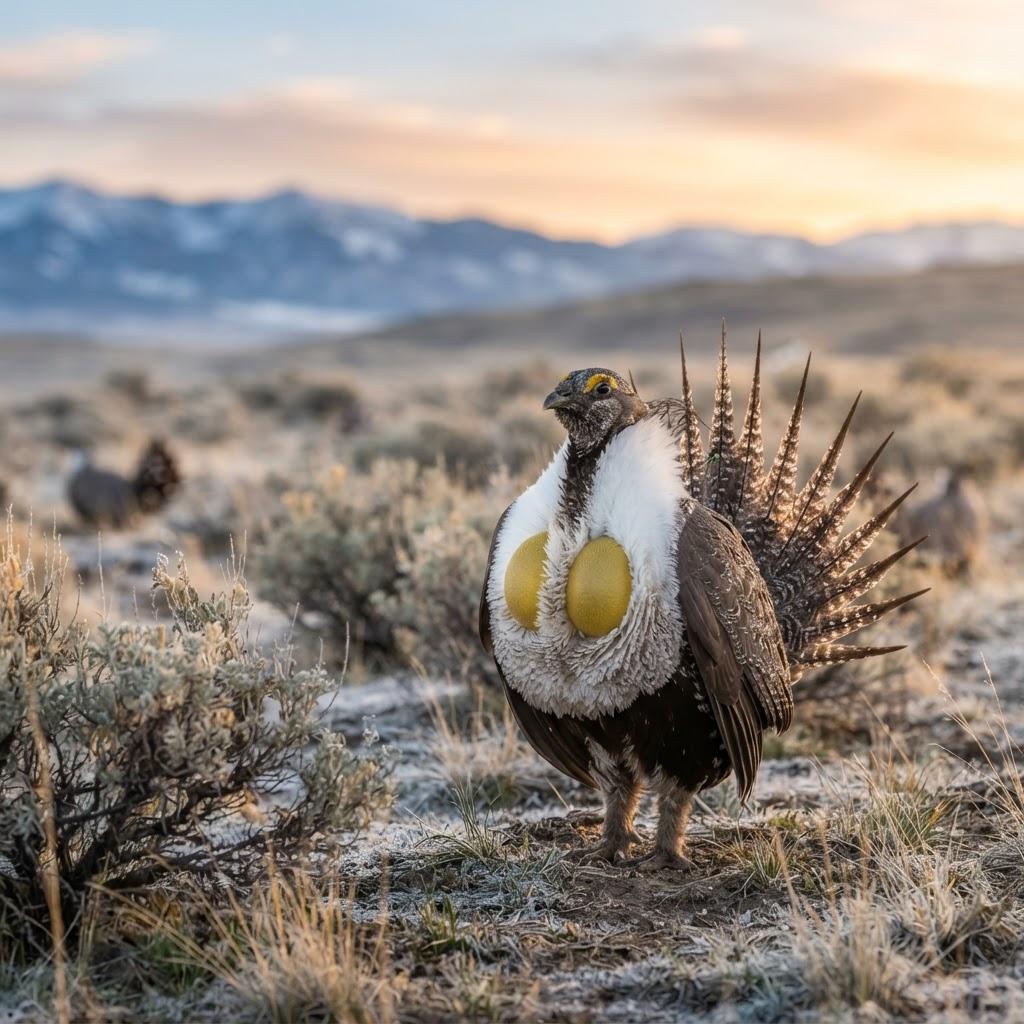
Centrocercus minimus
Gunnison Sage-Grouse
Meet the Gunnison Sage-Grouse, the bird that treats a meadow like a Broadway stage and a simple mating ritual like a heavy metal concert. With its bizarre air-filled chest balloons and frantic dance moves, this sagebrush specialist is the undisputed king of high-altitude drama.
Meet the Bird
Imagine a bird that looks like it got dressed in the dark using only items found in a dusty attic—a fancy neck-ruff here, some pointy tail feathers there, and a general aura of 'I meant to do that.' The Gunnison Sage-Grouse is not your average backyard visitor; it is the eccentric, tuxedo-clad uncle of the grouse family. With its mottled brown, black, and white plumage, it blends perfectly into the sagebrush landscape until it decides to explode into motion. This bird is all about the vibe. It struts through the high-altitude meadows of Colorado and Utah with a level of confidence that is honestly inspiring, even if that confidence is usually directed at a shrub. It is not just a bird; it is a walking, talking, and occasionally chest-thumping piece of living art. Think of it as the Groucho Marx of the avian world—serious about its business, inherently funny to watch, and perpetually suspicious of anything that moves too quickly.
Superpowers & Weird Abilities
The Gunnison Sage-Grouse possesses an internal plumbing system that would make an engineer weep with joy. The most striking 'superpower' is its ability to inflate two bright yellow esophageal sacs—those are the puffy, lemon-colored air bags on its chest—and then snap them shut to produce a sound like a low-frequency, bubbling pop. It is essentially a biological submarine airlock system. By using these sacs, the males emit a 'wuck-wuck-wuck' sound that travels across the vast, quiet sagebrush flats like a prehistoric drum beat. Furthermore, these birds have evolved to survive on a diet that would kill most other animals: sagebrush leaves. These leaves are loaded with chemical compounds that are toxic to most herbivores, but the grouse has specialized gut bacteria that essentially act as a detox unit. It is the avian equivalent of being able to eat raw poison for breakfast and call it a balanced diet.
Drama, Personality & Feathered Chaos
If there is a category for 'Most Likely to Start a Fight at the Local Pub,' the male Gunnison Sage-Grouse takes home the trophy. During the spring, their personalities shift from 'mild-mannered shrub-dweller' to 'aggressive ego-maniac.' These birds are not communal sharers; they are territorial tyrants who view every other male in the vicinity as a direct affront to their personal brand. They spend the vast majority of their time on display grounds, known as leks, where they engage in chest-to-chest combat that looks like two feathered pillows fighting in a slow-motion car crash. It is pure, unadulterated soap opera drama. They hold grudges, they engage in turf wars that last for hours, and they possess a stubbornness that makes a mule look like a pushover. If you think the neighborhood cat is a drama queen, just wait until you see two male grouse arguing over the prime spot on a dirt mound.
Bizarre Rituals & Quirky Habits
Beyond the chest-popping spectacle, the Gunnison Sage-Grouse has habits that fall somewhere between 'weird' and 'outright hallucinogenic.' One of their most peculiar behaviors is their strict adherence to the lekking schedule. These birds return to the exact same spots year after year, almost like they are fulfilling a sacred contract signed by their ancestors. They are also notoriously skittish, yet occasionally so preoccupied with their own vanity that they will practically trip over their own feet while trying to strut. They seem to enjoy a good dust bath, kicking up sand and debris with a frantic, uncoordinated energy that looks like a toddler having a tantrum in a sandbox. The reasoning? It keeps their feathers clean and keeps those pesky parasites at bay. It is a simple life, but one defined by a set of rigid, slightly absurd rules that they follow with alarming devotion.
Legends, Folklore & Human Stories
The Gunnison Sage-Grouse is a ghost of the Great Basin, a bird so tied to its specific landscape that it has become a symbol of the American West's rugged isolation. While not as heavily mythologized as the eagle or the raven, local ranching communities have long viewed these birds as the 'barometers of the sage.' If the grouse are doing well, the land is doing well, and the grass is healthy for the cattle. They are seen as stoic, silent observers of history, witnesses to the arrival of pioneers, the expansion of the railways, and the modern era of conservation. There is a quiet reverence for them; they are not pests or songbirds, but neighbors who have lived in the same valley for eons. To see one is considered a stroke of genuine luck, a fleeting encounter with a creature that seems to know secrets about the high desert that we have long forgotten.
Mating: The Ridiculous World of Avian Dating
The courtship ritual of the Gunnison Sage-Grouse is the avian equivalent of an elaborate, low-budget talent show. The males arrive at the lek before dawn, chest sacs inflated like oversized balloons, and begin their performance. It involves a strange, rhythmic strut, the flicking of sharp tail feathers, and that signature bubbling, popping sound that echoes across the dark prairie. The females wander through the crowd like judges at a dance competition, looking bored, unimpressed, and occasionally offended by a particularly clumsy suitor. If a male misses a beat or fails to inflate his sac to the proper tension, the female simply walks away, leaving him standing there in the dirt, looking like a discarded balloon at a birthday party. It is a high-stakes, high-stress scenario where only the most 'poppable' males get the girl, making the whole thing a masterclass in avian pick-up artistry.
Nesting: Master Architects and Lazy Slumlords
When it comes to building a home, the female Gunnison Sage-Grouse is the embodiment of 'less is more.' They do not construct elaborate, woven palaces. Instead, they find a small depression in the ground, usually under the protective canopy of a sagebrush bush, and scratch out a simple, shallow bowl. They add a few bits of grass, a stray feather or two, and call it a day. It is the architectural equivalent of a college student's dorm room—efficient, functional, and deeply minimalist. The brilliance lies in the concealment; because the nest is practically invisible from above, it avoids the prying eyes of coyotes, eagles, and other opportunists. While it might look like a lazy construction project, the strategic placement is a work of genius. It is not about luxury; it is about survival, and in the harsh world of the sagebrush flats, blending into the dirt is the ultimate success.
Raising Babies: The Screaming Food Disposals
The moment those eggs hatch, the mother grouse faces an immediate logistical nightmare. Sage-grouse chicks are precocial, which is a fancy scientific way of saying they are born with their eyes open and ready to run. They do not sit in the nest and wait for a parent to drop a worm into their gaping maws like a robin; they are up and wandering almost immediately, looking for their first meal. The mother’s job then shifts from 'nest sitter' to 'chief safety officer.' She leads them through the treacherous sagebrush, keeping a frantic eye out for hawks while the chicks frantically peck at insects and plants. It is a chaotic, exhausting process where the chicks are essentially miniature versions of their parents, just with worse coordination and an even stronger drive to sprint away from the only person keeping them alive. It is parenting by high-speed chase.
Bird-Watching Travel & Local Hotspots
If you are planning to cross the Gunnison Sage-Grouse off your life list, you need to be prepared for some early mornings and chilly weather. The primary, and most reliable, location to observe these birds is the Gunnison Basin in Colorado. Several local organizations and the Bureau of Land Management offer guided viewing opportunities during the peak spring lekking season, which usually falls between late March and mid-April. You must arrive well before sunrise, as the show starts when the world is still dark and frost is covering the ground. The key is to stay in your vehicle or behind a viewing blind; these birds are incredibly sensitive to human presence, and if you scare them off their lek, you might ruin the entire morning’s performance. Check the local visitor center in Gunnison, Colorado, for the latest lek viewing schedules and ethical birding guidelines.
Food, Feeder Hacks & DIY Projects
Here is the reality check: you are not going to attract a Gunnison Sage-Grouse to your backyard bird feeder. These birds are strict specialists; they are deeply tied to the sagebrush ecosystem and simply do not do 'backyards' in the traditional sense. They do not eat sunflower seeds, they do not care for your high-quality suet, and they definitely do not want your spilled millet. If you want to support them, the best 'DIY project' is habitat conservation. Instead of buying a feeder, consider donating to land trusts or conservation groups that work to protect sagebrush corridors from development. If you are a landowner in their range, native plant gardening—specifically maintaining healthy sagebrush—is the only way to invite them in. It is not the instant gratification of a hummingbird feeder, but it is the only way to actually help this species thrive.
Seasonal Guides & "Crisis" Management
The life of a Gunnison Sage-Grouse is a seasonal rhythm of survival. Winter is the hardest time, as the snow covers their food sources, forcing them to rely entirely on the tough, bitter sagebrush leaves that poke through the drifts. If you ever find a 'fledgling' in the wild—a young bird that looks uncoordinated and confused—the rule is simple: leave it alone. Young grouse are notoriously clumsy and often spend time hiding in the brush while the mother watches from a distance. If you pick it up, you are essentially kidnapping a teenager who is just trying to figure out how to forage. Unless the bird is clearly injured or bleeding, the best way to help is to back away and give them space. During the winter, avoid hiking in sensitive sagebrush areas where the birds might be huddled up, as burning unnecessary calories to escape you can actually be fatal for them.
Backyard Tech & Gadget Reviews
Technology for observing the Gunnison Sage-Grouse is best utilized in the field, not the backyard. If you are serious about capturing footage, a high-quality trail camera with a strong motion sensor is the gold standard. Place it near known lekking grounds during the off-season to monitor activity. For those interested in home tech, smart bird feeders with AI recognition are fantastic for learning about your local songbirds, but they will not help you with the sage-grouse. When you are out in the field, invest in a quality spotting scope rather than a camera gadget. A scope allows you to watch the birds from a distance without disturbing their display. As for window collisions, which are a major threat to all birds, use UV-reflective decals on your house windows to help the local avian population navigate safely, even if the grouse themselves never venture near your porch.
How to Spot One & How It Is Doing
Spotting a Gunnison Sage-Grouse is a test of patience. Look for the 'popping' movement in the early morning light—that distinct, rhythmically inflating chest sac is the giveaway. They are mostly ground-dwelling, so scan the base of sagebrush bushes rather than looking up at the sky. Unfortunately, this species is endangered, primarily due to habitat loss and fragmentation. Their dance floors are being replaced by roads, fences, and development. The best way to help is by supporting landscape-level conservation efforts. Spread the word about their precarious situation; the more people who know about this weird, chest-popping, sage-loving icon, the more likely we are to protect the vast, quiet spaces they call home. They are a treasure of the American West, and with a little bit of respect and space, we can ensure they keep dancing for generations to come.