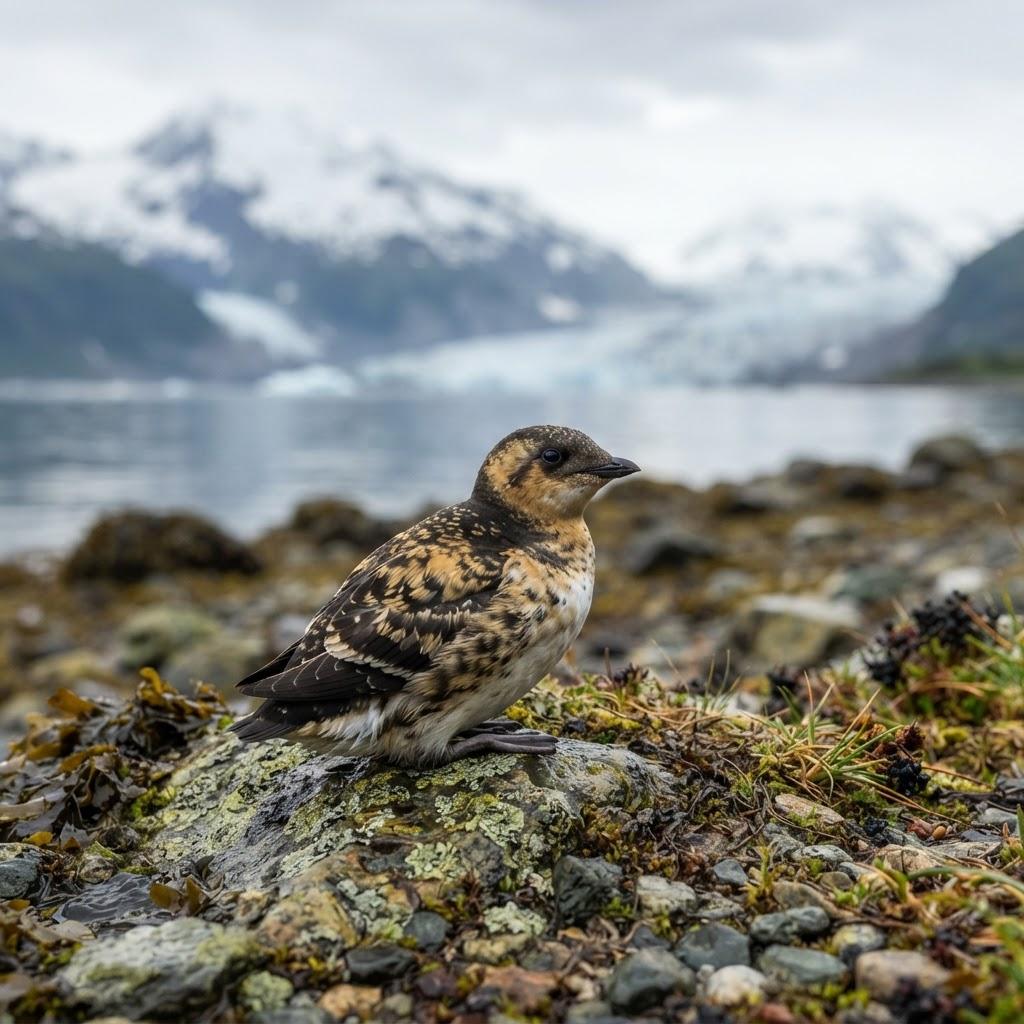
Brachyramphus brevirostris
Kittlitz's Murrelet
Meet the Kittlitz's Murrelet, a mysterious ghost of the icy north that prefers glacial fjords to tropical beaches. This avian enigma is as elusive as a secret agent and just as cool under pressure.
Meet the Bird
Imagine a bird that decided a tropical vacation was overrated and chose instead to hang out exclusively in the coldest, most treacherous glacial fjords on the planet. Enter the Kittlitz's Murrelet, the brooding, mysterious rebel of the auk family. While its cousins might be seen frolicking in busy harbors or lounging on accessible cliffs, this bird is the ultimate recluse. With its mottled, camouflaged feathers that perfectly mimic gravel and lichen, the Kittlitz's Murrelet looks like a piece of the mountain that suddenly decided to grow wings and fly away. It is essentially the bird equivalent of a ninja—stealthy, specialized, and rarely spotted by the untrained eye. If you happen to glimpse one bobbing on the frigid, mirror-like waters of an Alaskan bay, consider yourself initiated into a very exclusive club. It doesn't want your attention, it doesn't care about your feeder, and it definitely thinks your vacation photos are boring. This is a creature defined by its extreme lifestyle, living on the razor's edge of glacial ice and open sea, and it wouldn't have it any other way.
Superpowers & Weird Abilities
The Kittlitz's Murrelet possesses the biological equivalent of an all-terrain vehicle mode. Most birds are either masters of the air or masters of the sea, but this bird is a high-functioning hybrid. To survive in the freezing, nutrient-dense waters near glaciers, it has developed incredible physiological adaptations. It can dive to surprising depths in bone-chilling water to snag small fish, thanks to a dense, insulating plumage that would make a high-end winter parka look like a tissue paper shirt. But the real sci-fi ability is its navigation. These birds don't just fly from point A to point B; they navigate vast, featureless stretches of the Bering Sea with uncanny precision. They possess an internal compass that allows them to find their way back to specific, often isolated, high-altitude mountain nesting sites that look identical to a hundred surrounding peaks. It is like having a GPS embedded in your brain that functions perfectly in a blizzard, with zero bars of service, powered entirely by sheer avian instinct.
Drama, Personality & Feathered Chaos
If you are looking for a bird that throws social garden parties, look elsewhere. The Kittlitz's Murrelet is a solitary soul, and honestly, we respect the boundaries. While other seabirds live in noisy, crowded colonies that resemble a perpetual, screaming rock concert, the Murrelet practices intense social distancing. It is the ultimate lone wolf of the Pacific, navigating the drama of existence entirely on its own terms. There are no grudges held against humans because it simply doesn't interact with us long enough to build a case. It is a creature of deep, quiet focus. While the neighborhood jay might be busy starting fights over a peanut, the Murrelet is busy being an enigma. It exists in a state of perpetual chill, avoiding the chaotic drama of flock life in favor of the silent, icy solitude of the fjords. It isn't a bully; it's an ascetic, quietly going about its business while the rest of the avian world screams for attention.
Bizarre Rituals & Quirky Habits
One of the strangest things about the Kittlitz's Murrelet is its choice of real estate. While most seabirds build nests on cliffs or in burrows by the shore, the Murrelet decides to hike—or rather, fly—miles inland to lay its egg on bare, rocky, high-altitude slopes. Why? Because it can. It finds a spot that looks like a desolate moonscape, devoid of any protective cover, and just drops an egg right on the ground. It relies entirely on its magical, grey-brown camouflage to stay hidden from predators. It also exhibits a bizarre habit of flying at incredible speeds directly toward its nest, often at dusk or dawn, creating a whooshing sound that has startled many a researcher. This isn't just a flight; it's a high-speed landing sequence performed in low light, requiring reflexes that would make a fighter pilot look like a learner driver. The bird essentially turns itself into a feathered missile, guided by nothing but muscle memory and raw, unadulterated grit.
Legends, Folklore & Human Stories
In the indigenous cultures of the North Pacific, the Murrelet has long been seen as a spirit of the glaciers. Because they appear and disappear like fog in the mountains, they have become woven into stories about the shifting nature of the ice. There are tales of hunters who followed the call of the Murrelet through the mountain passes, only to find themselves in valleys that time seemed to have forgotten. To the locals who lived in harmony with the ice, the bird wasn't just a physical creature; it was a guardian of the high places. It remains a symbol of the untamed, frigid beauty of the north. Modern researchers often tell stories of spending weeks on a boat in freezing rain, waiting for a single, fleeting glimpse, only to be humbled by the bird's casual ability to vanish into the mist. It is a bird that demands respect, not by being loud, but by being impossible to pin down, keeping the mystery of the North alive for anyone daring enough to go looking.
Mating: The Ridiculous World of Avian Dating
The dating life of a Kittlitz's Murrelet is less about 'romantic dinners' and more about 'high-stakes aerial maneuvers.' Because they are so spread out, finding a partner is like trying to find a specific grain of sand in a glacier. Once they find one another, the courtship involves a series of synchronized flights that look like an intricate, high-speed ballet. They zoom past each other, calling in low, haunting tones that echo off the surrounding mountains. There are no fancy gifts, no elaborate stick-nests, and definitely no flowers. It is pure, kinetic energy. If the female is impressed by the male's ability to navigate the fjords without crashing, they form a bond that is as tough as the environment they live in. It's a no-nonsense, high-performance partnership. They don't have time for games; they have a short summer window to produce an offspring, so they get straight to the point with precision and efficiency.
Nesting: Master Architects and Lazy Slumlords
If you were expecting a cozy, woven basket lined with feathers, you are going to be disappointed. The Kittlitz's Murrelet is the ultimate 'minimalist' architect. It does not build a nest. It literally lands on a patch of loose rock, finds a slight depression, and says, 'This is fine.' There is no straw, no mud, no spider silk, and no interior design aesthetic. It is just the bird, the rock, and the egg. The egg itself is perfectly camouflaged to match the gravel, a marvel of evolutionary art. It is a gamble, really—the bird relies entirely on not being noticed by foxes or ravens. This nesting style is the pinnacle of risk-taking, making the 'pile of sticks' approach of a pigeon look like a high-end architectural firm. It is a dangerous game of hide-and-seek, where the only prize is the survival of the next generation. It's not lazy; it's simply trusting in the power of invisibility.
Raising Babies: The Screaming Food Disposals
Raising a chick on a mountain top while fishing in the ocean is a logistical nightmare. The parents spend their days acting as high-speed delivery couriers, flying back and forth between the ocean and the mountain, carrying a single, precious fish at a time to their hungry chick. The chick, once hatched, is a fuzzy, demanding ball of fluff that has no idea how hard its parents are working. It sits on the cold rocks, waiting to be fed, while the parents put in massive amounts of energy to keep it fueled. The chicks fledge—leave the nest—remarkably quickly. They essentially have to grow up fast because the environment is so brutal. There is no coddling in the Murrelet world. It is 'here is your fish, now get ready to fly, because winter is coming and the ice waits for no one.' It is a brutal, demanding upbringing that creates incredibly resilient birds.
Bird-Watching Travel & Local Hotspots
If you want to see a Kittlitz's Murrelet, you aren't going to find it in your local park. You need to pack your thermals and head to the rugged coast of Alaska. Glacier Bay National Park is the absolute gold standard for catching a glimpse of these ghosts. Specifically, the waters near tidewater glaciers are your best bet. Bring a pair of high-quality binoculars and a very warm coat. Another great spot is the Kenai Fjords National Park, where boat tours can take you out into the deep, cold bays where these birds congregate. The best time to go is during the breeding season, roughly from May to July. Be prepared for rain, wind, and the humbling realization that nature is much bigger than you are. Don't expect a close-up photo-op; this is a bird of patience. You will be scanning the water for hours, but when that distinctive, gray-mottled shape finally appears, it will be the highlight of your life.
Food, Feeder Hacks & DIY Projects
Here is the reality: you cannot attract a Kittlitz's Murrelet to your backyard with a tube feeder full of sunflower seeds. This bird is a specialized piscivore, which is a fancy way of saying it exclusively eats small fish and marine invertebrates. It is not going to touch your birdbath, it is not interested in suet, and it certainly doesn't care about your DIY pinecone projects. Attempting to 'hack' a feeder for this species would be like trying to feed a tiger in a goldfish bowl. The only way to 'attract' them is to protect the marine environments where they feed. If you want to help, support marine conservation efforts, reduce plastic waste that clogs up the oceans, and vote for policies that protect the pristine glacial fjords they call home. Your backyard is great for sparrows and finches, but the Murrelet demands the open, wild ocean. Respecting its need for space is the greatest thing you can do for it.
Seasonal Guides & "Crisis" Management
The life of a Murrelet follows the rhythm of the glaciers. In the spring, they return to the mountains to breed, and in the fall, they retreat to the open sea for the winter. There is no 'fledgling panic' season for homeowners to worry about, because you will never find a Murrelet fledgling in your flowerbed. If you are out in the wild and see a baby bird on the ground, remember the golden rule: leave it alone. The parents are almost certainly nearby, watching from a distance. If you see a bird that looks truly injured, call a local wildlife rescue expert, but do not touch it yourself. For the Murrelet, the 'crisis' is habitat loss. As glaciers melt and recede, their very specific nesting grounds are disappearing. Watching for signs of disturbance in their habitat during the summer months is the best way to be a guardian for this species.
Backyard Tech & Gadget Reviews
Since the Kittlitz's Murrelet will never grace your Bird Buddy or trigger your smart feeder, what tech should you actually use? Invest in a high-quality pair of waterproof, fog-proof binoculars. When you are on a boat in the Alaskan fjords, the moisture will destroy cheap gear instantly. You want something with at least 8x or 10x magnification that can handle a bit of spray. A decent camera with a long telephoto lens is also vital if you want to capture them, as they are rarely comfortable with getting close. Forget the motion-sensor yard cameras; instead, focus on using digital apps like eBird to track sightings in your travel regions. Sharing your observations helps scientists understand where these birds are shifting their populations as the climate changes. The real tech here is the tool that helps you document the bird's presence without invading its privacy, allowing you to contribute to citizen science.
How to Spot One & How It Is Doing
To identify a Kittlitz's Murrelet, look for a small, chunky bird that sits low in the water. Its plumage is a mottled gray and brown, which looks remarkably like salt and pepper from a distance. Its bill is short—hence the name 'brevirostris,' which is Latin for short-billed—and it has a very distinct, rapid wingbeat when it flies. Its conservation status is 'Near Threatened,' which means it is a species under pressure. The biggest threat is the retreat of the glaciers due to a warming climate, which removes their nesting habitat and disrupts the local marine food web. However, you can help by being an advocate for the wild places they inhabit. Whether it's supporting organizations like the Audubon Society or simply spreading the word about the beauty of these icy recluses, your interest keeps their story alive. They are the feathered ghosts of the north, and with a little care, they can continue to haunt the glaciers for generations to come.