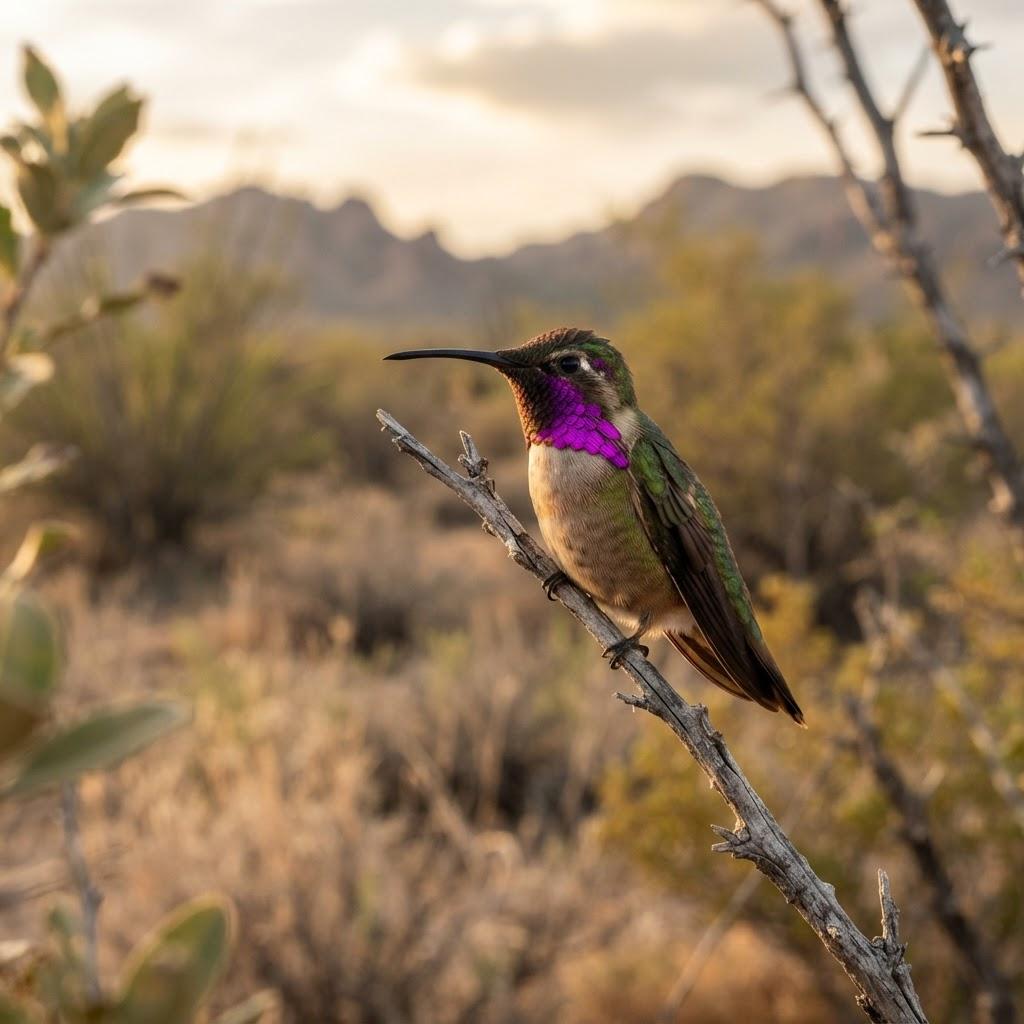
Calothorax lucifer
Lucifer Hummingbird
The Lucifer Hummingbird is a tiny, desert-dwelling daredevil that combines a curved beak with a theatrical personality. If you appreciate birds that act like miniature fighter jets with attitude, this is your new favorite avian celebrity.
Meet the Bird
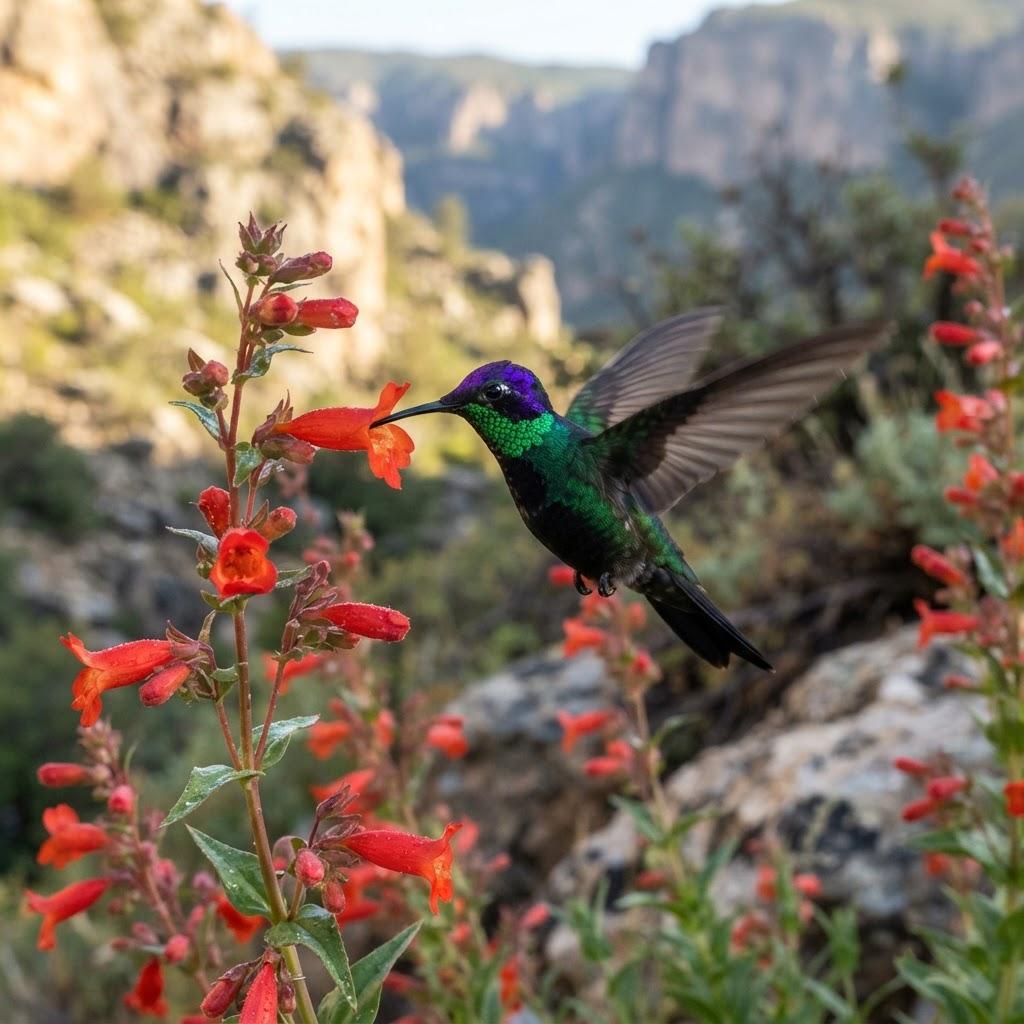
Imagine, if you will, a creature the size of a ping-pong ball that has the attitude of a heavyweight boxer in a mid-life crisis. Meet the Lucifer Hummingbird, a bird whose name sounds like it belongs to an 80s heavy metal band but whose lifestyle is all about finding the best nectar in the harshest desert landscapes. This isn't your average, garden-variety hummingbird that politely sips from a plastic feeder. The Lucifer is a specialist, a rugged survivor of the Chihuahuan Desert who looks like a feathered gem dipped in copper and neon purple. When it zips by, it sounds like a tiny, angry hornet that forgot its coffee. It has a long, down-curved beak that functions like a custom-made tool for sipping nectar from deep-throated desert flowers, specifically the agave. It is twitchy, it is fast, and it treats every morning like it is late for a very important meeting with destiny. You would be too if you weighed less than a nickel and possessed a metabolism that required a constant sugar high just to exist.
Superpowers & Weird Abilities
Hummingbirds are essentially the helicopters of the avian world, and the Lucifer is an advanced military-grade model. While most birds flap their wings in a generic up-and-down motion, the Lucifer pulls off a move known as a figure-eight stroke. This allows it to generate lift on both the forward and backward wing beat. Imagine trying to swim through water, but instead of just pushing, you’re pulling and pushing simultaneously to create a vortex. They do this roughly 50 to 80 times per second. To manage this kind of physical exertion, their hearts can beat over 1,200 times per minute. If you were a human doing that, you would effectively explode. Furthermore, they can hover in place with terrifying precision, allowing them to extract nectar from flowers that sway violently in the desert winds. They have adapted their bodies to handle G-forces that would make a fighter pilot pass out, all while maintaining the ability to switch directions faster than a politician changing their mind.
Drama, Personality & Feathered Chaos
If you put two Lucifer Hummingbirds in a room, you are going to get an immediate fight club scenario. These birds are not community-oriented souls who share the wealth. They are fiercely territorial, viewing every nectar-filled flower in a hundred-yard radius as their personal property. If another hummingbird, bee, or large moth dares to approach 'their' agave, the Lucifer dives in like a feathered missile, complete with high-pitched chirps of outrage. Their personality is best described as 'aggressive perfectionist.' They spend a vast portion of their day sitting on a high perch, watching for intruders, and then unleashing a miniature fury the moment anyone comes near. This drama is the primary form of entertainment for anyone lucky enough to have a nesting pair in their backyard. They don't just exist; they patrol. They don't just eat; they defend their culinary rights with a frantic, buzzing intensity that makes them feel far larger than they actually are.
Bizarre Rituals & Quirky Habits
One of the most peculiar habits of the Lucifer Hummingbird is its obsession with spider webs. It isn't just looking for bugs to snack on; it is looking for high-quality construction materials. They will actively hunt for spider silk, harvesting it with the precision of a master tailor. They use this sticky, elastic thread to bind their nests together, mixing it with plant down and lichen. Beyond their building supplies, they exhibit a strange behavior known as 'torpor.' When the desert temperatures plummet at night, the bird doesn't just sleep; it effectively shuts down. Its heart rate drops, its body temperature plummets to match the air, and it enters a state of deep suspended animation. It is essentially a biological 'off' switch that prevents them from burning through their remaining calories during the cold night. When the sun hits them in the morning, they effectively 'reboot' their systems and launch right back into the fray of the day.
Legends, Folklore & Human Stories
In the indigenous cultures of the American Southwest and Mexico, hummingbirds are frequently cast as messengers or symbols of enduring vitality. While the Lucifer specifically isn't the subject of a thousand bedtime stories, the general 'hummingbird spirit' is seen as a bringer of joy and a link between the mundane world and the supernatural. Given their name—Lucifer, which translates to 'light-bearer'—there is a certain poetic irony in how these birds sparkle under the desert sun. They are often perceived as tiny warriors of the drought, surviving in landscapes where most other creatures would wither away. Many local legends speak of hummingbirds being the guardians of the flowers, creatures that ensure the cycle of life continues even when the water runs dry. Human observers often report that their presence feels like a good omen, a tiny spark of brilliant, living energy that reminds us of the resilience of nature in the face of inhospitable terrain.
Mating: The Ridiculous World of Avian Dating
Courtship for the male Lucifer Hummingbird is a high-stakes, high-altitude performance art piece. The male chooses a spot and waits for a female to cruise by. Once she enters the airspace, he initiates a display that would make a stunt pilot blush. He flies in wide, soaring arcs, performing a U-shaped dive that involves incredible speed and a dramatic, loud 'whir' of the wings at the bottom of the arc. This sound isn't just flapping; it is a specifically engineered noise meant to signal his virility and fitness. If the female is unimpressed, she will simply fly away, treating him like a bad date at a coffee shop. If she is intrigued, she will perch, and he will continue to show off his iridescent throat feathers, angling them to catch the light until he looks like a strobe light on overdrive. It is a game of 'look at my colors, look at my speed, look at how well I can dance,' and it is deeply, hilariously dramatic.
Nesting: Master Architects and Lazy Slumlords
If the male is the drama king, the female is the structural engineer. After she has been sufficiently dazzled by the mating display, the male disappears, leaving the female to perform the monumental task of building a nest. She doesn't just throw some twigs together like a pigeon. She crafts a tiny, cup-shaped masterpiece out of plant fibers, moss, and, crucially, that pilfered spider silk. Because of the silk, the nest is actually expandable. As the chicks grow and fill the space, the nest literally stretches to accommodate them. It is a work of architectural brilliance hidden in plain sight, usually tucked away in the branches of a desert shrub or low tree. It’s camouflaged to look exactly like a knot of wood or a clump of lichen, which is a brilliant tactical defense against the prying eyes of snakes, lizards, and other predators that would love to treat her babies like a quick, bite-sized snack.
Raising Babies: The Screaming Food Disposals
Raising a family for a Lucifer Hummingbird is a marathon of exhaustion. Once the eggs hatch, the mother becomes a full-time flight attendant, bartender, and security guard. The babies, which start out the size of a bean, possess an unquenchable hunger. They spend the vast majority of their time with their mouths open, vibrating with a high-pitched demand for protein and nectar. The mother spends her entire day on the wing, buzzing back and forth, frantically collecting nectar and tiny insects to supply the caloric needs of her brood. She has to balance feeding them, protecting them, and keeping the nest clean, all while ensuring she doesn't starve herself. By the time the chicks are ready to fledge, they are nearly the same size as their mother. It is a miracle of efficiency, even if the chicks show absolutely no gratitude for the thousands of trips she has taken on their behalf.
Bird-Watching Travel & Local Hotspots
To see the Lucifer Hummingbird in its natural kingdom, you need to head toward the Chihuahuan Desert, specifically the mountainous areas of West Texas. Big Bend National Park is arguably the crown jewel for this endeavor. If you are there between April and September, your chances of catching a glimpse go up significantly. Look for the blooming agave plants or the Ocotillo flowers; if you stake out a flowering shrub in the desert canyons of the Chisos Mountains, you are playing the game correctly. Arizona and New Mexico also host these birds, particularly in high-elevation desert canyons. The key is to find the transition zones where the desert scrub meets the mountain woodland. It isn't a bird you usually see at your local park in the suburbs of a temperate city. This is a destination bird, requiring a bit of a hike, plenty of water, and a high-quality pair of binoculars to track their rapid-fire movements against the vast, dusty backdrop of the desert.
Food, Feeder Hacks & DIY Projects
If you live in a region where these birds visit, you can bring the desert to your backyard. They are nectar specialists, so forget birdseed—they aren't interested in your sunflower hearts. The best way to attract them is to plant native desert flora, like agave, desert honeysuckle, and penstemon. For feeders, a standard 4:1 water-to-sugar ratio is all you need. Do not, for the love of all things holy, add red food coloring—that is essentially junk food for birds and can be harmful. A simple DIY feeder project involves taking a small, red-topped feeder and hanging it near a bright red ribbon or flower to catch their eye. Keep the feeders sparkling clean; hummingbirds are fastidious eaters and will ignore a dirty, moldy feeder. If you want to keep costs down, stick to plain white sugar. It is cheap, effective, and works better than the expensive, pre-mixed nectar packets you find at big-box stores, which are often just overpriced sugar water anyway.
Seasonal Guides & "Crisis" Management
As the seasons shift, so does the life of the Lucifer. Spring is when they arrive, exhausted from migration, looking for territories to defend. This is the prime time to have your feeders pre-cleaned and hung. As summer hits, you are in the 'fledgling panic' season. You might see a tiny, scruffy-looking bird sitting on a branch that looks like it has forgotten how to be a bird. Do not panic, and definitely do not 'rescue' it. Unless it is clearly injured or in immediate danger from a cat, the mother is likely nearby, watching from a distance and bringing food. If you see a baby on the ground, the best course of action is to walk away and give it space. During the late summer and fall, prepare for them to be particularly grumpy as they fuel up for their return trip to Mexico. Keep those feeders full, as they are essentially loading up their internal fuel tanks for a massive journey.
Backyard Tech & Gadget Reviews
If you want to get into the high-tech side of birding, the market is full of 'smart' feeders that can capture high-definition footage of your visitors. A motion-activated camera pointed at your feeder is the best way to catch the Lucifer, because they move too fast for the human eye to appreciate fully. Slow-motion footage is life-changing—it allows you to see the individual iridescent feathers and the way their wings move like blades of a fan. Regarding window collisions, the biggest danger to these tiny speedsters is a clear glass reflection. Use window film, decorative decals, or even a simple piece of string grid to break up the reflection. It doesn't ruin the view, but it makes the glass visible to the birds. Investing in a cheap trail camera can also give you a window into the nightly lives of the creatures in your yard, providing a fun, low-effort way to observe nature without actually having to stand outside in the heat.
How to Spot One & How It Is Doing
Spotting a Lucifer is all about recognizing the 'whir.' It is a distinct sound, different from the buzz of a bumblebee, with a mechanical edge to it. Look for the male’s brilliant purple throat, which can look black until it catches the sun, at which point it flares with intensity. The female is less flashy, possessing a buffy-white underside that helps her blend into the desert sand. They are currently listed as Least Concern, which is great news, but they are still highly dependent on the health of the desert ecosystem. You can help by supporting local land conservation efforts that protect native desert habitat from being torn up for development. Protecting their flowers and their water sources is the best gift you can give them. They are tiny, tenacious survivors, and as long as we keep the desert healthy, the Lucifer will continue to provide the best, most frantic show in the Southwest.