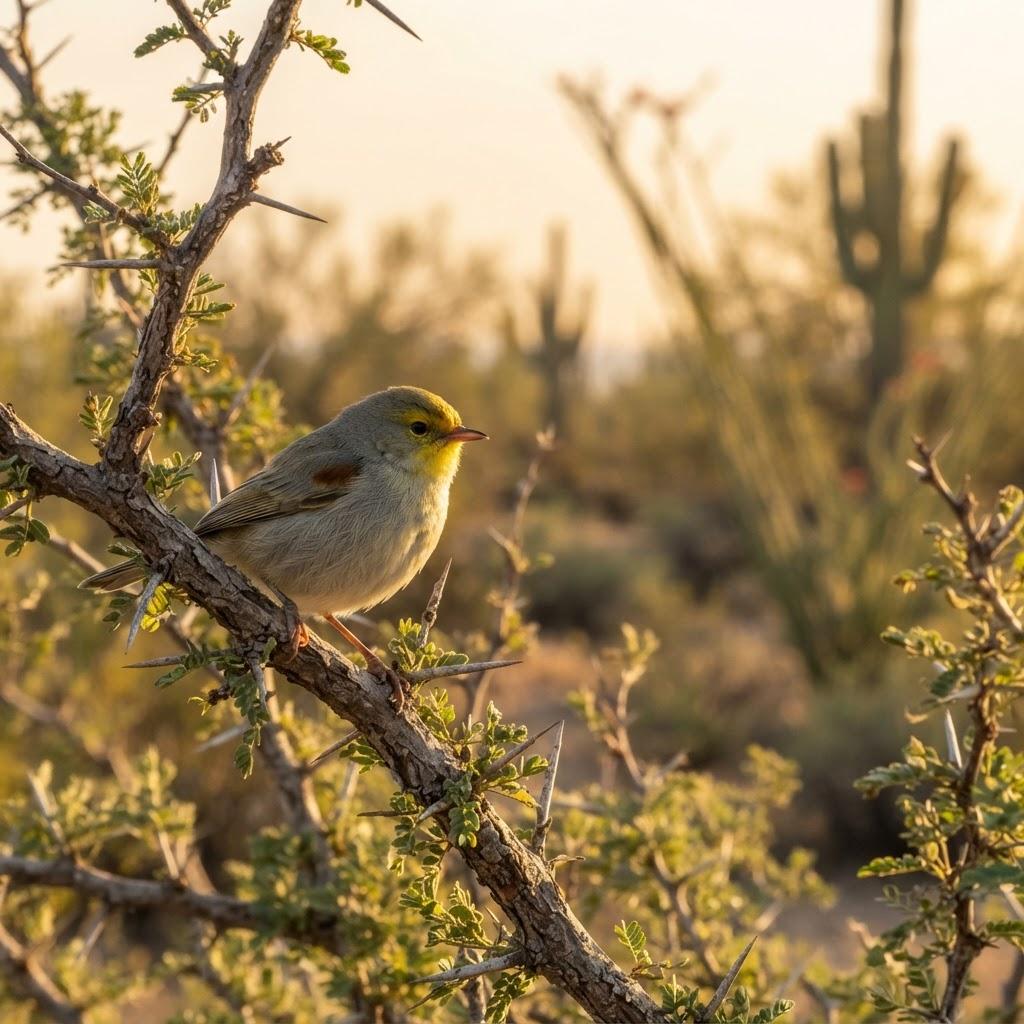
Auriparus flaviceps
Verdin
Meet the Verdin, the desert's most prolific architect who wears a bright yellow beret and acts like he owns the entire cactus patch. This pint-sized powerhouse is a master of survival in the heat, proving that you do not need to be big to be the boss of the brush.
Meet the Bird
Imagine a tiny, restless hyperactive ball of fluff that has decided the scorching, inhospitable desert is the perfect place to set up a luxury real estate empire. That is the Verdin. At about the size of a ping-pong ball, this bird is essentially a living, breathing yellow-headed firecracker. While other birds are busy worrying about finding shade, the Verdin is flitting through thorny, unforgiving scrub with the confidence of a king. It is easily recognized by its distinctive yellow head and the reddish-brown shoulder patches that look like tiny, fashionable epaulets on a pint-sized army general. The Verdin does not sit still; it vibrates with a constant, frenetic energy, hopping from branch to branch as if it is afraid that if it stops moving, the desert sun will catch it. It is the quintessential desert adventurer, a bird that saw a landscape of thorns, sand, and heat and thought, 'Yes, this is exactly where I want to raise a family.' It is small, it is bold, and it is entirely unimpressed by the fact that it lives in a place where most other animals go to hide. With a call that sounds like a rapid-fire series of 'tsip' notes, it announces its presence to everything within a mile, making sure everyone knows who is ruling the mesquite.
Superpowers & Weird Abilities
The Verdin’s superpower is not laser vision or super strength, but rather the ability to survive in a thermal oven that would leave most birds completely parched and exhausted. How does this tiny creature pull it off? It has a biological internal thermostat that would make a NASA engineer weep with joy. These birds have an incredible metabolic efficiency, allowing them to extract nearly every ounce of moisture from the meager diet they consume—mostly tiny insects and spiders found on desert vegetation. But their real trick is their nest architecture, which acts like a high-tech survival bunker. They build round, ball-shaped structures with a downward-facing entrance that effectively traps heat during the freezing desert nights and provides a cool, insulated retreat during the scorching days. They are essentially master engineers living in personal HVAC-controlled habitats that they build themselves. This is not just instinct; it is advanced structural engineering performed by a bird with a brain the size of a pea. They spend weeks meticulously weaving grass, twigs, and spider silk into a fortress that is both fortress-thick and perfectly temperature-regulated. While humans struggle to design energy-efficient housing, the Verdin has perfected the art of the off-grid, sustainable, climate-controlled mansion, proving that you do not need a degree in architecture to live comfortably in the middle of nowhere.
Drama, Personality & Feathered Chaos
If you want to witness true desert drama, look no further than a Verdin family dispute. These birds are the neighborhood busybodies of the scrubland. They do not just inhabit the desert; they actively patrol it. A Verdin will aggressively defend its territory against anyone it deems a threat, including birds ten times its size. If a hawk or a stray cat wanders too close to a Verdin's nest, the bird will launch into a furious, high-pitched scolding display, fluttering its wings and screaming with an intensity that seems disproportionate to its tiny stature. They are the 'get off my lawn' grandfathers of the avian world, forever suspicious of any intruder. Their personality is a chaotic blend of industrious workaholic and twitchy vigilante. They are constantly moving, constantly checking their perimeter, and occasionally getting into petty brawls with neighbors over the rights to a particularly buggy piece of bark. There is no such thing as a 'chill' Verdin. Even when they are simply foraging, they do so with a frantic urgency that makes it look like they are behind on a deadline. When they interact with each other, it is often a flurry of chirps, wing-flicking, and posturing that would put a reality television star to shame. They live their lives at 1.5x speed, and they expect every other bird in the ecosystem to respect their hustle.
Bizarre Rituals & Quirky Habits
Verdins are obsessed with nest-building, but not just for the purpose of breeding. They are notorious 'nest-hoarders.' Even when they are not actively raising a brood, they spend an inordinate amount of time building and maintaining multiple nests scattered throughout their territory. Think of it like someone who buys five houses but only sleeps in one, just to keep the neighbors guessing. These spare nests serve a variety of purposes: they are used as winter roosts to escape the biting desert chill, as decoys for potential predators, and occasionally just as a way for the male to show off his construction skills to potential mates. Watching a Verdin work is like watching a tiny, feathered construction crew. They select each twig with the precision of a jeweler, often choosing thorny sticks specifically because the thorns help lock the structure together. They then coat the inside with a soft, cozy lining of feathers, plant down, and even spider webs, which act as a glue. This obsession with building is a bizarre, deeply ingrained behavior that separates them from many other passerines who build a single nest per season. They are never truly satisfied with their current housing situation; there is always a gap that needs filling, a twig that needs repositioning, or a brand-new wing that needs to be added to their collection of desert real estate.
Legends, Folklore & Human Stories
In the folklore of the desert Southwest, the Verdin is often viewed as the 'Guardian of the Thorns.' Because they nest in the most impenetrable catclaw acacia trees, many indigenous cultures saw them as spirits that had mastered the harshness of the earth. They were considered birds of endurance and wisdom, respected for their ability to thrive where others withered. Early explorers were often baffled by the persistent, high-pitched calls of the Verdin, frequently mistaking them for the sound of wind whistling through the desert canyons or the spirits of the dead mocking them from the safety of the mesquite. There are old tales told by cattle ranchers about the Verdin being a weather-predictor; when the bird’s activity increased significantly, it was said that a storm was on the horizon, as the birds were rushing to fortify their nests against the coming wind. While science suggests their behavior is more about daily routine than meteorological foresight, the legends remain a testament to the fact that humans have long been captivated by this small, persistent creature. The Verdin represents the stubborn refusal to bow to the elements, a theme that resonates deeply in stories about surviving in the vast, empty landscapes of the American West. They are the tiny, golden-headed witnesses to the history of the desert, silently watching as the human world passes by, one desert sunset at a time.
Mating: The Ridiculous World of Avian Dating
The courtship of the Verdin is less of a romantic candlelit dinner and more of a frenetic, high-stakes audition. The male is the lead performer, and his stage is the entire desert scrub. He begins by singing a bright, repetitive, and surprisingly loud song that is meant to echo through the silence of the desert. If he spots a female, he shifts his strategy into a high-energy dance. He puffs out his feathers to look as large as possible—which, given that he is the size of a marshmallow, is still not very large—and flutters around her, flashing his yellow head and the reddish-brown epaulets on his wings like he is showing off a designer suit. The female, however, is a harsh judge. She will watch him with a critical eye, often flying away to see if he has the persistence to follow her. If she stops to inspect his nest—which he has been working on for months—the true test begins. She will poke around inside, evaluating the structural integrity, the lining comfort, and the security of the entrance. If she deems the real estate substandard, she will simply fly off, leaving the male to hang his head in shame and start the whole process over on a new branch. It is a harsh, unforgiving audition process, and for the male, the stress is immense. He has spent months preparing his home, and if his interior design skills do not meet her expectations, he is back to square one, single and forced to build another mansion.
Nesting: Master Architects and Lazy Slumlords
When it comes to nest construction, the Verdin is the Frank Lloyd Wright of the avian world, if Frank Lloyd Wright lived in a cactus patch. These birds build globes that are true engineering marvels. They start by weaving a frame of thorny, interlocking twigs that create a structural cage almost impossible for a predator to penetrate. Once the frame is set, they begin the interior decoration. They spend weeks gathering spider silk, which they use like super-strong tape to bind everything together. Inside, they create a 'soft room' lined with the absolute finest materials they can find—downy plant fibers, fur, and whatever shed feathers they can scavenge. The entrance is a tunnel that leads downward, a genius design that prevents heat from escaping while also making it very difficult for snakes or other predators to slither in. Compared to the lazily assembled stick-piles of a mourning dove, the Verdin’s home is a luxury bunker. However, they are also prone to hoarding. They will maintain several of these structures at once, moving between them as the season changes. While they are master builders, they are also essentially slumlords of their own creation, constantly renovating and adding on to their properties. You will often see a Verdin obsessively poking at its nest, adding a bit of fluff or adjusting a thorn, long after the eggs have hatched, proving that for this bird, a project is never truly finished.
Raising Babies: The Screaming Food Disposals
Once the eggs hatch, the peace and quiet of the desert are effectively replaced by a high-decibel demand for food. The Verdin parents become indentured servants to a collection of hungry, featherless, screaming mouths. For about two to three weeks, the parents work themselves to the point of exhaustion, flying back and forth from dawn until dusk, hunting for tiny caterpillars, spiders, and insects to cram into the gaping beaks of their brood. The babies, despite being the size of jellybeans, possess the lung capacity of an opera singer. As soon as a parent lands on the nest with a succulent morsel, the chicks erupt into a cacophony of begging chirps that can be heard from twenty yards away. They are relentless, impatient, and utterly ungrateful. If the parents are two seconds late with a delivery, the volume increases immediately. This period is a blur of non-stop work for the adults. They have to keep the nest clean, protect it from predators, and ensure that each of the three to five chicks gets an equal share of the protein. By the time the young birds are ready to fledge, the parents look like they haven’t slept in a month. It is a grueling, thankless job, but seeing the little fluff-balls eventually poke their heads out of the downward-facing entrance for the first time is the ultimate payoff for all that exhausting labor.
Bird-Watching Travel & Local Hotspots
If you are ready to witness the majesty of the Verdin in its natural habitat, you need to head toward the arid landscapes of the American Southwest. Your best bet is to visit the Saguaro National Park in Arizona, particularly during the spring months when the mesquite is buzzing with life. The desert washes and thickets are where the action happens. Another top-tier location is the Anza-Borrego Desert State Park in California. Here, the sheer density of native desert vegetation makes it a playground for these tiny architects. When searching, do not look high up in the trees; look low, in the thick, thorny shrubs and acacia bushes where the birds feel safe. The key to spotting them is listening—their high-pitched 'tsip' is distinctive once you know what to listen for. Early morning is the prime time, as the desert heat has not yet reached its peak, and the birds are at their most active. Be patient, bring a good pair of binoculars, and prepare to stand in the middle of a thorny patch of desert—it is worth it. For those traveling in winter, the lower Colorado River Valley is a sanctuary for them, as they hunker down in the relative warmth of the riverside thickets. No matter where you go, remember that they are small and quick; patience is the birdwatcher's best tool, and quiet observation is the only way to catch them in their daily routine.
Food, Feeder Hacks & DIY Projects
The Verdin is not your typical seed-eater; they are primarily insectivores, which makes attracting them to a standard bird feeder a bit of a challenge. They are not interested in your basic sunflower seeds or cracked corn. To invite them to your backyard banquet, you need to think about what a desert insectivorous bird actually craves. Suet is your best friend here. A high-quality insect-based suet block will draw them in, especially during the colder months when bugs are scarce. You can make a DIY 'desert feeder' by taking a small piece of wood, smearing it with high-quality peanut butter mixed with mealworms, and wedging it into a dense, thorny shrub in your yard. They feel much safer coming to a feeder if it is tucked deep into cover rather than sitting out in the open like a bait station for hawks. Planting native vegetation is also a game-changer. Catclaw acacia, mesquite, and desert willow are native plants that naturally host the insects they love. By planting these, you are providing both a buffet and a home. Avoid chemical pesticides at all costs; if you spray your yard, you are killing the very food that these birds depend on to survive. Keep it wild, keep it thorny, and keep the suet fresh—that is the formula for turning your yard into a Verdin hotspot.
Seasonal Guides & "Crisis" Management
Seasonal changes mean shift in gears for the Verdin. In the spring, they are hyper-focused on nesting, so if you see them pulling threads off your garden furniture, don’t panic—they are just using your property as a hardware store. Let them have it. During the freezing desert nights of winter, they rely heavily on their communal nests for warmth, so do not ever remove a nest that looks empty; it might be a winter bedroom. A very common 'crisis' for homeowners is finding a 'baby bird' on the ground in the spring. If you find a fluffy, seemingly helpless Verdin on the ground, take a breath. It is almost certainly a fledgling, a teenager that is learning to fly. It is not lost; its parents are likely watching from a nearby bush and bringing it food. Unless it is clearly injured or in immediate danger from a cat, leave it alone. The best thing you can do is keep your pets indoors during this time. If the weather is particularly harsh, you can place a shallow, clean water source nearby, as hydration is the greatest challenge for these birds. Remember, they have survived in the desert for millions of years without human help; a little space and protection from predators is usually all they really need to thrive.
Backyard Tech & Gadget Reviews
Birding technology has come a long way, and if you want to get a close-up look at a Verdin, you have some great options. Smart feeders with built-in AI cameras are incredible for capturing the frantic, hyper-speed movements of these birds, especially if you mount the feeder near a shrubbery where they like to hang out. However, don't expect them to sit still for a selfie. Because they are so small and move so fast, you will need a camera with a high shutter speed to get a crisp image. For those who want to see what they are up to at night, a trail camera set up on a motion sensor near a known nesting tree is a fantastic way to document their roosting habits. When it comes to the perennial problem of window collisions, the best solution is to break up the reflection. Window films, adhesive decals, or even simple screens can make a massive difference. Since Verdins are often darting in and out of dense foliage, they are especially prone to hitting glass if they think they are flying into a clear patch of sky. A little bit of 'bird tape' or decorative film is a small price to pay to keep your local desert residents safe while giving you a clear view of their antics.
How to Spot One & How It Is Doing
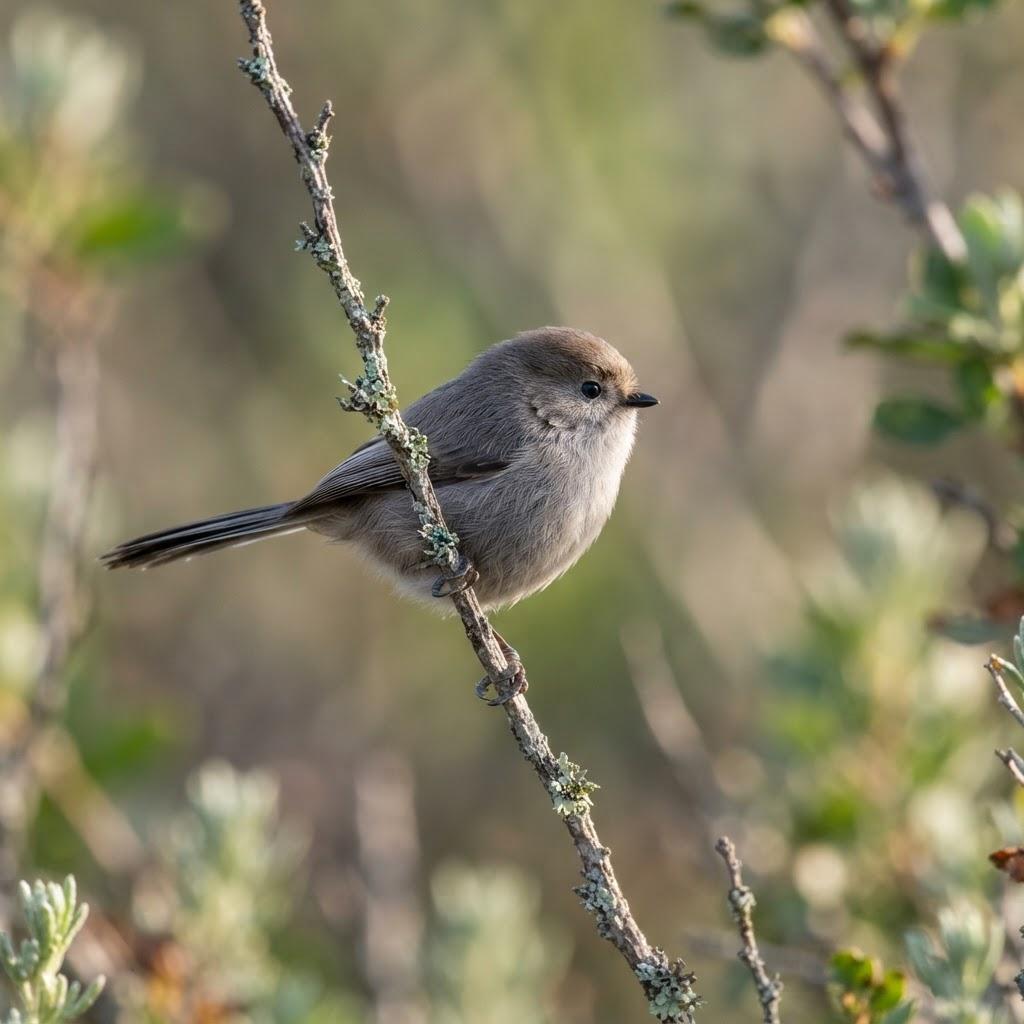
Spotting a Verdin is all about recognizing the 'flick.' They are constantly on the move, and their distinctive yellow head is the biggest giveaway. If you see a small, grayish bird doing a frantic gymnastic routine on a thorny branch, look for that bright pop of color on the head and the tiny reddish spot on the shoulder—that is your guy. They are doing quite well for themselves, as they have adapted perfectly to the harsh environments where they reside. Because they occupy areas that are often inhospitable to human development, their habitat remains largely intact compared to birds that require lush forests or wetlands. They are a 'Least Concern' species, which is a rare bit of good news in the world of conservation. But do not get complacent; they still face threats from invasive plants that replace their native mesquite homes and the ever-present danger of climate change shifting the desert ecosystem. The best thing you can do for them is to protect native desert corridors and advocate for the preservation of wild, scrubby landscapes. By appreciating the Verdin, you are celebrating the resilience of the desert itself. They are the small, golden-headed reminders that life does not just survive in the heat—it thrives, it builds, and it sings, even in the middle of a sea of thorns.