Eugenes fulgens
Rivoli's Hummingbird
The Rivoli's Hummingbird is the glam rock star of the hummingbird world, flaunting an iridescent crown and a personality that screams 'get off my lawn.' These feathered jets are larger than your average backyard visitor and bring a sense of royal drama to any feeder they decide to occupy.
Meet the Bird
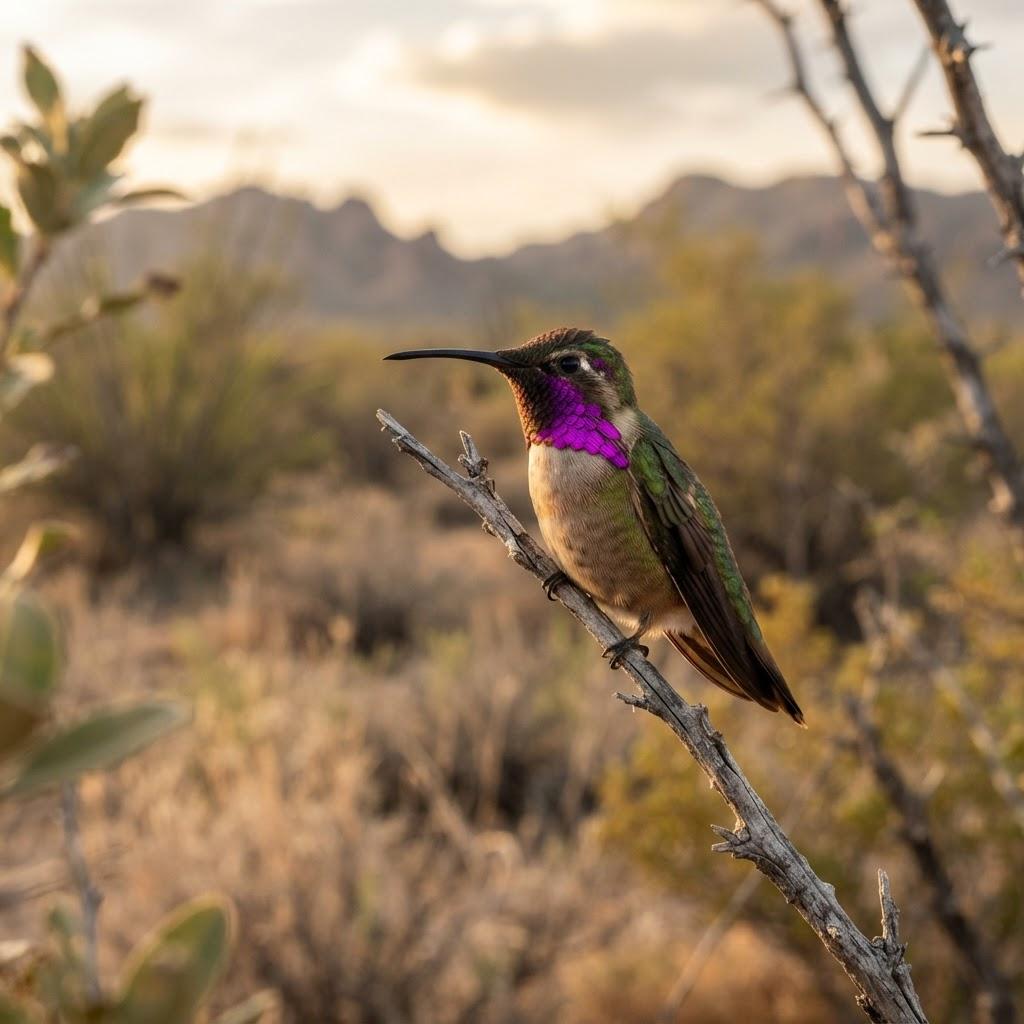
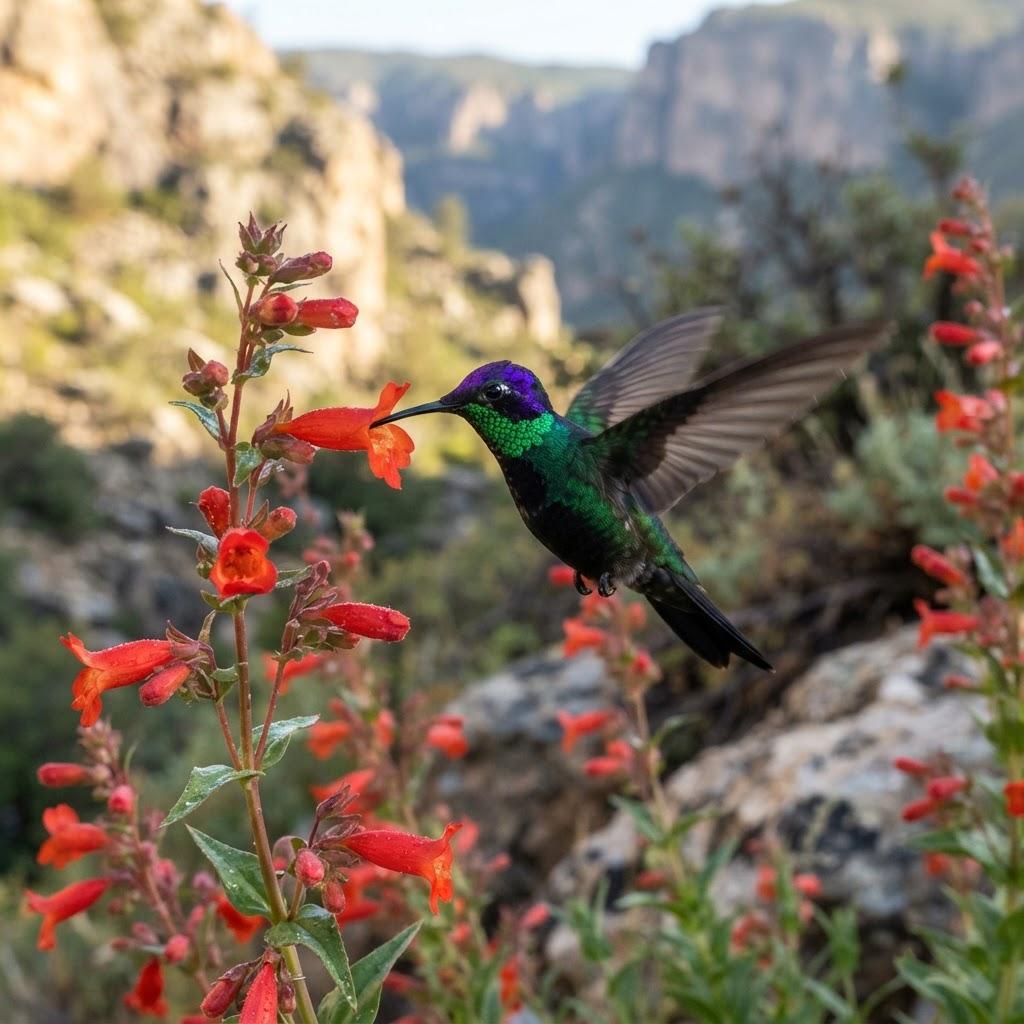
If the hummingbird world held a heavyweight championship, the Rivoli's Hummingbird would be the reigning king who walks into the room knowing he owns the place. Unlike the tiny, skittish sprites that usually visit your garden, this bird is a hulking giant—at least by hummingbird standards. Picture a tiny, high-octane fighter jet painted in shades of deep velvet emerald and obsidian, topped off with a metallic violet crown that catches the light like a disco ball. It does not just fly; it patrols. Its vibe is strictly 'business casual,' if business casual involved moving your wings fast enough to blur into a localized weather event. While other birds are busy being cute, the Rivoli's is busy conducting an intense survey of its domain, looking for any other feathered entity that dares to suggest this is a communal dining experience. It is large, it is imposing, and it definitely knows it looks better than you.
Superpowers & Weird Abilities
How does a creature that weighs about as much as a nickel manage to be such an aerial powerhouse? The secret lies in the shoulder anatomy, which functions more like a ball-and-socket joint than any bird should reasonably have. This allows the Rivoli's Hummingbird to rotate its wings in a complete 180-degree arc, effectively generating lift on both the forward and backward strokes of its wingbeat. While humans are stuck using muscles that only move one way, this bird is essentially swimming through the air. They possess a metabolic rate so high that if they were a human, they would have to eat hundreds of hamburgers a day just to keep their heart from stopping. They can also shift into a state of 'torpor,' a biological snooze button where they lower their body temperature and heart rate drastically overnight, saving energy like a laptop in deep sleep mode so they do not starve to death before breakfast.
Drama, Personality & Feathered Chaos
If you are a smaller hummingbird, the arrival of a Rivoli's is akin to a schoolyard bully pulling up in a monster truck. These birds are notoriously territorial, and they do not believe in sharing, kindness, or social etiquette. They will perch on a high branch overlooking a feeder, waiting like a feathered sniper for any smaller challenger to dare take a sip of nectar. Once a victim approaches, the Rivoli's drops from its post with an aggressive, buzzing scream, sending the intruder packing in a panicked blur of feathers. It is not just the food they care about; it is the principle of the thing. They are the ultimate gatekeepers, holding grudges against anyone, human or avian, who dares to stand too close to their favorite bloom. Expect absolute chaos when two of these titans decide they both want the same flower patch, resulting in high-speed dogfights that make fighter pilot movies look like slow-motion ballet.
Bizarre Rituals & Quirky Habits
Beyond their legendary bad attitude, these birds have some genuinely weird hobbies. Have you ever seen a bird that likes to groom itself using the precision of a surgeon? Rivoli's hummingbirds are obsessed with feather maintenance, spending a huge chunk of their day preening. They don't just fluff their feathers; they meticulously oil them with secretions from a gland near the tail, which helps keep the plumage waterproof and aerodynamic for those intense aerial maneuvers. They are also masters of the 'feeder patrol,' a ritual where they fly in a tight, systematic grid over their territory to ensure no one else is stealing their resources. Sometimes, you might see one suddenly drop to the ground or hover motionless for long periods, staring intensely at a leaf. They are likely hunting for tiny spiders or gnats—because nectar is great for the sugar high, but you need a little protein to maintain that grumpy attitude.
Legends, Folklore & Human Stories
In the cultures of the mountainous regions of Mexico and Central America, the hummingbird has long been a symbol of power, energy, and resilience. Because they seem to vanish and reappear like magic, they are often associated with the spirits of warriors or messengers between the worlds. While the Rivoli's might not be featured in every single ancient codex, their presence in the high-altitude cloud forests is deeply woven into the landscape's story. Local naturalists tell tales of these birds being the 'guardian of the mountain passes,' always present near the most beautiful blooming agave and sage. People who live in these remote, misty habitats see the Rivoli's as a constant companion—a reminder that even in the harshest, highest peaks where the air is thin and cold, life finds a way to be vibrant, aggressive, and incredibly, unapologetically loud.
Mating: The Ridiculous World of Avian Dating
Courtship for a Rivoli's Hummingbird is basically an extreme version of a dance-off in a club where the DJ is a caffeinated squirrel. The male doesn't bother with building a house or buying gifts; he relies entirely on his 'moves.' He will pick an open, sunlit spot and perform a series of pendulum-like swings back and forth in front of the female. He puffs out his iridescent gorget, the throat patch that glows like a neon sign, and vibrates it until it is practically blinding. If the female decides his neon-violet display isn't flashy enough, she will simply fly away, leaving him to do the same routine for the next prospect. It is a high-stakes performance that requires immense stamina, and if he messes up the tempo or hits a sour note in his high-pitched buzz-song, he gets rejected immediately. Avian dating is brutal, but for the male Rivoli's, it is all about the flash and the flair.
Nesting: Master Architects and Lazy Slumlords
While the male is busy showing off, the female Rivoli's is busy doing actual work. She is a master architect, weaving a tiny, cup-shaped nest out of plant down, moss, and spider webs. The spider silk is the real genius move here; it acts like a high-strength elastic band, allowing the nest to expand as the baby birds grow from tiny jellybeans into full-sized hummingbirds. The exterior is usually camouflaged with bits of lichen and bark, making the whole thing look like a simple bump on a branch. It is a feat of engineering that would put a human contractor to shame. She does this entirely alone, with the male showing zero interest in domestic life. Once the nest is done, she guards it with a ferocity that would scare a house cat, ensuring her little investment stays safe from prying eyes and hungry predators.
Raising Babies: The Screaming Food Disposals
Once the two tiny eggs hatch, the mother is locked into a cycle of infinite hunger. The chicks are basically naked, trembling bits of meat with oversized mouths that exist only to demand food. Because they grow at a meteoric rate, the mother must perform hundreds of trips a day to gather enough nectar and small insects to keep them alive. She injects the food directly into their throats with a long, needle-like beak—a process that looks terrifyingly precise. The babies, despite being roughly the size of a thimble, are incredibly loud, making high-pitched peeping noises that echo through the forest. There is no 'thank you' in this arrangement, just more screaming for more calories. After about three weeks, the babies are suddenly ready to burst out of their nest, having effectively consumed their body weight in food several times over, finally ready to join the high-octane world of their parents.
Bird-Watching Travel & Local Hotspots
If you want to catch a glimpse of the Rivoli's Hummingbird without traveling to the ends of the Earth, you need to head to the 'Sky Islands' of the American Southwest. Southern Arizona is the undisputed Mecca for this species. Spots like Ramsey Canyon Preserve or Madera Canyon are legendary for birders. The best time to visit is during the late summer, from July to September, when the monsoon rains turn the landscape into a blooming wonderland that draws these birds in by the dozen. If you find yourself in the Chiricahua Mountains, keep your binoculars ready near any reliable nectar feeder or stand of flowering salvia. These birds are not shy, but they move fast, so patience is key. Find a bench at a high-elevation birding lodge, order a coffee, and just wait. Eventually, the flash of the violet crown will give them away, and you will know you have arrived in their kingdom.
Food, Feeder Hacks & DIY Projects
In the wild, these birds are obsessed with tubular flowers, but in your yard, they will happily take nectar from a feeder if it is placed correctly. Skip the store-bought red dye—it is essentially junk food for birds and potentially harmful. Instead, mix your own by dissolving one part white granulated sugar in four parts boiling water. That is it. For a DIY project that actually works, try building a 'natural' feeder by planting native penstemon or hummingbird sage in a sunny patch near a window. If you want to get creative, attach a shallow, bright red dish filled with sugar water to a sturdy branch, and use plastic 'flowers' to entice them. Avoid 'bargain' seed mixes entirely, as those attract nothing but invasive house sparrows and pests; hummingbirds are strictly liquid-diet fans, so keep your yard clean, keep the sugar fresh, and wait for the show to begin.
Seasonal Guides & "Crisis" Management
Spring and summer are the peak times for Rivoli's activity, but autumn brings the migration shift. As the temperatures drop, these birds begin their journey toward warmer climates. If you find a 'fledgling' on the ground that looks like a ball of fluff with an oversized beak, do not panic! It is likely just learning to fly. Unless the bird is visibly injured or in immediate danger from a cat, leave it alone. The parents are probably watching from a nearby branch, ready to dive-bomb anyone who gets too close. If you must move it, gently place it on a higher branch. Also, if you live in a cold region, keep your hummingbird feeder clean and full during early autumn to help them fuel up for their long-distance flight. They need every ounce of energy, and your yard might just be the pit stop that helps them make it through the winter.
Backyard Tech & Gadget Reviews
If you are a gadget lover, the new generation of AI-enabled feeders is a game changer for monitoring your local hummingbird population. Devices that use motion-activated cameras can capture the lightning-fast movements of a Rivoli's that your eye might miss entirely. However, watch out for reflections! Hummingbirds are notorious for crashing into windows because they see the reflection of a flower or the sky and think it is a safe path. Apply window film or external screens to your glass to break up the reflection. If you really want to step up your game, get a cheap trail camera and mount it on a pole near your feeder. You will get high-definition footage of these birds fighting, feeding, and resting, all without the need for an expensive setup. It is a front-row seat to the most high-speed drama in the animal kingdom, right on your porch.
How to Spot One & How It Is Doing
To identify a Rivoli's Hummingbird, look for the 'giant' of the feeder. While most hummingbirds are tiny, this one has a thick body and a long, slightly curved bill that makes it look like it is wearing a suit that is a size too large. Listen for a distinct, low-pitched, buzzy 'chip' note that is louder than the high-pitched squeaks of smaller species. Conservation-wise, they are doing okay, classified as Least Concern, but their future depends on protecting the mountain habitats they call home. You can help by planting native nectar plants in your own garden, which creates a 'stepping stone' for migrating birds. Every single flower you plant contributes to a network of fuel stations for these incredible athletes. They are resilient, beautiful, and utterly fascinating—all you have to do is provide the juice and keep your eyes on the sky.