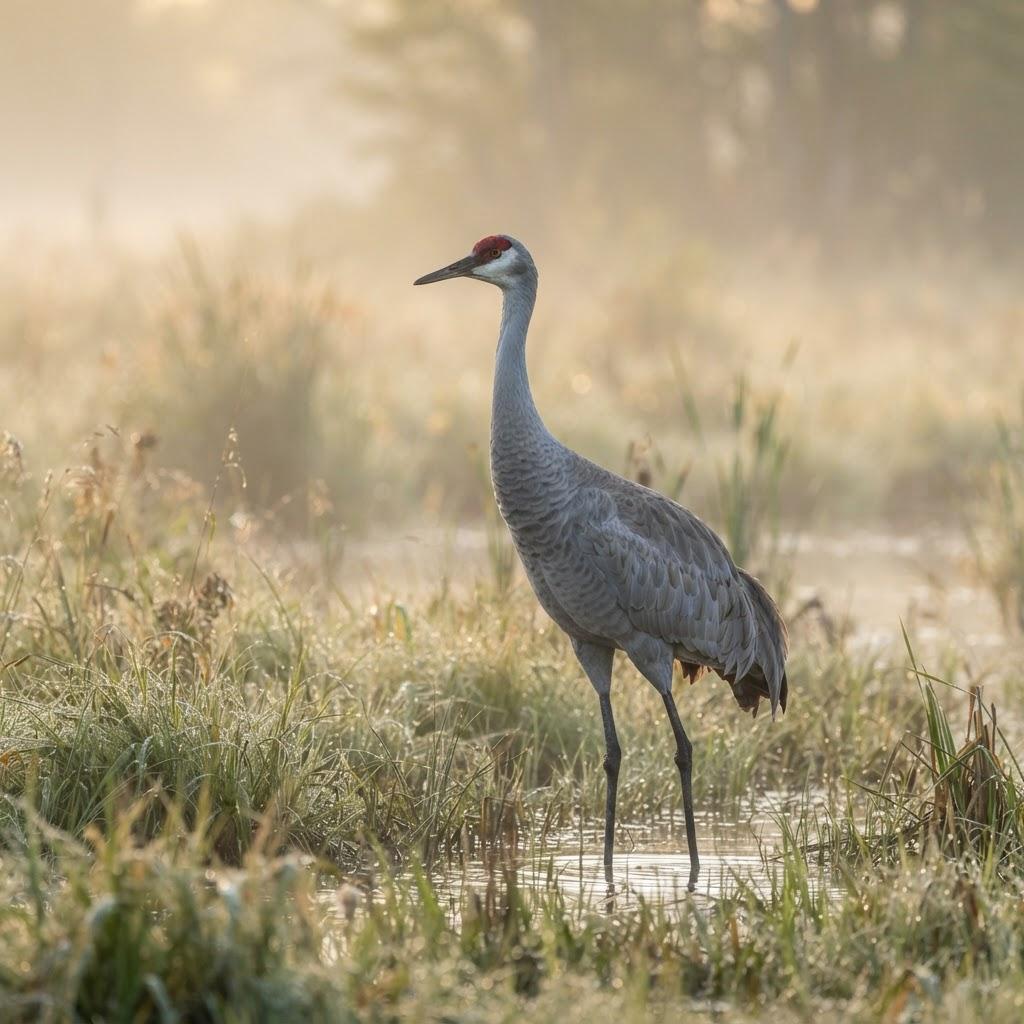
Antigone canadensis
Sandhill Crane
Meet the Sandhill Crane: the prehistoric-looking, jazz-dancing, sky-trumpeting giant that turns any field into a Broadway stage. They are long-legged masters of drama who have been perfecting their fancy footwork since the age of the dinosaurs.
Meet the Bird
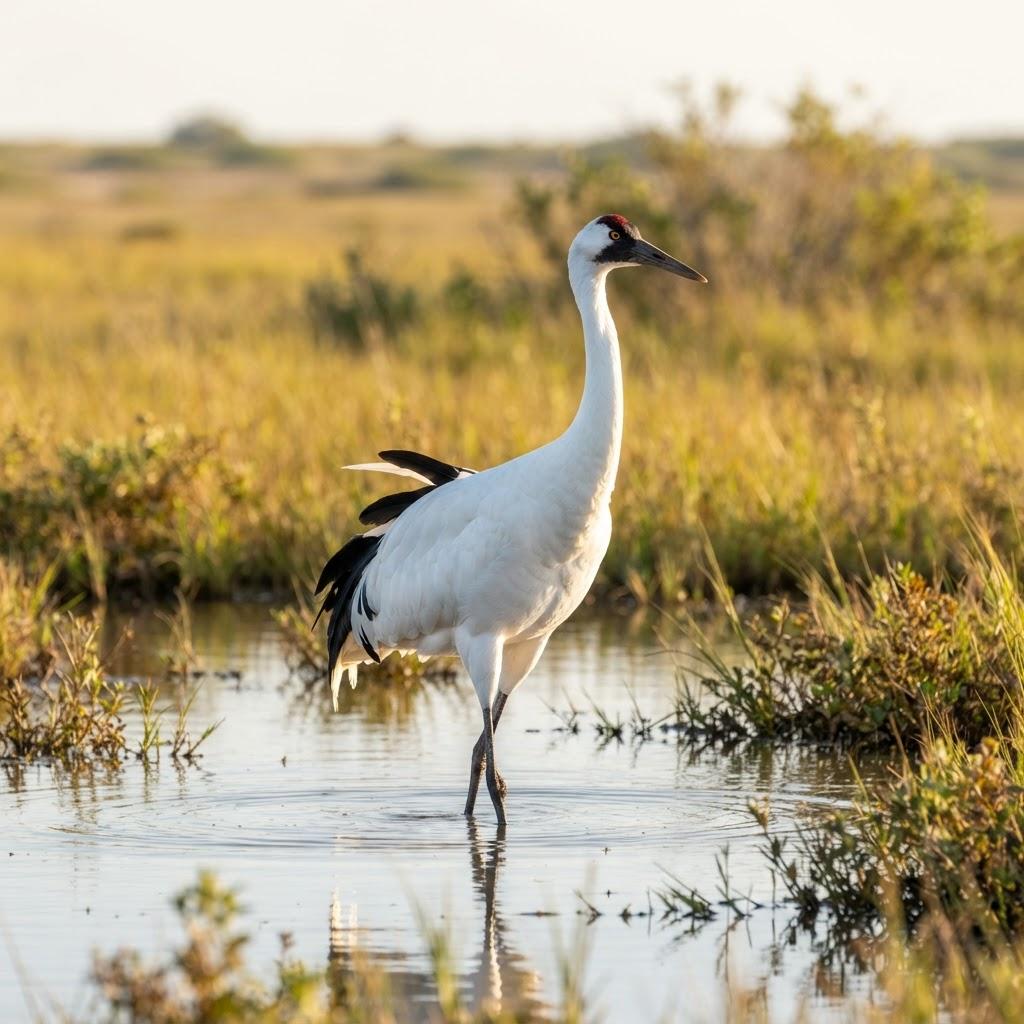
Imagine a bird that looks like a stork had a mid-life crisis and decided to dress up as a prehistoric dinosaur. The Sandhill Crane is the ultimate character actor of the bird world. Standing at four feet tall with a bustle of gray feathers, a flashy crimson-red cap, and a beak that means business, they look like they belong in a Jurassic Park deleted scene. They walk with the slow, deliberate swagger of a celebrity dodging paparazzi. These birds have an undeniable vibe of ancient wisdom mixed with absolute chaos. When they take flight, they transform from clunky ground-dwellers into aerodynamic marvels, neck stretched straight out like a spear. You will hear them long before you see them; their call is a rattling, guttural bugle that sounds like a rusted gate hinge screeching in a horror movie. They aren't just birds; they are the avian equivalent of an elderly person yelling at a cloud, and it is absolutely magnificent to behold.
Superpowers & Weird Abilities
While they might look like awkward toddlers on stilts, Sandhill Cranes possess biological engineering that would make a fighter jet pilot jealous. Their trumpeting call is amplified by a trachea—the windpipe—that is essentially a living trombone. It coils deep down into their chest cavity, acting like a built-in megaphone, allowing their calls to travel for miles across open plains. This is how they stay in touch with their social circle while foraging in massive groups. They also have an incredible ability to navigate thousands of miles during migration using a combination of the Earth's magnetic field and visual landmarks. Think of them as having a built-in GPS that never loses signal in a tunnel. Furthermore, their legs are masterpieces of heat exchange. They can stand in freezing water without getting frostbite because their veins and arteries are intertwined, pre-warming the blood as it travels back to the heart. It is basically internal radiator technology built right into their shins.
Drama, Personality & Feathered Chaos
Sandhill Cranes are the drama queens of the wetlands. They don't just exist; they perform. If another crane accidentally encroaches on their 'personal space'—which is roughly the size of a small suburban backyard—the response is immediate and theatrical. They will puff up their feathers, bow low, and march toward the offender with the intensity of a wrestler entering the ring. They are intensely social, often hanging out in massive, raucous flocks where the gossip never stops. Watching them interact is like eavesdropping on a soap opera. There is constant bickering, dramatic wing-flapping, and sudden, inexplicable displays of dominance. If you ever see a crane stomping its feet, know that it isn't just having a tantrum; it is asserting its social standing. They are fiercely protective of their family units, and the level of sass they display when a goose or heron gets too close is nothing short of legendary. These birds definitely take themselves very seriously.
Bizarre Rituals & Quirky Habits
The Sandhill Crane's most famous quirk is their obsession with choreography. They don't just walk; they dance. This isn't just for courtship—they dance when they are happy, they dance when they are annoyed, and they dance when they are bored. A crane will pick up a stick or a piece of dry grass, toss it into the air, and then hop around it like a Victorian-era ballerina who has had too much espresso. They also engage in 'feather painting.' During the breeding season, they will preen themselves using iron-rich mud from the marsh floor, which stains their gray feathers a deep, rusty brown. It is basically the avian version of getting a spray tan to look more attractive for the partner. Why do they do it? It’s a mix of vanity and utility, as the mud helps camouflage them against the brown grasses of the wetlands. They are essentially crafting their own runway couture using nothing but swamp sludge.
Legends, Folklore & Human Stories
Humans have been obsessed with cranes since we first figured out how to write things down. In many Native American cultures, the Sandhill Crane is a symbol of wisdom, longevity, and communication. Some tribes even integrated the 'crane dance' into their own social ceremonies, proving that we’ve been copying their moves for centuries. Because they are so loud and their migrations are so consistent, they have long been used as a living calendar. When the cranes start moving, the season is officially changing. There is a sense of awe that comes from watching these giant birds migrate; it feels like witnessing an ancient migration of gargoyles from a forgotten time. They are the heralds of the seasons. People don't just look for cranes; they wait for them, host parties for their arrival, and treat their departure like a sad breakup. They are embedded in the human psyche as markers of time, wildness, and the unyielding persistence of nature.
Mating: The Ridiculous World of Avian Dating
Dating for a Sandhill Crane is a high-stakes, competitive dance-off. A male hoping to find 'the one' will perform a series of bow-and-jump maneuvers that look like a jitterbug gone wrong. If the female is interested, she joins in, creating a synchronized duet of leaps and rhythmic wing-spreading. It is genuinely breathtaking. They are monogamous and tend to stick together for life, which is a big commitment considering they live for decades. The courtship dance isn't just a one-time thing; it is the glue that keeps the marriage together. They perform these dances throughout their lives to reinforce the bond. If a suitor isn't up to the task or lacks the rhythmic grace required, the female will just turn her back and wander off to find someone with better footwork. It is cruel, it is efficient, and it is a fascinatingly brutal reality of the marshland singles scene.
Nesting: Master Architects and Lazy Slumlords
When it comes to nesting, Sandhill Cranes aren't exactly building skyscrapers. They prefer a low-profile approach, constructing a massive, sprawling mound of reeds, grasses, and whatever else they can scavenge from the shallow water. It is a wet, soggy, floating island of a home. They take great pride in their real estate, and both parents work together to pile up the materials. It is not delicate work; it is heavy-duty construction. The nest is basically a soggy platform meant to keep the eggs above the waterline while the parents keep a watchful, grumpy eye on the surroundings. Because they build in open, wet areas, they are susceptible to flooding, so they are constantly adding more vegetation to the base. It is essentially a DIY landscaping project that never ends. They don't have the finesse of a weaver finch, but for a four-foot-tall dinosaur, it is a sturdy, functional, and very private fortress.
Raising Babies: The Screaming Food Disposals
A Sandhill Crane chick, known as a 'colt,' is essentially a fluffy, frantic ball of fluff on knobby legs. They are precocial, which is a fancy way of saying they are ready to hit the ground running just hours after hatching. They don't sit in the nest for weeks like a songbird; they are out in the marsh following their parents within a day. Raising a colt is a full-time job that requires constant supervision. The chicks are hungry, loud, and incredibly demanding. They grow at an astonishing rate, turning from tiny pom-poms into gangly teenagers in just a few months. The parents are absolute saints, spending the entire summer teaching their offspring how to find bugs, tubers, and seeds. If a predator gets too close, the parents switch into 'warrior mode,' hissing and fanning their wings with enough ferocity to scare away creatures twice their size. It is a brutal, high-speed education in how to survive in the wild.
Bird-Watching Travel & Local Hotspots
If you want to experience the true majesty of these birds, you have to go where the crowds gather. The Platte River in Nebraska is the absolute Mecca for crane watching during the spring migration. Hundreds of thousands of cranes descend on the river valley, and the sound alone will vibrate in your chest. It is a life-changing spectacle. For a more southern experience, the Bosque del Apache National Wildlife Refuge in New Mexico is a must-visit during the winter months. Seeing the cranes against the backdrop of snowy desert mountains is peak aesthetic. In Florida, you can spot the unique Florida subspecies year-round near the Everglades or even in quiet suburban ponds. When planning your trip, aim for the golden hour—just after sunrise or just before sunset—when the light is perfect and the birds are most active. Bring binoculars, bring patience, and bring a thermos, because you will want to stay until the last crane has settled for the night.
Food, Feeder Hacks & DIY Projects
Sandhill Cranes are the ultimate opportunists. In the wild, they dine on a buffet of insects, crustaceans, seeds, and even small rodents. They are effectively the lawnmowers of the bird world, constantly grazing in fields and wetlands. If you want to attract them to your property, forget the standard bird feeder; these guys are way too big for a tiny plastic tube. Instead, focus on 'landscape feeding.' Planting native tubers, grains, or leaving patches of your property un-mowed will turn your yard into a crane bistro. If you live in an area where they are comfortable coming closer, scattering cracked corn on the ground is the golden ticket. Avoid cheap mixes with red millet, which is just bird-junk food. Focus on whole grains. The best DIY project? A simple clearing with a shallow basin of water. They love to stand in water, wash their food, and gossip. Keep it natural, keep it ground-level, and you will eventually have a party of cranes.
Seasonal Guides & "Crisis" Management
Spring is the 'fledgling panic' season for Sandhill Cranes, just like every other bird. You might see a young colt stumbling through a field, looking absolutely miserable and lost. Do not try to 'rescue' it. Unless it is obviously injured, bleeding, or caught in a fence, it is likely just waiting for its parents to return with snacks. The parents are almost certainly watching from nearby. Keep your pets indoors, give the bird a wide berth, and enjoy the moment from a distance. During the winter, when the world freezes over, these birds rely on their high-fat reserves. If you have a pond that stays partially open, keeping it clear of thick ice can be a lifesaver. Seasonal changes dictate their migration, and your role as a human is to be a quiet observer. During the autumn, they start grouping up for the long haul, getting loud and restless. It is the perfect time to grab your camera and document the pre-flight jitters.
Backyard Tech & Gadget Reviews
If you want to get closer to the action without spooking these skittish giants, technology is your best friend. Trail cameras, the kind hunters use, are excellent for capturing activity in your yard when you aren't around. Mount one on a fence post or a tree, and you will get high-definition footage of your crane visitors without them ever knowing you were watching. For window safety, because cranes sometimes mistake their own reflection for a rival, apply window decals or bird-safe UV film. It breaks up the reflection and stops them from slamming into the glass in a fit of pride. While AI-powered smart feeders are great for finches, they aren't built for a four-foot bird. Save your money on the fancy gadgets and invest in a high-quality pair of 10x42 binoculars instead. The best tech for birding is still the gear that lets you see the world more clearly without becoming a part of it.
How to Spot One & How It Is Doing
To identify a Sandhill Crane, look for the 'three S's': Size, Stance, and Sound. They are large, they stand tall on long legs, and they make a sound that vibrates through your soul. Their gray bodies and red foreheads are the dead giveaways. Fortunately, their conservation status is 'Least Concern,' meaning they are doing quite well. They have adapted surprisingly well to agricultural changes, which is a rare success story in the modern world. You can help by supporting wetland conservation groups and protecting the local marshes that these birds rely on for their dance-offs and nesting. When you head out to find one, remember that you are a guest in their home. Keep your voice down, move slowly, and respect their space. If you see one, stop for a second, listen to that ancient, rattling bugle, and realize you are witnessing the same sight that our ancestors saw thousands of years ago. It is a privilege, a thrill, and the best way to spend a Saturday morning.