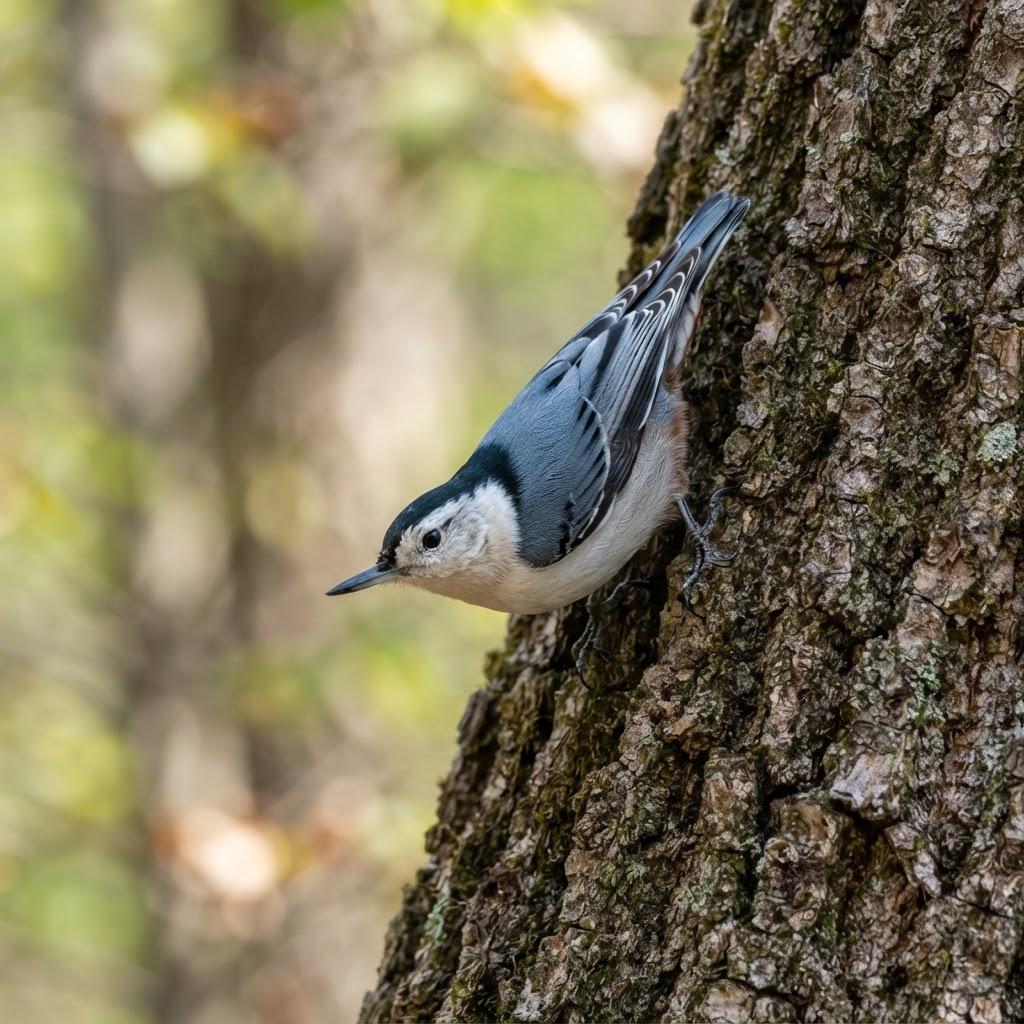
Sitta carolinensis
White-breasted Nuthatch
Meet the White-breasted Nuthatch, the bird that treats gravity like a mere suggestion. With its upside-down antics and relentless tree-trunk patrolling, this tiny comedian is the ultimate backyard acrobat.
Meet the Bird
Imagine a bird that has completely forgotten how gravity works. The White-breasted Nuthatch does not just climb trees; it ignores the traditional rules of avian physics by scurrying head-first down the trunk, staring you in the eye with a gaze that says, 'Yes, I know I look ridiculous, but I am finding all the best snacks.' This bird is essentially the parkour athlete of the woodland world. Sporting a slate-gray back, a stark white face, and a black cap that looks like a very sharp, very deliberate haircut, the White-breasted Nuthatch is always on the move. Its vibe is pure, caffeinated curiosity. While other birds are busy singing ballads in the treetops, this little guy is busy examining every single crevice of bark, acting as the forest's unofficial detective. It is small, chunky, and perpetually unimpressed by the concept of 'up.' If you have ever wanted to meet a creature that looks like it is constantly running behind schedule for an important meeting but takes the time to inspect a beetle anyway, this is your bird.
Superpowers & Weird Abilities
The primary superpower of the White-breasted Nuthatch is its anatomical refusal to be right-side up. Most birds have feet designed to grip a branch and look pretty; the Nuthatch has a specialized, extra-long hind toe—technically a hallux—that functions like an elite grappling hook. This biological hardware allows it to lock into the smallest fissures in tree bark while its head points toward the ground. Think of it as having built-in mountain climbing gear attached to your legs. Furthermore, these birds have an incredible ability to wedge large food items into bark cracks before hacking them apart with their needle-sharp bills. They are the master carpenters of the bird world, using their beaks as both chisels and hammers to pry open hidden prizes. They do not just have sharp eyes; they have a spatial memory that would put a GPS system to shame, remembering exactly which bark crevice they used to store their winter rations months after the fact.
Drama, Personality & Feathered Chaos
Do not let the cute white face fool you; the White-breasted Nuthatch is a bit of a neighborhood tyrant. When it shows up at a bird feeder, it behaves like someone who has just walked into a crowded party and decided they own the place. They are surprisingly bold and often engage in dramatic aerial disputes with other birds of similar size, such as Chickadees or Titmice. They are not shy about using their vocalizations—a nasal 'yank-yank' sound—to complain loudly if another bird dares to occupy their favorite suet station. This is the bird that will barge into a crowded feeder, grab the largest piece of suet, and then retreat to a branch to make sure every other bird knows exactly what it just pulled off. They are individualists who do not suffer fools gladly, and they bring a specific, chaotic energy to any backyard scene, ensuring that there is never a dull moment at the feeding station.
Bizarre Rituals & Quirky Habits
One of the most peculiar habits of the White-breasted Nuthatch is something called 'bill-wiping' or 'smearing.' They have been observed taking insects, usually blister beetles, and rubbing them all over the bark around their nest holes. Scientists speculate that the chemicals released by these insects act as a natural, bug-repelling paint. It is essentially the bird version of spraying your porch with citronella to keep the mosquitoes away. They also exhibit a habit of freezing in place when threatened. Unlike other birds that bolt at the first sign of a predator, the Nuthatch will press itself flat against a branch and go perfectly still, becoming a living piece of bark. They are essentially masters of camouflage who believe that if they do not move, you cannot see them. It is a hilarious yet effective psychological trick that keeps them safe while they continue their daily routine of upside-down reconnaissance.
Legends, Folklore & Human Stories
The Nuthatch has long been viewed as a symbol of industry and cleverness. In many North American indigenous traditions, the birds that spend their time on the trunks of trees are often seen as scouts or messengers between the earth and the canopy. Because of their habit of working tirelessly on tree bark, they are often linked to the idea of resilience and finding sustenance in difficult places. Human observers have long marveled at their ability to find food where none seems to exist. There is a sense of wonder associated with them; their name comes from the old practice of 'nut-hacking,' where they would wedge a nut into a crack and bash it until it split. This resourceful behavior has made them a favorite among bird watchers who admire their 'blue-collar' work ethic. They are rarely viewed as ominous; instead, they are seen as persistent, cheerful companions who make the forest seem a little more alive.
Mating: The Ridiculous World of Avian Dating
Courtship for the White-breasted Nuthatch is less about fancy feathers and more about showing off his potential as a provider. During the spring, the male performs a series of aerial displays that look like he is attempting a complicated dance routine to impress the ladies. He will approach a female, head held high, and flutter his wings in a rapid, vibrating motion that looks quite dramatic. The real show, however, happens when he starts offering her gifts. He will present her with small pieces of food, placing them in her beak with the grace of a gentleman. If the female is impressed, she will accept the offering, essentially signaling that he has passed the first round of the interview. If she is not interested, she will simply fly off, leaving him standing on a branch with his snack, looking slightly confused but ready to try again with someone else.
Nesting: Master Architects and Lazy Slumlords
When it comes to real estate, the White-breasted Nuthatch prefers a fixer-upper. They rarely dig their own holes, instead opting to occupy abandoned woodpecker cavities or natural hollows in trees. Once they secure a home, they become obsessive decorators. They line the hollow with soft materials like fur, feathers, and spider webs to make a cozy interior. They also engage in a fascinating protective behavior: they will take the aforementioned noxious insects and rub them around the entrance of the hole to ward off predators like ants or other small invaders. It is a defensive perimeter that would make a homeowner association proud. While some birds are sloppy, the Nuthatch takes pride in its humble cavity, ensuring the space is tight and secure. They are essentially the tiny, feathered renovators of the forest, turning a plain old tree hole into a luxury apartment for their future brood.
Raising Babies: The Screaming Food Disposals
Once the eggs hatch—usually a clutch of five to nine little nuggets—the parents shift into overdrive. A nest of baby Nuthatches is a loud, chaotic environment where the primary objective is to turn insects into feathers as quickly as possible. The parents are absolute machines, flying back and forth to the nest hundreds of times a day to deliver protein-rich snacks. The chicks, meanwhile, are essentially tiny, featherless mouths that scream for food the moment a parent arrives at the entrance. They grow at an incredible rate, moving from naked and helpless to ready to fly in just a few weeks. The amount of energy required to sustain a family of these tiny gluttons is staggering. It is a grueling, non-stop marathon of parenting that requires absolute dedication, resulting in fledglings that are basically miniature, hyperactive versions of their exhausted, hard-working parents.
Bird-Watching Travel & Local Hotspots
If you are planning a pilgrimage to see the White-breasted Nuthatch in its natural glory, you do not actually need to travel to a remote wilderness. They are masters of the urban forest. However, for a truly spectacular experience, visit the old-growth forests of the Great Smoky Mountains or the deciduous woodlands of the mid-Atlantic. In the fall, head to the coastal parks of New England where the migration of northern populations creates a flurry of activity. The best time to spot them is early morning during the late autumn, when the trees have shed their leaves and the Nuthatches are busy caching food for the impending winter. Check the bark of large oak or beech trees—anywhere you see a small, gray blur moving downward, you have found your target. They are year-round residents in many places, so there is never a bad time to go looking, provided you bring patience and a good pair of binoculars.
Food, Feeder Hacks & DIY Projects
To turn your backyard into a Nuthatch sanctuary, you need to cater to their love for high-fat, high-protein fuel. These birds are absolute fanatics for suet. Skip the cheap, seed-heavy mixes that just draw in aggressive starlings and instead invest in high-quality suet cakes or raw suet from your local butcher. A fantastic DIY project for kids is to take a piece of bark or a log, drill holes into it, and pack those holes with a mixture of peanut butter, lard, and sunflower seeds. The Nuthatches will treat this like a five-star buffet. Avoid cheap millet; it is a waste of money that only attracts unwanted guests. Planting native trees, especially oaks and hickories, provides a long-term food source that will keep them coming back year after year. A simple platform feeder with black oil sunflower seeds will also do the trick, keeping your local Nuthatches happy, healthy, and within view all winter long.
Seasonal Guides & "Crisis" Management
Nuthatches are tough. When winter hits, they do not migrate away; they hunker down and get to work. During these months, your role as a human provider is crucial. Keep those suet feeders full and consider adding a birdbath with a heater to ensure they have access to water when everything else is frozen. In the spring, you might run into the classic 'fledgling panic.' You see a young bird hopping on the ground, looking disheveled, and you think it is in trouble. Relax! The parents are likely watching from a nearby branch, monitoring the trainee. Unless it is clearly injured or in immediate danger from a cat, leave it alone. The baby is just learning how to operate its wings, and it needs the space to figure out the world. Your intervention is usually unnecessary and sometimes even harmful, so play the role of the quiet observer rather than the rescuer.
Backyard Tech & Gadget Reviews
If you want to get an intimate look at the Nuthatch's daily life, current birding tech has changed the game. AI-powered feeders, which send high-definition photos and video directly to your phone, are perfect for capturing their upside-down feeding habits. Because Nuthatches are so bold, they are frequent visitors to these cameras. For window safety, please, I beg you, use window decals or tape to break up the reflection. A bird as fast as a Nuthatch can easily misjudge a clean pane of glass as a clear path to a tree, which is a tragedy that is entirely preventable. Finally, a cheap motion-sensor trail camera strapped to a tree trunk near your suet feeder can reveal the hidden lives of your local birds at night. Seeing a Nuthatch emerge from its roosting hole in the morning is a fantastic way to start your day, provided your tech is set up properly.
How to Spot One & How It Is Doing
To identify a White-breasted Nuthatch, look for the 'upside-down' bird. If you see something moving head-first down a tree, it is a Nuthatch. Listen for their signature 'yank-yank' call, which sounds exactly like a tiny, nasal toy being squeezed. Their conservation status is currently 'Least Concern,' which is great news, but they still rely on mature trees to thrive. You can help by leaving dead branches on trees where it is safe—those are the Nuthatch's primary apartment complexes. Planting native trees and minimizing the use of pesticides keeps their insect-based food supply healthy. By keeping your yard 'messy' with a few logs and native plants, you create a perfect habitat for these resilient little acrobats. They are common, charismatic, and endlessly entertaining; enjoying them is as simple as looking up—or, in their case, looking down—at the trunk of the nearest tree.