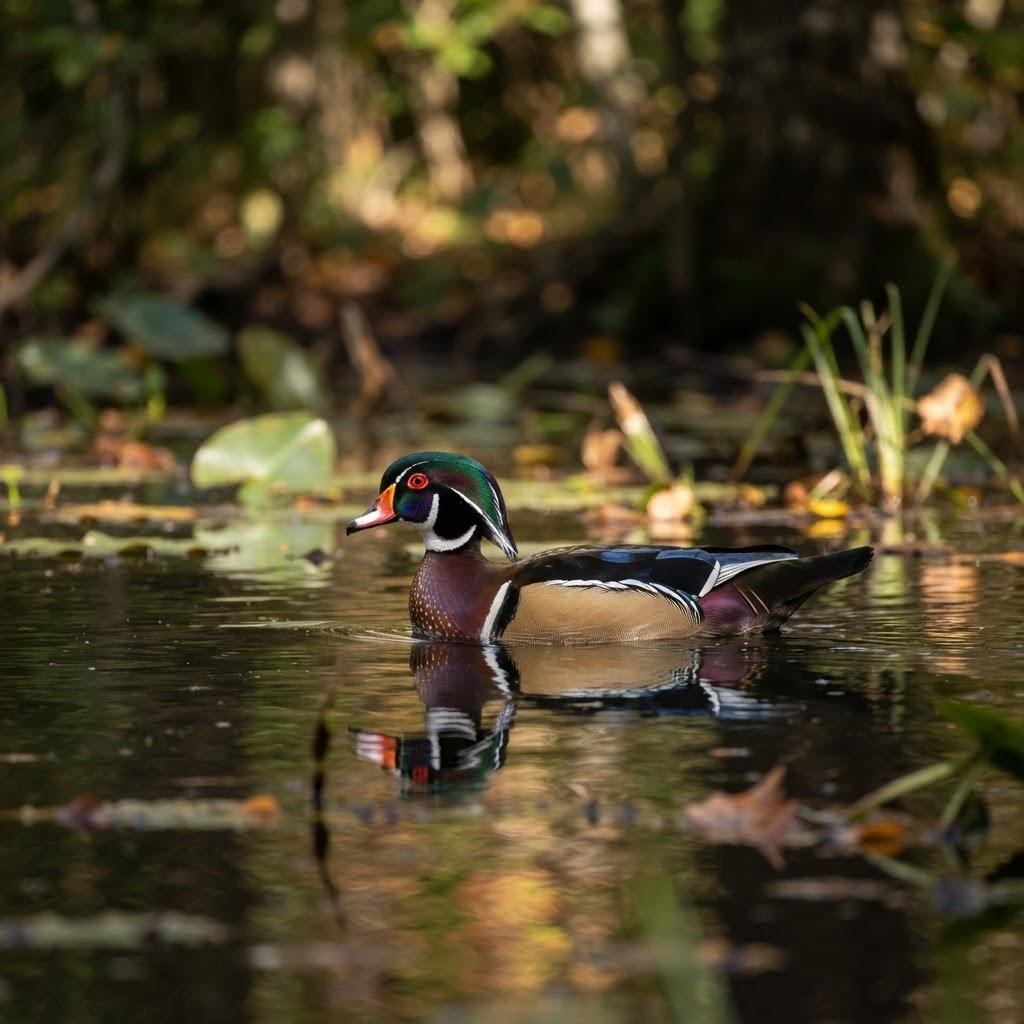
Aix sponsa
Wood Duck
Meet the Wood Duck, a waterfowl that looks like it was painted by a maximalist artist with a penchant for iridescent neon colors. These tree-dwelling quackers are the forest’s most fashionable residents, trading typical pond life for high-rise living in hollowed-out tree trunks.
Meet the Bird
If the duck world had an Academy Awards, the Wood Duck would win 'Best Dressed' every single year, likely while wearing an iridescent helmet and a suit that costs more than your monthly rent. This is not your average, bread-crust-begging mallard found at the local city park. The male Wood Duck is a walking, swimming hallucination of color: metallic greens, deep purples, fiery whites, and a dash of crimson around the eyes. He looks like a high-fashion accessory came to life, strutting through the swamp as if he owns the place. The female, while less flashy, is a master of camouflage, wearing an elegant, understated charcoal-and-brown outfit that allows her to vanish into the shadows of a willow tree. Their vibe is 'refined forest royalty' who prefer the quiet, leafy solitude of an ancient swamp over the crowded, noisy ruckus of a suburban lake. They are the brooding artists of the waterfowl world, mysterious, colorful, and strictly high-class.
Superpowers & Weird Abilities
While most ducks are content bobbing around like plastic toys in a bathtub, the Wood Duck decided to defy gravity and basic logic by choosing to live in trees. That is right, these are perch-dwelling ducks equipped with specially adapted, sharp, curved claws on their webbed feet. These claws act like miniature crampons, allowing them to grip onto the bark of trees as if they were feathered rock climbers. If you see a duck perched thirty feet up on a sturdy branch, don’t rub your eyes—it’s just a Wood Duck showing off its vertical agility. Furthermore, they have a superpower that would make an action hero jealous: their flight speed and maneuverability. They don't just plod through the air; they zip through dense, overgrown woodlands with the precision of a stunt pilot. While other birds are dodging branches, Wood Ducks are weaving through the canopy at top speed, making sharp turns that would leave a mallard dizzy and face-planting into a swamp.
Drama, Personality & Feathered Chaos
Wood Ducks are the classic 'introvert' ducks. They dislike the loud, bickering crowds of common waterfowl and instead prefer their own private slice of a wooded stream. However, do not let that quiet demeanor fool you; their social life is full of high-stakes drama. Because they compete for the best hollowed-out tree cavities, these birds are essentially involved in a perpetual, multi-generational real estate war. If a female finds a vacant apartment that another duck has been eyeing, things get feisty. It is not uncommon to see aerial chases where two drakes (male ducks) engage in a high-speed dogfight through the trees, squawking and flapping in a display of pure territorial rage. They are not bullies at the neighborhood buffet, but they are certainly protective of their private, luxury digs. They value their personal space immensely, and they aren't afraid to let others know when they are trespassing on their prime real estate.
Bizarre Rituals & Quirky Habits
One of the most peculiar habits of the Wood Duck is its preference for jumping into holes that seem far too small for them. When a female is scouting for a nesting site, she will perform a series of reconnaissance flights, peering into holes high above the ground. Once she finds 'the one,' she doesn't just flutter in; she often dive-bombs into the opening. It’s a bit like watching a tiny clown try to fit into a thimble at full speed. Additionally, they have a weird tendency to hang out in places that don't look like duck territory at all. If you are standing in a forest, deep away from any visible open water, you might hear a strange, high-pitched, whistled 'whoo-eek' sound. That’s the Wood Duck, chilling in a tree, far removed from the aquatic chaos of the lake. They are the only ducks in North America that regularly raise their families in elevated wooden apartments, completely ignoring the traditional duck lifestyle of ground-nesting in the grass.
Legends, Folklore & Human Stories
In many Native American traditions, the Wood Duck is seen as a symbol of beauty, forest health, and the importance of adapting to your surroundings. Because they disappear into the dense, dark woods, they have long been associated with the mystery of the deep forest. Early settlers were often baffled by these 'tree ducks,' with many stories telling of children finding 'ducks in the rafters' and wondering if they were witnessing some form of avian magic. There is a classic piece of human-duck cooperation involving these birds as well: the Nest Box Program. Seeing their habitat shrink, humans realized they could help these colorful beauties by building artificial homes. It is one of the most successful conservation efforts in history, with birders and hunters alike teaming up to hammer together thousands of wooden boxes, effectively inviting these elusive forest spirits to move into our backyards. The relationship has transformed from a fleeting, rare sight to a common occurrence in many woodland ponds.
Mating: The Ridiculous World of Avian Dating
The courtship of a Wood Duck is a choreographed performance that could give Broadway a run for its money. It usually involves a group of males surrounding a single female, each trying to out-dazzle the other. They don't just quack; they engage in a series of head-pumping, flicking, and calling motions designed to show off their metallic green crests to the maximum effect. The male will often swim in circles around the female, arching his neck and flashing his spectacular white patterns like a neon sign. If she’s interested, she’ll nod; if she’s bored, she will simply paddle away to find a date with better moves. It is a harsh, judgmental world where a bad hairdo or a lackluster head-bob can lead to an immediate rejection. The male must be persistent, graceful, and physically striking, or he risks spending the rest of the spring as a lonely bachelor in the back of the bayou.
Nesting: Master Architects and Lazy Slumlords
Wood Ducks are not technically builders; they are expert 'interior decorators' of existing property. They rely on the hard work of nature, specifically woodpeckers, to create holes in trees. Sometimes they will settle for a nice knot hole or a decaying trunk, but they refuse to carry twigs and mud like some lesser duck. Once they occupy a hole, the female lines it with her own down feathers, which she plucks from her chest to create a soft, warm, insulated cradle for her future children. It is basically the avian equivalent of finding a fixer-upper, tearing out the carpet, and replacing it with the most luxurious goose-down bedding you can find. Because they don't have to build, they can spend their energy ensuring their nest site is secure. It is the ultimate hack for any busy parent who doesn't have time to spend weeks building a house from scratch.
Raising Babies: The Screaming Food Disposals
When Wood Duck eggs hatch, the real adventure begins. The babies have to go from the inside of a hollow tree to the forest floor, which can be forty feet below. There is no gentle descent; the mother flies down to the water, calls up to her ducklings, and they literally jump. They are like tiny, fluffy, flightless paratroopers plummeting into the world. They bounce when they land and immediately start foraging, which is the cutest thing you will see all year. Once in the water, the chaos begins. These ducklings are professional scavengers, swimming in a frantic, disorganized swarm while the mother tries to keep them from becoming a snack for a hungry bass or a snapping turtle. They grow fast, they eat everything in sight, and they never, ever sit still. It is a high-speed, high-stress, and entirely adorable process that requires nerves of steel from the mother duck.
Bird-Watching Travel & Local Hotspots
If you are ready to witness the majesty of a Wood Duck, put away the lawn chair and head to your nearest National Wildlife Refuge. Places like the Patuxent Research Refuge in Maryland or the Sacramento National Wildlife Refuge in California are absolute meccas for these birds. The key is to arrive early—dawn is the 'happy hour' for Wood Ducks. Find a quiet, wooded pond with plenty of overhanging willow trees and mature oak trees nearby. If you are in the Southeast, look for cypress swamps where the light filters through the Spanish moss. Bring your binoculars and, more importantly, bring silence. These birds are twitchy. If you stomp through the brush, you will hear a sharp, wheezy 'ooh-eek' and see them blast off into the trees before you even get your lens cap off. Find a spot in the shade, sit still, and wait for the forest to reveal its most colorful secret.
Food, Feeder Hacks & DIY Projects
Wood Ducks are the connoisseurs of the marshland buffet, preferring acorns, seeds, and aquatic insects. You won't find them at your standard hanging bird feeder—they are too big and too shy to land on your average plastic tube. However, you can make your yard a Wood Duck paradise by planting native oaks and nut-bearing trees nearby. If you have a small pond, you can install a feeding station on the water's edge using submerged platforms, but skip the bread. Please, for the love of all that is feathered, do not feed them bread. It is basically the equivalent of feeding them junk food; it makes them sick and doesn't provide the nutrients they need. Instead, provide native vegetation and a clean, safe water source. A simple 'duck landing' platform made of driftwood and native aquatic plants will keep them coming back without turning your yard into a chaotic, messy gathering spot for aggressive geese.
Seasonal Guides & "Crisis" Management
Spring is when Wood Ducks are most active, especially as they scout for those perfect nesting holes. If you see a lone, confused-looking fluffball on the ground in early summer, don't panic! It is likely a duckling that has wandered away from the group. If the mother is nearby, she will be calling to it, and you should leave the area immediately. They are excellent at finding their way back if you don't interfere. In the winter, their survival revolves entirely around keeping their feet from freezing and finding high-energy snacks. If you have a pond that freezes, consider a pond heater to keep a small patch of water open. It is a lifesaver for all waterfowl. During these cold months, avoid getting too close. Birds are trying to conserve every calorie, and if you scare them into flying away, you are burning up their precious, energy-saving reserves.
Backyard Tech & Gadget Reviews
If you really want to stalk these birds (in a non-creepy way), a trail camera is your best friend. A simple, motion-activated camera strapped to a tree near a nesting box will give you a private window into their domestic life. You will see things that even professional photographers miss: the midnight comings and goings, the dramatic territorial disputes, and the hilarious faces they make while preening. As for window collisions, Wood Ducks aren't frequent flyers into living rooms, but if you live near water, it can happen. Use window decals—specifically the UV-reflective kind—to alert them to the glass. They are invisible to you but look like a flashing neon warning sign to a bird. For the tech-savvy, AI bird cams are great for songbirds, but for Wood Ducks, nothing beats a classic, high-definition wildlife camera with a long-lasting battery. It turns your boring backyard into a Discovery Channel episode.
How to Spot One & How It Is Doing
Spotting a Wood Duck is all about looking for the 'iridescent ghost.' In the water, look for a flash of metallic green that catches the sun, and listen for that distinctive, high-pitched whistle. Their flight pattern is rapid, direct, and usually happens low over the water. They are doing remarkably well, thanks largely to the massive, grassroots movement of people building nest boxes. They are no longer the vanishing creatures they were a century ago, and that is a testament to what happens when we pay attention to our feathered neighbors. If you want to help, donate to your local wildlife refuge or spend an afternoon helping a conservation group clean up a local pond. By protecting these hidden, leafy corners of the world, you aren't just saving a duck; you are ensuring that the forest stays a magical, living, breathing place for generations to come. Keep your eyes on the trees and your heart in the swamp!