Chamaea fasciata
Wrentit
Meet the Wrentit, the shy, secretive bird of California's chaparral that sounds like a bouncing ping-pong ball! This feathered enigma might be hard to spot, but its persistent, melodic song and unique habits make it a true character worth getting to know. Get ready for a deep dive into the life of a bird that’s part punk rocker, part woodland sprite.
Meet the Bird
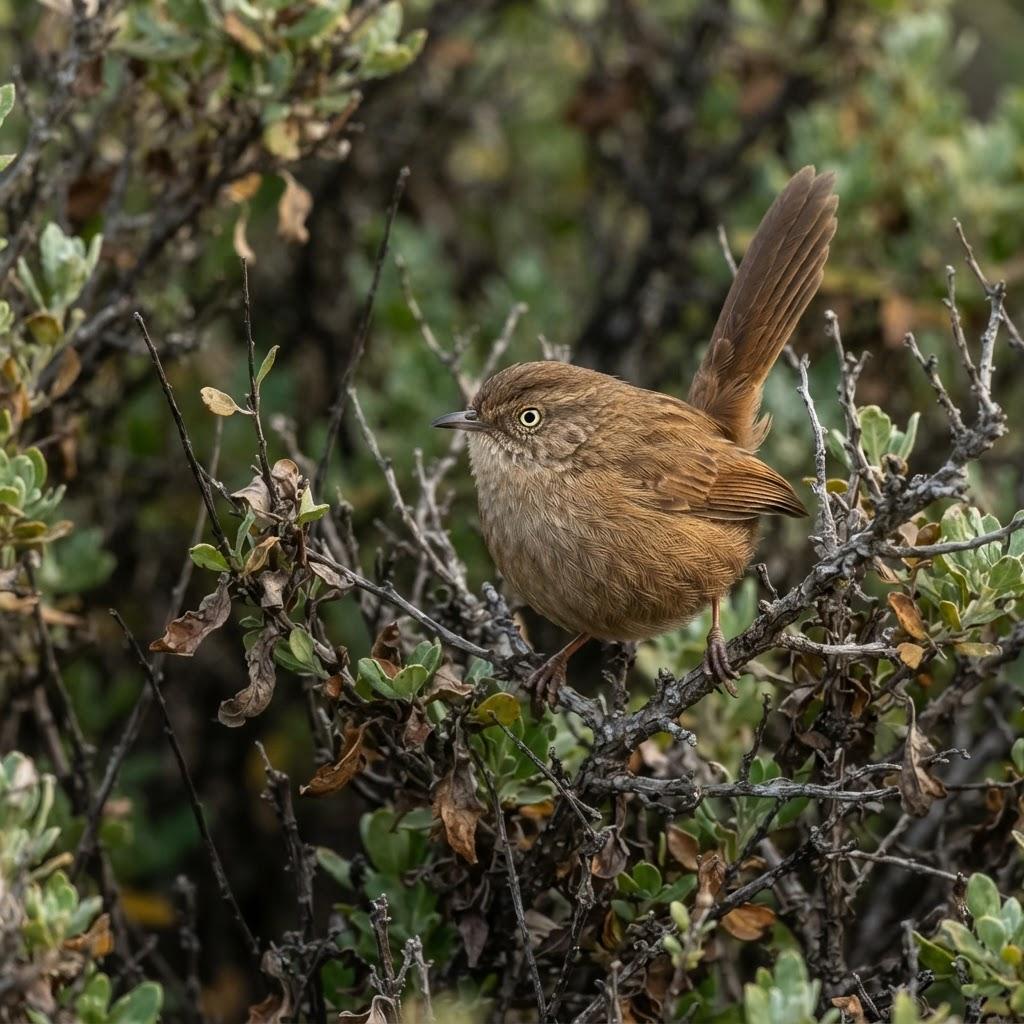
Picture this: you're hiking through a sun-drenched California hillside, the air thick with the scent of sage and wild rosemary. Suddenly, you hear it – a series of sharp, clear whistles that sound uncannily like a ping-pong ball being bounced with increasing speed. *Ting-ting-ting-ting-ting!* That, my friends, is your introduction to the Wrentit, the unofficial mascot of the West Coast's dense, scrubby habitats. This little bird is the only member of its family in North America, which is like being the only kid on the block with a pet dinosaur – pretty unique! The Wrentit is a master of camouflage, a shy sprite that prefers to stay hidden in the thickets it calls home. It’s not a bird that will typically perch on your bird feeder, flashing its plumage for all to see. Instead, it’s a creature of mystery, a whisper in the leaves, a sound before a fleeting glimpse. Its vibe? Think of a slightly anxious, perpetually curious character from an indie film – always peeking out from behind something, never quite ready for their close-up, but utterly captivating once you do catch a glimpse. It's smaller than a robin, bigger than a finch, with a longish tail and a rather drab, brownish-gray outfit that allows it to blend seamlessly into its surroundings. But don't let its understated appearance fool you; the Wrentit possesses a personality and a set of skills that are anything but ordinary. It’s the quiet kid in class who secretly writes epic poetry or builds mind-blowing robots after school. This bird is a testament to the fact that you don't need neon colors or ostentatious displays to be utterly fascinating.
Superpowers & Weird Abilities
The Wrentit might not have laser eyes or the ability to fly through time, but it boasts a suite of biological tricks that are pretty darn impressive, especially when you consider its humble appearance. For starters, its digestive system is practically magical. These birds have an incredibly efficient gut that allows them to extract maximum nutrients from tough, fibrous plant matter – think leaves, buds, and berries that would give most other birds a serious stomach ache. It’s like having a built-in, super-powered compost heap in your belly! This superpower is crucial for survival in their chaparral habitat, where food can be scarce and tough to digest, especially during dry spells. Scientists have marveled at their ability to thrive on what seems like a diet of twigs and leaves, a feat that requires a specialized gut microbiome – a complex community of bacteria and other microbes that help break down the indigestible. Imagine if humans could just munch on salad with the same efficiency, turning every spinach leaf into pure energy. Beyond their super-digestive abilities, Wrentits have an astonishingly acute sense of hearing, which is vital for navigating their dense, visually challenging environment. They rely heavily on sound to communicate, detect predators, and find food. Their world is a symphony of rustles, chirps, and calls, and they are attuned to every nuance. While not quite a 'superpower' in the traditional sense, their ability to survive and thrive in an ecosystem that would stump many other species, thanks to their specialized diet and sensory perception, makes them miniature marvels of adaptation. They are the ultimate survivors of the scrub, proving that resilience and efficiency are their own forms of magic.
Drama, Personality & Feathered Chaos
The Wrentit may be small and shy, but don't mistake that for a lack of personality. These birds are surprisingly territorial and can get quite worked up defending their patch of chaparral. While they aren't exactly known for dive-bombing intruders like some feistier species, they will engage in vocal disputes, puffing up their chests (figuratively speaking) and issuing sharp alarm calls to let rivals or perceived threats know they've crossed a line. Think of them as the slightly neurotic, but ultimately brave, homeowners of the shrubbery world, fiercely guarding their little piece of real estate. Their social lives are complex, and while they tend to form monogamous pairs for the breeding season, they aren't exactly lovebirds. If one partner disappears or dies, the survivor may pair up again, but there isn't a lot of mournful ballad singing involved. It's more of a pragmatic 'well, this is awkward, better find a new roommate for the nest.' One of the most intriguing aspects of their 'personality' is their remarkable shyness. They are masters of vanishing acts, and catching a good look can feel like a major accomplishment, akin to spotting a celebrity incognito. This elusiveness adds to their mystique; it’s as if they are intentionally playing hard to get, making you work for every glimpse. While they might not engage in the dramatic squabbles of jays at a feeder or the complex social hierarchies of crows, their quiet determination, territorial defense, and masterly evasion techniques paint a picture of a bird that is far from boring. They are the introverts of the bird world, but with a hidden depth and a surprisingly fierce protective streak when it comes to their homes. Their drama is subtle, unfolding in rustles and whistles rather than loud pronouncements, but it's there, woven into the fabric of their secretive lives.
Bizarre Rituals & Quirky Habits
While Wrentits might not be known for elaborate, avian-themed Broadway musicals or getting hammered on fermented berries (though who knows what happens after dark in the chaparral!), they do possess a few quirky habits that are worth a chuckle. One such habit, shared by many passerine birds, is something called 'anting.' This is where a bird deliberately picks up live ants and rubs them onto its feathers. Yes, you read that right – birds are using ants like tiny, six-legged feather polishers. The prevailing theory is that the formic acid secreted by the ants helps to clean the feathers, de-louse them, or perhaps even condition them, much like a human might use a special shampoo or conditioner. It sounds bizarre, but imagine having an itch you can’t scratch and deciding the best solution is to rub a colony of ants all over yourself. It’s a strangely effective, if slightly unsettling, grooming ritual. Another quirk is their diet. While they primarily eat insects and berries, they are known to occasionally consume small amounts of leaves and buds, especially when other food sources are scarce. This isn't just a casual snack; it speaks to their remarkable digestive adaptations, allowing them to extract nutrients from things that would be essentially inedible to most birds. It's like their bodies are saying, 'Oh, no juicy bugs today? No problem, I'll just metabolize this branch.' They also have a peculiar tendency to stay very low in their dense shrubby habitats. They aren't birds that typically soar or flit about in open spaces. Instead, they are ground-hugging, branch-hopping specialists, moving with a deliberate, almost furtive, manner through the undergrowth. It’s as if they are constantly playing a game of hide-and-seek with the world, and they've decided the best strategy is to stay hidden at all costs. These are the little oddities that make the Wrentit so endearing – a bird that’s quietly ingenious, resourceful, and just a little bit weird, in all the best ways.
Legends, Folklore & Human Stories
The Wrentit, being a creature of the dense, often wilder edges of human settlement, hasn't quite made it into the grand myths and legends that surround more charismatic or widespread birds like eagles or ravens. You won't find ancient tribes sacrificing to the 'Great Wrentit Spirit' or epic poems about its heroic flights across continents. However, its presence in human stories is more subtle, woven into the fabric of regional folklore and the collective memory of those who live amongst its preferred habitats. For many people in California and the Pacific Northwest, the Wrentit is more than just a bird; it's a familiar sound, a marker of place. Its persistent, percussive song is the soundtrack to countless hikes, backyard mornings, and quiet afternoons spent in coastal scrub or chaparral. It's the sound that tells you you're in the right kind of environment, the kind of place that feels wild and ancient, even if it's just a few miles from a bustling city. In a way, its elusiveness has made it a sort of whispered legend. It's the bird you hear but rarely see, the 'little brown bird' that becomes a quest for many observers. For those who do manage to catch a clear glimpse, it's often a moment of quiet triumph, a reward for patience and keen observation. It’s a bird that doesn't demand attention but earns respect through its quiet persistence and unique adaptation to its environment. While it may not have a starring role in global mythology, the Wrentit plays a significant role in the personal narratives of those who appreciate the wilder corners of the world. It's a symbol of resilience, a reminder of the intricate, hidden lives playing out just beyond our direct gaze, and the quiet beauty that can be found in the most unassuming packages. Its legend is written in the rustle of leaves and the persistent call that echoes through its domain.
Mating: The Ridiculous World of Avian Dating
When it comes to bird dating, forget Valentine's Day cards and whispered sweet nothings. For Wrentits, it's all about commitment, communication, and proving you're the best candidate to share your dense shrubbery with. These birds are generally monogamous for the breeding season, which means they need to find a suitable partner and stick with them, at least until the kids are out of the nest. The courtship process isn't as flashy as a peacock's tail or as architecturally ambitious as a bowerbird's display, but it's deeply rooted in vocalization and shared territory. The male Wrentit will often sing his heart out, not just to establish territory, but also to attract a female. His persistent 'ping-pong' song becomes a beacon, signaling his presence and his suitability as a mate. Think of it as his dating profile, constantly being updated and broadcast. Once a female shows interest, the pair will often engage in mutual vocalizations and spend time together exploring the territory. They might engage in what's called 'courtship feeding,' where the male brings food to the female. This isn't just a romantic gesture; it’s a practical demonstration of his ability to provide for her and their future offspring. It’s like him saying, 'See, I can find snacks! I won't let you starve while you're incubating eggs.' The relationship is cemented by shared nest building and, of course, the actual act of procreation. But unlike some birds where the male goes all out with elaborate dances or constructed 'love shacks,' the Wrentit's approach is more grounded, more about mutual selection based on territory, vocal prowess, and demonstrated foraging skills. If the female isn't impressed, she simply won't pair up, and the male has to keep singing his lonely tune. There’s no heartbreak hotel for Wrentits, just a continued search for a compatible companion in the tangled world of the chaparral. It’s a practical, no-nonsense approach to finding a partner, much like their overall demeanor – efficient, effective, and rooted in survival.
Nesting: Master Architects and Lazy Slumlords
When it comes to building a home, the Wrentit leans heavily towards the 'master architect' category, albeit with a distinctly practical, no-frills approach. They don't waste time on elaborate exterior decorations or gravity-defying feats of engineering. Instead, their nests are functional, sturdy, and perfectly camouflaged cups, expertly woven into the dense vegetation they call home. Think of it as the avian equivalent of a minimalist, earth-toned loft apartment – sleek, efficient, and designed to blend in. Wrentits typically build their nests in dense shrubs, thickets, or vines, often low to the ground but well-hidden. The nest itself is a marvel of natural construction, a cup-shaped structure meticulously crafted from fine twigs, grasses, plant fibers, and sometimes even spider silk, which provides a bit of elastic give. The interior is lined with softer materials, like animal hair or fine plant down, creating a cozy cradle for the eggs. This isn't a haphazard pile of sticks; it's a carefully constructed masterpiece of natural engineering, designed for both security and comfort. The camouflage is so effective that finding a Wrentit nest is a significant challenge, even for experienced birdwatchers. The nest is usually well-tucked into the heart of a bush, blending seamlessly with the surrounding leaves and branches. It’s as if the bird knows that standing out is the worst possible thing it could do. Unlike the pigeon’s notoriously sloppy nest of just a few twigs balanced precariously on a ledge, or the brood-parasitic cuckoo, which doesn't build a nest at all and tricks other birds into raising its young, the Wrentit takes pride in its home construction. It’s a testament to their skill and their need for a secure environment for their offspring. Their nests are a perfect reflection of their lifestyle: hidden, efficient, and deeply integrated into the natural world around them.
Raising Babies: The Screaming Food Disposals
Once the tiny, speckled eggs hatch, the Wrentit parents transition into full-on, 24/7 fast-food delivery service. Forget sleep, forget relaxation; it's all about keeping those gaping maws filled. A typical Wrentit clutch consists of 3-5 eggs, and as soon as those little beaks emerge from their shells, the real work begins. Baby Wrentits are essentially bundles of instinct and hunger, born with an insatiable appetite and an equally insatiable urge to vocalize their needs. They are born blind and naked, looking more like pink, squishy worms than birds, but their ability to demand food is already legendary. The parents, particularly the female who incubates the eggs and stays on the nest for the initial brooding period, will work tirelessly. The male plays a crucial role in foraging and bringing food, which he will then pass to the female to feed the chicks, or sometimes feed them directly. Their diet consists mainly of insects and spiders, which are packed with the protein and energy needed for rapid growth. Imagine being a parent, flying back and forth every few minutes, delivering a tiny caterpillar or spider leg to a creature that opens its mouth wide enough to swallow your finger. The chicks grow incredibly fast, developing their fluffy down and then their first set of feathers. They continue to be fed by their parents for about two weeks after they fledge, or leave the nest. Even after they can technically fly, they are still clumsy and vulnerable, relying on their parents for sustenance and protection. The constant chirping and begging from the nest can be deafening, a soundtrack of need that drives the parents to their limits. It's a chaotic, exhausting, but ultimately rewarding period, culminating in a brood of young Wrentits that are ready to disperse and begin their own lives in the dense thickets.
Bird-Watching Travel & Local Hotspots
If you’ve been bitten by the Wrentit bug and want to increase your chances of spotting this elusive gem, you'll need to head west, young birder, and aim for places where the scrub is thick and the air smells of sage. The prime Wrentit real estate spans the West Coast of the United States, from the coastal mountains and foothills of California northward through Oregon and Washington. They are also found in parts of Baja California, Mexico. Your best bet is to seek out dense chaparral, coastal sage scrub, or overgrown thickets. Think of places where you can barely see through the bushes – that's Wrentit territory. In California, places like Pinnacles National Park are legendary for their chaparral habitats and are excellent spots for Wrentit searching. The Santa Monica Mountains National Recreation Area also offers vast expanses of prime Wrentit habitat. Further north, look to the coastal ranges of Oregon and Washington. Oregon's Siuslaw National Forest and Washington’s Olympic National Park, particularly its coastal and lower-elevation forested areas with dense undergrowth, can be productive. The best time to find them is generally spring and summer when their distinctive song is most active, and they are busy with nesting. However, they are year-round residents in much of their range, so even winter birding trips can yield sightings, though they tend to be even more secretive when the weather is harsh. When you arrive at a promising spot, don't just stare at the treetops. Wrentits are ground-dwellers and low-shrub specialists. Walk slowly along trails that wind through dense vegetation, pausing frequently to listen. Their song is your best clue. Tune your ears to that accelerating ping-pong whistle, and then try to pinpoint its source. Be patient, move quietly, and look for movement in the low branches and undergrowth. The reward for your patience will be a glimpse of this truly unique and charming West Coast resident.
Food, Feeder Hacks & DIY Projects
Attracting a Wrentit to your backyard is like trying to get a shy teenager to join the family dinner conversation – it requires patience, the right environment, and a bit of clever strategy. Wrentits are primarily insectivores and frugivores, meaning they love bugs and berries. They forage for insects and spiders on the ground, in low shrubs, and on tree trunks, and they also relish various types of fruit and berries. While they aren't regular visitors to traditional seed feeders, you can entice them by offering foods that mimic their natural diet. Consider scattering mealworms or dried insects on the ground or in a platform feeder, especially in areas with dense shrubbery. During the fall and winter, offering fruit like chopped apples or berries can also be a draw. The most effective way to attract Wrentits, however, is not by relying on feeders alone, but by creating a habitat they find irresistible. Plant native shrubs that produce berries and provide ample cover. Think about species like toyon (Heteromeles arbutifolia), coffeeberry (Frangula californica), or various manzanita (Arctostaphylos spp.) and ceanothus (Ceanothus spp.) species. These plants offer both food and shelter. If you're feeling crafty, a simple DIY project could involve creating a 'bug buffet' – a shallow dish filled with soil and leaf litter, kept moist, which can attract insects that Wrentits will then forage for. Another idea is a simple suet feeder filled with a high-energy mix that includes fruits and insects, placed near dense cover. Avoid cheap seed mixes that are mostly millet or milo; these are unlikely to attract Wrentits and often just attract aggressive species or nuisance animals. Focus on providing natural food sources and plenty of dense, protective shrubbery, and you’ll significantly increase your chances of experiencing the quiet delight of a Wrentit in your own little patch of wilderness.
Seasonal Guides & "Crisis" Management
The Wrentit, like all its feathered brethren, navigates the year with a rhythm dictated by the seasons, and understanding these shifts can make you a more insightful observer and a better avian ally. As spring awakens, the Wrentits become more vocal, their territories firmly re-established, and pairs begin their courtship and nest-building rituals. This is a great time to start putting out supplemental food like mealworms or fruit if you're aiming to attract them, and to ensure your native berry-producing plants are thriving. The summer months are peak chick-rearing time, filled with the constant demands of hungry fledglings. You might notice adults looking a bit ruffled as they work themselves to exhaustion. As autumn arrives, insect populations dwindle, and berries become a critical food source. This is when Wrentits might become slightly more visible as they forage more actively for these remaining resources. Winter brings a quiet period for the Wrentits. They remain year-round residents in much of their range and are masters of surviving cold, damp conditions by hunkering down in dense cover. This is when high-fat suet mixes (without excessive filler seeds) or providing fruits can be most helpful, as it provides much-needed energy. Now, for the 'fledgling panic' – every spring and summer, people find fluffy, seemingly abandoned baby birds on the ground and rush to 'rescue' them. If you find a young Wrentit that is fully feathered but perhaps a bit clumsy on its feet, resist the urge to intervene immediately. Chances are, its parents are nearby, watching and waiting for you to leave so they can continue feeding it. The best course of action is usually to leave it be. If it's in immediate danger (like on a road or being stalked by a cat), gently move it a few feet into dense cover. Observe from a distance to see if parents return. Only intervene by contacting a licensed wildlife rehabilitator if the bird is clearly injured or has been orphaned for an extended period (many hours) with no sign of parents.
Backyard Tech & Gadget Reviews
In the quest to connect with the Wrentit, technology can be a surprising ally, though it’s important to remember the bird’s natural shyness. Let’s talk about the trendy 'smart feeders.' While a Bird Buddy or similar AI-powered feeder might snap a photo of a fleeting visitor, the odds of it capturing a Wrentit are slim. These birds are rarely drawn to the typical feeder setup these devices monitor. Their preference for dense cover and ground foraging means they're unlikely to be posing for a selfie on a perch. So, while the tech is fun for common feeder birds, it's not the best tool for Wrentit enthusiasts. For those who want to observe Wrentits more closely without disturbing them, consider trail cameras or motion-activated wildlife cameras. You can set these up near areas where you've seen or heard Wrentits, particularly near dense shrubbery or potential food sources like a ground feeder with mealworms. A camera placed strategically can capture surprising glimpses of their behavior when they think no one is watching – perhaps a quick visit to a berry bush or a rustle in the undergrowth. Regarding window collisions, a common hazard for all birds, Wrentits are no exception. The best solutions are those that break up the reflection of the sky or trees on your windows. Decals, specially treated window films, or even just strategically placed bird feeders (about 3-4 feet from the window, or much further away) can help. For a more DIY approach, you can hang lengths of string or twine every few inches across the outside of your windows, creating a visual barrier that Wrentits can see and avoid. The goal is always to make the glass visible as a solid object, not a portal to another dimension. While high-tech feeders might not be Wrentit-focused, simpler tech and thoughtful window treatments can significantly improve their safety and your chances of discreetly observing these fascinating, shy birds.
How to Spot One & How It Is Doing
Spotting a Wrentit is a bit like being a detective in a quiet neighborhood. Your primary clues will be auditory and environmental. Listen for its signature song: a rapid series of clear, metallic whistles that accelerate like a bouncing ping-pong ball, often ending with a trill or a short, sharp note. It's a distinctive sound that carries well through dense vegetation. Once you hear it, scan the area for thick, tangled shrubbery, chaparral, or overgrown thickets – these are their preferred hangouts. Wrentits are small to medium-sized birds, typically brownish-gray overall, with a slightly longer tail than many birds of similar size. They have a plain face, a short, stout bill, and they tend to move with a distinctive, almost furtive, hopping or flitting motion through the lower levels of vegetation. They aren't birds that perch conspicuously on high branches or engage in aerial acrobatics. Instead, they hug the cover, peeking out from behind leaves or darting from one dense clump of bushes to another. Look for movement low down, in the undergrowth. Patience and quiet observation are your best tools. When it comes to their population status, the news is good! The Wrentit is currently listed as 'Least Concern' by the IUCN. This means their numbers are relatively stable across their range, and they aren't facing immediate threats of extinction. Their adaptability to various types of shrubland, including some areas that have been altered by human activity (as long as dense cover remains), has helped them maintain healthy populations. However, as with all species, habitat loss and degradation are ongoing concerns. Supporting conservation efforts for shrubland ecosystems, planting native shrubs in your yard, and keeping these areas healthy helps ensure that future generations can continue to hear that unique ping-pong song echoing through the chaparral. You can help by simply appreciating these birds in their natural habitat, refraining from disturbing them, and creating welcoming, safe environments in your own backyard with native plants and minimal disturbance.