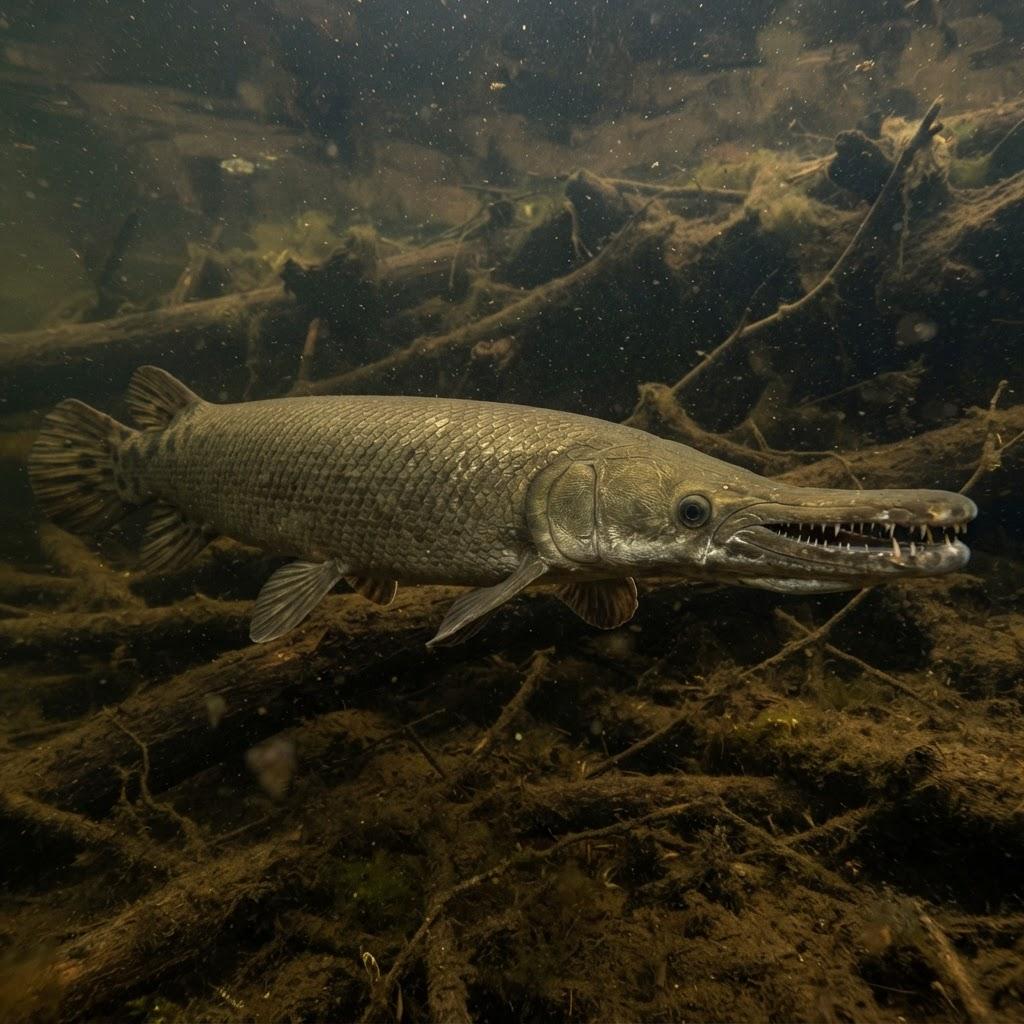
Atractosteus spatula
Alligator Gar
Meet the Alligator Gar, a living fossil that looks like a prehistoric chainsaw and acts like the neighborhood tough guy. With armor plating and a face only a dinosaur could love, this gargantuan predator is the undisputed heavyweight champion of the freshwater world.
Meet the Fish
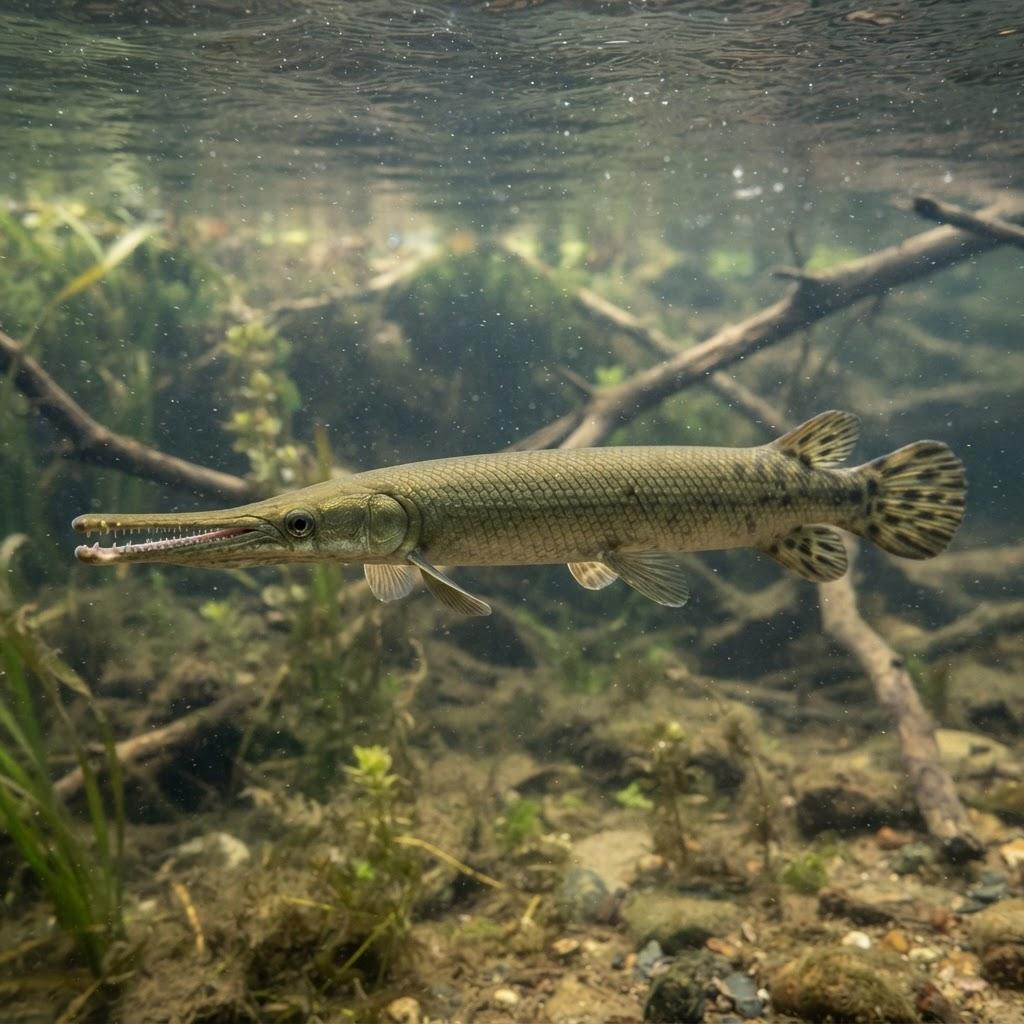
Picture a creature that decided to stop evolving about a hundred million years ago because, quite frankly, it already had the perfect design. Meet the Alligator Gar, the undisputed king of the murky backwaters. This isn't your average goldfish; it is a torpedo-shaped tank covered in armor that would make a medieval knight jealous. With a snout that screams 'I bite things,' this fish looks like it stepped straight off the set of a low-budget Jurassic Park sequel. It hangs out in the shadows, waiting for anything unlucky enough to swim by, and it does so with an air of cold, calculated indifference. While other fish are busy being streamlined and graceful, the Alligator Gar embraces a vibe that says, 'I am a relic of the age of reptiles, and I really do not care what you think about my fashion choices.' It is massive, it is toothy, and it is entirely unimpressed by your presence.
Weird Biological Superpowers Explained Simply
The Alligator Gar is basically the MacGyver of the swamp, and its greatest trick is a specialized swim bladder that functions like a makeshift lung. While most fish rely entirely on gills to extract oxygen from the water, the Gar lives in habitats that can get pretty low on oxygen during a hot, stagnant summer. When the water gets too 'stale' to breathe, the Gar simply sticks its snout above the surface and takes a big gulp of air. It’s like having a scuba tank that you can refill whenever you feel like coming up for a breather. This air-breathing capability allows it to survive in shallow, swampy, or polluted waters where other fish would literally pass out from lack of oxygen. It is a biological hack that keeps the Gar active and predatory while its neighbors are busy gasping for a breath on the surface.
Absurd Self-Defense Mechanisms
When you have skin made of 'ganoid' scales—which are essentially interlocking, diamond-shaped pieces of bone covered in a hard, enamel-like substance—you don't really need to worry about being poked or bitten. These scales are so tough that they were historically used by Native Americans as arrowheads and by early settlers to craft durable armor plating for plows. This isn't just skin; it's a mobile fortress. If a predator tries to take a nip at an Alligator Gar, they are more likely to break their own teeth than to get a satisfying meal. It’s the aquatic equivalent of wearing a full suit of bulletproof Kevlar to a casual brunch. While other fish depend on speed or camouflage to hide, the Gar simply sits there, glistening in its impenetrable coat of armor, basically daring anything in the water to come and try their luck.
Fish Drama and Gossip
Imagine a high school cafeteria where the biggest, toothiest kid at the table decides who gets the best lunch spot, and you have the social life of an Alligator Gar. While they are usually solitary hunters, things get heated when they congregate in certain deep river pools. There is a lot of posturing, side-glancing, and general 'don't look at me' attitude. They aren't exactly known for forming deep, emotional bonds; instead, they maintain a hierarchy based on size. If a slightly smaller Gar tries to muscle in on a prime ambush location, it will likely be met with a slow, menacing swivel of the head that sends a clear message: keep moving. It is the ultimate reality show of patience and intimidation, where the drama is slow-burning, long-lasting, and occasionally punctuated by a sudden, violent burst of feeding action.
The "Wait, That's Real?!" Deep-Sea Oddities
The Alligator Gar lives in the shallow, muddy, and often murky waters of the American South, a world away from the bioluminescent, neon-glowing dance parties of the deep sea. While deep-sea fish like the Anglerfish use glowing lures to attract prey in the infinite darkness, the Gar operates in the 'twilight' of shallow river beds where sunlight is often filtered through silt and mud. If the deep-sea fish are the aliens of the ocean, the Alligator Gar is the terrestrial cave-dwelling monster that somehow ended up in a river. Deep-sea creatures are often soft, gelatinous blobs designed to survive crushing pressure, whereas the Gar is a solid, rigid, prehistoric machine. It provides a fascinating look at how different environments force evolution to take wild turns—one side goes for glowing glass-like fragility, and the other goes for heavy-duty, bone-crushing, swamp-dwelling durability.
Myth Busting
For decades, folks loved to tell tall tales about Alligator Gar being maneaters, claiming they were just as dangerous as sharks or gators. Let’s put that to rest: there are zero confirmed reports of an Alligator Gar ever attacking a human. They are definitely big, and they have mouths filled with needle-sharp teeth, but they are incredibly shy around people. They aren't looking for a human-sized snack; they are looking for smaller fish, crabs, and maybe the occasional slow-moving duck. People also love to claim that these fish don't have brains or personalities, but like all fish, the Gar is a master of its own domain, capable of learning, navigating complex river systems, and identifying prime feeding times. It isn't a mindless monster; it is a highly evolved survivor that just happens to look like a nightmare from the Mesozoic Era.
Humorous Historical Tales or Folklore
In the annals of folklore, the Alligator Gar has been cast as everything from a river demon to a lucky charm. Native American tribes recognized their immense strength and utility, using their incredibly thick, bony scales for practical purposes while respecting them as powerful spirits of the river. Fast forward to the early 20th century, and the fish became the target of intense hatred from commercial fishermen who thought they were eating all the 'game fish.' They were treated like the villains of the swamp, with government-sanctioned programs aimed at exterminating them. Luckily, that shortsighted nonsense eventually stopped. Today, the Gar is celebrated as a 'living fossil' and a trophy, representing a link to a time before modern civilization. They have gone from being the 'scourge of the river' to a prized piece of living history that folks travel across the country just to glimpse.
Underwater Love Stories and Bizarre Romances
When it comes to romance, the Alligator Gar doesn't do quiet dinners or fancy light displays. Their mating rituals are essentially a massive, chaotic mosh pit. During the spring, when the water temperature hits that 'just right' sweet spot, these giant fish head into the shallow flooded grasses. It is a noisy, splashing affair where several males will crowd around a single, larger female. They churn the water and thrash about in a wild, group frenzy. It is less of a romantic candlelit moment and more of a rowdy festival. The female releases her eggs into the submerged vegetation, and the males do their best to fertilize them in the midst of the chaos. It’s high-energy, it’s messy, and it is a spectacle that happens in the blink of an eye, leaving behind a new generation of tiny armor-clad babies.
Underwater Architecture and DIY Nesting
If you are looking for a fish that builds elaborate sandcastles or hidden fortresses, the Alligator Gar is going to let you down. It doesn't believe in construction. Instead, it relies on the environment to provide the perfect nursery. The female simply chooses a spot in flooded marshes or areas with lots of thick, submerged vegetation. The eggs are sticky little treasures that cling to the plants and debris, hidden away from the prying eyes of hungry scavengers. This isn't laziness; it is a strategy. By scattering their eggs across a wide area of dense grass, the Gar ensures that a predator can't simply stumble upon a single 'nest' and wipe out the entire next generation. It is a simple, effective design that has worked for millions of years without needing a single blueprint or architect.
The Chaos of Raising Tiny Swimmers
Being a baby Alligator Gar is like being born into a war zone. Once those little eggs hatch, the fry are on their own. They don't have parents hanging around to bring them snacks or help them with homework. These tiny, needle-toothed babies are essentially miniature, defenseless versions of their parents. They grow incredibly fast, which is a great strategy because the faster you get big, the fewer things can eat you. They hide in the weeds, dodging everything from bigger fish to birds, and grow at an astonishing rate. By the time they have their full armor plating, they are basically tiny tanks prowling the shallows. It is a tough, high-stakes game of survival where the only rule is 'eat enough to become the thing that does the eating.' They are little survivors in a big, hungry world.
How to Spot One & How It Is Doing
If you want to spot an Alligator Gar, look for the 'logs' that move. If you see a large, dark shape near the surface that looks like a submerged piece of wood, but it has a distinct snout and eyes that look right back at you, you have found one. They are most commonly spotted in the slow-moving rivers of the southern United States. While they were once nearly wiped out by overfishing and habitat loss, populations are slowly making a comeback thanks to better management and a change in attitude. They are currently classified as 'Least Concern,' which is a massive win for a species that spent decades being vilified. You can help by keeping local waterways clean and supporting organizations that protect river habitats. These prehistoric giants have survived asteroid impacts and climate shifts—let's make sure they survive the next century with us.