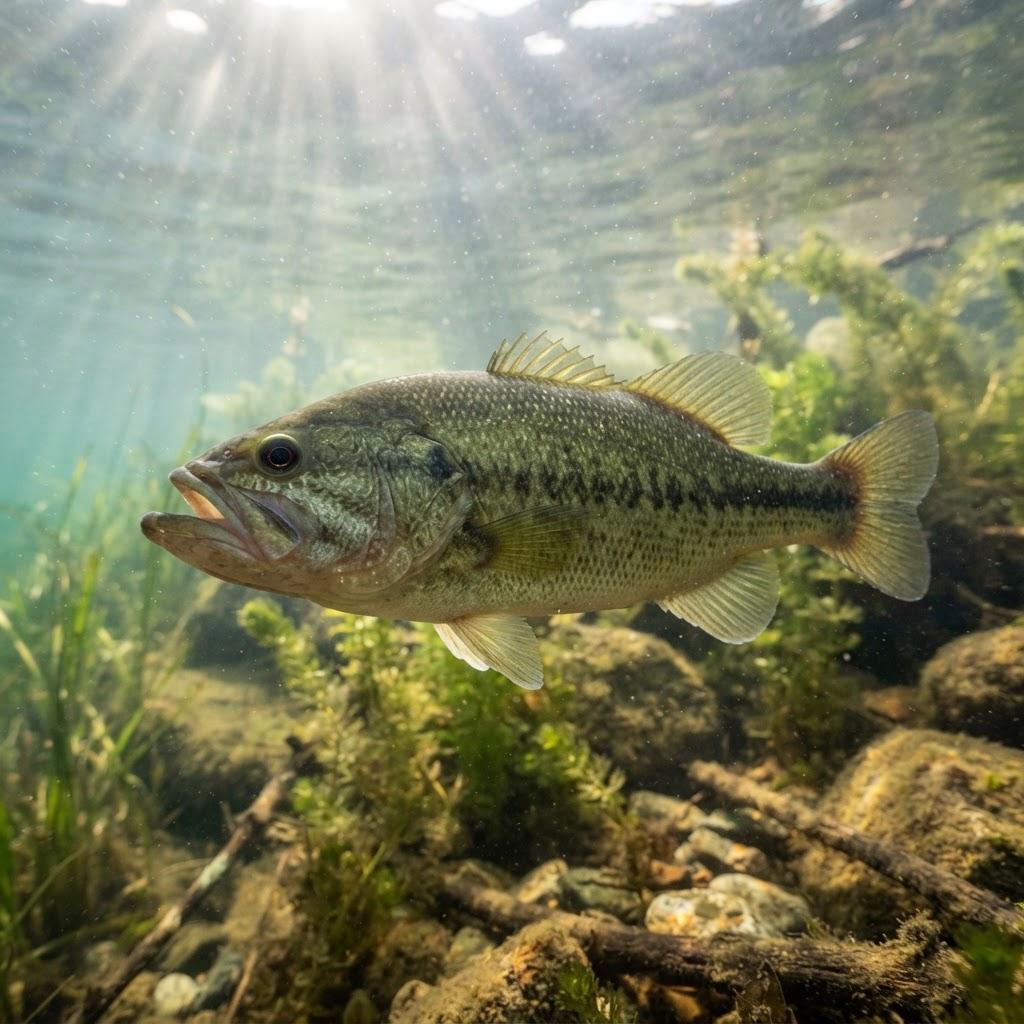
Micropterus salmoides
Largemouth Bass
Meet the Largemouth Bass, the undisputed heavyweight champion of the freshwater world with an attitude problem and an appetite that could shame a competitive eater. This green-sided gladiator is the reason weekend anglers lose sleep and keep tackle boxes stuffed to the brim.
Meet the Fish
Imagine a fish that went to the gym, got obsessed with protein shakes, and then decided it wanted to be the neighborhood bully. That is the Largemouth Bass. This fish is essentially the swaggering jock of the freshwater pond, possessing a jaw that hinges wide enough to inhale a small smartphone if it were feeling particularly adventurous. With its olive-green armor and a dark, jagged stripe running down its side like a lightning bolt, it moves with a level of confidence that demands attention. It is not just a fish; it is an ambush predator that treats every underwater shadow as a potential buffet. While some fish are content nibbling on algae or polite little bugs, the Largemouth Bass looks at the world and sees snacks, snacks, and slightly larger snacks. It is the kind of aquatic personality that waits in the weeds for hours, perfectly still, just to launch a high-speed strike that would make an Olympic sprinter look like they are standing in quicksand. It is aggressive, it is hungry, and it is entirely unapologetic about being at the top of the local food chain.
Weird Biological Superpowers Explained Simply
The Largemouth Bass has a secret weapon that is basically a hydraulic vacuum cleaner attached to its face. When this fish decides it is lunchtime, it does not just swim up and bite a target; it opens its mouth so fast that it creates a massive pressure drop. This sudden, violent expansion of its mouth cavity sucks the prey—and a significant amount of the surrounding water—right down its gullet before the victim even realizes the party is over. It is like an underwater super-soaker working in reverse. Beyond this suction power, the bass has a sensory organ called the lateral line, which runs like a racing stripe down its body. Think of this as a built-in sixth sense that allows it to feel vibrations in the water with surgical precision. It can detect the panicked heartbeat of a crawfish hiding behind a rock or the subtle splash of a frog falling off a lily pad from twenty feet away. It is essentially living with sonar-enhanced hearing, making it impossible to sneak up on one unless you are an expert at being absolutely silent.
Absurd Self-Defense Mechanisms
When you are the king of the pond, you do not really spend your time worrying about being eaten, but a Largemouth Bass still needs to stay sharp. Its primary self-defense mechanism is a mix of tactical camouflage and sheer intimidation. If a bigger predator—or a confused human—shows up, the bass can flush its color patterns to blend perfectly into the dappled sunlight hitting the reeds. It essentially turns on a personal invisibility cloak. However, when hiding is not an option, the bass relies on its spiny dorsal fin. These aren't just aesthetic accessories; they are razor-sharp, jagged spikes that act like a 'do not touch' sign for anything with a soft mouth. If a larger pike or a hungry bird tries to grab a bass, those spines flair out and make the fish feel like it is trying to swallow a porcupine dipped in glass. It is a brilliant way to ensure that even the bullies of the lake decide that lunch is just not worth the medical bills that would surely follow an attempt to eat a full-grown bass.
Fish Drama and Gossip
If you tuned into 'The Real Housewives of the Reservoir,' the Largemouth Bass would definitely be the cast member who starts all the fights at the brunch table. These fish are intensely territorial, constantly patrolling their 'turf' and chasing away anyone who looks like they might be eyeing their favorite stump or sunken log. It is not uncommon to see a bass charge another fish just for looking in its direction, a move that is less about actually wanting a fight and more about asserting dominance. There is a rigid hierarchy in the deeper waters, where the biggest, meanest, and oldest fish get the best spots with the most shade and the highest traffic of passing baitfish. Younger, smaller bass are often relegated to the shallow, weed-choked outskirts where they have to work twice as hard for half as much food. It is a high-stakes, constant battle of wills, where one wrong turn into another bass's living room usually results in a very brisk, very rude eviction notice served with a splash.
The "Wait, That's Real?!" Deep-Sea Oddities
While the Largemouth Bass is a shallow-water socialite, it is worth looking at its strange cousins in the deep dark. Deep-sea fish often look like they were designed by an artist on a fever dream, with bioluminescent lights that turn their bodies into floating nightclubs. While our bass sticks to the murky sunlit shallows where it can see its dinner coming, deep-sea residents have to deal with the pressure of a thousand atmospheres and total darkness. Some deep-sea fish, like the barreleye, have transparent heads so they can look up through their own skulls to spot predators. The bass, by contrast, keeps its biology strictly 'normal' but maximizes its efficiency. While a deep-sea anglerfish might use a glowing lure to trick prey in the void, the Largemouth Bass uses pure, explosive physical power in the bright, busy world of the surface. It is the difference between a high-tech spy satellite and a linebacker; both are effective, but one is clearly much better at smashing through a door when the mood strikes.
Myth Busting
There is a persistent myth that fish are essentially mindless automatons with the memory span of a blink, but the Largemouth Bass is here to prove that theory absolutely wrong. Studies have shown that bass are highly capable of 'associative learning,' which is a fancy way of saying they remember things that benefit their stomachs. If a bass gets stung by a particularly spiky lure or narrowly escapes a fisherman’s hook, it remembers that experience for months, possibly years. They learn to avoid areas where they have had 'bad' interactions and will even learn to recognize different types of bait. They are not just swimming snacks; they are calculating, observant predators that build mental maps of their environment. Another myth is that they are constantly aggressive all the time; in reality, they are actually quite lazy. They spend the vast majority of their day holding perfectly still in one spot to conserve energy, waiting for the perfect, low-effort opportunity to strike. They are the ultimate masters of the 'work smarter, not harder' lifestyle.
Humorous Historical Tales or Folklore
The Largemouth Bass has a long, illustrious history with humans, primarily because it is so good at making us look foolish. There are endless legends of 'Monster Bass'—massive, mythical fish that have supposedly lived in local ponds for generations, evading every lure thrown their way. These fish become local celebrities, with names like 'Old Mossy' or 'The General,' and generations of anglers grow up trying to catch them, only to come home empty-handed and full of excuses. One historical account from the early 20th century involves a competition where a bass was reportedly trained to eat from a human hand, proving that even a grumpy predator can be bribed with a free meal. The folklore surrounding these fish is almost entirely tied to the 'one that got away,' cementing their place in our culture as the fish that challenges our ego. It is a fish that has inspired more tall tales, exaggerated hand gestures at parties, and questionable boat-buying decisions than arguably any other species in the North American continent.
Underwater Love Stories and Bizarre Romances
When spring rolls around and the water temperatures start to tick upward, the Largemouth Bass enters a phase of life that is best described as a very wet, very intense romantic comedy. The males start by scouting for a perfect piece of real estate, usually a nice, flat patch of sandy bottom in shallow water. Once the site is picked, the male spends his time aggressively courting females, performing displays that involve vibrating his fins and showing off his colors like he is wearing his Sunday best. If a female is impressed—or just decides he is the best option in the vicinity—she will join him at the nest. It is not exactly a candlelit dinner, but it is effective. The female deposits her eggs in the nest, and the male fertilizes them immediately. The romance part ends pretty abruptly there, as the female usually jets off to find another snack, leaving the male to deal with the overwhelming responsibility of being a single father for the next week or so.
Underwater Architecture and DIY Nesting
You might think of a fish as a creature that just drifts around, but a male Largemouth Bass is a surprisingly dedicated construction worker. When it is time to build a nest, he uses his tail to fan away silt and debris, creating a perfectly circular depression in the lake floor. This is not just a random hole; it is a meticulously cleared nursery. He removes sticks, rocks, and anything else that might harbor fungus or predators that could threaten the future fry. The result is a clean, bowl-like basin that acts as a fortress against the elements. This construction process requires a significant amount of effort, and the male will defend this little patch of real estate with the ferocity of a knight guarding a castle. He is constantly patrolling the perimeter, nudging away curious intruders and ensuring that the water flow over the eggs remains constant, which is essential to keep them oxygenated until they hatch into a school of tiny, hungry adventurers.
The Chaos of Raising Tiny Swimmers
Once those eggs hatch, the real insanity begins. The tiny fish, known as fry, emerge looking like little more than eyeballs with tails. For the first few days, they stick close to the nest, but they are incredibly vulnerable to everything from dragonfly larvae to other, more aggressive fish. The male bass, despite his reputation as a cold-blooded killer, turns into a surprisingly protective dad. He hovers over the fry, chasing away anything that moves. However, the 'chaos' factor comes in when the fry start to become mobile. They form a 'ball' of swimming fish that drifts through the weeds, and keeping that ball together is like herding thousands of microscopic cats. As they grow, they lose their baby stage and start acting like miniature, hyper-aggressive versions of their parents. The parenting stage is short-lived, though; once they are big enough to fend for themselves, the father suddenly stops seeing them as 'my kids' and starts seeing them as 'small, bite-sized protein,' which is a pretty jarring shift in family dynamics.
How to Spot One & How It Is Doing
If you want to spot a Largemouth Bass, grab a pair of polarized sunglasses and head to the nearest lake or slow-moving river. Look for the 'structure'—that is angler-speak for docks, fallen trees, patches of lily pads, or rocky shelves. If you see a shadow that looks like a football with a serious attitude, you have likely found one. They are hardy, adaptable, and currently doing quite well across their natural range. Because they are so popular for recreational fishing, many lakes have active management programs to ensure the populations stay healthy and balanced. The biggest threat they face is habitat loss—when we remove the weeds and logs that they use for shelter, we make it harder for them to hide and hunt. You can help by supporting local water conservation efforts, keeping our waterways clean, and always practicing 'catch and release' if you are fishing, which ensures these grumpy, green legends remain the stars of our lakes for generations to come.