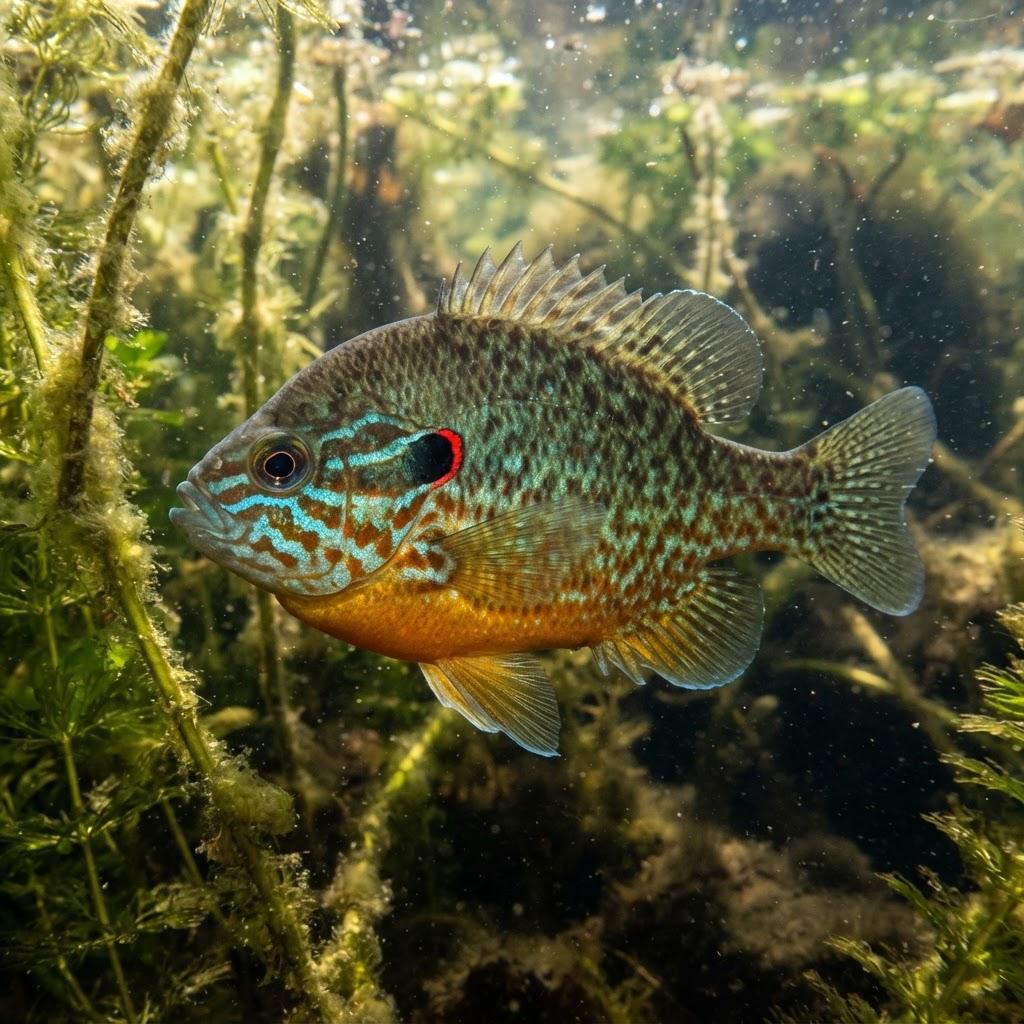
Lepomis gibbosus
Pumpkinseed Sunfish
Meet the Pumpkinseed Sunfish, the glitter-bomb of the freshwater world with the attitude of a neighborhood bouncer. These pint-sized pugilists are more than just a pretty face; they are the true legends of your local pond.
Meet the Fish
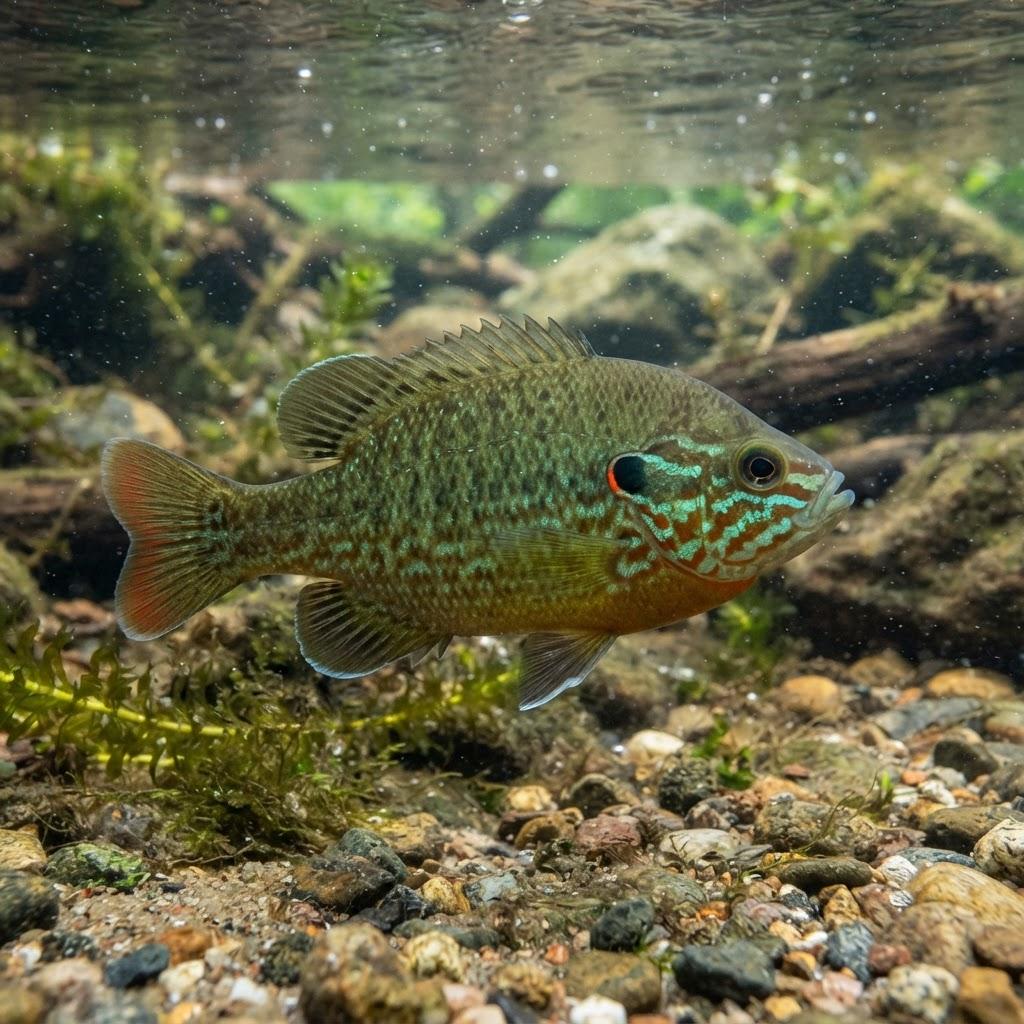
Imagine if a disco ball and a grumpy gardener had a baby that lived underwater. That is the Pumpkinseed Sunfish. While its name sounds like something you would find in a trail mix, this little guy is actually the undisputed fashion plate of the freshwater pond. With neon-blue streaks, orange spots that look like they were airbrushed on by a professional, and a vibrant little red dot on its gill cover that functions like a high-fashion accessory, it is impossible to ignore. But do not let those vibrant colors fool you into thinking this is a passive, gentle creature. The Pumpkinseed has the personality of a caffeinated toddler at a birthday party—curious, incredibly territorial, and always ready to investigate whatever is happening in its general vicinity. It is essentially the neighborhood busybody of the lake, constantly darting between lily pads to see if anyone is encroaching on its patch of weeds or if there is a juicy snail to be bullied. It is truly the protagonist of every freshwater documentary that never got made, and it wears its sparkly scales with an air of immense, unearned importance.
Weird Biological Superpowers Explained Simply
The Pumpkinseed might not be able to shoot lightning or walk on water, but it possesses a biological toolkit that makes it a top-tier hunter in its leafy jungle. Its superpower lies in its suction-feeding mechanism, which is basically an underwater vacuum cleaner trick. When a delicious snail or insect larva gets too close, the Pumpkinseed snaps its mouth open in a fraction of a second. This creates a vacuum pressure so intense that the water—and the snack—is sucked directly into its gullet before the prey even realizes it has become a meal. It is like the underwater equivalent of opening a heavy door inward and watching the draft pull all the papers off your desk. Furthermore, its lateral line system is essentially a built-in sonar that detects vibrations in the water. Think of it as having thousands of tiny, invisible whiskers all over its body that allow it to feel the heartbeat of a nearby crustacean from several feet away. It is not just swimming; it is navigating through a symphony of water ripples that humans cannot even fathom, turning the murky lake bottom into a crystal-clear map of culinary opportunities.
Absurd Self-Defense Mechanisms
When you are a small, colorful snack in a pond full of hungry bass and pike, you need a strategy, and for the Pumpkinseed, that strategy is being a prickly, unswallowable nightmare. The Pumpkinseed is built like a medieval fortress. It features a set of dorsal spines that are sharp enough to make any self-respecting predator rethink its lunch plans. If a bass tries to grab one, the Pumpkinseed immediately locks those spines into a rigid, fan-like display, effectively turning itself into a spiky water-caltrop. Most predators take one look at those rigid, needle-like fins and decide that a nice, squishy minnow would be a much better life choice. It is the fishy equivalent of wearing a suit covered in sewing needles—you might look fashionable, but everyone keeps their distance. Coupled with its ability to turn almost sideways to look impossibly thin when hiding among reeds, the Pumpkinseed excels at being a difficult target that is both too sharp to swallow and too sneaky to catch. It is the ultimate lesson in why you should never try to eat a spiky, vibrant, and incredibly stubborn neighbor.
Fish Drama and Gossip
Life in the pond is essentially a nonstop soap opera, and the Pumpkinseed is definitely the character who spends all their time stirring the pot. These fish are intensely territorial, often getting into high-stakes stare-downs with rivals over who gets to hang out by the 'cool' log. If another male wanders into a patch of weeds claimed by a resident, the resident immediately engages in a vibrant color-changing display, flaring its gills to look as large and intimidating as possible. They will circle each other like boxers in a ring, nipping at fins and trying to assert dominance with aggressive body slams. It is basically the underwater version of high school students arguing over the best parking spot. There is constant social posturing, subtle color-flashing to signal status, and a general air of 'this is my pond, stay away.' If you ever see a Pumpkinseed darting aggressively at another fish, you are witnessing a full-blown argument over real estate that could last for an entire afternoon, involving more dramatic posturing than a Shakespearean play.
The "Wait, That's Real?!" Deep-Sea Oddities
While our friend the Pumpkinseed is a shallow-water socialite, it is worth comparing its vibrant existence to the absolute chaos of the deep sea. In the midnight zone, creatures like the Barreleye fish have transparent heads, which makes the Pumpkinseed’s orange spots look positively understated. While the Pumpkinseed relies on sunlight to keep its colors bright and its hunting grounds visible, deep-sea dwellers have to manufacture their own neon light shows just to find a date or lure in a meal. Imagine living in a world of absolute, crushing darkness where the only way to say 'hello' is to glow like a sentient glow-stick. Pumpkinseeds are quite lucky that their version of a 'weird encounter' is a turtle swimming by, whereas a deep-sea fish might encounter a predator that looks like a nightmare made of teeth and bioluminescent slime. The Pumpkinseed is essentially the suburban commuter of the fish world, living in a well-lit, plant-rich neighborhood, far away from the crushing, alien-like pressures and bioluminescent horror stories of the deep ocean floor.
Myth Busting
There is a persistent myth that fish have a three-second memory, which is honestly a bit rude to the intelligence of our aquatic friends. Science has long proven that Pumpkinseeds and their relatives are actually quite clever—they can recognize their territory, identify food sources, and even remember individual fish they have interacted with in the past. If they really had a three-second memory, they would be constantly bumping into walls and forgetting where the best patch of shrimp is, which would make them terrible at surviving. Furthermore, people often assume that because they are small, they are defenseless. This is a massive misconception. A Pumpkinseed is a tactical mastermind of the pond, utilizing its environment, its spine-locking capabilities, and its ability to remember the layout of its home to outwit predators. They are not mindless, colorful snacks; they are calculating, observant little engineers of the pond who keep track of their social standing and their favorite hiding spots with a level of detail that would put most casual pond observers to shame.
Humorous Historical Tales or Folklore
Historically, the Pumpkinseed has been a favorite subject of anglers, though it rarely gets the 'legendary monster' status of the giant oarfish or the elusive sturgeon. However, in various folklore traditions, sunfish were often seen as symbols of luck and vitality due to their shimmering, sun-like colors. Some old-world superstitions even suggested that keeping a piece of sunfish scale in your pocket would ensure a bountiful harvest, though why anyone would carry a slimy, drying-out scale is anyone’s guess. There are also charming, albeit scientifically dubious, tales of early settlers using the brightly colored gill covers of the Pumpkinseed as makeshift decorations in their cabins, believing the fish held a bit of the pond's 'magic' inside it. While they never became the center of grand sea-serpent myths, they have always been the quiet, reliable stars of the local fishing hole, the fish that introduces generations of children to the thrill of the tug on the line and the joy of seeing something so bright and beautiful pulled from the water.
Underwater Love Stories and Bizarre Romances
When romance is in the air, or rather, in the water, the Pumpkinseed turns into the most dedicated architect in the pond. During the breeding season, the male undergoes a transformation that would make a reality TV star jealous. He becomes a master of the dance, clearing off a patch of gravel and sand with vigorous fin movements until it is perfectly clean. Once the nest is pristine, he spends his time performing elaborate, jittery swimming displays to entice a female. It is essentially a high-energy dance competition where he tries to show her that he has the best real estate in the pond. If she is impressed—and she is a very picky critic—they will spawn in the nest. But the drama does not end there; the male then takes his job as a romantic partner and father so seriously that he chases off everything from tiny minnows to giant snapping turtles that dare to wander too close to his prized nesting site.
Underwater Architecture and DIY Nesting
The construction of a Pumpkinseed nest is not just a pile of dirt; it is a structural masterpiece of the shallow water. The male utilizes his tail like a heavy-duty broom, whisking away silt and sediment until he reaches a solid layer of clean, coarse sand or gravel. This isn't just for show; the nest needs to be perfectly clear so that the eggs can be well-oxygenated. If the nest is dirty, the eggs won't get enough water flow, and the whole project is a bust. He builds these nests in groups, sometimes creating a 'neighborhood' of sunfish nests, which is a hilarious display of fishy urban planning. Imagine a row of tiny, perfectly circular apartments all being defended by proud, color-flashing bouncers. They spend hours obsessively maintaining the nest, removing bits of debris and checking the water flow. It is the ultimate DIY project, proving that you do not need big tools to create a safe, secure, and highly aesthetic nursery for the next generation of pond royalty.
Raising Tiny Swimmers
Parenting for a Pumpkinseed is not for the faint of heart. After the eggs are laid, the male Pumpkinseed becomes the most dedicated, high-strung helicopter parent in the entire ecosystem. He does not just leave; he stays right there, hovering over the nest like a protective gargoyle. He fans the eggs constantly with his fins, ensuring they get plenty of fresh, oxygenated water while simultaneously preventing algae from settling on them. He is essentially the ultimate childcare worker, dealing with constant threats from egg-stealing scavengers. If a curious crawfish or a hungry bluegill tries to take a peek, the father turns into a miniature torpedo, ramming the intruder with incredible speed. He will spend days on end without wandering far, eyes fixed on the cluster of eggs until they hatch. The chaos happens once they are free-swimming, as the fry disperse into the weeds, and the father’s job finally shifts from bodyguard to a slightly more relaxed observer of his rapidly growing, neon-spotted legacy.
How to Spot One & How It Is Doing
Spotting a Pumpkinseed is remarkably easy if you know what to look for. Just head to a clear, shallow lake or pond, find a spot near some weeds, and look for a flash of bright color flickering near the bottom. They are not shy; they are the fish that will swim right up to your toes to see if you have dropped anything interesting. Look for that signature round, 'pumpkin-seed' shape, the vibrant orange spots, and that distinct, bright red or orange dot on the gill cover. Conservation-wise, they are doing fantastic. They are not just surviving; they are thriving in waters that might be too murky for more sensitive species. They are a sign of a healthy, productive pond. To help them, simply keep their home clean—don't dump chemicals or trash into local waterways. Being a friend to the Pumpkinseed is as simple as being a friend to the pond itself. Appreciate their beauty, respect their territory, and remember that these tiny, spiky, and incredibly stylish fish are the real icons of your local backyard lake.