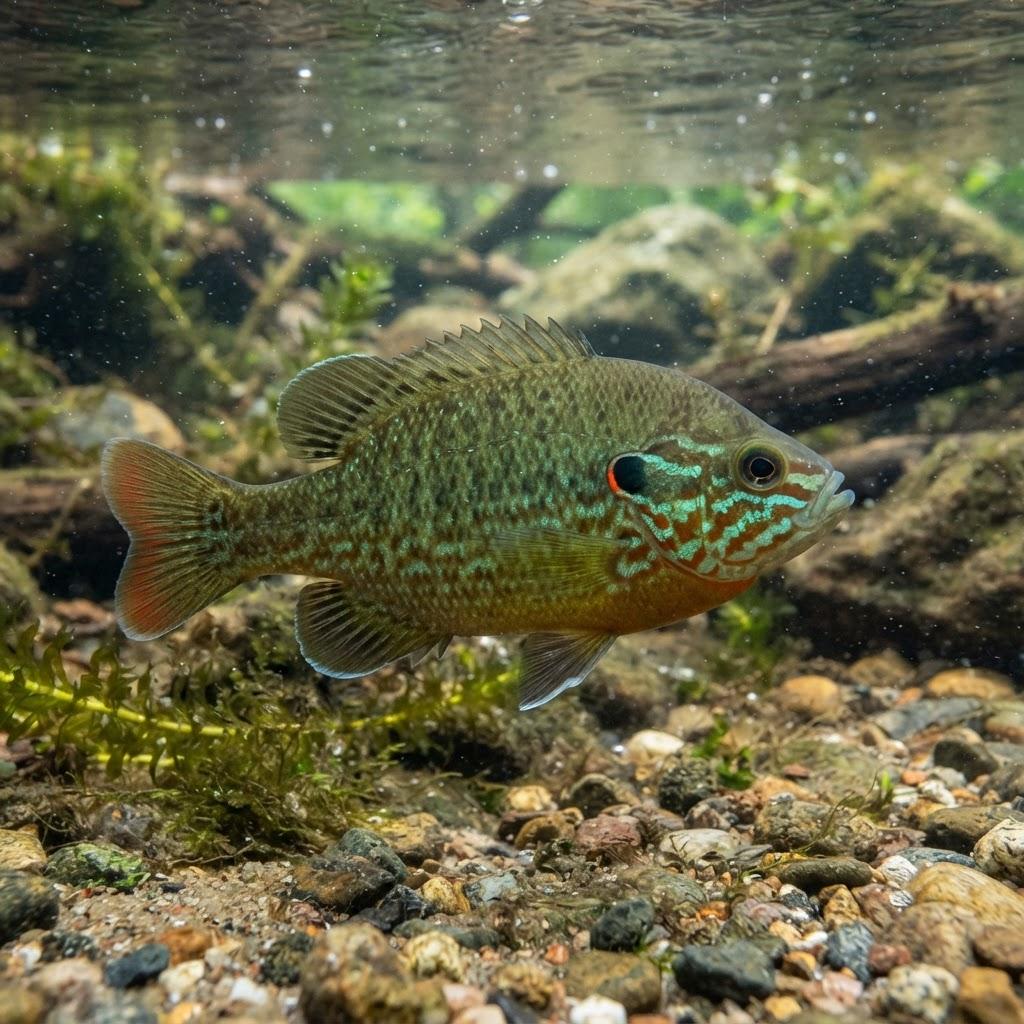
Lepomis cyanellus
Green Sunfish
Meet the Green Sunfish, the undisputed bouncer of the freshwater world with an ego far bigger than its tiny body. This feisty little fish turns every pond into an action movie scene, proving that you don't need size to run the neighborhood.
Meet the Fish
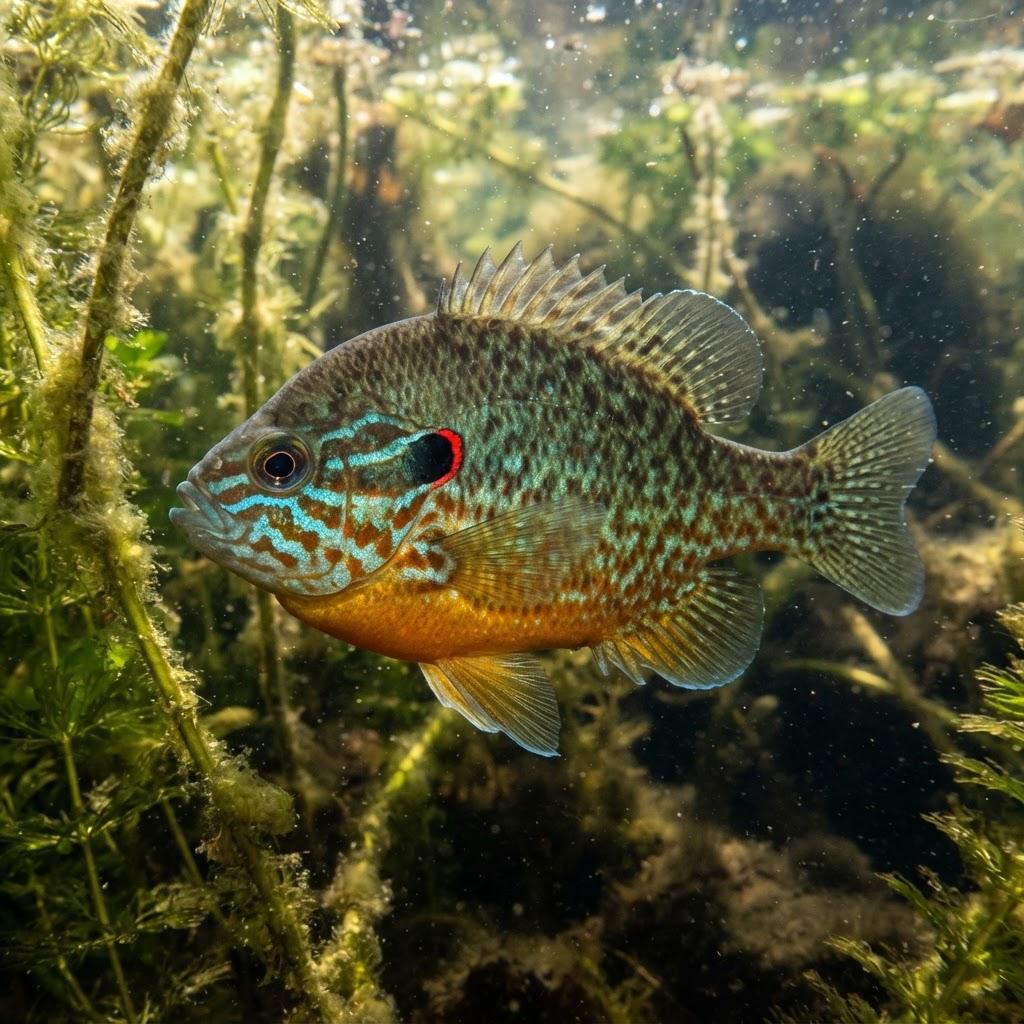
If the Green Sunfish were a high school student, it would be the freshman who walks with a massive chip on its shoulder, constantly picking fights with the varsity football team. It is essentially the honey badger of the freshwater world—tiny, incredibly grumpy, and absolutely convinced it is the king of the jungle. Measuring just a few inches, this little guy possesses a mouth that looks like a miniature vacuum cleaner and an attitude that could intimidate a bass twice its size. You might mistake it for a typical, boring panfish, but one look at its iridescent blue-green spots and that permanent, judgmental scowl will tell you otherwise. This is a fish that does not just swim; it patrols. It is the kind of creature that stares directly into your soul from beneath a lily pad, daring you to disturb its personal space. While other fish might dart away when they see movement, the Green Sunfish holds its ground, puffing out its gill covers to look much larger than it actually is. It is a master of the standoff, an expert in aggressive staring contests, and perhaps the most confident inhabitant of any local creek you will ever encounter. Its vibe is pure, unadulterated neighborhood watch energy, and it takes its job very seriously.
Weird Biological Superpowers Explained Simply
While it doesn't shoot lasers from its eyes, the Green Sunfish has a secret weapon that is arguably cooler: an almost supernatural ability to thrive in 'trash' water. While most delicate fish require crystal-clear, oxygen-rich rivers to survive, our little hero is perfectly happy in a muddy, oxygen-deprived puddle that smells like a damp gym sock. This is thanks to its incredible metabolic flexibility. Imagine being able to jog a marathon while everyone else is gasping for air because you learned how to breathe while holding your nose. Its body is built like a rugged, off-road vehicle; it can handle temperature spikes, low oxygen levels, and murky water conditions that would make a rainbow trout keel over in minutes. Furthermore, its lateral line—that magical sensor strip running down its side—is tuned to a frequency that can detect the tiniest twitch of a bug landing on the water surface from feet away. It is like having a built-in radar system that never sleeps. When you combine this 'hardy as a cockroach' physiology with sensory input that would make a CIA agent jealous, you get a fish that is essentially biologically unkillable, provided it doesn't get eaten by a hungry heron first.
Absurd Self-Defense Mechanisms
The Green Sunfish doesn't rely on spikes or toxic goo to stay alive; it relies on pure, unadulterated intimidation and a willingness to be as unpleasant as possible. When a predator approaches, this fish undergoes a transformation. It flares its gill covers wide, displaying dark, ink-colored patches that mimic the eyes of a much larger, more dangerous fish. It is the aquatic version of putting a 'Beware of Dog' sign on a fence when you actually own a temperamental Chihuahua. If the predator isn't fooled, the Green Sunfish immediately dives into the thickest, nastiest patch of weeds it can find. It turns itself into a spiky, defensive tangle, locking its fins in a way that makes it nearly impossible to swallow. Trying to gulp down an annoyed Green Sunfish is like trying to eat a closed pocketknife; the more you try to clamp down, the more it digs in. It isn't just fast; it’s prickly, difficult, and stubborn. By maximizing its 'surface area' and ensuring it is as sharp and wide as possible, it convinces most bass or pike that lunch is probably just not worth the throat damage, and they usually opt to hunt something easier, like a polite minnow.
Fish Drama and Gossip
Welcome to 'Real Housewives of the Pond,' where the Green Sunfish is the star of every scandalous episode. These fish are remarkably territorial, meaning they treat their specific patch of mud like a gated community where visitors are strictly prohibited. You will frequently see males chasing each other in elaborate, high-speed circles, nipping at tails and asserting dominance like two guys fighting over the last seat at a buffet. It is a never-ending cycle of 'This is my log, move along' and 'Oh yeah? Well, this is my rock now.' They are notoriously petty. If one fish manages to steal a particularly nice piece of gravel, the original owner will spend the next three hours sulking and trying to sabotage the new construction. They don't just share water; they engage in constant, low-level warfare. There are no alliances here, only temporary truces. If you watch a shallow area for long enough, you will see a soap opera unfold where the drama is high, the stakes are low, and the egos are massive. It is hilarious to watch these tiny, vibrant-colored creatures act like they own the entire ecosystem, completely oblivious to the fact that they are essentially living in a glorified roadside ditch.
The "Wait, That's Real?!" Deep-Sea Oddities
While the Green Sunfish lives in the sunny shallows rather than the dark, crushing depths of the midnight zone, it is worth noting just how alien our freshwater heroes are compared to their deep-sea cousins. In the deep sea, fish are mostly mushy, translucent nightmares that look like they were built by a committee that couldn't agree on basic body geometry. You have things like the barreleye fish, which has a literal transparent dome for a head so it can look through its own skull. Compare that to the Green Sunfish, which is built for the sunny, vibrant life of a shallow creek. Where deep-sea fish have evolved to create their own light because the sun never reaches them, the Green Sunfish has evolved to be a master of camouflage within the dappled sunlight of tree branches and lily pads. The deep sea is a place of 'if you can't see it, it doesn't exist,' whereas the Green Sunfish’s world is one of 'I see you, and I am going to chase you.' Both worlds are equally weird, but the Green Sunfish proves that even in our own backyards, you can find creatures that are just as strange and fascinating as anything living five miles below the surface.
Myth Busting
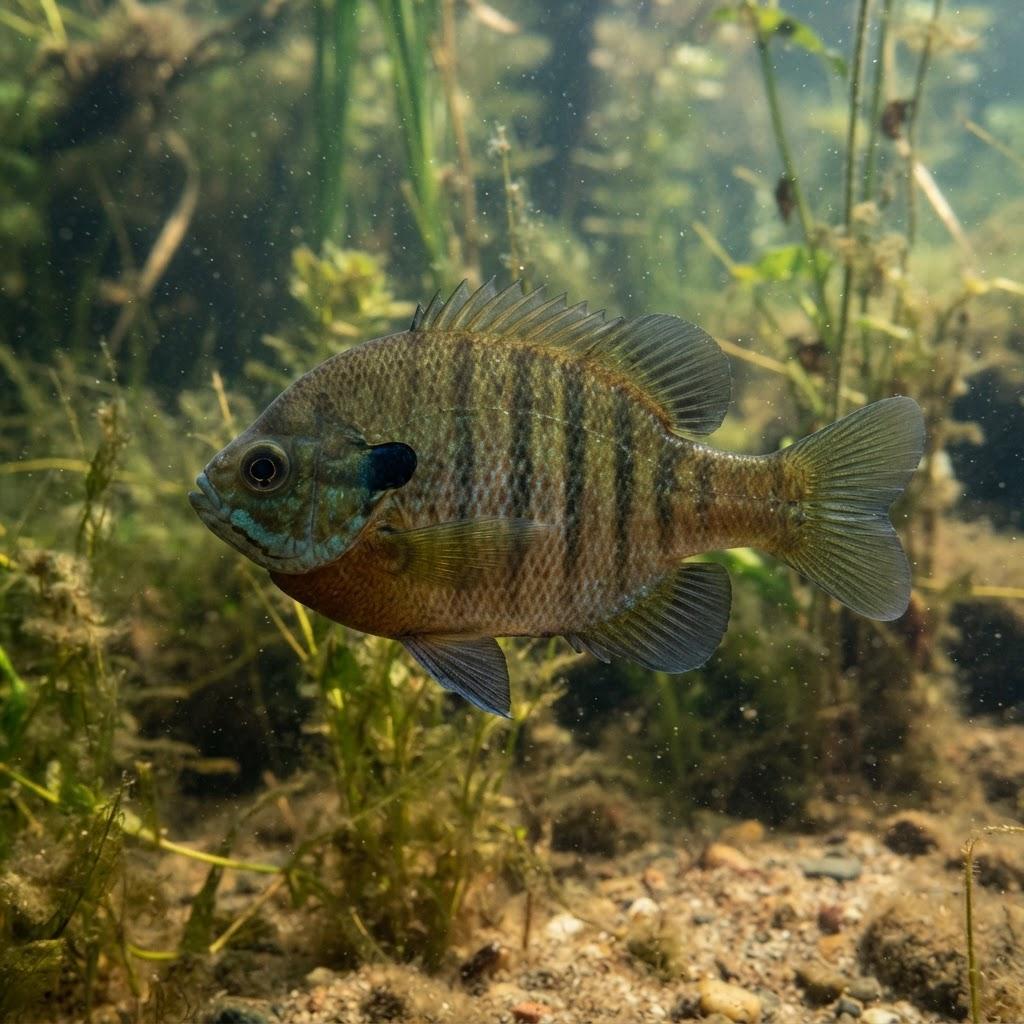
Let us clear the air: the idea that the Green Sunfish is a brainless eating machine is complete nonsense. People often dismiss these fish as simple, reflex-driven snacks, but they are actually remarkably observant. There is a persistent myth that fish have a three-second memory, but the Green Sunfish proves that's garbage. They are actually quite capable of recognizing human faces—or at least, recognizing the 'giant shadow that brings free food.' If you feed them regularly, they will hover near the surface waiting for you, proving they have associative learning skills that rival a house cat. Another myth is that they are invasive everywhere they go. While they are bold, they aren't some mystical, uncontainable force; they are simply very good at surviving where other fish fail. They aren't 'monsters' invading the lake; they are just opportunistic survivors who noticed the neighbors were moving out and decided to move in. People often confuse them with Bluegill, but Green Sunfish have larger mouths and a more aggressive attitude, which is the scientific difference between 'a polite dinner guest' and 'the person who tries to fight the waiter over the bill.'
Humorous Historical Tales or Folklore
History has largely ignored the Green Sunfish because, frankly, it isn't big enough to be a sea monster. You never hear stories about 'The Giant Green Sunfish of Loch Ness' because it would struggle to terrify a small goldfish, let alone a village. However, in the annals of rural Americana, this fish holds a special place. Generations of kids growing up in the Midwest have cut their teeth fishing for these little guys. There are countless stories of grandfathers swearing that a specific Green Sunfish in a local pond had been 'outsmarting the neighborhood for twenty years.' It’s the fish that every kid remembers catching first—the one that hit the hook so hard you thought you’d caught a shark. They are the true folk heroes of the small-town swimming hole, the silent witnesses to thousands of summer afternoons, sunburns, and 'the one that got away' stories. While they don't have ancient myths about guiding ships or curing diseases, they carry the weight of human nostalgia. They are the backbone of childhood memories, the feisty little fighters that taught us all that you should never underestimate the small, colorful thing staring back at you from the reeds.
Underwater Love Stories and Bizarre Romances
When a male Green Sunfish decides it is time to find a partner, he stops being a neighborhood bully and starts acting like a high-stakes wedding planner. He clears a perfect, circular nest in the sediment, meticulously removing every piece of debris until the ground is pristine. Then, he begins his performance. He hums, he vibrates, and he displays colors that seem to glow with an electric intensity. It is an aquatic ballroom dance where the goal is to convince a female that he is the most desirable landlord in the pond. If she isn't impressed, she leaves, and he has to start the process all over again. The courtship involves a lot of synchronized swimming, circular chasing, and what can only be described as 'aggressive posing.' It is a high-pressure environment; the male is so focused on his display that he forgets to eat and often ignores potential threats. It is a genuine romantic comedy, but with more fin-flaring and less dialogue. He is putting his heart and soul into his little dirt pit, hoping to attract a queen who will lay eggs in his fancy new fortress. It is both sweet and remarkably desperate.
Underwater Architecture and DIY Nesting
The construction skills of a Green Sunfish are surprisingly impressive for an animal that doesn't have hands. Using nothing but its tail and mouth, the male crafts a 'nest' that is effectively a shallow crater. This isn't just a random hole; it is a carefully curated piece of underwater architecture designed to optimize water flow over the eggs. He spends days vibrating his tail to clear away silt, ensuring that the water stays fresh and oxygenated for the future babies. If he finds a piece of gravel that looks slightly off-center, he will pick it up and move it with the precision of a professional landscaper. He creates a perimeter, a fortress of stones and mud, to ensure no wandering snails or rival fish can make a move on his real estate. It is the fish equivalent of a man building a backyard shed, except he does it entirely with his body and a lot of sheer willpower. When you see those little indentations in the sandy bottom of a shallow pond, you are looking at the result of a grueling DIY project that would put many home renovations to shame.
The Chaos of Raising Tiny Swimmers
Once the eggs are laid, the real madness begins. The father turns into a hover-parenting, hyper-caffeinated security guard. He stays over the nest, constantly fanning the eggs to keep them clean and oxygenated. He attacks anything that comes within a foot of the nest—crayfish, other fish, falling leaves, even curious fingers. It is a full-time, high-stress job. The moment the eggs hatch into larvae, the 'swimming' part starts, but they are absolutely helpless. The father guards them for a while, but eventually, they drift away into the dangerous, wide world. This is where it gets chaotic. A single nest can produce hundreds of babies, and they have no sense of self-preservation. They are essentially tiny, drifting snacks for everything else in the pond. The survival rate is statistically miserable, which is why the Green Sunfish has to be so prolific. It is a numbers game; if you have a thousand babies, you only need one or two to survive to keep the legacy alive. Watching the father guard the brood is like watching a frantic babysitter trying to keep a dozen toddlers from wandering into traffic, except the 'traffic' is a hungry bullfrog.
How to Spot One & How It Is Doing
Spotting a Green Sunfish is a masterclass in patience. Head to any shallow, quiet area of a pond or a slow-moving stream where the water looks a bit murky. Look for a fish that is acting like it owns the place—hovering near a sunken log or a weed bed, staring at everything that moves. They have a stout, somewhat blocky body, dark green sides with iridescent blue speckles, and a very distinct black spot on the back of their gill covers. If it looks at you like you owe it money, that is definitely a Green Sunfish. As for their status, they are doing exceptionally well. They are classified as 'Least Concern' because they are basically the cockroach of the fish world—they can live almost anywhere and eat almost anything. They aren't going anywhere anytime soon. If you want to help, just keep your local waterways clean. They might be tough, but they still appreciate a habitat that isn't filled with plastic trash. By picking up a stray bottle from the creek bank, you’re making the neighborhood a little bit nicer for the neighborhood bouncer, and that is a pretty good deed for the day.