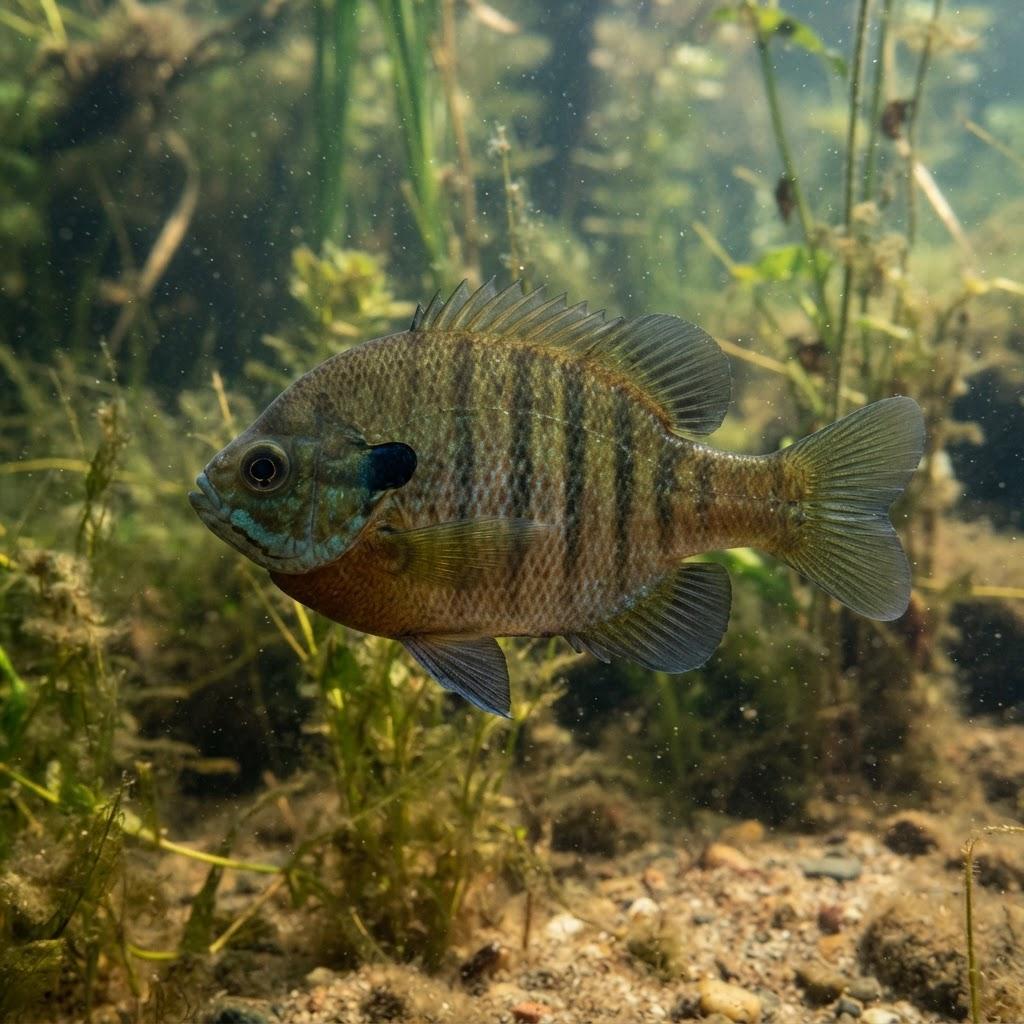
Lepomis macrochirus
Bluegill
Meet the Bluegill, the pond’s pugnacious little landlord that thinks it owns the entire zip code. This vibrant panfish is a master of miniature drama, home renovation, and neighborhood feuds.
Meet the Fish
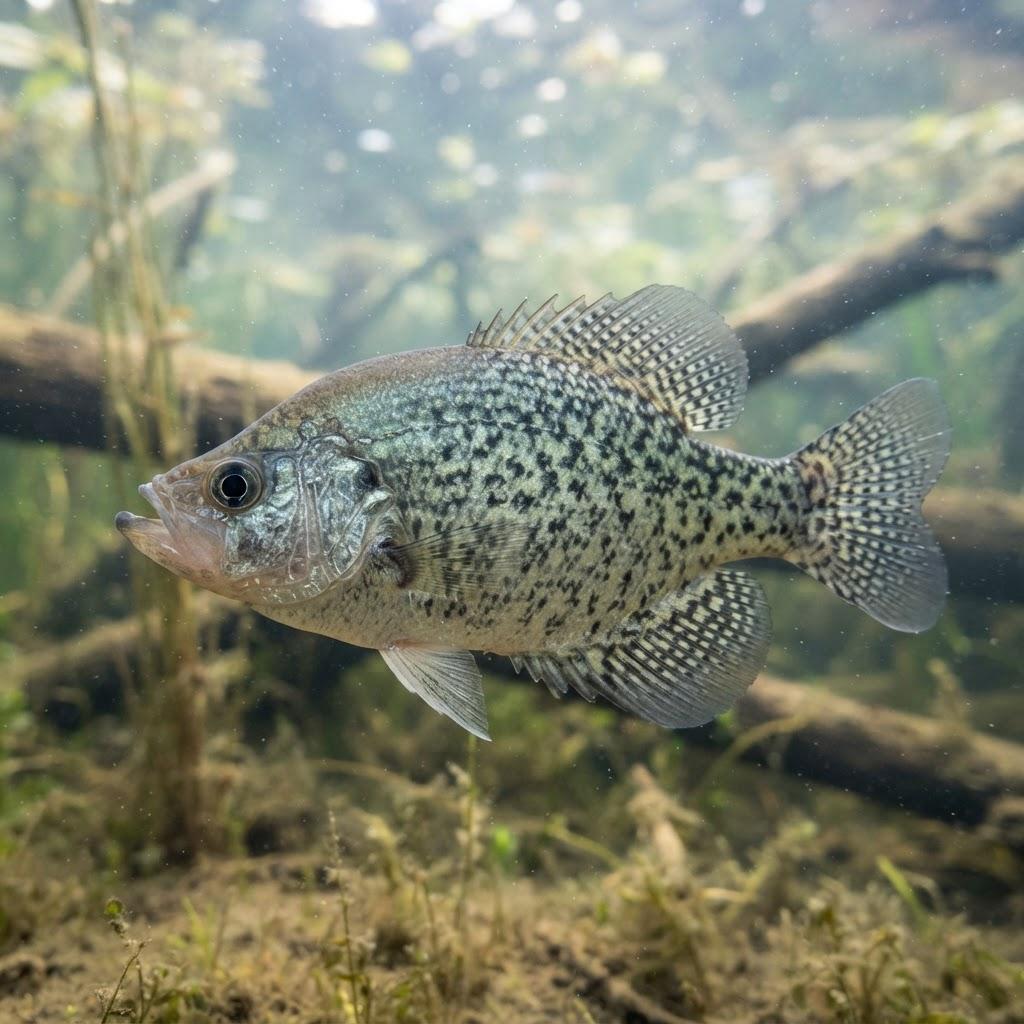
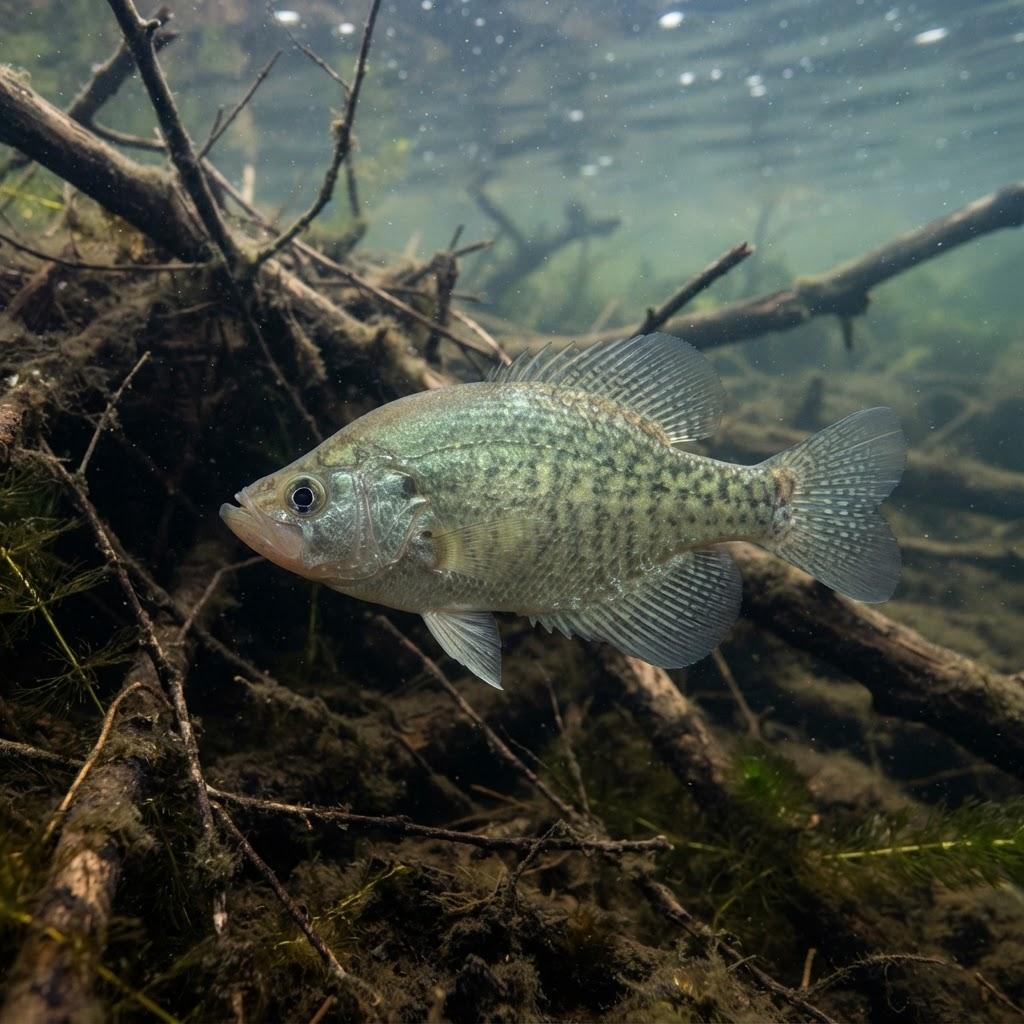
Imagine a fish that possesses the raw, unadulterated confidence of a nightclub bouncer packed into a tiny, palm-sized, neon-tinted body. That is the Bluegill. If the underwater world had a neighborhood watch program, the Bluegill would be the guy who knows exactly when your trash cans are left out and will definitely tell you about it. With its signature deep blue gill flaps and a body shaped like a shiny, squashed dinner plate, this fish isn't trying to hide. It is the quintessential fish-next-door, found in almost every pond, lake, and slow-moving stream across North America. It is vibrant, sassy, and perpetually hungry. While it might lack the jagged teeth of a piranha or the sheer size of a sturgeon, the Bluegill commands respect through sheer, stubborn presence. It is a fish that refuses to be ignored, darting through weeds with the agility of an Olympic fencer and the attitude of a soap opera star. If you are casting a line into a quiet lake, you are essentially knocking on the Bluegill's front door to ask for an interview, and they are almost always home, ready to start a fight.
Weird Biological Superpowers Explained Simply
While they might look like standard-issue pond decor, Bluegills have a secret superpower: the ability to turn their mouths into high-speed vacuum cleaners. When a Bluegill spots a tasty morsel, like a tiny bug or a crustacean, it doesn't just swim toward it. Instead, it snaps its mouth open in a fraction of a second, creating a massive drop in pressure that acts like a biological suction device. This is known as suction feeding. To a tiny insect, it is the equivalent of being suddenly pulled into a jet engine. This rapid expansion of their mouth cavity draws in water and prey so fast that the victim has zero reaction time. Furthermore, their eyes can swivel and track movement with an intensity that would make a professional tennis spectator jealous. Their vision is sharp enough to detect a fly landing on the surface from several feet away, giving them the ultimate tactical advantage in the game of pond-side hide-and-seek. It is not exactly laser vision, but for a creature that spends its life watching for ripples, it is practically a superpower that turns them into the local neighborhood sniper.
Absurd Self-Defense Mechanisms
When a predator like a Northern Pike or a hungry bass rolls into town, a Bluegill doesn't just cower. It pulls a move that is the underwater equivalent of turning into a sentient, prickly caltrop. The Bluegill has an array of stiff, razor-sharp spines along its back and pelvic fins. When threatened, it locks these spines into an upright, fanned-out position. Imagine trying to swallow a delicious, squishy sandwich, only to have the sandwich suddenly sprout a forest of needle-sharp sticks that poke the roof of your mouth. That is exactly what a predator feels when it tries to gulp down a Bluegill. By inflating their body slightly and locking those spines, they become essentially impossible to swallow for anything with a throat slightly too small or a stomach that prefers a smoother dining experience. It is a brilliant, passive-aggressive defense strategy. They essentially tell every bigger fish in the lake that while they might be a tasty snack, they are definitely not worth the trip to the emergency room. It is the fishy equivalent of wearing a suit made entirely of hidden thumb-tacks just to walk through a crowd.
Fish Drama and Gossip
If you installed a hidden camera in a Bluegill colony, you would essentially be watching a never-ending season of a suburban reality show. These fish operate in a complex social hierarchy that would make a middle school social circle look tame. Male Bluegills are the undisputed drama kings of the pond. During the breeding season, they compete for the prime real estate—the shallow, sandy areas where they can build their nests. This leads to constant territorial disputes. You will see them posturing, flaring their gill covers to make themselves look larger, and engaging in high-speed chases that look like miniature aerial dogfights. There is even a sub-group of 'sneaker' males who act like sneaky teenagers at a party, hanging around the edges of a nest built by a more dominant male. While the 'alpha' male is busy defending his patch from invaders, the sneaker male waits for the perfect moment to swoop in and try to fertilize the eggs. It is pure, unfiltered chaos involving backstabbing, territory theft, and elaborate disguises. If these fish could talk, their gossiping would be the only thing anyone in the lake listened to.
The "Wait, That's Real?!" Deep-Sea Oddities
The Bluegill lives in the bright, sunny shallows, a far cry from the crushing, black void of the deep ocean where things get truly weird. Deep-sea creatures, like the barreleye fish, have evolved to exist in a world without sunlight, often sporting translucent heads or light-emitting organs to communicate in the dark. While the Bluegill stays in the shallow, clear water where it can rely on its keen eyesight, its deep-sea cousins have had to get creative. If you took a Bluegill to the Midnight Zone, it would be as out of place as a neon-colored disco ball at a funeral. Deep-sea fish rely on bioluminescence—biological light—to lure prey or find mates in the pitch black. The Bluegill, meanwhile, relies on the ambient light of the sun. It is a fascinating contrast: the Bluegill is a master of vibrant color and visual display, while deep-sea fish are masters of the flashlight and the glow-in-the-dark aesthetic. Both have adapted perfectly to their environments, but where the Bluegill uses its appearance to signal dominance in the sunlight, the denizens of the deep use light as a tool for survival in a world that never sees the day.
Myth Busting
Let us clear the air: there is a long-standing myth that Bluegills are 'dumb' fish that will bite at anything shiny because they have the brain capacity of a pebble. This is completely false. Scientific studies have shown that Bluegills are surprisingly intelligent and capable of learning. They can distinguish between different types of food and even recognize the presence of regular visitors to their pond. They are not mindless eating machines; they are calculated, observant creatures that assess risks before deciding to strike at a lure. Another myth is that they grow into giant 'sunfish' species if they are just left alone in a big enough pond, but Bluegills have a set genetic limit—they are a distinct species, not just a younger version of a monster bass. They also have an incredible memory for their home turf. If you move a Bluegill to a different part of a large lake, it will often navigate its way back to its original territory. They aren't the simpletons people make them out to be; they are actually the sharp-eyed tacticians of the freshwater world.
Humorous Historical Tales or Folklore
Humans have had a long, complicated love affair with the Bluegill. In the early 20th century, before modern environmental regulations were standard, some towns treated their ponds like magical, infinite pantries. There are hilarious folklore stories from the Midwestern United States about 'Bluegill kings'—a local legend where people believed that if you caught a fish that looked a certain way, it was the monarch of the pond. Some old-timers swore that if you caught the 'King' and released it, the rest of the school would follow you back to the shore, ready to be harvested. Of course, this is complete nonsense, but it speaks to how much these fish have been a part of human history. They were the original 'learning to fish' species for generations of kids, serving as the bridge between human curiosity and the natural world. There is even a weird, forgotten piece of folklore suggesting that the blue-colored cheek patches of the male were actually a warning sign to humans to stay out of the water, a superstition likely invented by parents trying to keep their children from getting muddy near the banks.
Underwater Love Stories and Bizarre Romances
When love is in the air—or rather, the water—the Bluegill takes a very direct approach to romance. During the spawning season, the male Bluegill becomes a dedicated, if somewhat obsessive, romantic lead. He doesn't go in for gentle courtship; he goes for structural improvement. He creates a circular depression in the lake bed, fanning away silt with his tail to expose clean gravel. This 'nest' is his way of saying, 'Look at my real estate investment.' Once the nest is pristine, he starts doing elaborate, jittery swimming dances to attract a passing female. He is essentially the guy standing in the driveway revving his engine, trying to look cool. If a female shows interest, she enters the nest, and they begin a synchronized swimming routine that culminates in the release of eggs and milt. However, it is not always a happy marriage. The female often visits multiple nests, and the male, having played his part, is left to handle the childcare. It is a high-stakes, soap-opera-worthy courtship that focuses more on architecture and persistence than tender words.
Underwater Architecture and DIY Nesting
If you look down into the shallows of a quiet lake in the spring, you might see what looks like a series of strange, round craters on the bottom. You are looking at the master-planned communities of the Bluegill. These aren't just random holes; they are marvels of underwater engineering. The male Bluegill works tirelessly, pushing sediment away until he reaches the hard substrate, creating a bowl-shaped fortress. This nest is crucial because the eggs need to be kept clean and oxygenated by the constant current of water. The male is a perfectionist. He will pick up small pebbles and move them, literally landscaping his own yard to ensure the environment is perfect for his future offspring. Seeing a colony of these nests is like looking at a miniature, underwater suburban development, with each male fiercely guarding his own plot of land. They are the Bob Vils and HGTV hosts of the fish kingdom, spending their days ensuring their architectural projects meet the highest standards of the pond, all while warding off any 'neighbor' who dares to get too close.
The Chaos of Raising Tiny Swimmers
Once the eggs are laid, the real work begins for the male Bluegill. He transitions from a flirtatious bachelor to a high-strung, over-protective helicopter parent. He doesn't feed much during this time, preferring to stay glued to the nest. His job is to constantly fan the eggs with his fins, which serves a dual purpose: it keeps the eggs from suffocating under a layer of silt and keeps them well-oxygenated. He is a one-fish daycare, swatting away any tiny intruder that wanders too close to his brood. The sheer amount of effort is staggering. Imagine standing in one spot, fanning your arms for days on end without stopping for a snack, all while yelling at imaginary intruders. That is the life of a father Bluegill. When the eggs finally hatch, the tiny fry are like a living, wiggling cloud of curiosity, and the father keeps a watchful eye on them for as long as he can. It is a chaotic, exhausting, and strangely sweet aspect of their lifecycle that highlights how much work goes into ensuring the next generation survives in a world full of hungry neighbors.
How to Spot One & How It Is Doing
If you want to find a Bluegill, grab a pair of polarized sunglasses and head to your nearest park pond or quiet lake. Look into the shallow, murky water near submerged logs or lily pads. The Bluegill is a master of camouflage when it wants to be, but look for that signature dark blue, almost black, flap on the back of its gill cover. If you see a small, round fish darting between the weeds, you've found one. They are doing quite well, thank you very much. They are incredibly resilient, adapting to almost any freshwater habitat that isn't completely polluted. Their 'Least Concern' conservation status is a testament to how well they handle human activity. To help them continue their reign as the kings of the pond, the best thing you can do is be a good neighbor to their ecosystem. Keep the water clean by properly disposing of trash, avoid using harsh chemicals near the water's edge, and always practice 'leave no trace' when you are out enjoying their home. They are a hardy, cheerful part of our natural world, and with just a little bit of respect, they will keep on swimming for generations to come.