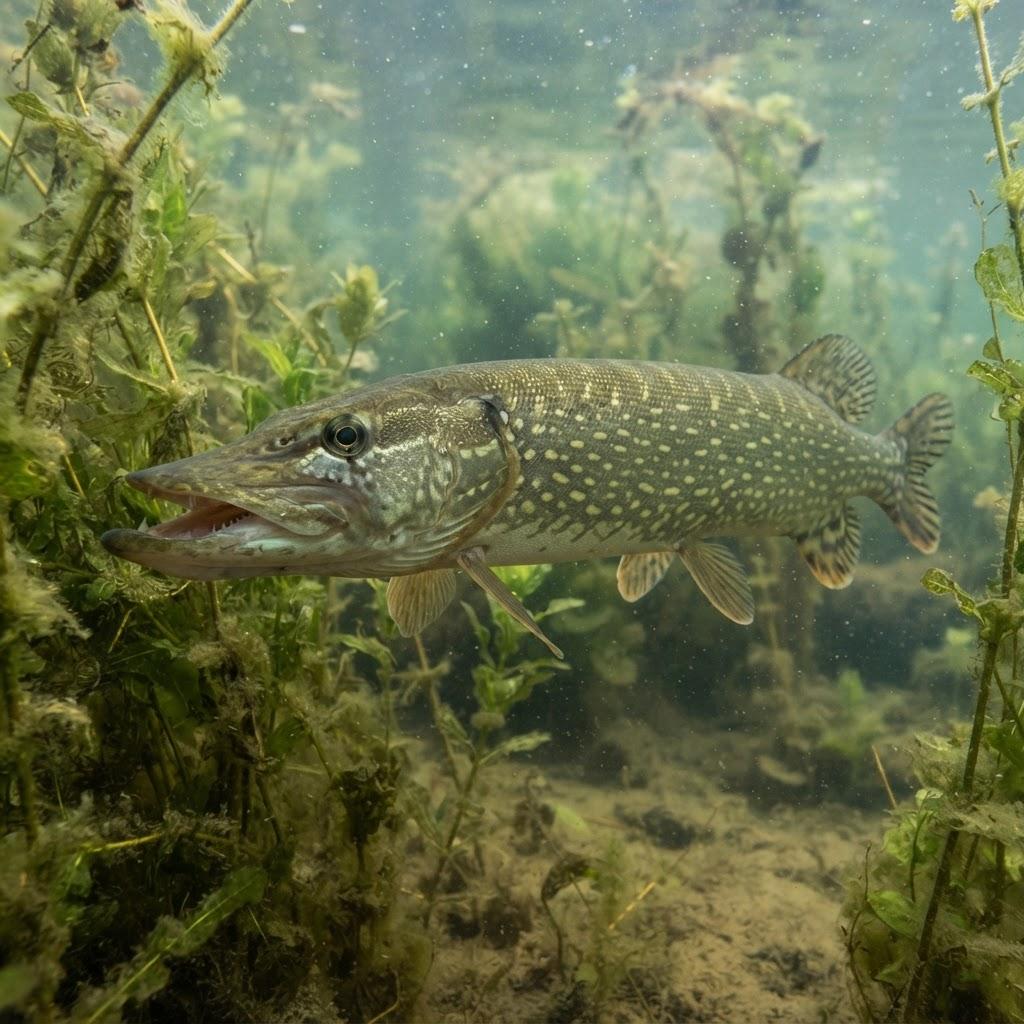
Esox lucius
Northern Pike
Meet the Northern Pike, the undisputed heavyweight champion of freshwater ambush predators. With a face only a mother could love and a speed that defies physics, this torpedo-shaped terror turns your favorite fishing hole into a high-stakes survival thriller.
Meet the Fish
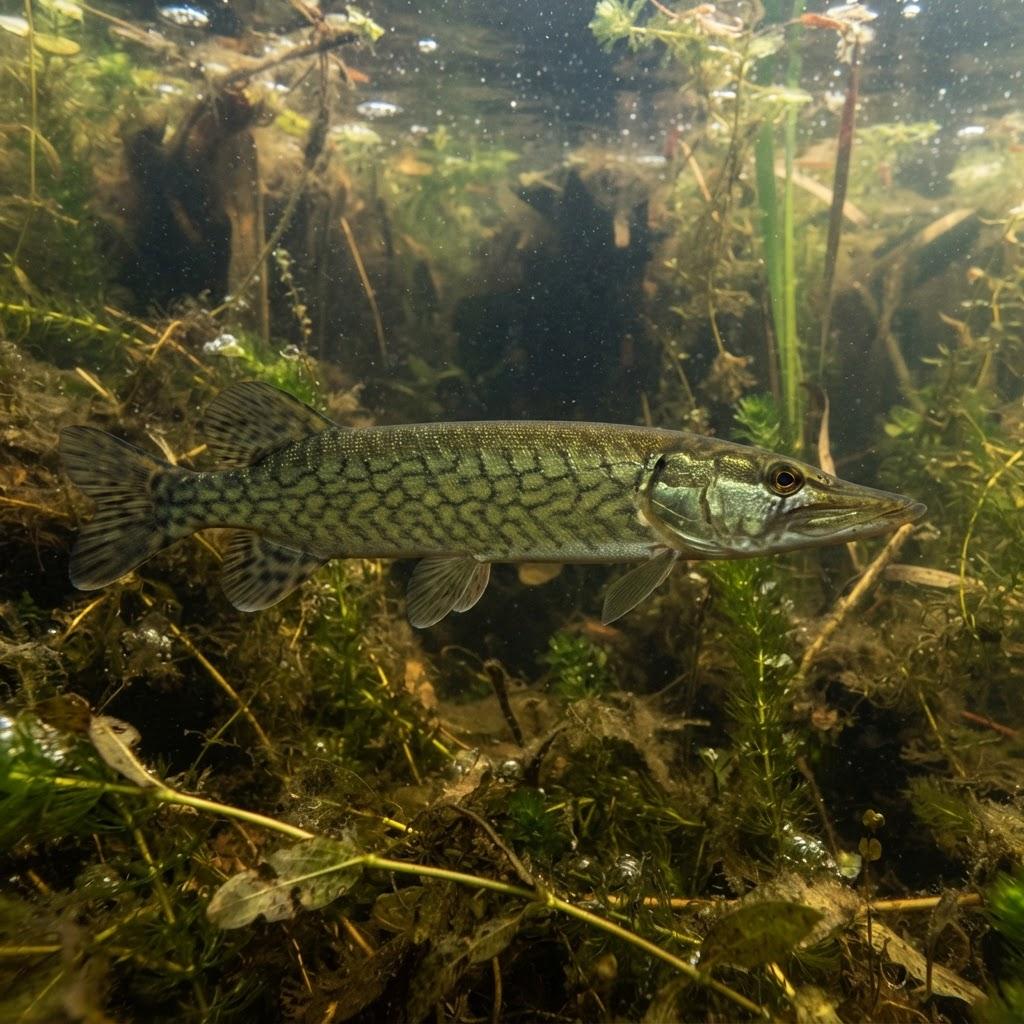
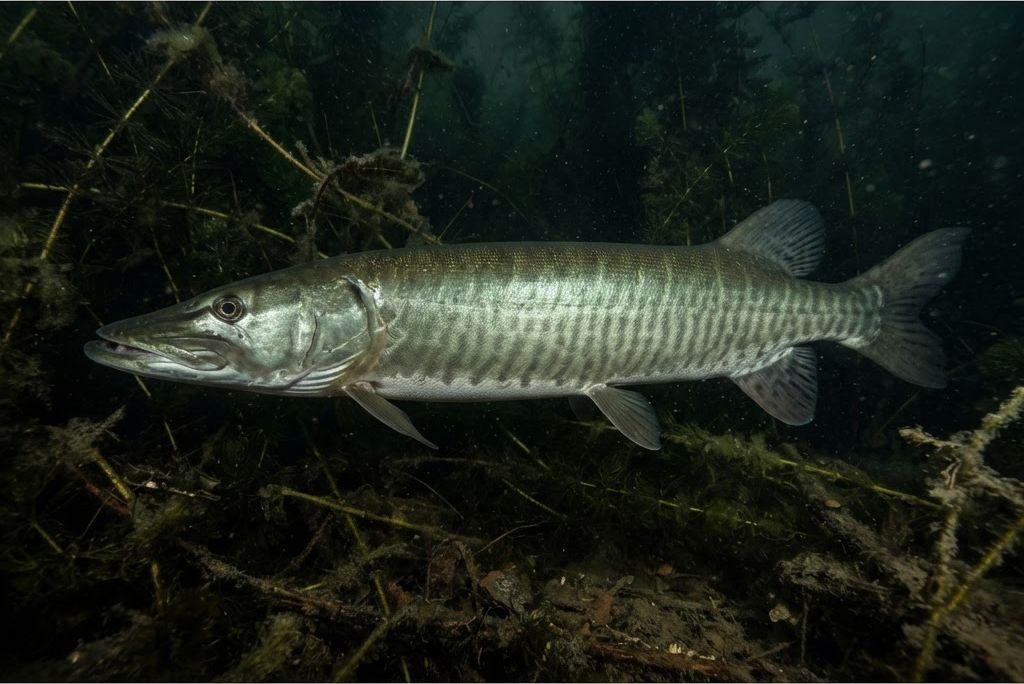
Imagine a torpedo crossed with a chainsaw and given an attitude problem that would make a movie villain blush. That is the Northern Pike. With a body built purely for explosive acceleration and a mouth lined with hundreds of razor-sharp teeth that point backward—designed specifically so that once you are in, you are never getting out—this fish is the underwater equivalent of a gated community resident who absolutely hates solicitors. They spend most of their time hovering in the weeds, looking like a submerged log, only to launch themselves with such terrifying velocity that they often leave little wake behind. They possess a gaze that is both glassy and deeply judgmental. When you look into the eyes of a pike, you get the distinct feeling it is calculating exactly how much effort it would take to drag your hand into the murky depths. They are the apex gangsters of the weed beds, holding court with a stillness that is frankly unsettling to anyone trying to swim nearby.
Weird Biological Superpowers Explained Simply
The Northern Pike is a masterpiece of biological engineering, specifically designed for the art of the sudden surprise. Their most impressive superpower is the lateral line, a sensory organ that runs down their sides like a high-definition motion detector. Think of it as a built-in radar system that feels tiny vibrations in the water, allowing them to track the heartbeat or the frantic fin-wiggles of a potential snack even in total darkness or murky water. Couple this with their massive, muscular tail—which acts like a literal hydraulic pump for movement—and you have a creature that can go from a dead stop to Mach one in a fraction of a second. They don't have to chase things for miles; they just wait for the right moment and then snap their jaws with the force of a bear trap. It is a biological magic trick: they are basically invisible until the exact second they decide you are dinner, turning the water into their personal strike zone.
Absurd Self-Defense Mechanisms
Most fish try to hide or swim away when trouble arrives, but the Northern Pike follows the school of thought that says the best defense is being so scary that nobody wants to mess with you. While they don't have spikes or slime, they have the ultimate psychological deterrent: the aura of pure, unadulterated menace. They also possess a remarkably tough, armored-like skin that is covered in a thick layer of protective slime. This slippery coating isn't just for looking fancy; it acts like a biological raincoat, keeping parasites at bay and allowing them to glide through thick, prickly weeds without getting a single scratch. If an otter or a bigger fish tries to take a bite, the pike is so fast and so surprisingly dense that it is hard to get a good grip. It is like trying to grab a greased-up lightning bolt. They don't need to inflate or puff up; they just exist as a solid, muscular tube of grumpy muscle that is remarkably difficult to annoy.
Fish Drama and Gossip
If the weed beds were a high school, the Northern Pike would be the kid sitting in the back of the cafeteria throwing mashed potatoes at anyone who made eye contact. They are notoriously antisocial, preferring to live a solitary, moody existence rather than joining any of those popular schools of baitfish. Pike are fiercely territorial, which leads to the kind of drama that would make reality TV producers weep with joy. If two pike find themselves in the same patch of lilies, it isn't a conversation—it is a staring contest that lasts for hours, with fins flared and jaws slightly ajar in a display of posturing that clearly says, 'This is my lake, move along.' They are the ultimate loners, viewing every other fish as either a rival or a snack. There is no social climbing here, just the cold, hard hierarchy of who has the sharpest teeth and the fastest strike rate.
The "Wait, That's Real?!" Deep-Sea Oddities
While the Northern Pike is a champion of the freshwater shallows, it shares a certain unsettling 'alien' vibe with its distant deep-sea cousins. If you look at a pike, you can see the same primal, prehistoric design that makes deep-sea dwellers so fascinating. While the deep-sea viperfish is busy using bioluminescence to trick prey into its glowing maw, the pike is using its dark, mottled colors to disappear against the shadows of the lake bottom. The deep sea is a world of pressure and cold, where creatures have to look weird just to survive, but the pike proves that even in shallow, sunlit water, you can evolve to be a monster. Both the deep-sea angler and the pike share a similar philosophy: why waste energy swimming around when you can just sit there, look like a piece of the landscape, and wait for the buffet to come to you? Nature clearly loves a patient, hungry predator, regardless of the depth.
Myth Busting
Let’s squash the rumor that the Northern Pike is just a mindless, bloodthirsty monster that will bite anything that touches the water, including people's toes. While they are bold, they aren't stupid. They are actually quite observant and learn from their mistakes. There is a common myth that pike are 'trash fish' that just eat everything in sight, but in reality, they are quite picky eaters. They have a sophisticated sense of taste and preference, often ignoring subpar bait if they aren't feeling it. Another myth is that they are indestructible, but they are actually sensitive to water quality and temperature, requiring healthy ecosystems to thrive. They aren't the mythical sea monsters of folklore that grow to the size of a submarine; they are just highly efficient, perfectly adapted hunters doing their part to keep the lake ecosystem in check. They are not mindless zombies; they are actually quite calculated, intelligent predators that deserve a bit more credit for their strategic approach to life.
Humorous Historical Tales or Folklore
History is littered with tall tales about the Northern Pike, with one of the most hilarious being the legendary 'Emperor's Pike.' According to 15th-century folklore, a massive pike was caught in a lake in Germany, and attached to its gills was a copper ring inscribed with a date that suggested the fish was over two hundred years old. People claimed this 'King of the Lake' had been released by a famous emperor and had lived through generations of wars and shifts in power, growing into a gargantuan, ancient beast. While science tells us that fish don't usually live to be two centuries old, the legend speaks to the awe that humans feel when they encounter a pike. They feel like creatures out of time, relics of a prehistoric era when things were just naturally bigger and meaner. This folklore highlights how the pike has captivated our imagination for centuries, standing as a symbol of the wild, untamable power hidden beneath the surface of our quiet local ponds.
Underwater Love Stories and Bizarre Romances
When it comes to romance, the Northern Pike doesn't do candlelit dinners or long, romantic swims. Their dating life is a high-speed, chaotic affair that happens in the early spring, often right after the ice melts. The males arrive at the shallow spawning grounds first, scouting out the best patches of weeds as if they are preparing to rent out luxury apartments. When the females arrive, they are significantly larger—a classic case of 'bigger is better' in the underwater dating scene. The courtship involves a lot of chasing, splashing, and synchronized swimming, which is the fish equivalent of a tango. It’s not particularly delicate; it’s more like a frantic dance party where the main goal is to ensure the eggs are fertilized and protected. There is very little 'romance' in the traditional sense, but in the harsh reality of a frozen lake, this vigorous display of health and stamina is the ultimate way to prove you are a quality partner.
Underwater Architecture and DIY Nesting
Unlike some fish that spend their weekends building elaborate sand castles or pebble fortresses, the Northern Pike is more of a minimalist. They don't 'build' a nest in the traditional sense; they look for high-end real estate. A prime spawning site is a flooded meadow or a patch of thick, submerged vegetation that provides plenty of hiding spots for the coming generation. They are looking for the underwater equivalent of a gated nursery. By choosing areas with dense vegetation, they ensure that their eggs don't drift away in the current and that they are hidden from the prying eyes of opportunistic scavengers. It isn't a complex structure, but it is a strategic choice of location that requires deep knowledge of the lake's geography. They are experts at finding the perfect, safe spot in a chaotic world, proving that you don't need fancy tools to be an excellent manager of your family's future.
The Chaos of Raising Tiny Swimmers
Raising tiny pike is not a gentle affair; it is survival of the fittest from day one. Once the eggs hatch, the tiny fry are basically miniature, grumpy versions of their parents, immediately looking for something to eat. There is zero 'parenting' involved here. The parents drop off the eggs and leave, which is a cold, calculated strategy. They produce a massive number of offspring, banking on the fact that while most will be eaten by hungry insects or other fish, a small percentage will survive to become the next generation of lake gangsters. The fry are so tiny that they spend their early days clinging to vegetation using special adhesive glands on their heads—it’s like they have built-in suction cups. They stay there, motionless, waiting for their yolk sacs to absorb, before setting off into the terrifying world to hunt down tiny water fleas. It is a world of high-stakes gambling, where every surviving fry is a tiny, scaled victory.
How to Spot One & How It Is Doing
If you want to spot a Northern Pike, look for the 'gator' silhouette. Watch the shallow, weedy edges of lakes on a calm day. You are looking for a long, dark, immobile shape that looks suspiciously like a submerged branch that has grown fins. If you see a ripple of disturbance in the weeds and a sudden flash of silver-green, you have likely found one. Fortunately, the Northern Pike is doing quite well in most of its range. They are resilient, adaptable, and generally good at thriving in the messy environments that most other fish avoid. To help them out, focus on keeping local waterways clean and protecting the shoreline vegetation they rely on for spawning. If the weeds are healthy, the pike are happy, and if the pike are happy, the lake stays in balance. So next time you are out by the water, keep a sharp eye on those weeds—you might just lock eyes with the most entertaining, grumpy, and cool predator in the lake.