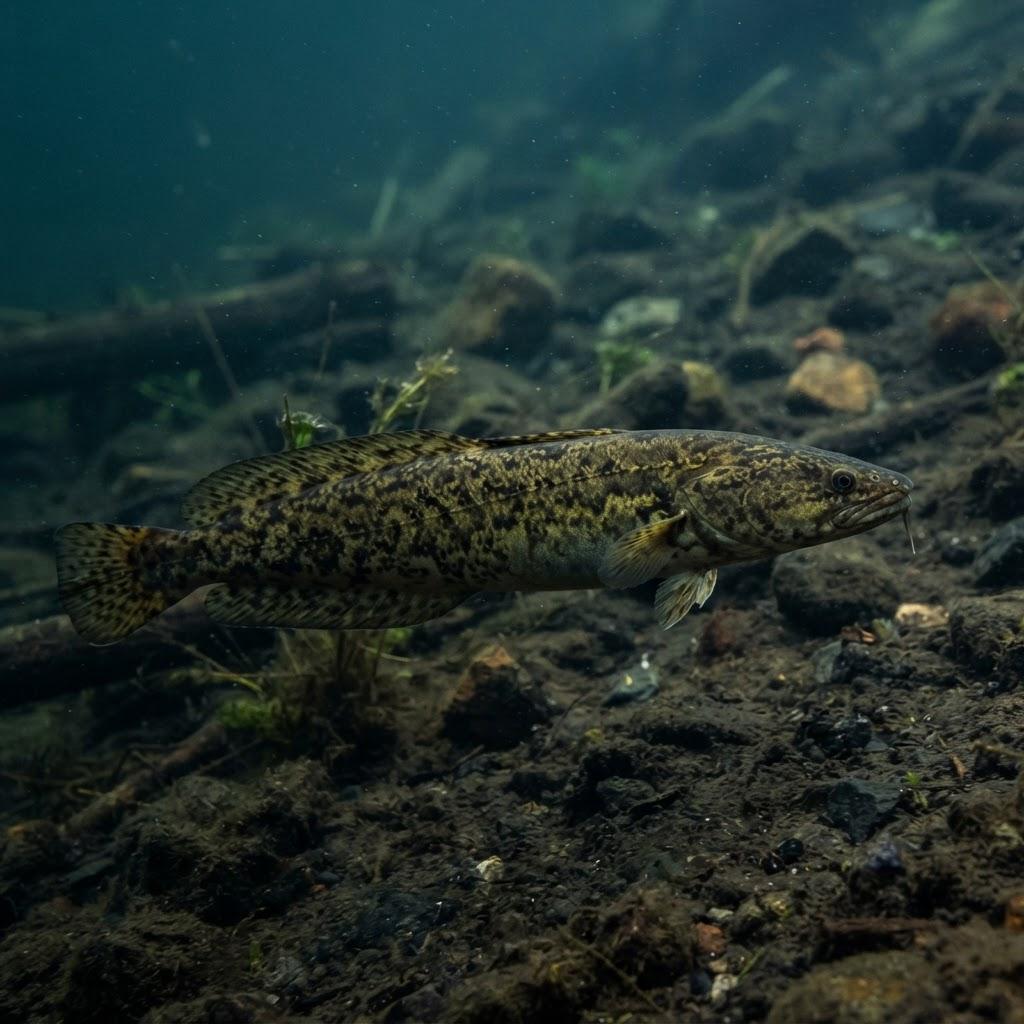
Lota lota
Burbot
Meet the Burbot, the only freshwater cousin of the mighty cod that looks like a catfish had a messy makeover with an eel. This bottom-dwelling weirdo loves the freezing cold, haunts your local lake like a shadowy monster, and is basically the misunderstood goth kid of the freshwater world.
Meet the Fish
Imagine a fish that wandered into a costume party dressed as a mash-up of a cod, an eel, and a grumpy old man. That is the Burbot. While most freshwater fish are out there chasing sunbeams or hiding in bright, cheerful lily pads, the Burbot has chosen the aesthetic of a Victorian basement dweller. It has a long, slender, almost serpentine body, mottled skin that looks like a camouflage shirt from the bargain bin, and a single, lonely whisker-like appendage dangling from its chin—a chin barbel, for those keeping score. If you ran into a Burbot on the street, it would likely be wearing a trench coat and asking you if you have the time. This fish does not care about your social norms or your shiny fishing lures; it is a bottom-dweller with a permanent scowl, lurking in the deepest, coldest parts of lakes and rivers. It is the only member of the cod family that decided freshwater was the place to be, effectively ghosting its salty marine relatives to start a new, much colder life in the depths of the northern hemisphere. It is weird, it is slithery, and it is arguably the most eccentric fish you will ever encounter under the ice.
Weird Biological Superpowers Explained Simply
If you think your favorite superhero has cool gear, wait until you hear about the Burbot’s sensory array. This fish is essentially a living, breathing sonar and chemical sensor factory. That little chin barbel we mentioned? It isn't just a fashion statement; it is a highly advanced chemical detector. Imagine if your chin could taste the water for miles, allowing you to smell a snack from across the lake before you even see it. This is how the Burbot survives in total darkness under thick, impenetrable ice. It also has a lateral line system—a row of sensory pores that run down its sides—that detects the tiniest pressure waves in the water. Think of it like having 360-degree night vision, but for sound and movement. While we humans are blundering around in the dark knocking over lamps, the Burbot is effortlessly navigating through pitch-black, freezing water, sensing every vibration of a fleeing minnow. It is essentially a submarine with built-in heat-seeking (well, vibration-seeking) missiles. This biological hardware makes it the undisputed king of hunting in conditions that would make any other fish pack its bags and move to Florida for the winter.
Absurd Self-Defense Mechanisms
When you look like a slimy, mottled sausage, you might expect to be a snack for the nearest pike or muskellunge. But the Burbot has developed a strategy that essentially says, 'I am just too gross to bother with.' Its skin is covered in an exceptionally thick, heavy layer of protective mucus. Think of it as wearing a full-body hazmat suit made entirely of slime. If a predator tries to grab a Burbot, they aren't just grabbing a fish; they are grabbing a greased pig at a county fair. It is nearly impossible to keep a firm grip on one. Beyond the slime, the Burbot knows that the best defense is simply not being there. It is a master of hiding in the nooks and crannies of the lake bed—under logs, in rock crevices, or burrowing slightly into the silt. It is the ultimate game of hide-and-seek player. If it gets cornered, it can whip its tail around with enough force to kick up a massive, blinding cloud of sediment, essentially dropping a smoke grenade so it can vanish into the murk while the attacker is left wondering if they just hit a rock or a dinner.
Fish Drama and Gossip
If the underwater world had a version of a high-school cafeteria, the Burbot would be sitting at the table in the back that everyone is slightly afraid of. They are notoriously antisocial outside of their spawning season, preferring the company of their own thoughts and perhaps a very slow crayfish. During the winter months, however, things get interesting. When it is time to spawn, Burbots stop being lone wolves and turn into a giant, writhing pile of fish drama. They engage in what researchers call 'spawning balls.' It sounds like a party, but it is basically a mosh pit of hundreds of Burbots knotting themselves together in the dark. There is no lead singer, just a tangled, chaotic mess of fins and ambition. It is the aquatic equivalent of a crowded subway car at rush hour, where everyone is pushing and shoving, hoping for a chance to contribute to the next generation. This isn't exactly high-society behavior, but in the world of the Burbot, it is the social event of the century. They don't have time for complex hierarchies or feuds; they just want to get the job done before the ice melts and the water gets uncomfortably warm.
The "Wait, That's Real?!" Deep-Sea Oddities
While the Burbot lives in freshwater, it behaves exactly like a deep-sea creature. Most freshwater fish are diurnal, meaning they like the sun and hate the dark, but the Burbot is a nocturnal soul living in the 'midnight zone' of a lake. Because it lives in such deep, dark, and cold environments, it shares more traits with creatures living in the Mariana Trench than it does with a goldfish. In the deep sea, animals often lack bright colors because light doesn't exist there, so why bother? The Burbot follows this rule with its dull, mottled brown and olive skin. It doesn't need to be flashy; it needs to be invisible. If you were to take a flashlight into the depths where a Burbot lives, you would see a world that feels just as alien as the ocean floor. The pressure is high, the temperature is low, and the inhabitants are all specialized weirdos that have evolved to survive without the luxury of photosynthesis-driven brightness. The Burbot is the freshwater ocean ambassador, reminding us that you don't need to go thousands of feet down in the sea to find monsters; sometimes, they are just chilling at the bottom of your local reservoir.
Myth Busting
Let’s clear the air: there is a long-standing myth that Burbots are terrible to eat because they are 'slimy.' This is a classic case of judging a book by its cover. People look at the Burbot’s mucus-heavy coat, assume the meat is just as gross, and toss it back. This is a tragic mistake. In reality, the Burbot is often called 'poor man’s lobster.' If you take the time to skin it properly—which admittedly requires a sharp knife and a bit of patience—the meat is firm, white, and tastes incredibly similar to cod or even lobster when dipped in melted butter. Another myth is that they are dangerous to humans because of their 'eel-like' appearance. Rest assured, unless you are a small minnow, the Burbot is completely harmless. It has no interest in biting you, and it certainly won't try to wrap itself around your leg like a sea serpent. It just wants to exist in its cold, dark void, eat some bugs, and be left alone. It is not a monster; it is just a very specialized, very tasty, and very misunderstood fish that deserves a spot on your dinner plate instead of a bad reputation.
Humorous Historical Tales or Folklore
Throughout history, the Burbot has been the subject of some truly bizarre stories. In parts of Europe, it was once rumored that the Burbot could act as a weather forecaster. Local folklore suggested that if you kept one in a jar—which, for the record, please don't do—it would swim near the surface when a storm was approaching and stay near the bottom during fair weather. It is the aquatic equivalent of a groundhog, but with fewer top hats and more slime. In medieval times, because of their elusive nature and strange, snake-like appearance, they were sometimes associated with darker superstitions, though usually, they were just prized as a delicacy for the nobility who knew how to cook them properly. There were even tall tales told by ice fishermen about 'giant burbot' the size of rowboats that could drag a man through a hole in the ice. While a 34-kilogram fish is certainly a hefty catch, the idea that they were out hunting fishermen is pure, unadulterated nonsense—though it makes for a fantastic story to tell around the campfire while shivering on a frozen lake.
Underwater Love Stories and Bizarre Romances
Romance for a Burbot is about as far from a candlelit dinner as you can get. Since they spawn under the ice, often in the dead of winter when most other fish are essentially in a catatonic state, their courtship is a feat of pure, cold-blooded endurance. There are no elaborate songs or bright displays of color. Instead, the 'dance' consists of a frantic, high-energy writhing session. Because the water is freezing, their metabolism is incredibly slow, but during the spawn, they ramp it up to eleven. They gather in these massive spawning balls, where the vibration of hundreds of fish moving against each other helps synchronize the release of eggs and sperm. It is messy, it is chaotic, and it is entirely communal. They don't have partners; they have participants. Once the eggs are released into the water column, the adults just kind of swim away and leave the mess behind. There are no doting fathers guarding the nest or mothers bringing breakfast to the kids. It is a 'love them and leave them' situation on a grand, icy scale, and honestly, in those temperatures, you can't really blame them for wanting to get home.
Underwater Architecture and DIY Nesting
If you are looking for architectural masterpieces like the intricate sand circles of a pufferfish or the elaborate nests of a stickleback, you are looking in the wrong place. The Burbot is the ultimate minimalist. It believes that the best home is no home at all. They do not build structures; they do not carry pebbles; they do not weave seaweed. They simply let their eggs drift down into the crevices of the rocky bottom. The 'nest' is whatever hole or crack in the rocks happens to be there when the eggs fall. It is the equivalent of just throwing your groceries on the kitchen counter and calling it a pantry. However, this is actually a brilliant strategy. By dropping their eggs into the deep, dark cracks of the substrate, they are hiding them from hungry predators that prefer to hunt in the open. It is a lazy approach to parenting, yes, but it is also a highly effective one that has kept the Burbot population thriving in some of the most inhospitable environments on the planet for millions of years. Who needs a castle when you have a mountain of boulders?
The Chaos of Raising Tiny Swimmers
Once the eggs hit the bottom, the life of a larval Burbot is basically a game of 'don't get eaten' played on the highest difficulty setting. A single female can lay millions of eggs—yes, millions. It is a numbers game. Most of these tiny, transparent specks will be eaten by anything with a mouth, from insects to other fish. The ones that survive do so by being incredibly good at hiding in the silt. They don't have parents to guide them, feed them, or tell them to brush their teeth; they are born into a brutal world and are expected to figure out the concept of 'eat or be eaten' immediately. As they grow, they move from eating microscopic plankton to slightly larger bugs and eventually small fish. It is a chaotic, Darwinian free-for-all where the only thing that matters is growth rate. Those that pack on the weight fast enough to stop being bite-sized snacks get to live long enough to become the next generation of icy, swampy, deep-dwelling monsters. It is a harsh cycle, but for a fish as resilient as the Burbot, it is just Tuesday.
How to Spot One & How It Is Doing
If you want to catch a glimpse of this icy eccentric, you are going to need a lot of layers and a lot of patience. They are best spotted in the winter through the ice, especially at night when they come out to feed. Use a glow-in-the-dark jig; they are suckers for anything that twinkles in the blackness of a frozen lake. Look for lakes with deep, cold, oxygen-rich water—the clearer the better, though they don't mind a bit of silt. As for their status, the Burbot is doing quite well, thank you very much. They are considered a species of Least Concern, which is excellent news. They are survivors. However, they are sensitive to changes in water temperature and pollution. Because they rely on cold, oxygen-rich environments, global warming is a bit of a party pooper for them. You can help by supporting clean water initiatives in your area and being mindful of how pollutants enter our watersheds. Keep the lakes clean, keep the water cold, and the Burbot will continue to haunt the depths, serving as a reminder that the weirdest, coolest stuff is often hiding right under our feet—or, in this case, under a foot of ice.