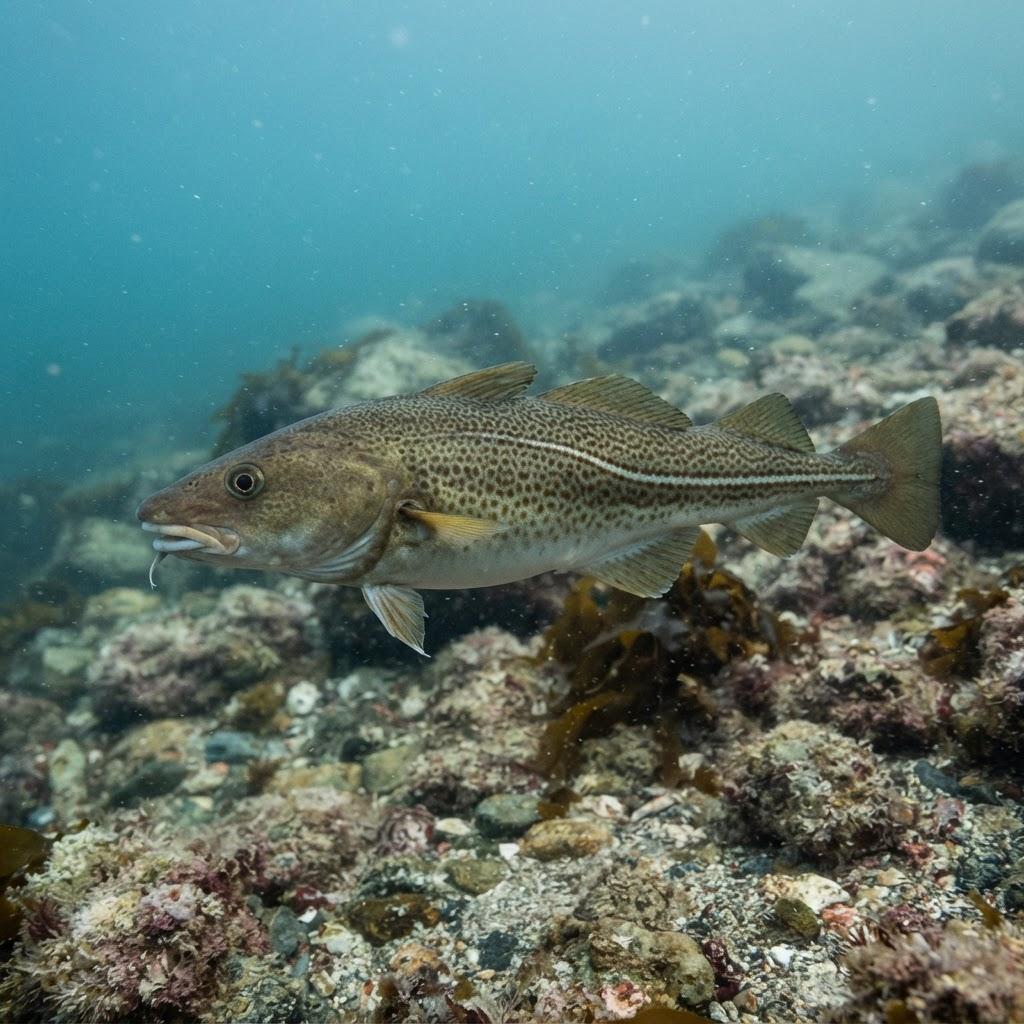
Gadus morhua
Cod
Meet the Atlantic Cod, the undisputed heavyweight champion of fish history and the ultimate ocean wanderer. This isn't just your dinner fish; it is a legendary traveler that literally shaped empires and changed the course of human maps.
Meet the Fish
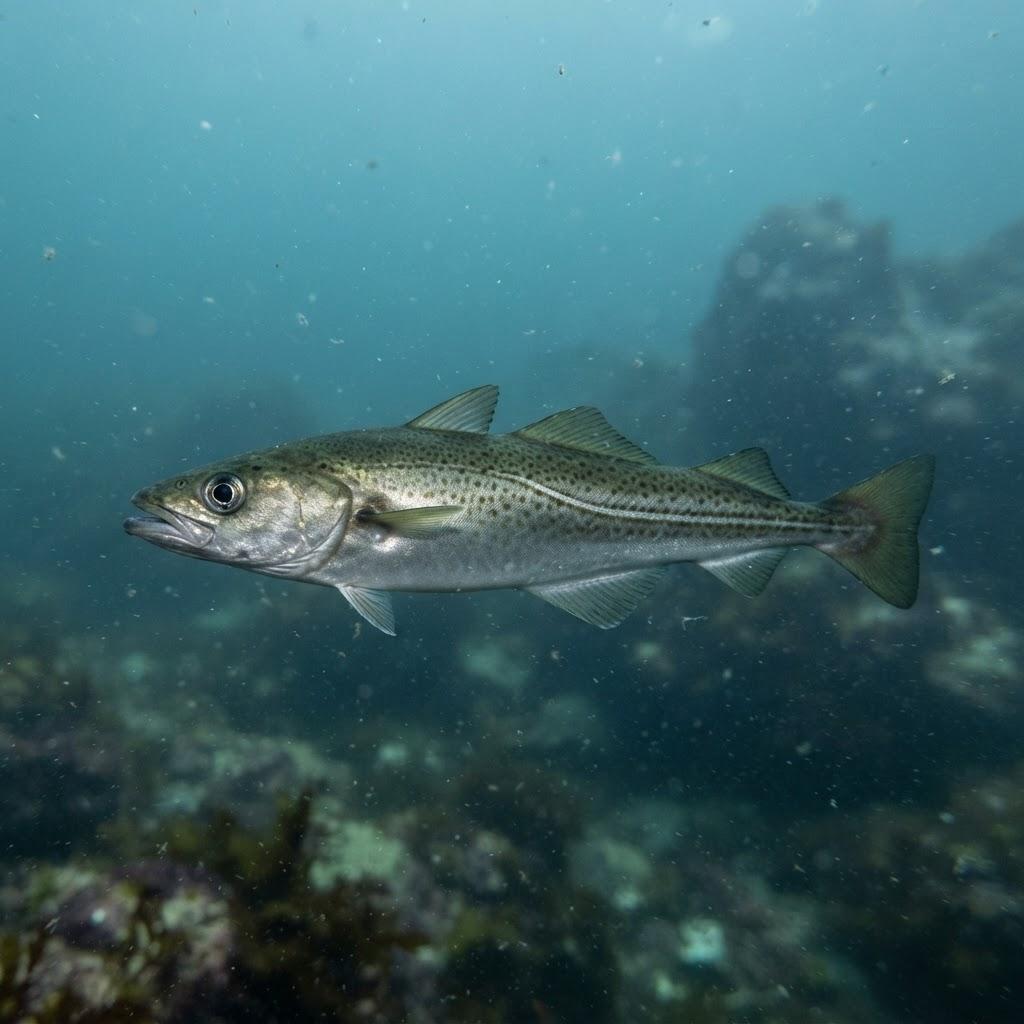
Imagine a fish that looks like it just rolled out of bed after a century-long nap, but secretly runs the entire neighborhood. That is the Atlantic Cod. With a chin barbel—a sensory whisker that makes it look like a grumpy grandfather—and a speckled coat that could hide in a bowl of oatmeal, the cod is the definition of understated cool. It doesn't need neon colors or spikes to get attention. Instead, it drifts through the cold, murky Atlantic like a seasoned detective in a noir film, always scanning the seabed for a snack. While other fish are busy being flashy or venomous, the cod prefers the rugged, low-key lifestyle of a scavenger and predator. It is a chunky, muscular wanderer that has been traveling the same watery highways for thousands of years. Think of the cod as the blue-collar worker of the sea; it is reliable, tough, and frankly, a bit of a legend. When a cod enters a room—or a trench—the vibes shift because everybody knows this fish is the backbone of the North Atlantic ecosystem. It doesn't have time for social media, because it is far too busy exploring the depths and making sure the smaller fish know who is really the boss of the deep.
Weird Biological Superpowers Explained Simply
If you ever wondered how a fish manages to stay perfectly buoyant without having to constantly swim like a frantic toddler, look no further than the cod’s internal gas balloon. It has something called a swim bladder, which is essentially a private, internal scuba tank that keeps it from sinking like a stone to the abyss. This bladder allows the cod to adjust its buoyancy by manipulating gas levels, a bit like how a submarine manages depth. But that is not even the coolest part. The cod is essentially a living, breathing sensory suite. That tiny whisker under its chin? It is a high-tech sensor used to taste and touch the seabed while hovering in dark, murky water. It is like having a GPS system that can also taste your lunch before you even arrive. Additionally, the cod has a lateral line running down its body, which acts as a super-sensitive movement detector. It can feel the tiniest vibration of a krill from meters away, meaning it doesn't even need eyes to see you coming. It is basically the Daredevil of the ocean, relying on tactile feedback and acoustic pressure to dominate its environment.
Absurd Self-Defense Mechanisms
When you are a cod, you don't have the luxury of venomous spines or a shell that could stop a submarine, so you have to be clever. The cod’s primary defense is, quite frankly, an Olympic-level ability to disappear. Its body is covered in specialized skin cells called chromatophores that can change the shade of its pigments. Think of it as an organic, living camouflage pattern that lets it blend perfectly into the rocky, kelp-covered ocean floor. If a predator like a seal or a larger shark shows up, the cod doesn't panic; it just turns into a boulder. It becomes one with the landscape, essentially performing the world’s most effective magic trick. If that fails, it relies on its sheer, raw muscle power. Cod are built like linebackers; they can execute explosive bursts of speed that leave confused predators biting at empty bubbles. It is the aquatic version of doing a sudden U-turn in a sports car while your pursuer is still trying to figure out which pedal is the brake. In the high-stakes game of don't-get-eaten, the cod wins by being the most boring-looking rock in the vicinity.
Fish Drama and Gossip
Let’s talk about the social hierarchy of a cod school, which is basically a high-stakes version of a busy commuter train during rush hour. While they are not exactly known for dramatic displays of affection, cod are surprisingly social animals. They live in massive, loose-knit groups where the social currency is all about size and experience. If a younger, scrawny cod tries to cut in line for a prime spot of crustaceans, the older, grizzled veterans will definitely let it know who owns that patch of the reef. It is not exactly a soap opera, but there is definitely a quiet, intense tension. They don't have reality TV confessionals, but if they did, the biggest cod would be talking about how it spent twenty years navigating the Grand Banks and why the newcomers just don't have the work ethic required to survive a winter in the Barents Sea. It is a society built on mutual respect and keeping a safe distance from each other’s personal bubbles, punctuated by the occasional skirmish over a particularly tasty clam.
The "Wait, That's Real?!" Deep-Sea Oddities
While the cod is perfectly comfortable in shallow to moderate depths, it has distant cousins that live in the true twilight zones of the ocean, where the pressure could crush a tractor like a tin can. The deep sea is a weird, alien place where creatures use bioluminescence to turn themselves into living disco balls just to find a date or lure in a meal. The cod, by comparison, is a sensible neighbor. While it doesn't need to glow in the dark to prove its worth, it possesses eyes adapted to low-light conditions that would make a human feel like they were in a dark basement. The deep-sea environment is essentially a desert where the food falls from above like manna from heaven. The cod has evolved to be the perfect middle-manager of the ocean; it occupies the layer just above the really strange monsters, acting as a crucial link in the food chain. If the deep-sea fish are the eccentric, neon-lit party animals, the cod is the practical homeowner who ensures the neighborhood stays functional, stable, and well-fed throughout the changing seasons.
Myth Busting
For years, people thought fish like the cod were just mindless, swimming vegetables that lacked any real personality or intelligence. Let's bust that right now. Cod are actually incredibly curious and show signs of being able to learn and remember routes across thousands of miles of ocean. They aren't just bumping into stuff until they find food; they have internal maps that put your smartphone’s GPS to shame. Another myth is that fish can't feel anything or form bonds. Observational data shows that cod exhibit complex group behaviors, suggesting they are very aware of their peers. People also used to think cod were infinite, that the ocean was so vast they could never be overfished. That myth led to near-total collapses of their populations, proving that even a fish as robust and legendary as the cod has limits. They are not mindless automatons; they are savvy, tactical survivors that have adapted to some of the harshest conditions on the planet. Anyone who calls a fish 'dumb' hasn't spent time watching a cod navigate a complex, changing current with absolute, unerring precision.
Humorous Historical Tales or Folklore
The history of the cod is so intense that people actually fought wars over it. Yes, entire nations went to loggerheads over who got to catch the most cod. In the 15th and 16th centuries, explorers were crossing the Atlantic specifically to find new fishing grounds, and the wealth generated by cod was essentially the Bitcoin of the Middle Ages. There is a legend about the Basques discovering the Americas long before Columbus, but they kept it a secret just so they wouldn't have to share their secret cod-catching spots. Talk about dedication to the catch! In folklore, the cod was often seen as a bringer of prosperity, a fish that literally kept entire coastal civilizations from starving through the long, brutal winters. It became a symbol of resilience and survival, showing up in heraldry, songs, and tall tales told by sailors who claimed they caught cod so big they could barely pull them onto the deck. These stories might have been inflated by a little bit of rum, but they speak to the deep, almost spiritual connection humans have felt with this fish for centuries.
Underwater Love Stories and Bizarre Romances
When a cod decides it is time to find a partner, it doesn't just send a text; it hosts a full-blown oceanic concert. Male cod are known to grunt—yes, they make actual, vibrating grunting sounds—using special muscles around their swim bladder to create a rhythmic, low-frequency beat. It is basically the fish equivalent of a bass-heavy club song designed to draw a female into their personal space. Once the female arrives, the real dance begins. They swirl around each other, syncing their movements in a graceful, slow-motion ballet that would make a ballroom dancer jealous. It is surprisingly romantic in a rugged, deep-water way. They press their bellies together and release millions of tiny eggs and clouds of sperm into the current, hoping for the best in the vast, cold blue. There is no long-term nesting, no "till death do us part" sentimentality; it is a brief, intense, and highly coordinated explosion of life that happens in the middle of the dark, freezing winter, making them the ultimate party starters of the North Atlantic.
Underwater Architecture and DIY Nesting
Most people think of fish as lazy, just drifting where the current takes them, but cod are actually quite particular about where they choose to stage their events. They don't build nests out of twigs or sticks like a bird, because, well, everything would float away. Instead, they look for specific 'thermal sanctuaries'—pockets of water with just the right temperature and salinity. Think of it as scouting for the perfect, prime real estate location for a high-end pop-up restaurant. They need deep-sea channels or rocky crevices that offer protection from the strongest currents. Once they find the right 'neighborhood,' they aggregate there by the thousands. It is a massive, coordinated DIY project where the collective movement of thousands of fish keeps the water stirred and active, maintaining the perfect conditions for their offspring. It is not architecture in the sense of building a wall, but it is architectural in the sense of finding the exact structural niche in the ocean that acts as the perfect incubator for the next generation of cod.
The Chaos of Raising Tiny Swimmers
If you think parenting human toddlers is stressful, imagine releasing millions of tiny, microscopic babies into the open ocean and essentially saying, 'Good luck, kids, see you in a few years!' A female cod can release up to five million eggs in a single season. That is not just parenting; that is a total commitment to the 'quantity over quality' survival strategy. These eggs are tiny, transparent, and float near the surface, where they are basically the ultimate snack for every other sea creature. The ones that survive the first few weeks are the ones that are fast, lucky, and incredibly good at hiding. It is a chaotic, Darwinian free-for-all. There is no maternal instinct, no feeding the kids, and no helping them with their homework. The 'daycare' is the entire North Atlantic. Only a tiny fraction of these millions will ever grow up to be the massive, chin-whisker-sporting adults we know. It is a wild, high-stakes game of survival that requires nothing short of a miracle for a single cod to reach adulthood.
How to Spot One & How It Is Doing
If you want to spot a cod, you’ll likely need to be on a fishing boat or a very dedicated scuba expedition in cold, northern waters. Look for that signature speckled brown skin, the three distinct dorsal fins along the back, and the prominent chin barbel that makes it look like it is ready to give you some sage advice. They are masters of hiding, so if you see one, count yourself lucky. Currently, the cod is considered vulnerable because we spent centuries treating it like an infinite resource. However, there is good news: with smarter fishing regulations and a growing focus on sustainability, many cod populations are showing signs of bouncing back. You can help by supporting sustainable fisheries when you’re out grocery shopping—look for the labels that certify your fish was caught with care. It is not just about keeping the fish on our plates; it is about keeping this legendary, history-making species swimming for another few thousand years. The cod is the heartbeat of the North Atlantic, and it deserves a future as big as its past.