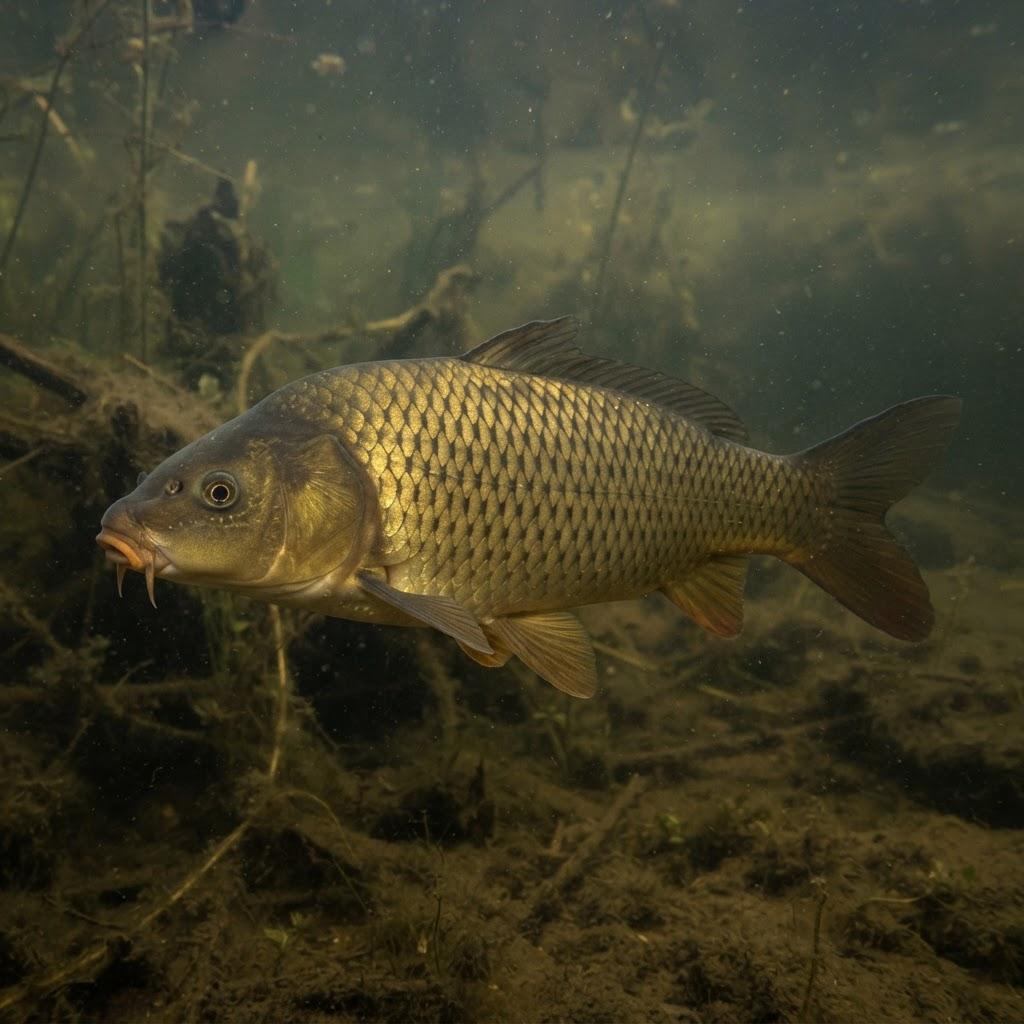
Cyprinus carpio
Common Carp
Meet the Common Carp, the world's most successful underwater golden retriever that just wants to eat everything in sight. These chunky, mud-loving legends have traveled across empires and continents, proving that if you have a big enough appetite, you can take over the world.
Meet the Fish
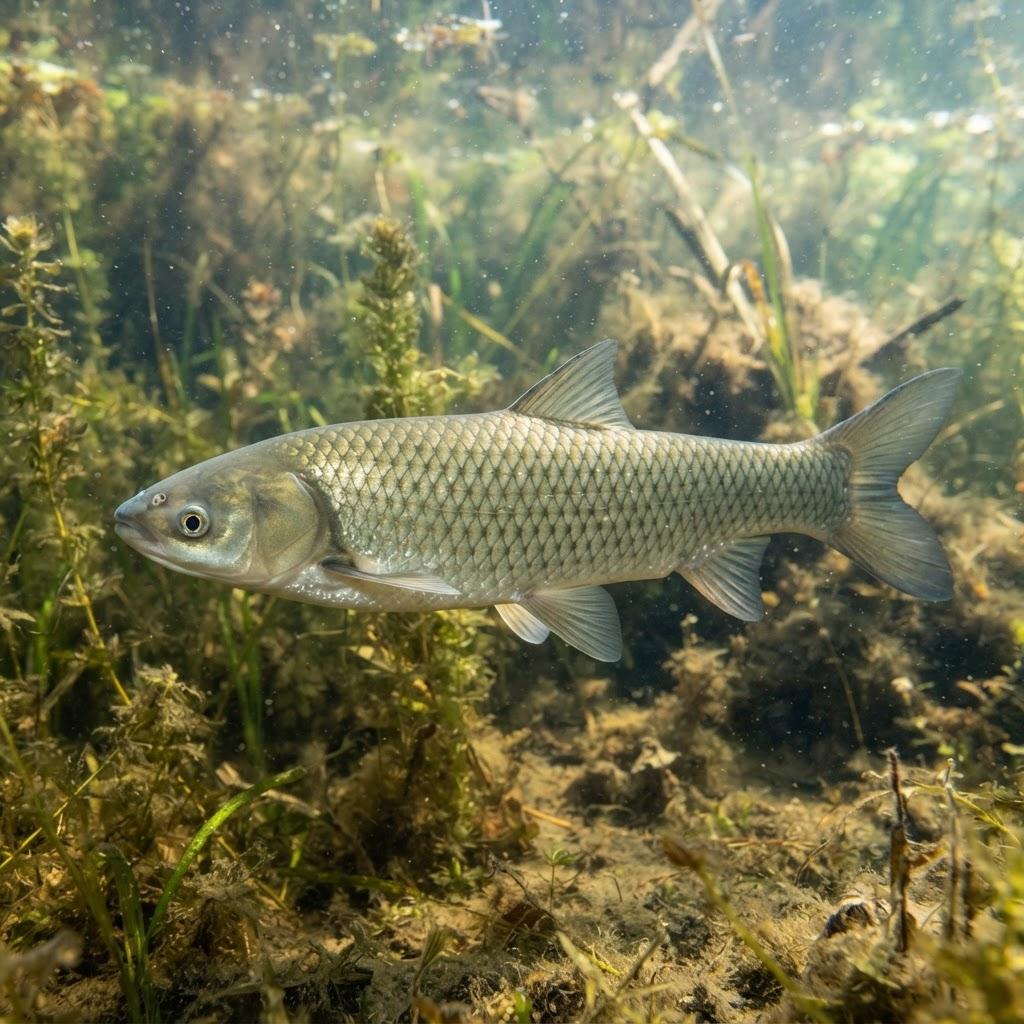
Imagine a fish that grew up in the pond version of a high-end buffet, realized it liked snacks more than swimming laps, and just never stopped eating. That is the Common Carp. With their golden-bronze scales and lips that look like they are constantly pursing for a selfie, these guys are the kings of the bottom-feeding world. They are the aquatic equivalent of that one friend who shows up to every party, stands near the snack table, and somehow manages to become the life of the event without even trying. Unlike the sleek, brooding predators that want to engage in high-speed chases, the carp is the ultimate chill-vibes master. They are heavy, deliberate, and possess a level of confidence that only comes from knowing you are built like a tank. They are the 'dad-bod' of the fish kingdom—sturdy, lovable, and surprisingly capable of causing a massive commotion if you accidentally step on their toes.
Weird Biological Superpowers Explained Simply
While other fish are busy evolving wings or glowing in the dark, the Common Carp decided to master the superpower of 'extreme digestion.' They have a set of throat teeth, called pharyngeal teeth, that act like a personal food processor. Imagine having a blender hidden in your esophagus that grinds up tough plant matter and crunchy snails before it even hits your stomach. It is like eating a salad and having it turn into a smoothie instantly. Beyond their internal blender, carp have an incredible sense of smell and taste that borders on supernatural. Their entire body is essentially a giant taste bud. They can detect a tiny morsel of food in murky water from half a mile away, making them the ultimate treasure hunters. It is a biological superpower designed for one goal: finding snacks in low visibility where most fish would be completely lost. They treat the entire lake floor like a giant hidden-object game.
Absurd Self-Defense Mechanisms
If you are a carp, your best defense isn't hiding; it is being too big and too slippery to bother with. When danger approaches, a carp doesn't just swim away; it uses its massive, muscular tail to create a blast of muddy water. Think of it like a ninja throwing a smoke bomb. By vigorously flapping near the muddy bottom, they kick up a massive cloud of silt that obscures the water instantly, turning the immediate area into a 'good luck finding me' zone. This sudden change in the water's transparency is enough to confuse even the hungriest pike or heron. Furthermore, they are essentially armored tanks. Their scales are thick, rigid, and overlapping, acting like medieval chainmail against nips and bites. If a predator tries to grab them, they find themselves biting down on a mouthful of hard, slippery armor rather than soft, delicious fish. It is nature's way of saying, 'don't bother, I am just not worth the effort.'
Fish Drama and Gossip
The social life of a carp pond is basically an endless loop of 'who is hogging the mud?' and 'did you see how big that guy got?' Carp are surprisingly social creatures that tend to hang out in loose schools, but there is definitely a hierarchy based on size. The biggest, oldest carp—the 'Grandpas of the Pond'—naturally demand the prime feeding spots, and the younger, smaller carp generally know better than to challenge them. It is a very polite, albeit intense, game of musical chairs. When feeding, they often work together to disturb the bottom, which kicks up food for everyone, so there is a strange mix of cooperation and competition. If a new, large carp enters the territory, there is a whole unspoken tension where everyone stares at each other through the murky water, assessing who is the hungriest. They are the reality stars of the freshwater world, always watching each other and waiting for a chance to snatch the best patch of silt.
The "Wait, That's Real?!" Deep-Sea Oddities
While our chunky friends live in shallow, sun-drenched ponds, their deep-sea cousins are living in a sci-fi horror movie. Think of the carp as the reliable minivan of the fish world, while the deep-sea inhabitants are like those bizarre experimental hovercrafts that only work in high-pressure, freezing environments. In the deep ocean, fish like the Barreleye have transparent heads so they can look straight up through their own skulls, whereas the carp is perfectly happy looking down at a nice, reliable patch of duckweed. Deep-sea creatures often need bioluminescence—the ability to light up like a neon sign—to communicate, but the carp finds this entirely unnecessary. Why glow in the dark when you can just be really good at detecting the scent of a discarded earthworm? It is a stark contrast between a life of extreme, alien adaptation and the carp’s life of sensible, shallow-water living. One is a mysterious puzzle; the other is a happy, mud-loving glutton.
Myth Busting
There is a persistent myth that carp are just 'trash fish' with no brains, but this couldn't be further from the truth. In reality, these fish are sharp. They have excellent spatial memory and can actually recognize individual humans who frequent the bank. If you spend time feeding them at a local park, they learn the sound of your footsteps or the shape of your silhouette. It is not just instinct; they are actively learning who the 'food bringer' is. Another myth is that they are dirty animals. People see them in muddy water and assume they like filth, but they are just creatures of habit adapted to soft sediment. They are actually vital cleaners of the ecosystem, vacuuming up decaying matter that would otherwise clog the pond. They aren't dirty; they are just professional pond-keepers who aren't afraid to get their fins a little muddy while they do the hard work of tidying up the local ecosystem.
Humorous Historical Tales or Folklore
The history of the carp is a wild ride of human obsession. Centuries ago, in medieval Europe, monks were essentially the original 'carp influencers.' They realized that carp were the perfect monastic snack—they were hardy, easy to keep in monastery ponds, and they grew incredibly fast. The monks essentially 'domesticated' them, selectively breeding them for size and color. This led to the creation of the Mirror Carp, a variety with very few, large scales, which made them much easier to clean for the dinner table. There is even folklore that claims carp can live for hundreds of years, and while that is an exaggeration, they do live impressively long lives. In Japan, the koi, which is a specialized, fashion-forward version of the common carp, became a symbol of perseverance because of its ability to swim upstream. They have gone from being the 'monk's dinner' to the 'prized backyard ornament,' traveling across the globe on the back of human ambition and taste buds.
Underwater Love Stories and Bizarre Romances
When it comes to dating, carp aren't exactly doing elaborate tango dances. Instead, they treat courtship like a chaotic, high-energy pool party. During the spawning season, the water practically boils as the fish chase each other through the reeds in a frenzy. The males become hyper-active, nudging the females toward shallow, weed-filled areas. It is not romantic in the traditional sense; it is a full-contact sport. There is splashing, thrashing, and a whole lot of tail-slapping as the females release thousands of eggs onto the vegetation and the males follow closely to fertilize them. It is essentially the underwater version of a mosh pit. Once the main event is over, the participants are exhausted and return to their normal routines, leaving the future generation to fend for themselves among the pond plants. It is less of a sonnet and more of an energetic, slightly messy flash mob event that happens in the spring.
Underwater Architecture and DIY Nesting
Carp are not exactly master architects like the beaver or the bowerbird. Their 'nesting' strategy is much more 'minimalist chic.' They don't build stone castles or dig elaborate tunnels. Instead, they rely on the natural architecture of the pond: thick mats of aquatic weeds, tangled roots, and submerged grasses. They seek out these underwater jungles specifically because the sticky eggs need a place to cling to so they don't drift away into the abyss. You could call them 'structural opportunists.' They don't modify the landscape; they find the best real estate and make it work. By selecting areas with plenty of vegetation, they ensure that their offspring have instant camouflage and a snack bar nearby the moment they hatch. It is efficient, low-effort, and incredibly effective. Why waste energy building a mansion when you can just find a perfectly good, pre-furnished patch of weeds in a sun-warmed shallow cove?
The Chaos of Raising Tiny Swimmers
If you are looking for a 'helicopter parent' of the fish world, keep looking. Carp are the polar opposite. They are the 'here is your lunch money, see you at graduation' type of parents. Once the eggs are fertilized and stuck to the leaves, the parents pretty much hit the 'unfollow' button and move on with their lives. They don't stick around to guard the nest or teach the babies how to hunt. The fry hatch in a few days as tiny, helpless slivers of life, and they have to rely on their yolk sacs for food until they are big enough to fend for themselves. It is a high-stakes, numbers-game strategy. They lay so many eggs that even if most of them become snacks for a passing dragonfly larva or a minnow, there will still be plenty of survivors to grow into the next generation of mud-shuffling legends.
How to Spot One & How It Is Doing
Spotting a Common Carp is easier than spotting a needle in a haystack—look for the gold. If you see a large, bronze-colored shadow cruising slowly near the surface or kicking up a cloud of silt near the bank, you have found one. Their oversized, rubbery lips are the dead giveaway. As for how they are doing, these guys are winning the game of life. They are incredibly resilient and have successfully spread to almost every corner of the globe. In some places, they are so successful that they are considered an invasive species because they out-compete native fish. The best way to help is to simply enjoy them where they belong and avoid moving them to new ponds where they don't belong. Keep your local waterways clean, and you will ensure that these golden, mud-loving storytellers continue to thrive for generations to come. They are the world's most successful survivors, and they aren't going anywhere anytime soon.