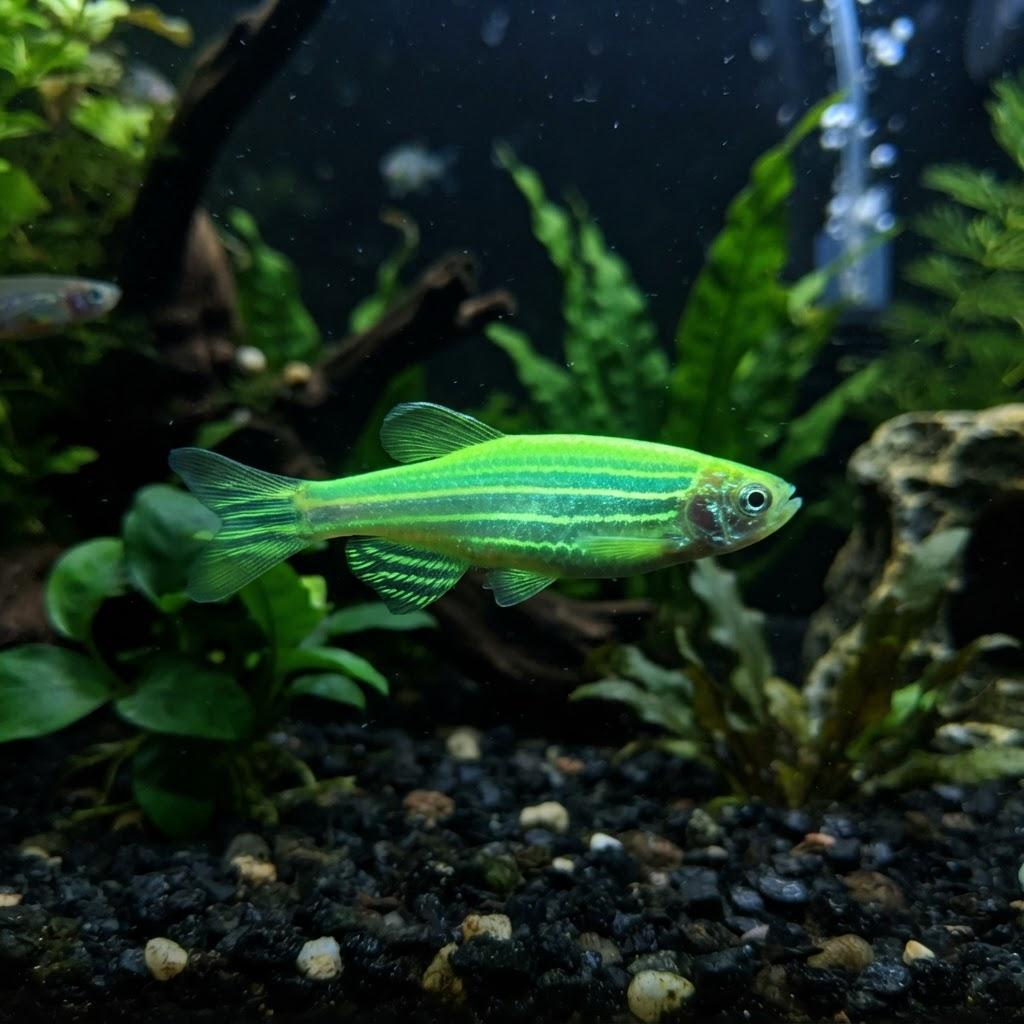
Danio rerio
GloFish Danio
Meet the GloFish Danio, the rave-ready version of the humble zebrafish that glows in the dark like a neon sign. This tiny party animal brings high-voltage color to the aquarium world through a dash of genetic flair.
Meet the Fish
Imagine you are at a high-end disco where the music is thumping and every single person is wearing a neon jumpsuit that practically vibrates with energy. Now, take that image and shrink it down to a two-inch-long fish, and you have the GloFish Danio. This isn't your grandfather's goldfish, which is basically a sleepy, orange blob floating in a glass bowl. The GloFish is the trendsetter of the aquatic world, a neon-bright dynamo that radiates brilliant shades of electric green, sunburst orange, and cosmic blue. Unlike most creatures that rely on evolution to produce camouflage, this little guy is essentially a walking, swimming highlighter pen. While its ancestors were perfectly happy blending into the muddy, brown waters of South Asian streams, the modern GloFish decided that being invisible is for boring people. It zips through the water like a caffeinated lightning bolt, acting as the life of the party in any aquarium lucky enough to host one. You cannot look at one without expecting it to start spinning disco tracks or breakdancing on a piece of aquarium driftwood. Its vibe is pure, unadulterated high-energy chaos, and it manages to look like a prop from a science fiction movie while doing nothing more than just existing in its tank.
Weird Biological Superpowers Explained Simply
The secret to the GloFish’s light show isn't magic, though it certainly looks like it. It is actually a clever bit of genetic tailoring that would make a mad scientist giggle with delight. Scientists took the DNA from jellyfish and sea anemones—two types of creatures that are experts at bioluminescence, which is just a fancy way of saying they can glow—and carefully introduced that DNA into the zebrafish. Think of it like a biological cut-and-paste job. They basically took the coding for the glowing protein from the ocean's own neon lights and installed it directly into the Danio's genetic instruction manual. Because these fish have this specialized protein embedded in their cells, they absorb light from their environment and re-emit it as a vibrant, glowing color. It is exactly like those glow-in-the-dark stars you used to stick to your bedroom ceiling as a kid, but instead of fading after ten minutes, these guys are permanently powered by their own biology. It is a stunning example of how science can borrow the best features from one species to give another a literal upgrade. The fish isn't just painted; it is built to be a living light show, proving that nature and technology can dance together quite beautifully.
Absurd Self-Defense Mechanisms
While the GloFish looks like a neon billboard, in the wild, its ancestor, the humble zebrafish, has developed some remarkably fast reflexes to avoid becoming a snack. If you were a small, shiny fish, your biggest problem would be looking delicious to literally everything else in the river. To combat this, the Danio has mastered the art of the 'zoom.' These fish have incredibly fast-twitch muscles that allow them to change direction with the speed of a startled cat. Imagine trying to catch a fly with chopsticks while riding a rollercoaster; that is basically the experience a predator has when trying to catch a Danio. They are masters of the frantic zig-zag, a movement that confuses the target acquisition systems of bigger fish, birds, and even the occasional hungry frog. It isn't just about speed; it is about unpredictability. They also hang out in groups, creating a chaotic 'shimmer' effect that makes it nearly impossible for a predator to focus on just one fish. It is like being in a mosh pit where everyone is wearing the same outfit; you just can't pick out your target before they vanish into the crowd. This social strategy turns individual vulnerability into a group effort of mass confusion.
Fish Drama and Gossip
Step aside, reality television, because the social hierarchy of a GloFish tank is where the real drama unfolds. Even though they are tiny, these fish act like they are competing for a crown in a cutthroat beauty pageant. They are intensely social, which means they spend all day deciding who is the boss, who is just hanging out, and who is currently being picked on. It is a constant cycle of chase-and-swivel, with dominant individuals acting like the popular kids in a high school cafeteria, chasing away anyone who gets too close to their preferred patch of gravel. There is a lot of posturing, fin-flaring, and side-swimming, which is basically the fish equivalent of an aggressive stare-down at a bar. If you watch them long enough, you will see 'schooling' behaviors that resemble a synchronized swimming team, but with more shouting and less music. Sometimes, the drama turns into a full-on territorial dispute over a particularly nice piece of fake moss. One fish will swoop in, the other will dart out, and for a few seconds, the whole tank is a flurry of neon colors and bad attitudes. It is high-stakes social climbing, all happening inches away from your living room sofa.
The "Wait, That's Real?!" Deep-Sea Oddities
While the GloFish lives in shallow, sun-drenched streams, their distant, weird cousins in the deep sea take the 'glowing' concept to terrifying, otherworldly extremes. In the midnight zone of the ocean, where sunlight is just a fading memory, being able to glow isn't just a party trick; it is a way to survive. You have creatures like the anglerfish, which dangles a glowing lure over its own face like a horrifyingly cute fishing pole, or the barreleye fish, which has a transparent head that lets you look right into its skull to see its glowing, green eyes. Compared to the deep-sea crowd, our GloFish is like a cute, glowing hamster. Deep-sea fish use light to find mates, confuse predators, and lure unsuspecting prey into their gaping maws in the crushing darkness. It is an alien landscape where everything is bioluminescent, squishy, and perpetually hungry. The GloFish is a reminder that nature loves to play with light, whether it is for showy display in a colorful stream or as a survival weapon in the crushing, pitch-black silence of the ocean trenches. They are all cousins in the grand, luminous family of aquatic life, just operating at completely different ends of the brightness spectrum.
Myth Busting
There is a persistent myth that fish have a memory span of only three seconds, which would make life pretty difficult for a fish trying to remember where it put its lunch or how to avoid predators. This is utter nonsense, especially for the savvy GloFish. Studies have shown that these fish are surprisingly sharp; they can learn to navigate complex mazes, associate specific colors with food, and even recognize their keepers. If you walk into a room, they know that the giant human-shaped light source usually leads to the arrival of dinner. They exhibit social memory, too, remembering which tank-mate is the bully and which one is the friend. They are not mindless, water-breathing statues. They are observing you just as much as you are observing them. The idea that they live in a permanent, three-second loop is just a convenient excuse for humans to keep them in boring, tiny tanks. In reality, they are intelligent, curious, and perpetually engaged with their environment. They have a rich inner life that mostly involves looking for snacks and keeping an eye on the other fish, proving that they are far more clever than common folklore would have you believe.
Humorous Historical Tales or Folklore
The zebrafish, the ancestor of our glowing friend, has a history that is arguably more scientific than mystical, but it has certainly played a huge role in how we understand our own bodies. For decades, it has been the 'lab rat' of the fish world. Because their eggs are transparent, scientists have been able to watch a fish grow from a single cell into a complex organism in real-time. It is like being able to watch a skyscraper being built from the inside out, floor by floor. While this might sound like a dry, clinical history, think of the irony: a fish that was once used to help scientists understand human heart disease is now the star of birthday parties and neon-themed bedrooms. It is a strange twist of fate for a species that spent millions of years hiding in the mud to suddenly become a symbol of genetic exploration. There is no ancient legend about a giant, glowing Danio rising from the river to guide ships, but if there were, it would definitely be a fish that demanded the best snacks and insisted on being the center of attention. They have moved from the quiet, serious laboratories of geneticists to the glittering, frantic world of household pets, which is a pretty epic journey for a creature that barely weighs as much as a paperclip.
Underwater Love Stories and Bizarre Romances
When it comes to romance, GloFish are not interested in long, romantic walks on the beach. Their dating life is much more like a high-speed chase through a neon obstacle course. The males become particularly intense, pursuing females with a level of focus that is honestly a little overwhelming. The mating dance involves a lot of rapid swimming, side-by-side posturing, and high-speed maneuvers that look like they are trying to set a new record for aquatic laps. It is less of a candlelit dinner and more of a synchronized aerobics class gone wild. The male will try to drive the female into the substrate, nudging her and shivering his fins, hoping she will decide that he is the most suitable partner for the job. It is a chaotic, frenetic display of energy. Once a pair has successfully bonded, they essentially scatter their eggs into the wild, leaving the parenting to the currents. There is no 'settling down' or building a white-picket-fence nest here; it is all about speed, efficiency, and making sure the next generation is just as bright and energetic as the last. It is a whirlwind romance that lasts for as long as it takes to deposit the eggs, and then it is back to the group drama.
Underwater Architecture and DIY Nesting
If you are looking for a fish that spends its weekends crafting elaborate sandcastles or hidden stone fortresses, you might be looking for the wrong species. Our GloFish friend is a minimalist. They don't have the patience or the inclination for long-term architectural projects. They prefer to live in a world of open water and occasional plants. Their idea of 'nesting' is finding a nice patch of fine-leaved plants where they can hide their eggs before they drift away. They are not interested in interior design; they are interested in speed and survival. Their simplicity, however, is a survival strategy. By not investing time into building a home, they are never tied down to one location. They are nomads of the stream, constantly on the move, looking for the next best patch of water. While other fish spend their energy rearranging rocks or digging pits, the Danio is busy exploring, racing, and reacting to its environment. They treat the entire aquarium as their oyster, preferring the freedom of movement over the confines of a home they have to maintain. It is a breezy, low-maintenance lifestyle that keeps their schedules open for more important things, like chasing food and bothering their tank-mates.
The Chaos of Raising Tiny Swimmers
Raising tiny GloFish is less about tender parenting and more about surviving a deluge of miniature, hungry replicas. Once the parents have done their part, they have absolutely no interest in playing the role of mom and dad. In fact, if the parents see their own fry, they might just view them as a convenient, bite-sized snack. This is why successful breeding often involves moving the eggs away from the adults as quickly as possible. The fry hatch within a couple of days, looking like nothing more than a tiny, translucent speck with a pair of eyes. They are essentially microscopic nomads, floating through the water column and waiting to grow enough to join the school. For the first few days, they have a yolk sac that provides all the nutrition they need, but once that is gone, it is a race to find food before they become food for someone else. It is a high-stakes, hilarious world where the 'daycare' is just open water and the only rule is to keep swimming. It is a chaotic start to life, but it ensures that only the fastest and the smartest make it to adulthood to join the neon school.
How to Spot One & How It Is Doing
Spotting a GloFish is incredibly easy because they are essentially designed to be seen from across the room. If you are in a pet store, just look for the tank that looks like a rave in a box. They are distinct, vibrant, and always on the move. When you are looking for them, you will see a slim, torpedo-shaped body that zips back and forth, reflecting the tank's lighting in a way that makes them look like they are plugged into an electrical socket. They are the easiest fish to identify because, well, they glow in the dark! As for their conservation status, these are captive-bred marvels, so they are not struggling for survival in the wild; in fact, they are thriving in the hearts of hobbyists all over the globe. Because they are lab-developed, their population is stable and safe in human care. The best way to help is to ensure they have plenty of room to zoom, clean water to swim in, and a group of friends to hang out with. They are healthy, vibrant, and, most importantly, happy to be the neon center of your aquatic universe. With a bit of good care, they will keep the party going in your living room for years to come.