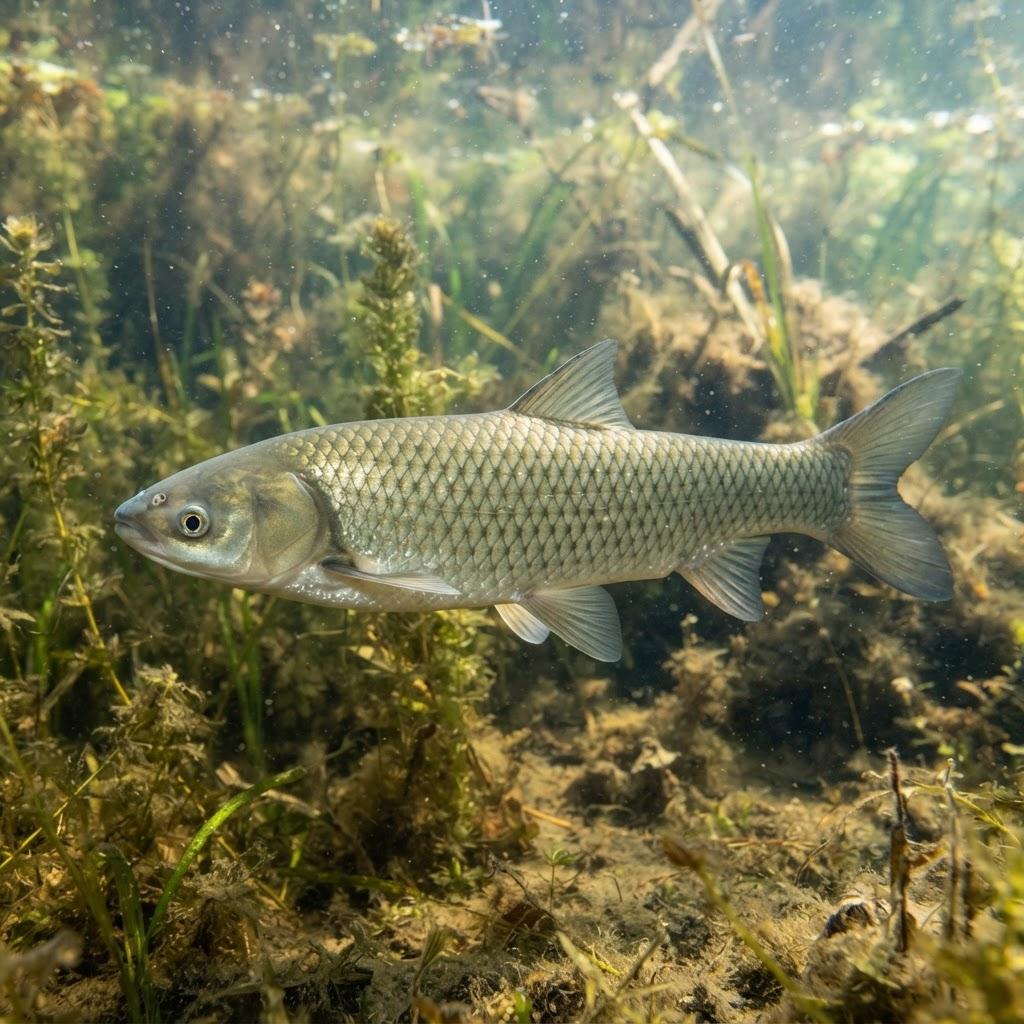
Ctenopharyngodon idella
Grass Carp
Meet the Grass Carp, the aquatic equivalent of a lawnmower with fins and a serious appetite for greenery. This torpedo-shaped eating machine is the ultimate underwater landscaper, turning entire ponds into salad bars one bite at a time.
Meet the Fish
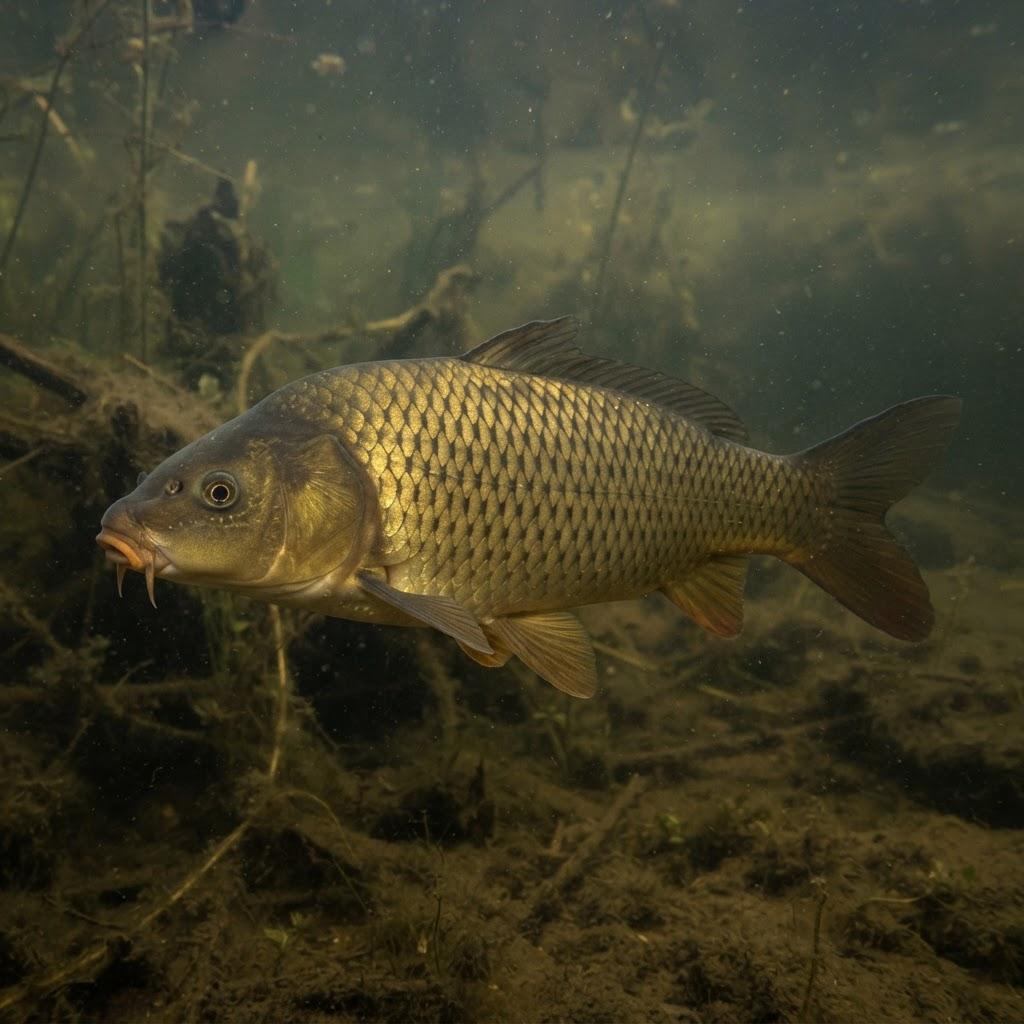
Imagine you are at a suburban backyard barbecue, but instead of a person talking about their prize-winning tomato plants, you encounter a torpedo-shaped, silver-scaled eating machine that weighs more than a golden retriever. That is the Grass Carp. This fish is the ultimate 'foodie' of the freshwater world, but with a twist: it only wants the salad. While other fish might be chasing flashy lures or hunting minnows like they are in a high-speed action movie, the Grass Carp is the zen master of the vegetation patch. It moves with a calculated, heavy grace, scouting for the freshest, most delicious water weeds like a gourmet diner scanning a menu. It has a vibe that suggests it has seen it all, done it all, and currently just wants to find the best patch of pondweed in the tri-state area. It is not just big; it is structurally imposing, built for long-distance cruising rather than sprinting. When it decides to start munching, it acts with the efficiency of an industrial lawnmower, earning it a reputation as a living, swimming weed-whacker that never needs to be refueled with gasoline.
Weird Biological Superpowers Explained Simply
The Grass Carp does not have lasers or the ability to walk on water, but it possesses a digestive system that borders on the miraculous. Because it eats plants—stuff that is usually tough and fibrous like celery—it needs a special way to break it down. Unlike humans who have flat molars to crush salad, the Grass Carp has evolved a set of pharyngeal teeth. Imagine having a set of grinding plates located way back in the back of your throat, deep behind your gills. These are not for biting; they are for crushing, mincing, and shredding plant material until it reaches a state where the fish can actually digest it. It is essentially a food processor installed internally. They also have an incredible ability to process massive amounts of food, which means they grow at a pace that seems unfair to every other fish in the pond. This rapid growth is fueled by their ability to constantly graze, processing their own body weight in vegetation in a surprisingly short window. It is basically the biological equivalent of being able to eat your own weight in pizza every day and somehow growing taller instead of getting sick.
Absurd Self-Defense Mechanisms
When you are a massive, slow-moving sausage of a fish, you might think you would be an easy target for predators. However, the Grass Carp plays a different game: the game of 'I am too big to bother.' Most predators in the water look for quick, frantic movements—the 'panic reflex' that signals an easy meal. The Grass Carp, on the other hand, is the master of the slow, deliberate glide. They are calm, collected, and surprisingly elusive. Their primary defense is sheer mass and a highly developed lateral line system. This is a sensory organ running along their side that detects even the most microscopic changes in water pressure. If a predator tries to sneak up on them, the Grass Carp detects the displacement of water long before the attacker gets within striking distance. They also have the ability to jump quite high when startled, a frantic 'get out of dodge' move that can easily knock an unsuspecting fisherman off balance or send a predator scrambling for cover. It is the fish equivalent of a bodybuilder deciding to jog away from a fight—not fast, but very difficult to actually stop once they get moving.
Fish Drama and Gossip
Life in the pond for a Grass Carp is surprisingly low-drama, mostly because they are too busy eating to worry about social status or petty squabbles. You will not see these guys engaging in the dramatic fin-flaring territory battles common to bettas or the complex hierarchies of cichlids. They are more like the 'loner at the party who just stands by the snack table.' They are social, yes, but their social circle is more of a collective grazing herd. That said, there is definitely some unspoken etiquette regarding who gets the prime, tender shoots of hydrilla. If a massive adult shows up, the smaller fish generally yield the space, not out of fear, but out of a sort of weary respect for the fish that has clearly mastered the art of pond maintenance. It is a very polite, Canadian-style social scene where everyone just wants to eat their greens in peace. If another fish tries to interrupt their meal, the Grass Carp simply turns its bulk and drifts away to another patch, effectively ending the conversation before it even starts. It is the ultimate act of social avoidance.
The 'Wait, That's Real?!' Deep-Sea Oddities
While the Grass Carp lives in the bright, sunny shallows of rivers and lakes, it stands in stark contrast to its deep-sea cousins who live in the abyss where light is just a memory. Deep-sea fish have to deal with crushing pressure and absolute darkness, leading to bizarre evolutionary choices like glowing lures dangling from their faces or eyes that can look upward through transparent skulls. The Grass Carp, by comparison, is an evolutionary 'normal.' They don't need bioluminescence because they spend their lives in the 'photic zone,' where the sun is their primary lighting system. However, they share a lineage of resilience with those deep-sea monsters. While deep-sea fish are masters of energy conservation, the Grass Carp is a master of energy consumption. One lives by hoarding every calorie like a miser in a cave, and the other lives by turning the entire environment into an all-you-can-eat buffet. It is a funny contrast: the deep-sea fish is a hermit, and the Grass Carp is the hungry neighbor who shows up at your house every time you order takeout.
Myth Busting
There is a persistent myth that the Grass Carp is a mindless, gluttonous vacuum that will destroy every single piece of plant life until the water is nothing but brown soup. While it is true that they are vigorous grazers, they are not actually the indiscriminate monsters that urban legend suggests. They are quite picky. They have favorite types of plants—the tender, nutritious ones—and they will often leave the tough, woody stuff alone until they have absolutely no other choice. Another common myth is that they are impossible to catch because they are too smart. The truth is that they are just suspicious. They have evolved to recognize shapes and shadows because they spend so much time in clear, shallow water. If a human shows up looking like a giant predator, they are not being 'smart'; they are being cautious. It is not that they have a secret library of books on human behavior; they just know that when a shadow blocks the sun in an unnatural way, it is probably a good time to vacate the premises and find a deeper, darker, and more delicious spot to hang out.
Humorous Historical Tales or Folklore
Throughout history, humans have had a complicated relationship with the Grass Carp, mostly because we keep dragging them to places they did not ask to go. In their native Asia, they have been a staple of aquaculture for thousands of years, revered as the 'cleaners' of the irrigation channels. Imagine being a farmer in ancient times and realizing you have a fish that does your weeding for you for free; you would probably treat that fish like a minor deity. Because of this, many cultural legends portray them as symbols of prosperity and hard work. When they were introduced to the West, however, the tone shifted from reverence to bewilderment. They were brought over to manage aquatic weeds, essentially serving as a biological alternative to chemical herbicides. The folklore of the American angler is filled with 'the one that got away' stories, where giant carp are described as being the size of small canoes, capable of snapping heavy-duty fishing lines with a flick of their tail. These stories have elevated the humble Grass Carp from a simple garden tool to a legendary river beast that only the most dedicated fishers can ever hope to tame.
Underwater Love Stories and Bizarre Romances
If you are looking for the 'Romeo and Juliet' of the fish world, keep looking, because the Grass Carp has a very business-like approach to romance. They do not do the elaborate courtship dances or the multi-day nesting rituals seen in other species. Instead, their mating is a chaotic, high-energy event that happens when the water temperatures rise and the rivers begin to swell. It is less of a romantic candlelit dinner and more like a high-stakes group sprint. The females release their eggs into the current of a large, flowing river, and the males follow, fertilizing them on the fly. It is a numbers game. They release thousands, sometimes hundreds of thousands of eggs, hoping that the sheer volume of the 'cloud' of life will ensure that at least a few make it to adulthood. There is no jealousy, no partner selection, and certainly no wedding vows. It is just biology doing its thing in the middle of a river current, treating the process like a grand, aquatic party where everyone is invited and no one really keeps track of who is who.
Underwater Architecture and DIY Nesting
Unlike some fish that spend their lives acting like civil engineers, building elaborate castles out of pebbles or carving out tunnels in the mud, the Grass Carp is essentially a 'digital nomad' of the fish world. They do not build nests. They do not have a home address. They are constantly on the move, following the flow of the water and the availability of the best salad patches. Their 'architecture' is the environment itself—they rely on the river current to keep their eggs buoyant and safe. If they were to lay their eggs in a stagnant pool, the eggs would sink and get covered in silt, which would be the end of that generation. So, they have evolved to trust the river's movement. They are the ultimate minimalists. Why build a house when you can just drift through the world, eating everything in your path and letting the river handle the logistics of raising your children? It is a bold, low-stress lifestyle that works perfectly, provided the river doesn't stop flowing.
The Chaos of Raising Tiny Swimmers
If the mating process is a chaotic party, the childhood of a baby Grass Carp is essentially a survival training montage. Because there is no parental care—no mother guarding the eggs, no father bringing snacks—the tiny 'fry' are on their own from the second they hatch. They are microscopic, transparent bits of energy that have to navigate a world filled with things that want to turn them into a snack. Their strategy is pure, unadulterated numbers. By flooding the ecosystem with thousands of potential offspring, the adults ensure that even if 99% of them get eaten by insects, small fish, or water birds, a lucky few will make it to the 'teen' stage where they become too large for most predators to handle. It is a harsh reality, but for the Grass Carp, it is the only way to play. The ones that survive the gauntlet grow at an astonishing speed, quickly becoming the massive, salad-munching giants that we recognize. They start as fragile specks and end as river-dwelling tanks, proving that with enough luck and a fast metabolism, you can survive anything.
How to Spot One & How It Is Doing
So, you want to spot a Grass Carp? First, put down the fancy lure and pick up a pair of polarized sunglasses—you need to cut the glare off the water. Look for large, torpedo-shaped shadows moving slowly through the shallows, especially near mats of weeds or overhanging tree branches. They look like a giant, brownish-silver version of a goldfish that has spent way too much time at the gym. If you see a patch of weeds that looks like it has been 'mowed' in a jagged line, you have likely found their dining table. Conservation-wise, they are doing great—sometimes too great. Because they are so effective at eating plants, they have been introduced to many areas to control invasive weeds, but sometimes they do their job a little too well and start eating the plants that the native fish need. They are not endangered; in fact, they are often managed to keep their populations in check. The best way to help is to admire them in their natural habitat and support local watershed management programs that keep our lakes and rivers healthy and balanced for all species, not just the hungry lawnmowers.