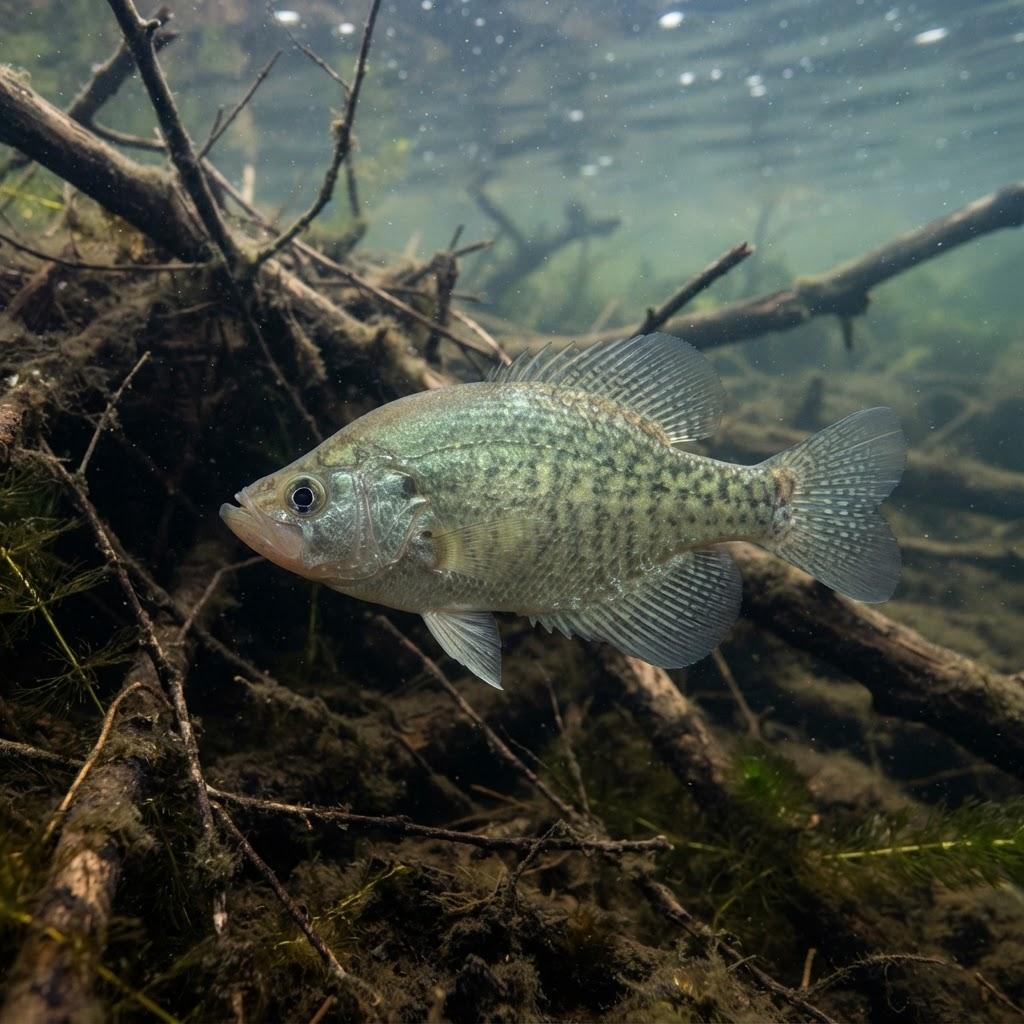
Pomoxis annularis
White Crappie
Meet the White Crappie, the silver-scaled socialite of the freshwater world that turns murky waters into a high-stakes lounge. It is a fish that balances a life of culinary fame with a reputation for being the most charmingly indecisive diner in the lake.
Meet the Fish
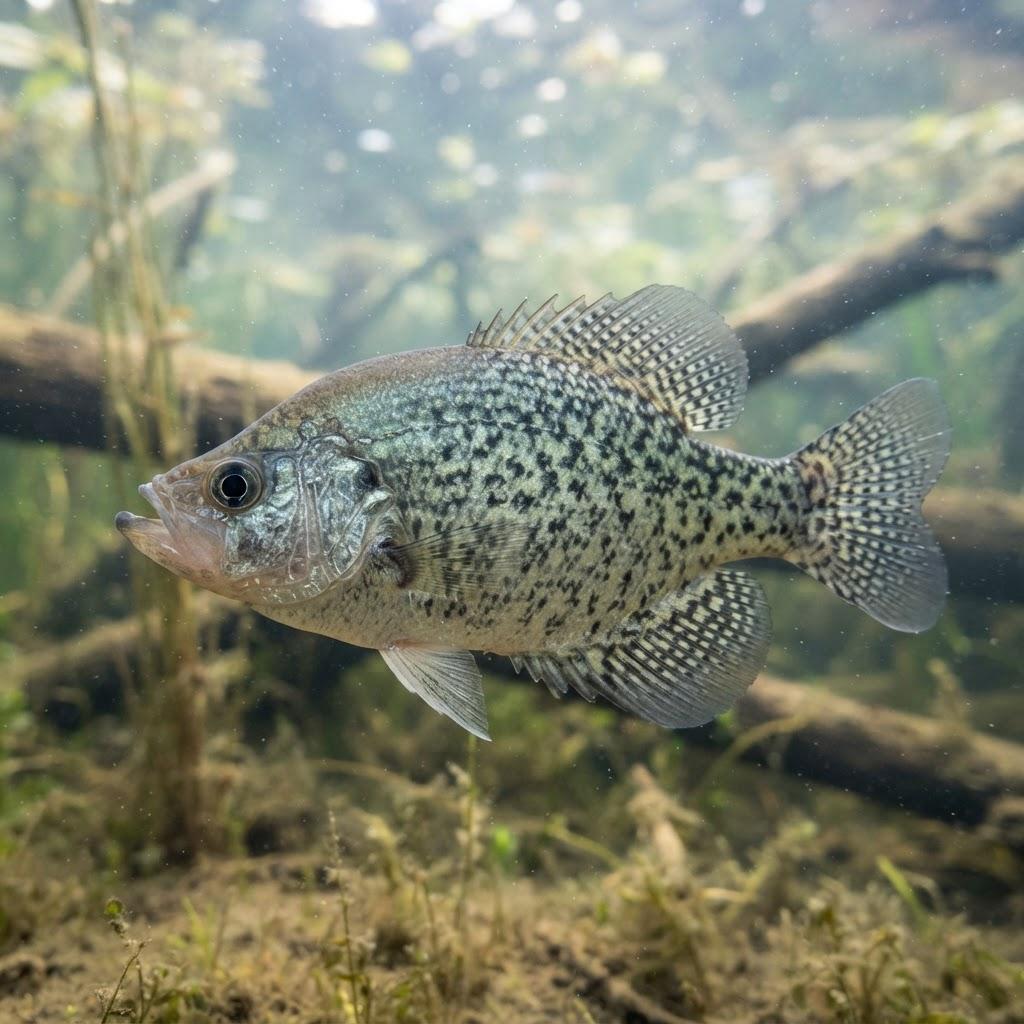
Imagine a fish that looks like it spent a little too much time at a fancy masquerade ball wearing a silver suit that is just one size too big. The White Crappie is the life of the party in almost every freshwater lake it inhabits, carrying itself with a relaxed, low-stakes energy that feels suspiciously like it knows a secret you do not. With its deep, compressed body, it looks like a dinner plate that decided to go for a swim, and its silvery-white complexion is accented by vertical bars that give it a sophisticated, pinstriped aesthetic. Unlike its cousin, the Black Crappie, which prefers to keep things dark and moody with mottled patterns, our friend the White Crappie prefers a lighter look, making it the perfect candidate for a moonlight dip. It is not exactly the biggest predator in the pond, but it possesses a certain kind of charisma—a 'cool kid' vibe—that keeps anglers obsessed and other fish wondering exactly what it is up to next. It is not just a fish; it is a freshwater icon with a personality that oscillates between shy wallflower and bold opportunist depending entirely on the temperature of the water.
Weird Biological Superpowers Explained Simply
The White Crappie has a superpower that makes it the king of the dim-lit deep: it possesses 'high-definition' night vision that would make a stealth fighter pilot weep with jealousy. Its eyes are not just for show; they are massive, light-gathering orbs that allow it to hunt in murky, tea-colored water where the average fish would be bumping into logs like a toddler in the dark. It is essentially the underwater equivalent of wearing military-grade night-vision goggles while everyone else is trying to navigate with a flickering candle. Furthermore, its body is equipped with a sensory system called the lateral line, which is like a secret sixth sense running down its sides. This line detects the tiniest changes in water pressure, meaning the White Crappie can feel the approach of a meal or a threat before it even sees it. It is like having a constant, low-frequency radar hum in your brain that alerts you to the exact location of a snack or a predator from three feet away. This is not just luck; it is a highly evolved, biological super-suit that turns the Crappie into a silent, silver ghost of the river bottom.
Absurd Self-Defense Mechanisms
When you are a tasty, plate-shaped snack in a lake full of hungry largemouth bass and pike, you need a plan, and the White Crappie has perfected the art of the 'flash and dash.' It doesn't use poison or slime; instead, it relies on its ability to turn on a dime and disappear into the safety of the nearest pile of sticks. When threatened, the Crappie flares its fins, turning its flat body into a wide wall of resistance, making it much harder for a predator to get a good grip or swallow it whole. It is basically the aquatic version of opening an umbrella inside a doorway—good luck getting past that! If that does not work, it utilizes its impressive burst speed to dart into the absolute center of a complex log jam. It is a master of structural warfare; it knows exactly where the narrowest gaps in the vegetation are, and it uses its thin, disk-like frame to slip through places that its bulky predators cannot follow. It is like watching a professional gymnast perform a daring escape through a maze of razor-sharp obstacles, all while maintaining its dignified, pinstriped composure.
Fish Drama and Gossip
If the local lake were a high school cafeteria, the White Crappie would be the group that hangs out by the lockers—social, slightly cliquey, and always moving in schools. They are notoriously social creatures, and you will rarely find one hanging out by itself unless it is having a bad day or a very important meeting. Their school structure is a whirlwind of drama where positions in the formation are constantly changing. Dominance is not determined by a physical brawl but by who gets the prime real estate near the drop-off ledge or the shaded side of a dock. They move together with a synchronized, ballet-like grace, but don't be fooled; if food drops, it is every fish for itself. They have been observed 'skimming' the surface or 'cruising' the mid-levels of the water column in tight, coordinated packs that communicate through subtle shifts in position and movement. It is a constant, shifting dance of social hierarchy where you have to stay sharp, keep your scales shiny, and never, ever be the one left behind when the school decides to migrate to the next feeding ground.
The "Wait, That's Real?!" Deep-Sea Oddities
While the White Crappie enjoys the shallower comforts of lakes and rivers, it is essentially the suburban cousin of those weird, glow-in-the-dark monsters you see in deep-sea documentaries. If you think the Crappie is cool, imagine a cousin that lives in the 'midnight zone'—a place so dark and pressurized that it would crush a submarine like a soda can. Deep-sea creatures, like the barreleye fish, have developed transparent heads just so they can point their eyes upward to spy on the silhouettes of prey above them. Our White Crappie doesn't need a transparent dome because it has those giant, light-sensitive eyes adapted for the murky freshwater life. While the deep-sea fish are out there making their own light through bioluminescence—essentially carrying a neon sign to attract friends or food—the White Crappie is the master of light-avoidance, using shadows and murky water to stay hidden. It is a fascinating comparison: both worlds require extreme visual adaptations, but while one is trying to light up a dark room, the other is trying to become a shadow within a shadow to survive.
Myth Busting
Let us clear the air: there is a long-standing rumor that the White Crappie is a 'lazy' feeder that just waits for food to drift into its mouth. This is completely false. In reality, the Crappie is an active, precision-based hunter. Another myth is that they only eat minnows; in reality, they are gourmet diners who will happily snack on aquatic insects, tiny crustaceans, and anything else that fits their specific size profile. People also often think that because they live in schools, they are mindless automatons, but studies have shown they exhibit curiosity and can learn to associate specific sounds or water movements with the presence of food. They are far from the simple, mindless fish that folklore paints them to be. They are actually quite picky about their environment and will abandon a perfectly good spot if the water quality or oxygen levels shift even slightly, proving they have a much more sophisticated awareness of their surroundings than most people give them credit for. They are not just swimming plates; they are calculated, intelligent, and highly adaptable aquatic residents.
Humorous Historical Tales or Folklore
Historically, the White Crappie has been the unsung hero of the angler’s dinner table, leading to some truly bizarre local legends. In parts of the American South, there was once a folk belief that if you caught a Crappie with a particularly bright silver sheen, it was a 'lucky sign' for the coming harvest. Some old-time fishermen claimed that they could predict the weather based on how deep the Crappie were swimming—if the fish were deep, a cold front was coming; if they were shallow, you might as well leave your raincoat at home. While scientifically shaky, these stories highlight the deep connection between humans and this fish. There were even tall tales of 'giant' Crappies that grew to the size of garbage can lids, guarding ancient sunken treasures in the bottoms of local reservoirs. While the world record definitely isn't the size of a garbage can lid, the myth persists because the Crappie has such a magical ability to show up exactly when you are looking for a good time. It is the fish that made people start telling stories, even if those stories were mostly about the 'one that got away'.
Underwater Love Stories and Bizarre Romances
When spring rolls around and the water temperatures start to tick up, the White Crappie turns into a romantic lead in a soapy drama. The males are the ones doing the heavy lifting, as they get all dressed up in darker breeding colors to signal to the ladies that they are ready to settle down. It is a high-stakes competition. The male stakes out a small piece of territory and defends it with the intensity of a homeowner protecting a garden from a weed invasion. He doesn't just wait; he puts on a show, flashing his sides and patrolling his perimeter. Once a female is interested, there is a delicate dance—a back-and-forth swimming motion that involves a lot of posturing and careful navigation around the nest site. It is intense, it is competitive, and it is entirely focused on ensuring that the next generation of silver-scaled socialites gets off to a strong start. The romantic drama is palpable, with rival males constantly lurking nearby, hoping to swoop in if the current suitor loses his focus even for a second.
Underwater Architecture and DIY Nesting
You might think of a fish as just drifting along, but the White Crappie is an architectural mastermind. During spawning season, the male gets to work on a construction project that would make a handyman proud. He selects a prime location, usually in shallow, relatively calm water, and starts clearing out a circular depression by fanning his fins to sweep away silt and debris. This isn't just a haphazard pit; he is clearing down to the gravel or firm substrate to create a clean, safe nursery for the future brood. He works tirelessly, moving pebbles and ensuring that the nest is perfectly positioned to get enough oxygen-rich water flow. It is a DIY masterpiece that serves as the foundation for the family. Watching a male Crappie work on his nest is like watching someone meticulously prepare a guest room before the in-laws arrive, except the stakes are way higher and the 'guests' are several thousand tiny eggs that need to be protected from every hungry scavenger in the neighborhood.
The Chaos of Raising Tiny Swimmers
Once the eggs are laid, the real madness begins. The father doesn't just walk away; he transforms into a full-time, high-octane bodyguard. He hovers over that nest with unblinking devotion, fanning the eggs to keep them supplied with fresh, oxygenated water and chasing away anything—and I mean anything—that dares to get within a few inches of his precious cargo. It is a grueling, 24/7 job that leaves him exhausted and thin by the time the fry hatch. And when those eggs finally do hatch, the result is a cloud of tiny, translucent swimmers that have no concept of danger. Raising thousands of fry is a game of sheer numbers and pure luck. Most of them will become snacks for larger fish, but the ones that survive are the result of that father's relentless defense. It is a chaotic, beautiful mess of life, where the survival of the species relies on the father's stubborn refusal to let anyone touch his tiny, swimming project.
How to Spot One & How It Is Doing
Spotting a White Crappie is a rewarding experience for any nature enthusiast. Look for calm, warm waters with submerged structures like sunken logs, brush piles, or weed beds. They love the shadows, so if you are looking at a dock, check the dark, quiet corners near the pilings. When you see one, look for that characteristic silver, pinstriped look and those slightly larger-than-average, soulful eyes. As for their status, they are doing quite well. They are considered a species of 'Least Concern' because they are incredibly adaptable and thrive in man-made reservoirs and lakes, which are popping up everywhere. They are the ultimate survivors of the freshwater world. To help them out, you can focus on keeping our local waterways clean and avoiding the spread of invasive plants or algae, which can choke the structures they rely on for nesting. Supporting local conservation groups that focus on watershed health ensures that these pinstriped charmers continue to thrive in our lakes for generations to come. Be a friend to the water, and the Crappie will be there to greet you.