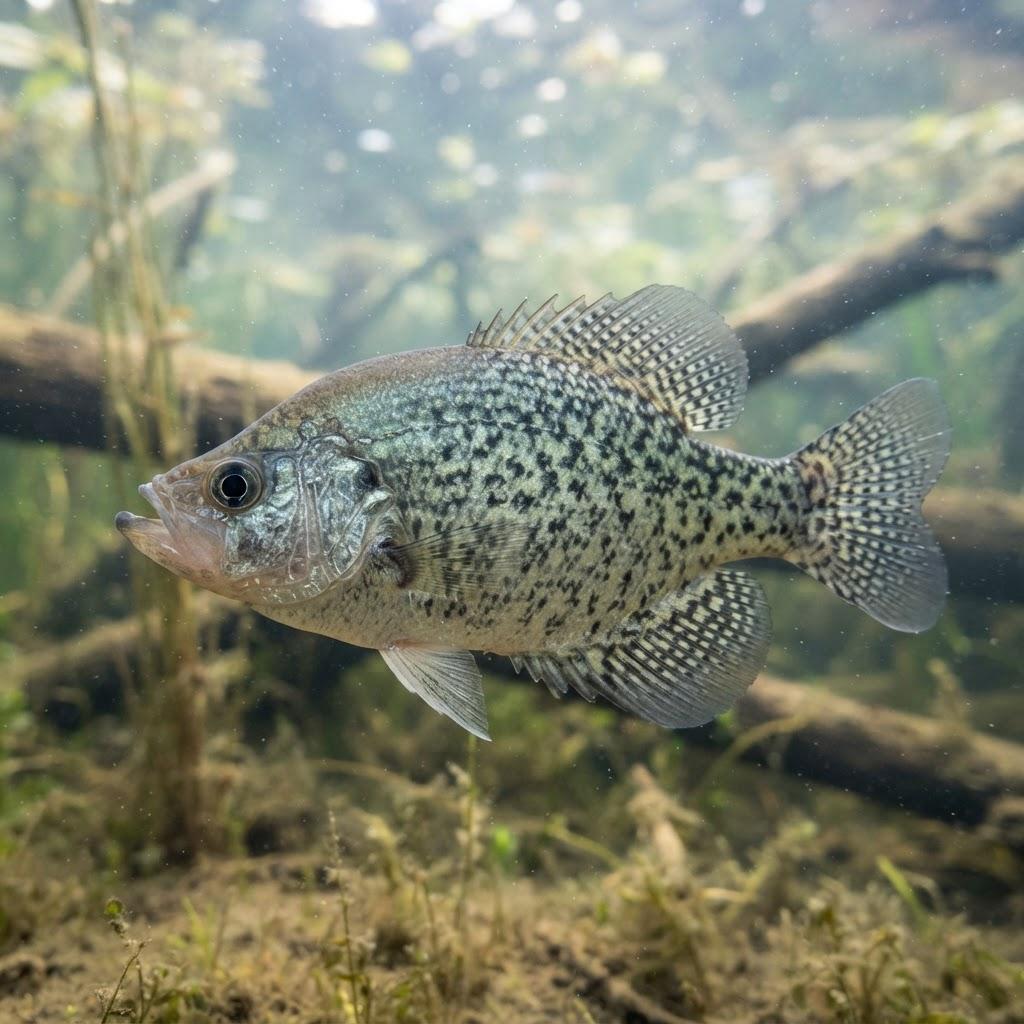
Pomoxis nigromaculatus
Black Crappie
Meet the Black Crappie, the dapper, polka-dotted socialite of the freshwater world. Part ninja, part party animal, this fish turns every weedy lake into its own high-stakes theater of snacks and romance.
Meet the Fish
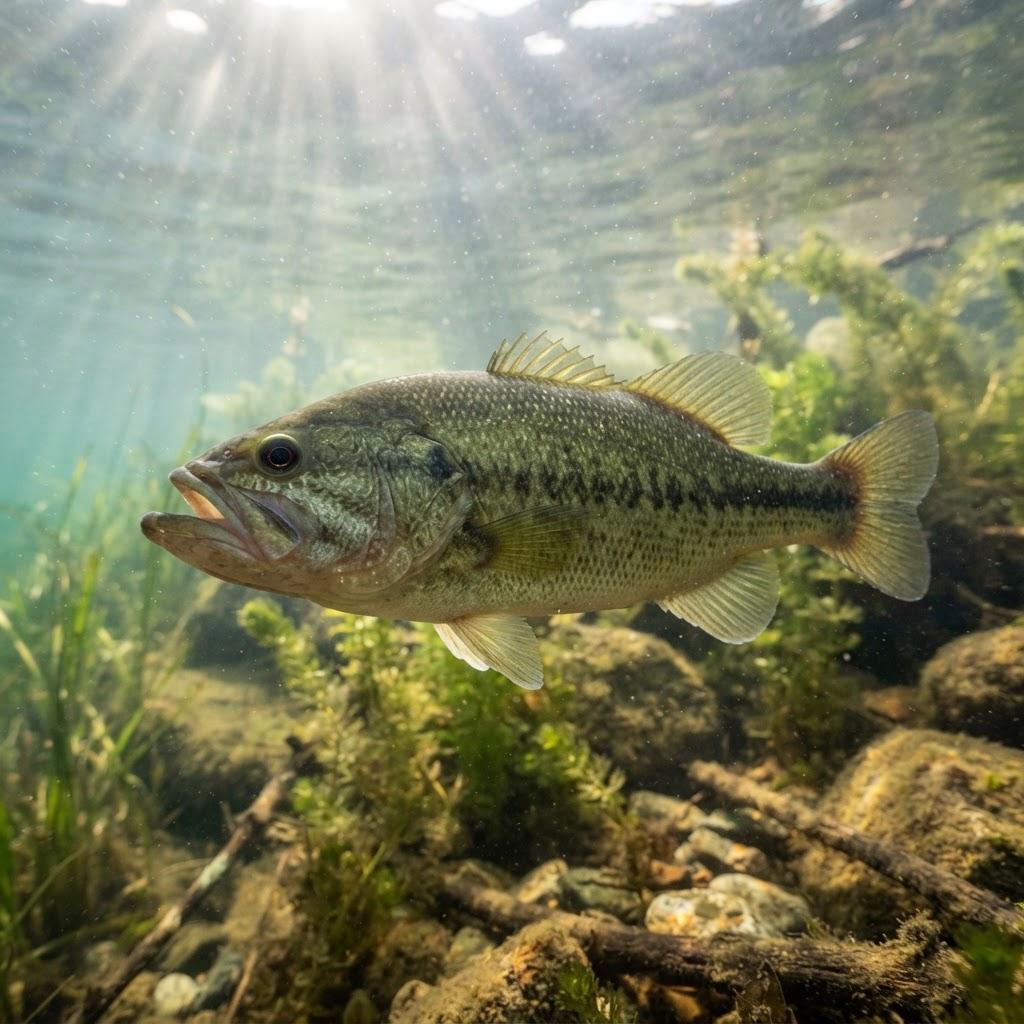
Imagine a fish that decided to go to a formal dinner party wearing a dress covered in dark, edgy charcoal spots. That is the Black Crappie. While its cousin, the White Crappie, looks like it just rolled out of bed with a few faint vertical stripes, the Black Crappie is dressed to the nines in an intricate mosaic pattern that makes it the best-dressed guest at any lily pad gathering. This fish is the quintessential introvert that occasionally explodes with bursts of speed that would make a drag racer jealous. It possesses a distinctively deep, pancake-like body shape that suggests it is constantly surprised by its own reflection in the water. With an upturned mouth that gives it a look of eternal curiosity—or perhaps disdain for the worm you just offered—this species is a master of hanging out in the shady parts of the neighborhood. It is not trying to be the biggest bully in the lake, nor is it the fastest swimmer, but it owns its space with a calm, deliberate charm that has earned it a cult following among anglers who appreciate a fish that knows how to pose for a camera.
Weird Biological Superpowers Explained Simply
If you look closely at a Black Crappie, you will notice eyes that seem far too large for its head. This isn't because it’s perpetually wide-eyed from shock, but because of a biological superpower called high-sensitivity vision. Crappies are practically the nocturnal commandos of the freshwater realm. Their eyes contain a tapetum lucidum, which is a fancy way of saying they have a built-in light-amplification system. Think of it like a cat’s eyes or a high-end camera sensor designed for low-light photography. While humans are stumbling around in the murky depths of a sunset-lit lake, the Black Crappie is seeing the world in high-definition 4K. This allows them to spot the tiniest insect larvae or baby minnows in conditions where other fish are effectively blind. It’s like having a permanent pair of top-tier night-vision goggles fused directly into your skull. This adaptation makes them incredibly lethal hunters during the twilight hours when prey feels safe and exposed, unaware that they are being watched by a very hungry, very observant polka-dotted ghost.
Absurd Self-Defense Mechanisms
When a predator like a Northern Pike or a massive bass decides that a Black Crappie looks like a tasty afternoon snack, the Crappie doesn't just give up. It deploys the 'Spiky Surprise.' The Black Crappie is armed with a series of dorsal fin spines that act like a collection of tiny, sharp umbrellas that won't close. When threatened, the fish flares its fins out wide, turning itself from a manageable, bite-sized pancake into a prickly, geometry-defying nightmare that is incredibly difficult to swallow. It’s the aquatic equivalent of trying to eat a succulent that has suddenly decided to sprout sewing needles. Furthermore, they are masters of the 'flick-and-fade.' They don't run away in a straight line; they use their laterally compressed body—which means they are very flat from side to side—to pivot on a dime, vanishing into the tangled mess of weeds where a larger, blunter predator cannot follow. It’s a classic case of using shape and posture to turn a death sentence into a mild annoyance for the bully on the block.
Fish Drama and Gossip
Life in the weeds is basically a never-ending soap opera where the stakes are always high and the cast is constantly shifting. The Black Crappie is a schooling fish, which means it participates in the fish version of a high-school cafeteria social structure. There is constant jostling for the best position in the school—the 'cool kids' get the prime spots with the best view and the easiest access to food, while the younger or less experienced fish hover on the periphery, watching for snacks and predators. Territorial disputes are common, but they are rarely the knock-down-drag-out fights seen in other species. Instead, it’s all about intimidation: flashing scales, flaring fins, and the 'stare-down.' If a stranger enters a particularly lush patch of weeds, the local resident will puff out its chest, fan its fins, and essentially demand, 'Do you even go here?' It is a subtle, polite, yet deeply intense social dance where reputation and space are the ultimate currencies, and every fish is fighting for its slice of the lily-pad lifestyle.
The "Wait, That's Real?!" Deep-Sea Oddities
While the Black Crappie is a freshwater dweller, its cousins in the deep sea take the 'weird' factor to a galactic level. If the Black Crappie is a guy in a spotted sweater, deep-sea fish are creatures from a sci-fi blockbuster. Consider the Barreleye fish, which lives in the crushing dark of the midnight zone; it has a transparent, jelly-filled dome on its head through which you can literally see its tubular, glowing green eyes staring straight up. It’s like a living submarine with a cockpit you can look into. While our friend the Crappie uses its big eyes to hunt in the dim light of a local lake, deep-sea dwellers use bioluminescence—the ability to make their own neon light—to lure partners or blind enemies. The Black Crappie might not have a glowing lure hanging from its forehead, but it does live in a world of dark, submerged forests of vegetation that are just as alien to us as the deep-sea trenches are to the creatures that thrive in the light-starved abyss.
Myth Busting
There is a persistent myth that Black Crappie are 'dull' fish that just drift aimlessly through the water, waiting to be caught. This couldn't be further from the truth. In reality, these fish are highly intelligent tactical thinkers. Another myth suggests that fish memory is only three seconds long, but research on the Sunfish family—to which the Crappie belongs—proves they are actually quite capable of remembering complex environments and recognizing the difference between a threat and a harmless obstacle over long periods. They are not mindless swimming machines. They map their environment, memorize where the best food sources hide throughout the day, and can even learn which areas are frequented by humans. They are the chess players of the freshwater world, constantly assessing risks and optimizing their foraging routes. If they were as stupid as folklore suggests, they wouldn't have survived as long as they have, and they certainly wouldn't be as notoriously tricky to lure as many disappointed anglers have discovered on a slow Sunday afternoon.
Humorous Historical Tales or Folklore
History has been somewhat unfair to the Black Crappie. For generations, they were considered 'panfish,' which essentially meant that anything you caught that was small enough to fit in a frying pan was deemed a 'panfish' regardless of its actual species. It was the participation trophy of the angling world. There are even tall tales in the American Midwest about the 'Ghost of the Weeds,' where early settlers claimed that if you saw a dark, spotted shadow flickering in the water, it was a bad omen for the harvest. These were likely just sightings of massive, old-growth Crappies that had managed to evade nets for years. In some regions, they were historically treated as the 'gentleman’s fish' because they were notoriously difficult to catch without finesse. If you managed to haul in a limit of these spotted beauties, it was a sign that you had mastered the patience of a saint. The lore surrounding them is less about sea monsters and more about the quiet, maddening thrill of outsmarting a fish that is clearly smarter than the person trying to hook it.
Underwater Love Stories and Bizarre Romances
When spring hits and the water temperature starts to climb, the Black Crappie transforms into a hopeless romantic. The male takes on a look that can only be described as 'intense.' His usually charcoal-spotted sides turn into a deep, velvety, almost coal-black hue. He’s essentially wearing his finest tuxedo, ready for the big dance. But the courtship isn't a ballroom waltz; it’s a high-pressure real estate acquisition. The male clears out a circular patch of sand or gravel, effectively buying a fixer-upper, and then begins to guard it with the passion of a billionaire defending his beachfront property. He will perform elaborate displays, fanning the water with his fins to create a gentle current that wafts pheromones toward any female passing by. It is a siren song of chemistry, hoping to attract a lady who appreciates a well-manicured nest. Once she arrives, they engage in a brief, frantic, and highly synchronized dance, circling the nest in a spiral that would make a ballet choreographer weep with joy.
Underwater Architecture and DIY Nesting
The construction skills of a male Black Crappie are frankly impressive given that he lacks thumbs. He spends days scouting for the perfect location—ideally in shallow water protected by thick stalks of weeds or submerged logs. Using his tail as a combination shovel and broom, he excavates a circular, saucer-shaped depression in the lake bottom. He meticulously removes pebbles and debris, ensuring the base of his nest is pristine and ready for eggs. It’s like watching an underwater interior designer prepare for a guest who is very particular about floor texture. Once the nest is ready, he isn't just waiting around; he’s maintaining the grounds, constantly patrolling the perimeter to chase away smaller, meddlesome fish who want a look at the renovations. The nest is a fortress, and the male is the foreman, the guard, and the proud property owner. This dedication to architectural perfection is what keeps the species thriving year after year, even in the face of busy lake traffic.
The Chaos of Raising Tiny Swimmers
After the romance and the nest construction, things get real very quickly. The female drops thousands of eggs into the freshly cleaned crater, and then—in a move that might seem negligent to humans—she essentially leaves the male to deal with the chaos. The male Black Crappie then becomes the 'Super-Dad' of the lake. He is stuck in the nest 24/7, guarding the eggs with a ferocity that defies his small stature. He fans the eggs constantly to make sure they get enough oxygen and stay free of silt, acting like a constant air-conditioning unit for his unborn children. When the fry finally hatch, they are tiny, transparent specks that look like swimming punctuation marks. For the first few days, he herds them like a frantic border collie, keeping them clustered together so they don't wander off into the mouths of hungry sunfish or beetles. It is a high-stress, low-sleep job that turns him into a shadow of his former self, but his commitment is the only thing standing between his offspring and a tragic, quick end.
How to Spot One & How It Is Doing
If you want to catch a glimpse of this polka-dotted legend, grab a pair of polarized sunglasses and head to a calm, clear lake with plenty of vegetation. Look for the 'dark patches' near lily pads or around fallen tree branches—that’s where they play hide-and-seek. Their charcoal-mottled skin acts as perfect camouflage, making them nearly invisible against the dappled light of the weeds. Conservation-wise, the Black Crappie is doing fantastic. They are not endangered; in fact, they are among the most resilient and adaptable fish in North American waters. They handle changes in water clarity and temperature with a shrug, though they do prefer their homes clean. You can help them by simply being a responsible visitor: pick up your fishing line (which is a massive death trap for all fish), keep your boats clean to prevent the spread of invasive plants, and respect the 'quiet zones' where they raise their young. By looking after their neighborhood, you ensure that these dapper, spotted acrobats keep swimming for generations to come.