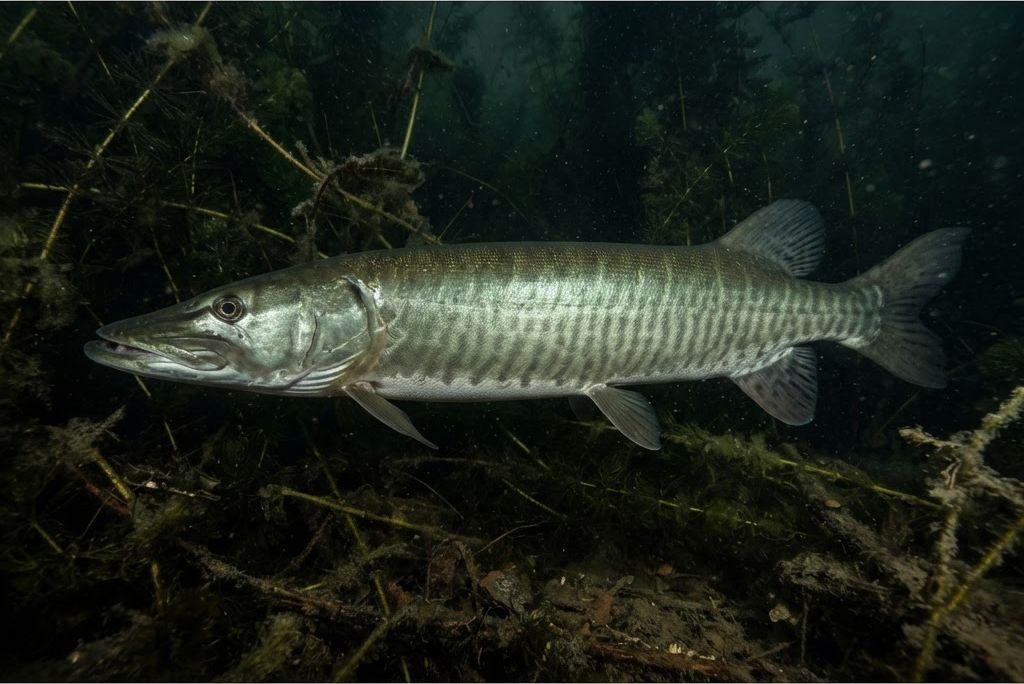
Esox masquinongy
Muskie (Muskellunge)
Meet the Muskellunge, the undisputed heavyweight champion of freshwater lakes and the piscine equivalent of a hungry, armored torpedo. With a grin that would make a shark nervous, this toothy legend is the ultimate catch for those who like their nature with a side of adrenaline.
Meet the Fish
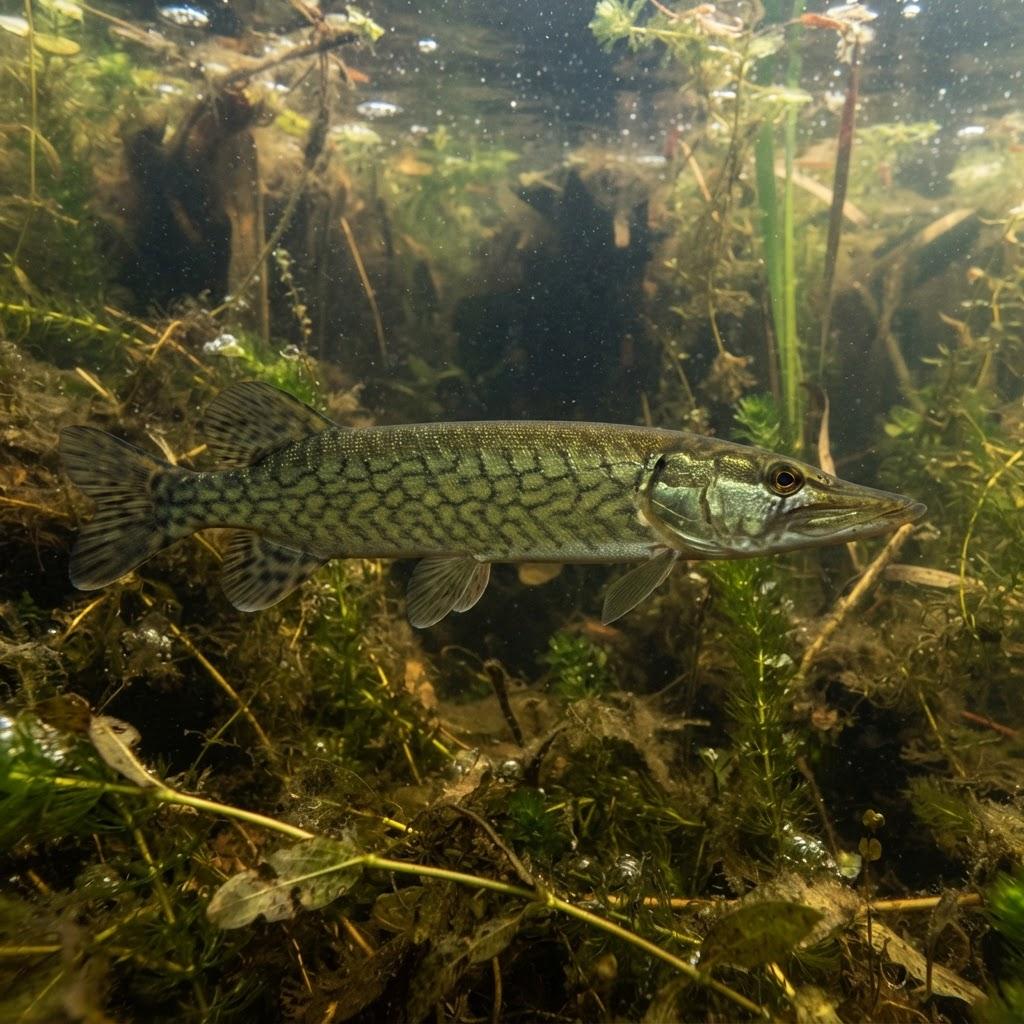
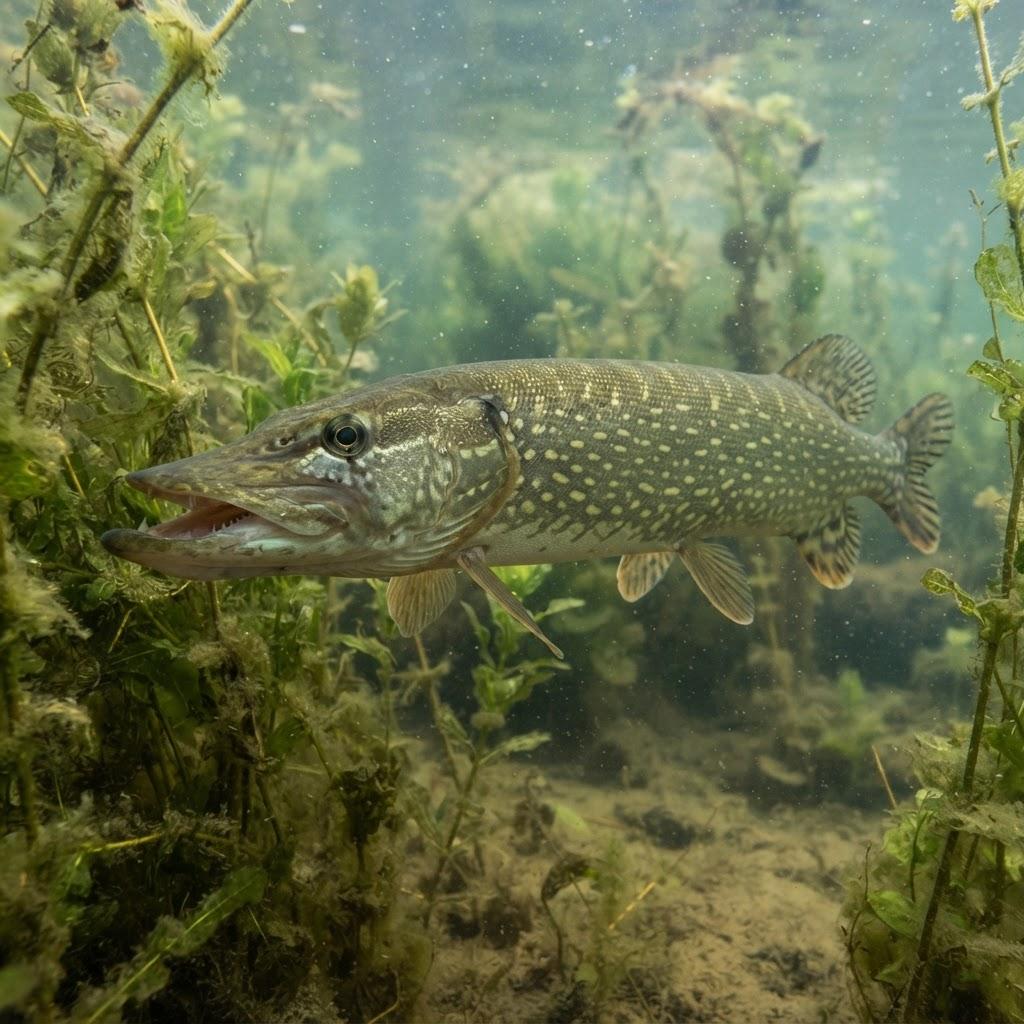
Picture a sleek, olive-green submarine with a face only a mother—or a very dedicated angler—could love. The Muskellunge, or Muskie, isn't just a fish; it is the apex predator of the freshwater world, acting like the moody, brooding lead character in an underwater noir film. This fish doesn't just swim; it prowls with a lazy, menacing grace that suggests it knows exactly where you are and is probably judging your choice of boat paint. Stretching upwards of six feet, the Muskie is essentially a muscle-bound stick of dynamite shaped like a torpedo. Its jaw is a masterpiece of evolution, filled with enough razor-sharp, backward-pointing teeth to make a velcro strip look tame. It sits perfectly still in the shadows, looking like a discarded log until the exact moment a hapless bait fish wanders by, at which point it transforms into a blur of speed and aggression. While most fish are perfectly content minding their own business, the Muskie treats the entire lake like its own personal fiefdom, acting as the neighborhood bully that everyone else is secretly afraid of. You do not just run into a Muskie; you have an encounter, usually involving a sudden splash and a frantic heart rate.
Weird Biological Superpowers Explained Simply
If nature had a superhero casting call, the Muskie would show up with its lateral line system turned up to eleven. Imagine having a built-in sonar, GPS, and motion detector combo running along your sides like a specialized sensory racing stripe. This lateral line consists of a series of tiny, fluid-filled canals just under the skin, packed with microscopic hair cells that react to even the tiniest vibration or pressure wave in the water. A Muskie could feel a minnow sneezing three yards away. It is essentially cheating at life. When you combine this 'spidey-sense' with the fish's ability to maintain neutral buoyancy through its swim bladder, you get an organism that can suspend itself in the water column like a ghost, waiting for the perfect millisecond to lunge. Their eyes are also positioned to provide a near-panoramic view, meaning they are constantly scanning for movement in every direction. They don't need to hunt like a search party; they are built to detect energy, vibration, and light shifts, effectively making them a sentient, living radar dish that also happens to be covered in very sharp teeth.
Absurd Self-Defense Mechanisms
The Muskie doesn't really have a 'flee' mode. Its primary defense mechanism is basically the fishy equivalent of a bouncer at a club who tells you to keep walking. Because they are the top predators in their ecosystem, they don't have to worry about becoming a snack for much of anything, provided they reach adulthood without becoming a smaller fish's lunch. However, when they are young and vulnerable, they utilize the ultimate stealth technology: camouflage. Their bodies are marked with vertical dark bars or spots that act as a 'disruptive coloration' suit, perfectly mimicking the interplay of light and shadow filtering through the reeds and lily pads. If a potential threat approaches, the Muskie doesn't puff up or slime out; it simply ceases to exist visually. They can melt into the background so effectively that you could be looking directly at one and still fail to notice until it darts away. It is less of a defensive maneuver and more of a 'you cannot find what you cannot distinguish from a pile of lake weeds' strategy that has served them remarkably well for millions of years.
Fish Drama and Gossip
Welcome to the real-world equivalent of a high-stakes high school drama, where the Muskie is the captain of the football team who refuses to share the bench. Muskie are notoriously solitary and territorial, acting as if they own every square inch of the prime hunting grounds. If another Muskie dares to venture into their designated weed bed, you can expect an icy stare-down followed by a very fast eviction notice. They aren't interested in social media or communal hangouts; they value personal space above all else. During the breeding season, this territorial behavior shifts from cold, detached disdain to absolute chaos. Imagine a party where the host invites everyone but is also fighting everyone at the same time. The 'gossip' among the local baitfish is that if you see a Muskie, you leave the area immediately, because their social policy is 'I am the only fish allowed here, and everyone else is lunch.' Their presence dictates the entire social structure of the lake, forcing other species to adapt their own schedules just to avoid bumping into the neighborhood titan.
The "Wait, That's Real?!" Deep-Sea Oddities
While our Muskie friend stays firmly in the shallows of freshwater lakes, it is fascinating to compare its predatory lifestyle to the absolute weirdos of the deep ocean. If a Muskie met a deep-sea anglerfish, it would likely be confused by the glowing fishing rod dangling from the angler's forehead. The deep sea is a place where light is a luxury and pressure is a weight that would turn a boat into a soda can. While the Muskie uses its lateral line to sense movement in clear, sunlit water, deep-sea creatures like the barreleye fish have evolved transparent heads to watch for silhouettes above them in total darkness. The Muskie’s strategy of 'sit and wait' is shared by many deep-sea predators that simply cannot afford to waste energy swimming around looking for snacks that might not exist. Both the Muskie and a deep-sea viperfish are essentially efficient, tooth-filled hunger machines, proving that no matter how strange or dark the environment, the formula for a successful predator remains remarkably consistent: have big teeth, stay quiet, and never pass up a free meal.
Myth Busting
Let’s address the elephant in the lake: the idea that Muskie are mindless monsters that will attack anything that moves, including swimming poodles or unsuspecting toes. This is pure, unadulterated nonsense. Muskies are actually incredibly picky eaters, which is why they are often called 'the fish of ten thousand casts.' If they were mindless gluttons, they would be easy to catch, but instead, they are notoriously difficult to trick. They have high standards for their dinner, and if your lure doesn't look, move, or vibrate exactly like a dying perch, they are going to ignore you with the same haughty indifference of a cat watching a laser pointer. Another myth is that they grow to monstrous, boat-sinking sizes capable of swallowing a small child. While they are big, they aren't mythological beasts from a horror movie. They are just highly adapted, apex predators living their best lives in the weeds, trying to avoid the giant, colorful plastic lures that keep showing up in their living room, which is actually a fairly annoying inconvenience for them.
Humorous Historical Tales or Folklore
History is littered with legends about the Muskie, mostly from anglers who have spent forty years trying to land a trophy and lost their minds in the process. In certain indigenous cultures and later among frontier settlers, the Muskie was often viewed with a mixture of reverence and superstitious fear. There are old tales of 'ghost Muskies' that haunt specific bays, fish that have supposedly lived for decades and grown wise enough to steal lures right off the line without ever getting hooked. It is essentially the aquatic version of the 'bigfoot' legend. Then there are the historical records of the early 20th century, where men would exaggerate the size of their catches so much that they claimed to have caught fish the size of canoes. These stories are a vital part of the Muskie’s legacy—not because they are factually accurate, but because they capture the immense psychological impact this fish has on anyone brave enough to hunt it. The legend of the Muskie is part fact, part obsession, and a whole lot of storytelling around the campfire.
Underwater Love Stories and Bizarre Romances
When it comes to courtship, the Muskie takes a 'strictly business' approach. There is no elaborate singing, no bright colors, and certainly no exchange of romantic gifts. It is essentially a high-speed, unceremonious affair. During the spring, when the water temperature hits that sweet spot, males and females congregate in the shallow, grassy areas. It is less of a date and more of a chaotic, splashing sprint through the aquatic vegetation. Multiple males will often shadow a single female, turning the whole event into a frantic, high-speed chase that looks like an underwater game of tag gone wrong. The female sheds her eggs, and the males immediately follow to fertilize them. It is fast, it is messy, and it is entirely focused on the survival of the next generation rather than any kind of romantic gesture. Once the business is concluded, they all go their separate ways, having zero interest in maintaining the relationship or helping with the chores. It is the ultimate 'no-strings-attached' aquatic hookup.
Underwater Architecture and DIY Nesting
If you are looking for complex architecture, you should probably check out the cichlids or the sticklebacks, because the Muskie is the definition of an 'as-is' renter. They do not build nests. They do not excavate sand castles. They do not spend hours arranging pebbles to show off their structural engineering skills. Instead, the female simply deposits her eggs over submerged vegetation, rocks, or gravel and says, 'Good luck with that.' It is the pinnacle of minimalist parenting. The eggs are sticky, which allows them to adhere to the weeds, effectively using the lake’s natural environment as an incubator. This strategy relies entirely on the 'scatter and hope' philosophy. By not building a nest, the Muskie avoids creating a permanent target that predators might learn to recognize. It is a brilliant, lazy adaptation that allows them to move on quickly and leaves the survival of the next generation to the power of pure, randomized probability. It isn't pretty, and it isn't complex, but it works, and in the wild, working is all that matters.
The Chaos of Raising Tiny Swimmers
The life of a baby Muskie—or 'fry'—is essentially a non-stop, high-stakes game of survival where the odds are stacked aggressively against them. From the moment they hatch, these tiny, translucent specks are on their own. They aren't coddled, they aren't fed, and they definitely aren't protected by a watchful parent. They have to start eating almost immediately, transitioning from a yolk sac to hunting microscopic water critters, and then eventually moving up the food chain to larger prey. It is an absolute gladiator match from day one. Most of them will get eaten by everything from dragonflies to other fish, including their own siblings if they aren't careful. It is a brutal existence, but the ones that do survive grow at an astronomical rate, transforming from a fragile sliver into a miniature, hungry, toothy version of their parents in record time. It is a chaotic, Darwinian scramble where only the fastest, smallest, and most aggressive make it to the next stage, but that is the cost of being born into the top-predator class.
How to Spot One & How It Is Doing
If you want to catch a glimpse of this freshwater titan, keep your eyes on the weed lines in clear, cool, northern lakes. You are looking for a long, shadowy silhouette that doesn't quite move like a log in the current. If you see the water boil near a shoreline, there is a good chance a Muskie has just made someone’s bad day. As for how they are doing, the good news is that the Muskie population is doing fairly well thanks to some very dedicated conservation efforts and smart catch-and-release practices. Many anglers now treat the Muskie with the respect a king deserves, ensuring these fish get back into the water quickly and safely. You can help by supporting clean water initiatives and respecting local fishing regulations, which are designed to keep these amazing animals thriving for generations to come. They are the pride of the lake, a reminder that wild, toothy wonders still exist, and they need us to keep their home clean and their habitats intact.