Coregonus artedi
Cisco (Lake Herring)
Meet the Cisco, the tuxedo-wearing socialite of the Great Lakes that keeps the whole ecosystem humming. This shiny silver speedster is more than just a snack for giants; it is an unsung hero of northern waters.
Meet the Fish
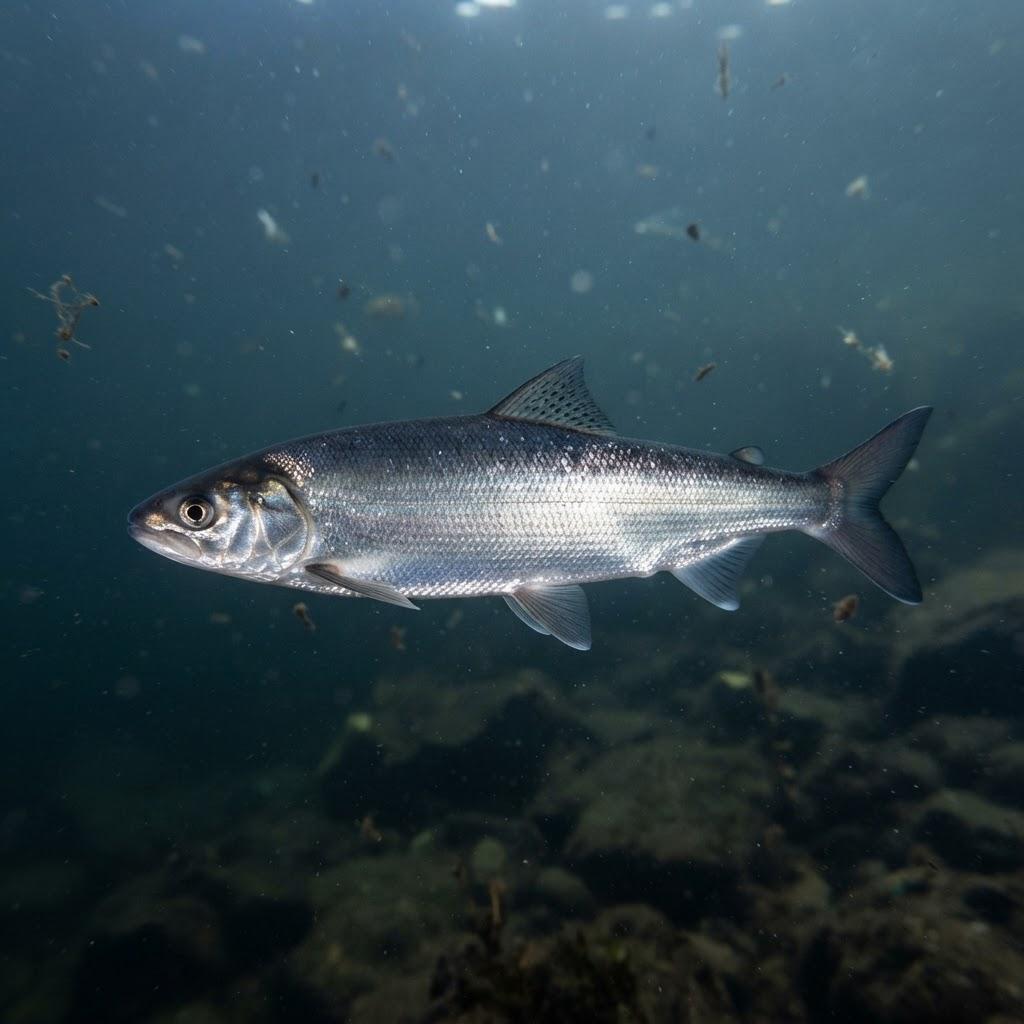
Imagine a fish that spent its entire life trying to look like it is heading to a high-stakes poker game in the deepest part of a northern lake. The Cisco, also known as the Lake Herring, is the silver-scaled dreamboat of the Salmonidae family. It carries a vibe of effortless cool, sporting a sleek, streamlined body that screams 'aerodynamic' if fish were airplanes. While it does not have the neon lights of a deep-sea rave or the terrifying teeth of a barracuda, the Cisco possesses an understated elegance. It is the guy in the room who doesn’t need to shout to get attention; it just shines with a metallic brilliance that makes every other fish look like they forgot to brush their scales. These fish are the ultimate middle-management professionals of the aquatic world, serving as the essential bridge between the tiniest plankton and the legendary predators like Lake Trout that would otherwise go hungry. They are fast, they are shimmering, and they definitely know they look good.
Weird Biological Superpowers Explained Simply
If you think being able to run fast is a superpower, you have clearly never tried to navigate the crushing physics of a cold, deep lake while chasing invisible snacks. The Cisco possesses a specialized organ called a swim bladder that acts like a built-in scuba buoyancy compensator. By adjusting the gas inside this sac, the Cisco can hover perfectly at any depth without wasting energy, almost like a drone stuck in mid-air. Even cooler is their lateral line, a sensory system running down their sides that functions like a sixth sense. It detects minute pressure changes in the water, allowing the Cisco to 'feel' the movement of a single crustacean drifting nearby in the pitch-black darkness. Think of it as having high-definition sonar built directly into your skin. While they aren't shooting lightning bolts, their ability to navigate turbulent, freezing currents with millimeter precision while maintaining perfect neutral buoyancy is a feat of engineering that would make any robotics expert weep with envy.
Absurd Self-Defense Mechanisms
In the world of the Great Lakes, being a Cisco is a lot like being a tasty slider at an all-you-can-eat buffet for bigger fish. Since they don't have poison barbs or the ability to inflate into a prickly beach ball, they rely on the classic, high-octane art of 'Don't Get Eaten, Bro.' Their primary defense is the tactical use of the school. By swimming in a hyper-coordinated swarm, they create a dizzying visual effect that makes it nearly impossible for a predator to lock onto a single target. It is essentially the fish equivalent of a human crowd running in random directions to confuse a pickpocket. Furthermore, their silver coloration provides countershading, a clever optical illusion where their dark backs blend into the deep water when viewed from above, and their bright bellies mimic the light-dappled surface when viewed from below. They are the masters of the vanishing act, playing a high-stakes game of hide-and-seek where the prize for losing is becoming lunch for a massive pike.
Fish Drama and Gossip
The social life of a Cisco is less of a quiet morning commute and more of a chaotic rush-hour traffic jam that never actually stops. These fish are intensely gregarious, which is a fancy way of saying they are obsessed with their social circles. There is constant, low-level competition for the best positions in the school, where the 'insiders' get first dibs on the freshest clouds of zooplankton, while the 'outsiders' have to settle for the leftovers. If a predator looms, the shift in the school is instantaneous, with thousands of fish twitching in unison like a living, breathing liquid curtain. It is essentially a high-speed, underwater mosh pit where maintaining your lane is literally a matter of life and death. There are no permanent leaders in this clique; the hierarchy is fluid, shifting based on who is hungriest and who is the quickest to react when a shadow appears from the murky depths of the abyss.
The "Wait, That's Real?!" Deep-Sea Oddities
While the Cisco is a freshwater resident, it lives in the 'twilight' depths of our northern lakes, which are the closest things to deep-sea environments we have on land. Deep-sea fish often look like they were designed by a team of cartoonists who only had access to glowing paint and spare parts. You have the Barreleye fish with its see-through head or the Anglerfish with its own personalized fishing rod light. The Cisco doesn't have the bioluminescence or the freaky transparent skull, but it shares the same commitment to a life of cold, dark solitude. Like its deep-sea counterparts, the Cisco is perfectly adapted to environments where humans wouldn't last five minutes. While they don't need a light show to lure in prey, they have mastered the art of living in a world of limited light, proving that you don't need to look like an alien to thrive in a place that feels completely out of this world.
Myth Busting
There is a persistent myth that fish like the Cisco are 'simple-minded' and operate entirely on a twitch-response basis, but this is pure fishy propaganda. Science has shown that fish are surprisingly capable learners. They can remember where the best food sources are located and even recognize individual members of their school, which is more than some people can do at a party. Another common misconception is that Lake Herring are just another version of the sea-dwelling herring you find in a tin can. Despite the name, they aren't even remotely related! One lives in the ocean, the other is a freshwater aficionado who wouldn't know what to do with a salt crystal if it hit them in the fin. Clearing up these rumors is important because it stops us from underestimating these sharp little navigators. They aren't just mindless swimming snacks; they are intelligent, specialized creatures that have perfectly adapted to the complicated life of the Great Lakes.
Humorous Historical Tales or Folklore
Historically, the Cisco was the backbone of the entire Great Lakes fishing industry, a local celebrity that paid the bills for generations of families. There are legends from early fur trappers about the 'silver clouds' in the lakes—massive schools so dense that they looked like shimmering oil slicks moving just below the surface. Some old-timers believed that if you caught a Cisco with a certain pattern on its scales, it was a harbinger of a harsh winter, a superstition that was probably just an excuse to stay inside and drink warm cider. They have been featured in tall tales of giant, lake-dwelling monsters who supposedly grew so large by feasting exclusively on these silver beauties. While no sea serpents were ever officially invited to tea, the Cisco remains a cultural icon, representing the cold, clear heart of the north and a time when the lakes were so abundant you could practically scoop dinner out of the water with a bucket.
Underwater Love Stories and Bizarre Romances
When the water turns crisp and the leaves begin to drop, the Cisco switches gears from 'cool loner' to 'determined romantic.' The dating ritual for these fish is a high-energy scramble that takes place in the dark, cold autumn nights. There is no elaborate singing or gift-giving here; it is all about the speed and the synchronized swim. Groups of Cisco gather together, performing a frantic, swirling dance near the lake bottom. It’s a bit like a mosh pit, but instead of bumping into each other, they are trying to coordinate the release of eggs and milt—the fishy version of pollen—into the water column. The sheer chaos of thousands of fish doing this at once creates a blizzard of life. It’s a messy, high-stakes, and surprisingly romantic way to ensure that the next generation of silver speedsters has a fighting chance to make it into the following spring.
Underwater Architecture and DIY Nesting
You might expect a fish to build a fancy condo, but the Cisco is a minimalist who prefers the 'scenic route' approach. They don’t build nests, dig tunnels, or arrange pebbles into artistic patterns to impress a partner. Instead, they are master strategists of the scatter-and-settle method. They choose specific areas of the lake floor—usually rocky or sandy shoals—that are swept clean by deep-water currents. By releasing their eggs over these patches, they let the natural flow of the water tuck the tiny, sticky eggs into the crevices of the rocks, far away from the prying eyes of egg-eating predators. It is an evolutionary version of 'set it and forget it.' They rely on the architecture of the lake bed itself to serve as a natural nursery, proving that sometimes the best home improvement project is simply finding a good location and letting nature do all the heavy lifting for you.
The Chaos of Raising Tiny Swimmers
Once the eggs hit the gravel, the parents are officially done with their child-rearing responsibilities. There is no hovering, no goldfish-style coaching, and definitely no 'fishy-parent' support groups. The eggs have to survive on their own, tucked away in the rocks until they hatch into tiny, transparent fry that look like translucent noodles with eyes. These babies immediately have to learn how to swim, feed, and avoid becoming a snack for literally every other predator in the lake. The sheer survival rate for these little swimmers is a mathematical miracle, as thousands of eggs produce only a handful of adults. It is the ultimate underwater boot camp. While it sounds harsh, it ensures that only the swiftest and smartest Cisco make it to adulthood. It is a world where being born is just the first, and most difficult, task on a very long list of survival to-dos.
How to Spot One & How It Is Doing
If you are lucky enough to be on the Great Lakes with a decent pair of polarized glasses, you might spot a flash of silver darting near the surface. To identify a Cisco, look for that signature deeply forked tail, a small adipose fin on their back, and a lower jaw that protrudes just a bit more than the top one, giving them a perpetually surprised look. They are currently doing okay, though they face challenges from invasive species that try to steal their food, like the pesky zebra mussels that make the water too clear and disrupt the plankton blooms. To help out, the best thing you can do is support local watershed cleanup efforts and be mindful of what you introduce into our lakes. We don’t want to lose these shiny, silver speedsters. Keeping our waters clean and cool is the best way to ensure the Cisco keeps dancing in the deep, maintaining the rhythm of the lakes for generations to come.