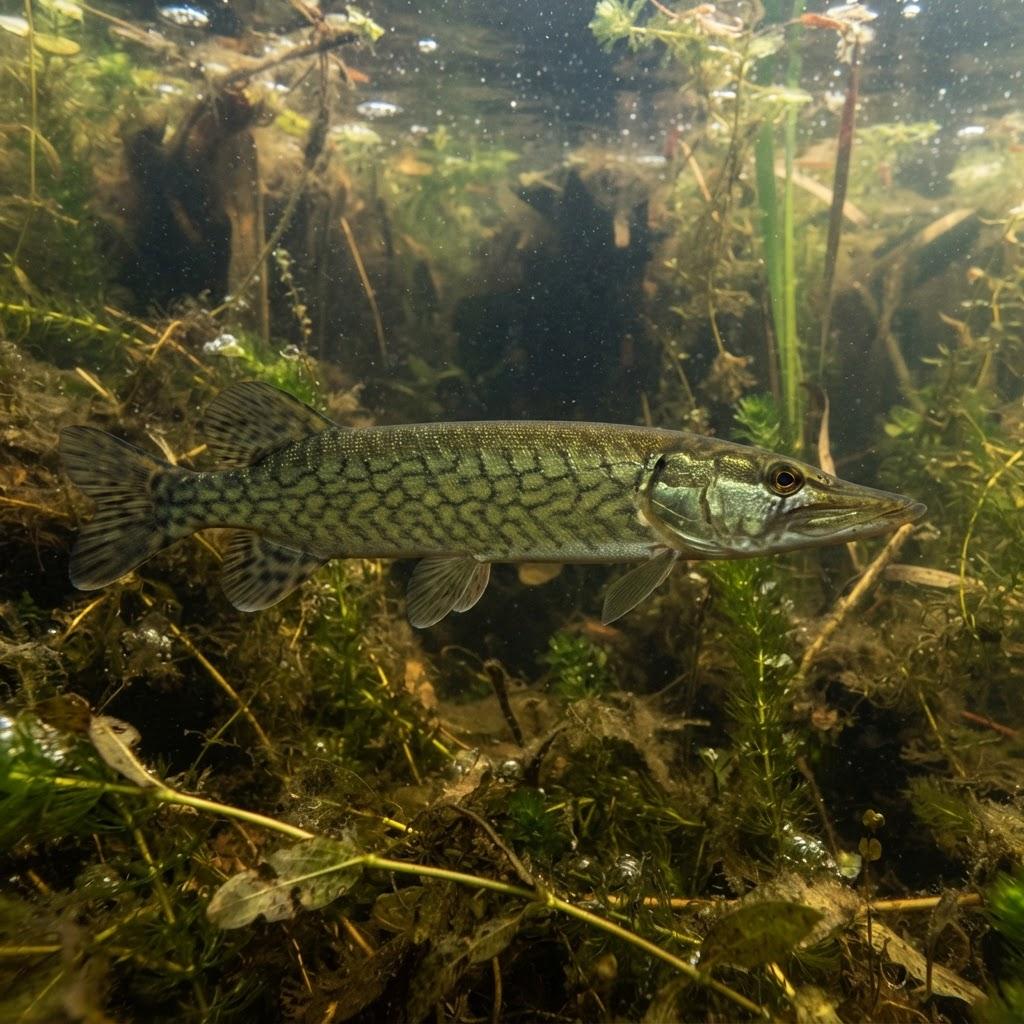
Esox niger
Chain Pickerel
Meet the Chain Pickerel, the underwater equivalent of a grumpy woodland ninja with a fashion sense that screams 'stealth chic.' This ambush predator turns the average freshwater pond into its own personal, high-stakes game of hide-and-seek.
Meet the Fish
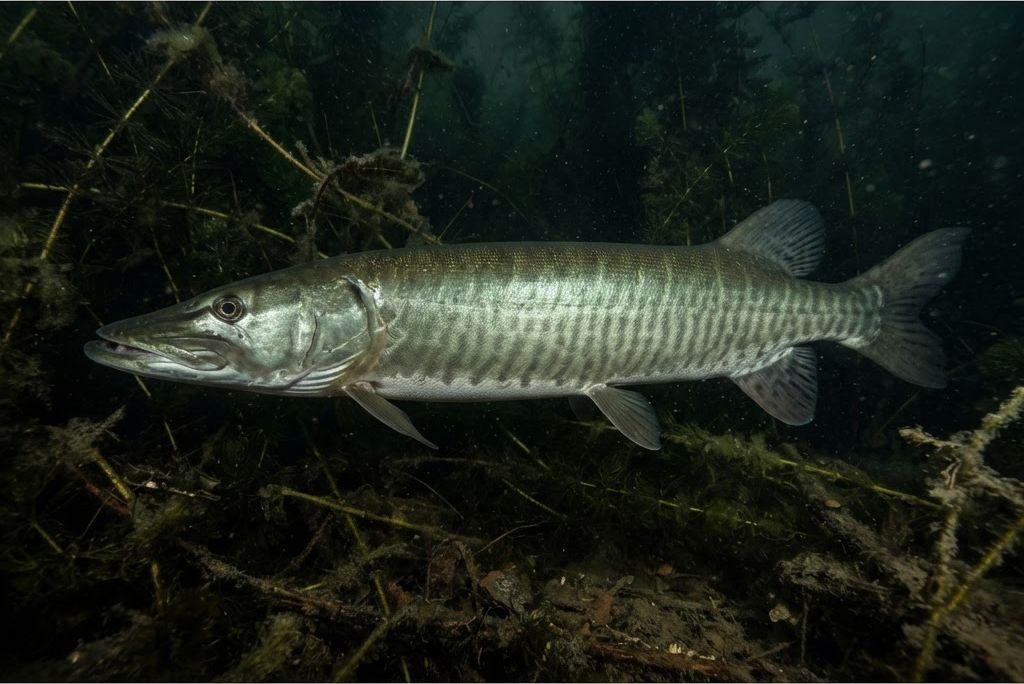
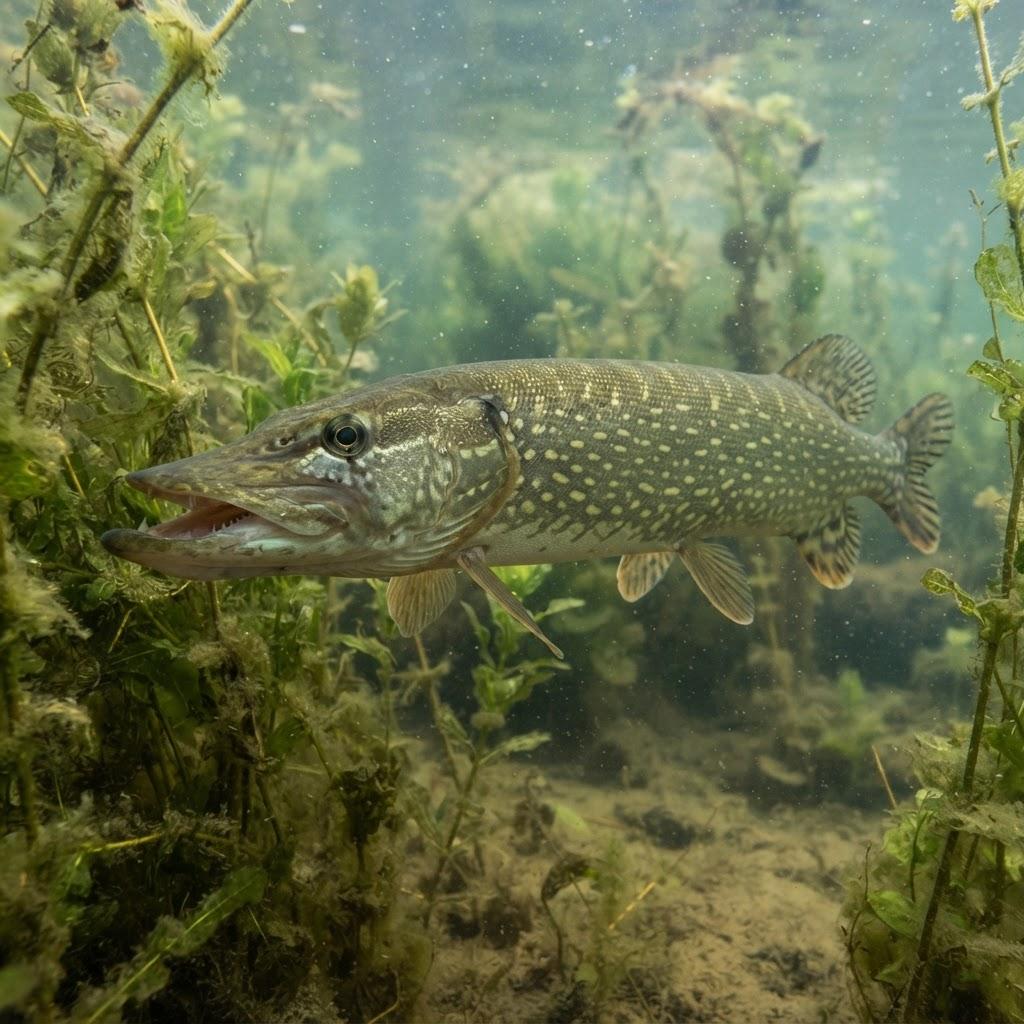
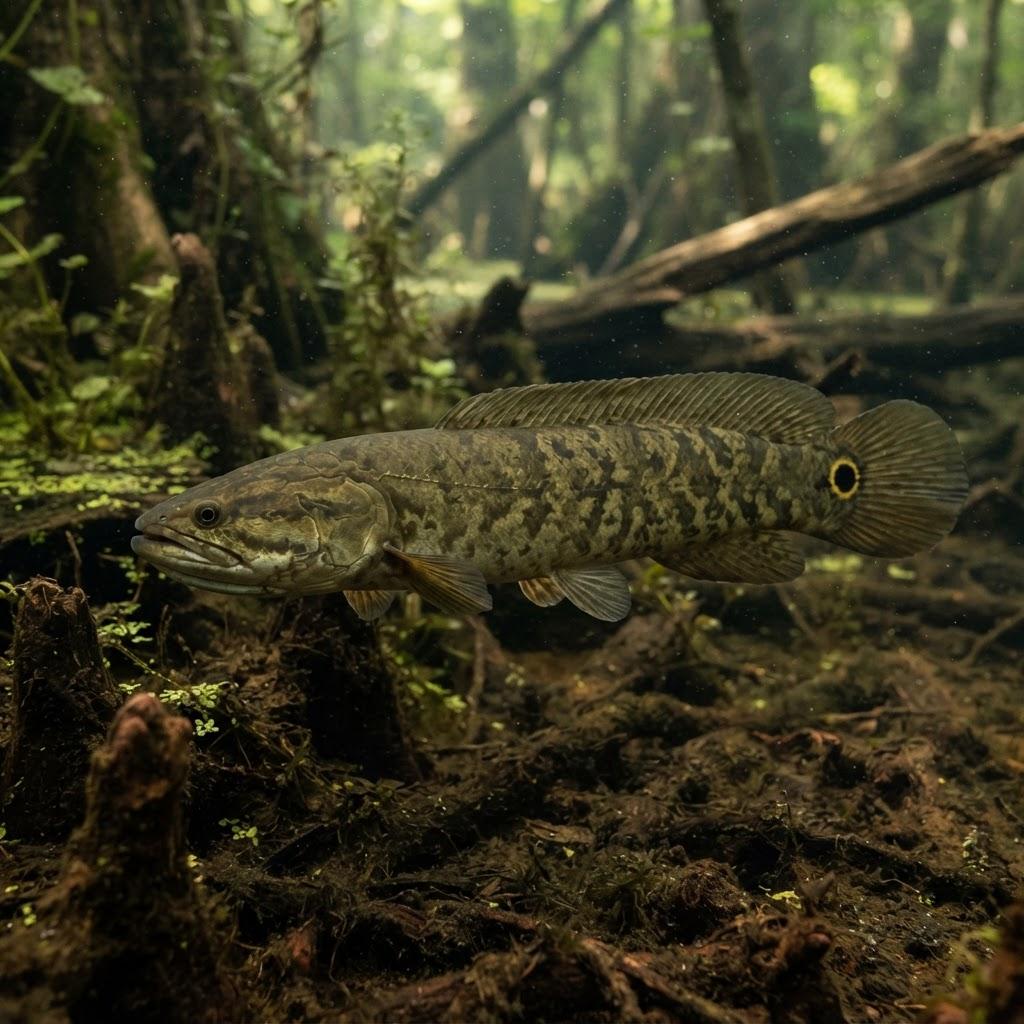
If you were to walk into a high school cafeteria, the Chain Pickerel would definitely be the kid sitting alone in the corner, wearing a long trench coat, intensely watching everyone pass by. This fish is the ultimate stealthy grump of the freshwater world. It has a long, lean, aerodynamic body that looks like someone stretched a torpedo out in a taffy puller. Its signature look is a cool, dark, chain-link pattern running down its sides, which acts as the perfect camouflage when it is hanging out near underwater weeds. This isn't a fish that goes out looking for a fight; it is the fish that waits for the fight to come to it, then ends it in a nanosecond. It is a member of the pike family, so it has that classic 'don't talk to me until I have had my coffee' expression, mostly because its mouth is permanently lined with rows of razor-sharp teeth that seem designed specifically for grabbing snacks. It is not trying to be the most popular fish in the lake, it is just trying to be the most efficient predator, and it plays that role with a level of commitment that is almost impressive.
Weird Biological Superpowers Explained Simply
The Chain Pickerel has a superpower that makes it the aquatic king of the jump-scare. It has a specialized sensory system running down the sides of its body called the lateral line, which is basically a high-definition radar for movement. Think of it like a cat's whiskers, but for sensing water pressure vibrations. This allows the pickerel to 'feel' a tiny minnow swimming five feet away, even if it is pitch black out. When it spots a target, it uses a rapid-fire acceleration system based on its powerful, muscular tail. It can go from zero to 'total destruction' in a split second. This is called burst speed, and it works by snapping the entire body into a tight 'S' shape and then launching forward like a coiled spring released at once. It also has something called a swim bladder that acts like a buoyancy tank, letting it stay perfectly motionless in the water column without sinking or floating up, essentially allowing it to hover in place like an underwater drone waiting to strike.
Absurd Self-Defense Mechanisms
When you look like a walking set of kitchen knives, you don't really have to worry about being bullied, but the Chain Pickerel still keeps some tricks up its sleeve. Its primary defense mechanism is the most effective one in the wild: invisibility. That signature chain-link pattern isn't just for style; it breaks up the fish's silhouette when it is tucked into a patch of lily pads or submerged logs, making it look like just another piece of shadow or tangled roots. If a bigger predator—like a giant bass or an otter—does come sniffing around, the pickerel doesn't run away blindly. It utilizes a 'flick and vanish' technique. It performs a sudden, jarring burst of speed that creates a small cloud of silt and debris. By the time the predator clears its eyes, the pickerel has already bolted into the nearest thicket of weeds, effectively teleporting out of sight. It relies on the environment to protect it, acting like a ninja who knows exactly where all the trapdoors are in the forest.
Fish Drama and Gossip
The social life of a Chain Pickerel is essentially nonexistent, and honestly, they prefer it that way. These fish are the ultimate loners of the freshwater scene. In the underwater soap opera, the pickerel is the character who hates parties and would rather spend a Friday night reorganizing its collection of rocks. Because they are territorial, they don't do much in the way of 'hanging out.' If two adult pickerels bump into each other, it isn't a friendly hello; it is a tense standoff that looks like a western movie where the music stops and the tumbleweed rolls by. They hold their ground with a stoic silence, their fins slightly flared in a 'back off, pal' gesture. There is no complex hierarchy here because everyone is too busy guarding their own patch of prime hunting real estate. They are the antisocial hermits of the lake, living by the motto that if you are close enough to touch another fish, you are either a threat or a snack, and they have zero interest in either.
The "Wait, That's Real?!" Deep-Sea Oddities
While the Chain Pickerel lives in shallow, sun-dappled creeks and ponds, its distant cousins in the deep sea would make the pickerel look like a house cat compared to a dragon. The deep sea is a place where sunshine goes to die, and the fish there have evolved to look like they were designed by a late-night horror movie prop department. While our pickerel relies on its eyes and lateral line in the shallows, deep-sea fish are out there glowing in the dark with chemical light shows called bioluminescence. Some of them have dangling lures that look like fishing rods to trick prey, and others have jaws that can unhinge to swallow things twice their size. If you took a Chain Pickerel and dropped it into the midnight zone, it would be hopelessly lost without its favorite patch of weeds. The pickerel is perfectly adapted to the light, using the shadows of plants to hide, whereas the deep-sea monsters have had to learn how to manufacture their own light just to survive the eternal, crushing darkness of the abyss.
Myth Busting
There is a persistent myth that Chain Pickerel are 'garbage fish' that ruin the ecosystem by eating everything in sight. People love to cast them as the villains of the lake because they aren't as 'sporty' or 'flashy' as a trophy bass. But let’s set the record straight: they are a critical part of the cleanup crew. By eating sick or slow-moving prey, they keep the population of other fish healthy and prevent over-crowding. Another myth is that they are mindless biting machines. In reality, they are surprisingly picky eaters. They have a sophisticated way of selecting prey based on size and energy, and they won't waste their precious energy chasing a snack that isn't worth the effort. They aren't the mindless zombies of the pond; they are the shrewd, calculating managers of the local aquatic economy, keeping the population of smaller, more aggressive species in check so that the entire system stays balanced and healthy for everyone else.
Humorous Historical Tales or Folklore
History has always been a little suspicious of anything with as many teeth as a Chain Pickerel. In some old folklore of the American Southeast, the pickerel was occasionally referred to as a 'pond serpent' or a 'jack,' with tall tales suggesting that these fish could grow large enough to drag a small dog under the water. Of course, that is pure fish-story nonsense, but it highlights how intimidating that jagged, toothy grin can look to a person standing on the bank. There are also legends about how the pickerel’s chain markings were created when a giant spirit of the lake painted them onto the fish using a necklace made of silver links. It is the kind of whimsical storytelling that makes sense when you see a pickerel shimmering in the light of a sunset. People have always looked at the pickerel and projected their own fears and fascinations onto it, treating it like a miniature version of the monsters that lurk in the dark corners of human imagination.
Underwater Love Stories and Bizarre Romances
Dating for a Chain Pickerel is a cold, calculated affair that lacks all the romance of a Hollywood movie. There are no candlelit dinners or long, moonlit walks along the riverbed. Instead, when spring rolls around, the male pickerel finds a female and the 'dance' begins. It is less like a ballroom dance and more like a high-speed chase through an obstacle course. The male will swim alongside the female, nudging her gently to encourage her to find a good spot in the weeds. Once they have found a suitable piece of vegetation, they release their eggs and milt—the fishy version of sperm—at the exact same time. It is a 'hit it and quit it' scenario; as soon as the eggs are fertilized, the parents swim away to find a snack, leaving the future generation to fend for themselves. It is the ultimate commitment-free relationship, focused entirely on the business of life rather than the sentimentality of romance.
Underwater Architecture and DIY Nesting
If you are looking for complex underwater castles or intricate nests, the Chain Pickerel will disappoint you. This fish is definitely not an architect; it is a minimalist. They don't build nests, they don't dig burrows, and they certainly don't paint the nursery. Instead, they look for the best 'fixer-upper' real estate in the lake: a healthy, dense patch of submerged aquatic vegetation. To a human, it just looks like a tangle of weeds, but to a pickerel, it is a high-security bunker. The female scatters her eggs across these plants, which are sticky enough to cling to the leaves. This protects the eggs from being washed away by the current and keeps them hidden from the roving eyes of hungry predators. It is a strategy of scattering, hoping that out of the hundreds of eggs laid, a few will manage to survive the gauntlet of the pond. It is not glamorous, but for a fish that just wants to get on with its day, it works perfectly.
The Chaos of Raising Tiny Swimmers
Parenting is not a concept the Chain Pickerel understands. Once those eggs are laid, the parents are completely checked out. The baby pickerel, known as fry, are basically born into a 'Lord of the Flies' situation. They hatch and have to immediately start swimming and hunting tiny microscopic organisms called zooplankton. From the moment they break out of their eggs, they are the smallest, tastiest morsels in the entire lake, targeted by everything from dragonflies to other fish. Most of the fry don't make it to adulthood, which is why the mother lays so many eggs. Those that do survive are the ones who learned to be fast, quiet, and antisocial before they were even an inch long. It is a brutal upbringing, but it ensures that only the craftiest, quickest fish make it to become the next generation of pond ninjas. They grow up fast, moving from tiny water-fleas to bigger insects and eventually, once they have enough size, to small fish.
How to Spot One & How It Is Doing
If you want to spot a Chain Pickerel, grab some polarized sunglasses—which cut through the glare of the water—and walk slowly along the edge of a pond where the water is calm and there are plenty of weeds. Look for a long, dark shape hovering motionless in the shadows. They are most active during the spring and fall when the water is a comfortable temperature. As for their status, the Chain Pickerel is doing just fine. They are listed as 'Least Concern' because they are tough, adaptable, and not particularly picky about their water quality. They are common, and they are here to stay. To help them out, just be a good steward of the water. Don't dump trash or chemicals into the local pond, and try to keep those native aquatic plants healthy. By protecting the weeds, you are protecting the secret hideouts of one of the coolest, grumpiest, and most fascinating ambush predators in the freshwater wild.