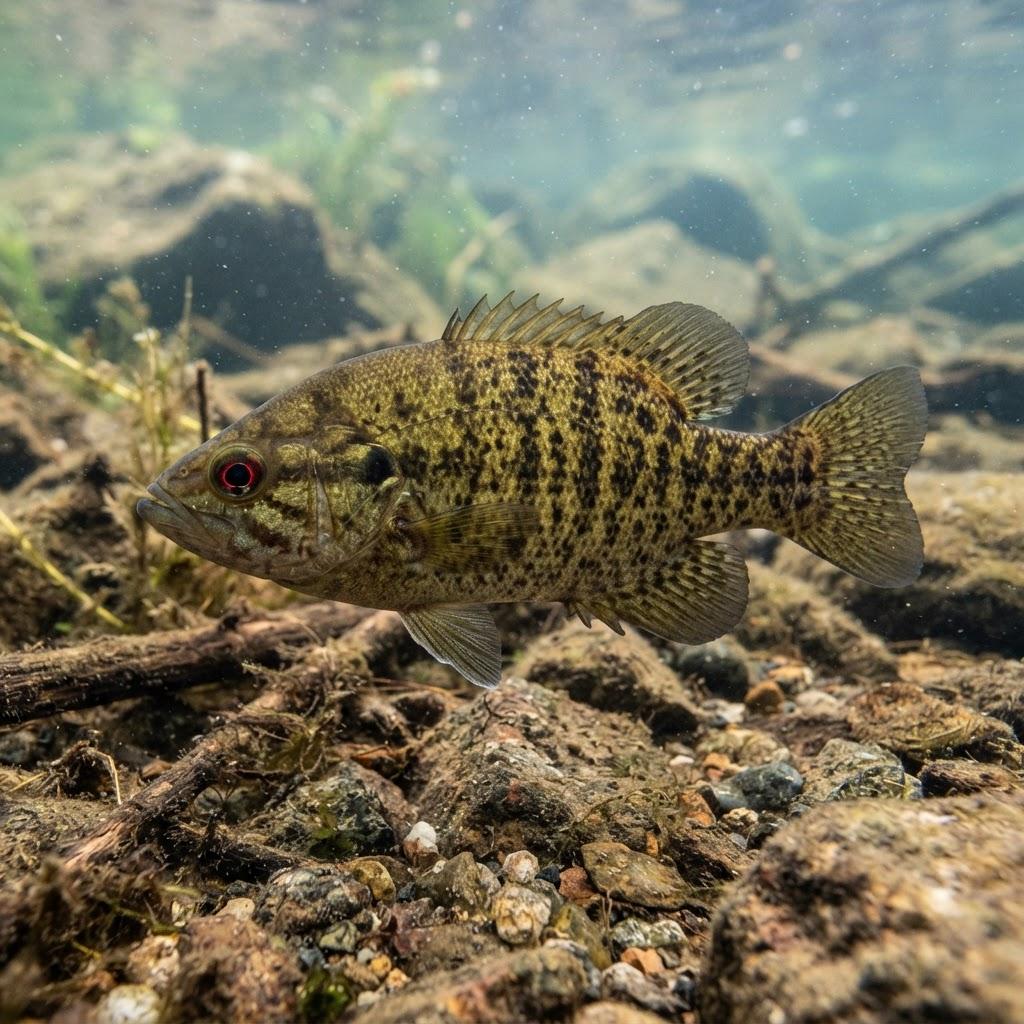
Ambloplites rupestris
Rock Bass
Meet the Rock Bass, the underwater equivalent of that grumpy uncle at the family barbecue who secretly loves everyone. This rocky-bottom specialist is a master of camouflage and a surprising powerhouse in the world of North American freshwater fish.
Meet the Fish
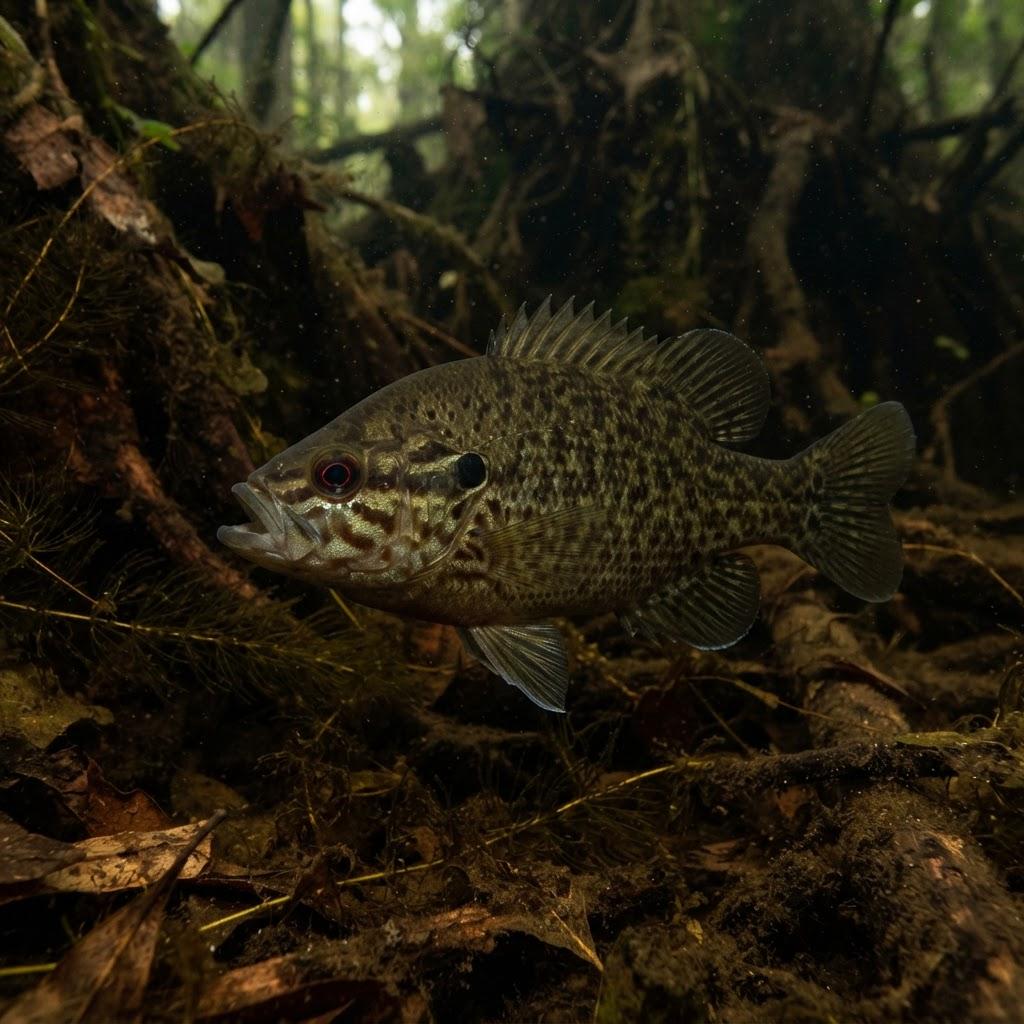
If the Rock Bass were a character in a high school movie, it would definitely be the brooding, slightly misunderstood kid who sits in the back of the library wearing a leather jacket. They aren't the biggest, splashiest, or most colorful fish in the lake, but they have a vibe that is pure, unadulterated coolness. With their bulging, ruby-red eyes that look like they’ve seen too many late-night horror movies and their mottled, armor-plated appearance, they look exactly like what their name suggests: a rock. These fish spend their days blending perfectly into the riverbed, waiting to strike with the precision of a ninja. They are the masters of the 'I was here the whole time' aesthetic. While the flashy Smallmouth Bass is out there performing acrobatics, the Rock Bass is chillin' by a boulder, keeping it real. They are the unsung, rugged heroes of the freshwater world, and once you start looking for those spooky red eyes, you will realize they are watching you from every corner of the creek.
Weird Biological Superpowers Explained Simply
The Rock Bass possesses a biological superpower that puts high-end camouflage tech to shame: chromatophore-controlled pigment shifting. Imagine if you could change your skin color to match your couch just by thinking about it—that is basically what this fish does. Their skin contains tiny, color-changing cells called chromatophores. By sending signals through their nervous system, they can expand or contract these cells to instantly change from a dark, brooding charcoal to a mottled, sandy brown. It is like having a living, breathing wardrobe that perfectly matches the local rock architecture. Beyond the fashion show, they have a specialized sensory system called a lateral line, which runs down their sides like a high-tech vibration sensor. This line detects the tiniest ripples in the water, allowing them to track prey in absolute darkness. It is essentially an organic sonar system that makes them feel the heartbeat of the river, ensuring they never miss a snack, even when the water is murkier than a teenager's bedroom.
Absurd Self-Defense Mechanisms
When a predator decides it wants a Rock Bass-themed snack, these fish don't just swim away; they turn into living, breathing pincushions. Their dorsal fin—the big sail on their back—is equipped with sharp, needle-like spines that they can snap into a locked, upright position the second they feel threatened. Think of it like a medieval knight suddenly raising a spiked shield. Any hungry pike or larger bass that tries to take a bite is going to get a mouth full of jagged, pointy regret. It is a brilliant, evolutionary 'do not touch' sign that works every single time. Beyond the hardware, they rely on their extreme 'rock-ness.' They are so adept at wedging themselves into tight crevices between stones that they become practically unmovable. Once a Rock Bass has jammed itself into a rocky crack, it is basically a permanent part of the geology. You aren't going to pull them out without a crane, and a predator isn't even going to try.
Fish Drama and Gossip
If there were a reality show titled 'The Real Housewives of the Riverbed,' the Rock Bass would be the stars of the drama. These fish are notoriously territorial. They aren't just sitting around; they are constantly patrolling their 'estate'—a patch of rock or submerged log that they consider their kingdom. If another Rock Bass wanders into their zone, the air—well, the water—instantly turns electric. They engage in a display of posturing that involves puffing out their gills, flaring their fins, and staring each other down with those intense red eyes. It is the fish version of a classic western standoff. There is constant bickering, brief chases, and endless boundary disputes. They take their personal space very seriously, and they won't hesitate to remind their neighbors exactly where the property line ends. It is a world of constant, low-stakes tension, where the biggest drama is someone deciding to hover three inches too close to your favorite flat stone.
The "Wait, That's Real?!" Deep-Sea Oddities
While our Rock Bass friend is a freshwater dweller, its distant cousins in the deep-sea abyss take 'weird' to an entirely different dimension. In the midnight zone, there is no sun, so many creatures have developed bioluminescence—essentially, they grow their own neon signs. Imagine a Rock Bass trying to survive in a place where the main entertainment is a glowing vampire squid doing a light show. In the deep sea, fish like the Barreleye have a transparent head that lets you look directly into their brain and eyes. It makes the Rock Bass look downright normal. The deep sea is an alien landscape where the pressure would crush a human like a soda can, and creatures live by different rules of physics. Compared to the glowing, gelatinous nightmares of the abyss, the Rock Bass is a sturdy, grounded, and refreshingly 'normal' citizen of the stream, proving that you don't need a light-up body to be an interesting character.
Myth Busting
For years, people have whispered that Rock Bass are 'dumb' fish that just sit around and wait to get caught, or that they are somehow harmful to other fish populations. Let's set the record straight: these fish are remarkably intelligent and highly observant. They have incredible memories, particularly when it comes to locating their home territory and recognizing the movement of their preferred snacks. There is also a persistent myth that they are 'trash fish' that shouldn't be eaten. This is absolute nonsense. They have firm, mild, and delicious white meat that would make any gourmet chef happy. The idea that they are an invasive nuisance is also frequently overblown; they are perfectly adapted native creatures that play a crucial role in their ecosystem by controlling populations of smaller minnows and crustaceans. They aren't the villains of the river; they are just efficient, savvy, and misunderstood survivors who have been unfairly judged by anglers who wanted to catch something flashier.
Humorous Historical Tales or Folklore
Throughout history, the Rock Bass has been the silent witness to the expansion of civilization across North America. Native American tribes recognized them as a steady, reliable food source, often praising their tenacity. There is a fun bit of frontier folklore suggesting that pioneers would use Rock Bass to predict the weather. If the bass were hiding deep in the rocks, the pioneers believed a storm was coming because the fish could feel the changes in barometric pressure. While the science might be a bit loose, it reflects the deep connection between humans and these sturdy little fish. There is even an old, tall tale from the 1800s about a 'Giant Rock Bass' in a Kentucky stream that supposedly grew to the size of a man. While that is clearly a fish story meant to entertain travelers at the tavern, it speaks to how the Rock Bass has captured the imagination of people for generations as the mysterious, watchful eyes peering out from beneath the riverbanks.
Underwater Love Stories and Bizarre Romances
When love is in the air—or rather, in the current—the Rock Bass doesn't mess around with romantic gestures. They believe in the power of the home. The male prepares the nest with the precision of a real estate mogul, clearing away silt and debris to create a perfect, clean-stone basin. Once the setup is complete, he waits for a female to approve of his construction work. If she likes the architecture, she deposits her eggs, and he immediately fertilizes them. It is a highly practical, no-nonsense courtship. There are no fancy underwater dances or neon-light displays; it is just, 'Hey, look at this clean pile of rocks I built for you.' If the female is impressed by his domestic skills, she stays long enough to complete the task and then often leaves the male to deal with the rest. It is a story of efficiency, commitment to property, and the ultimate test of whether your date appreciates a good home-improvement project.
Underwater Architecture and DIY Nesting
The construction abilities of the Rock Bass are truly something to behold. They are the Bob Vils of the stream bed. The male spends days working on his nest, using his tail to fan away loose sand and gravel until he hits solid, clean bedrock. This is a crucial task because the eggs need to stick to the rocks, not sink into the mud. He is essentially creating an underwater nursery that protects the offspring from being washed away or buried. He will even pick up small pebbles and move them to create a rim around the nest, acting as a defensive wall against wandering predators. It is an incredibly meticulous process. He doesn't just slap something together; he creates a fortified, clean, and safe environment that is designed to last. Watching a male Rock Bass work is like watching a construction site in miniature, where every single pebble is placed with a specific purpose in mind.
The Chaos of Raising Tiny Swimmers
Once the eggs are laid, the real work begins, and the male Rock Bass transforms into the ultimate overprotective parent. He becomes a full-time, round-the-clock bodyguard. He hovers over that nest, snapping at anyone—big or small—who dares to drift too close. It is a high-stakes, stressful environment. He refuses to leave, even if a giant human wading boot comes near, showing an impressive, if slightly foolish, amount of courage. The eggs hatch into tiny, vulnerable fry, and the dad remains in 'guard mode,' keeping the perimeter clear of curious critters. Eventually, the fry become free-swimming, and the chaos shifts into a frantic, tiny swarm. For a few days, it is like a cloud of energetic, microscopic bubbles that dart around in complete coordination. The dad finally steps back once the kids are big enough to hide in the rocks, but for those first few weeks, it is non-stop parental vigilance.
How to Spot One & How It Is Doing
If you want to spot a Rock Bass, your best bet is to find a clear, slow-moving stream with plenty of rocks. Bring some polarized sunglasses, which cut the glare on the water, and scan the areas near submerged boulders or fallen logs. Look for those tell-tale, deep ruby-red eyes peering back at you from the shadows. They are essentially the experts of 'staying hidden in plain sight.' Conservation-wise, the Rock Bass is doing fantastic. They are categorized as 'Least Concern' because they are tough, adaptable, and aren't overly picky about where they live. To help them continue to thrive, just practice good river stewardship: don't leave trash behind, avoid disturbing nest sites during the spring, and help keep local waterways clean. They are a resilient species, but they still appreciate a clean home. By simply enjoying the river responsibly, you are ensuring these grumpy-looking, red-eyed masters of camouflage can keep patrolling their rocky kingdoms for years to come.