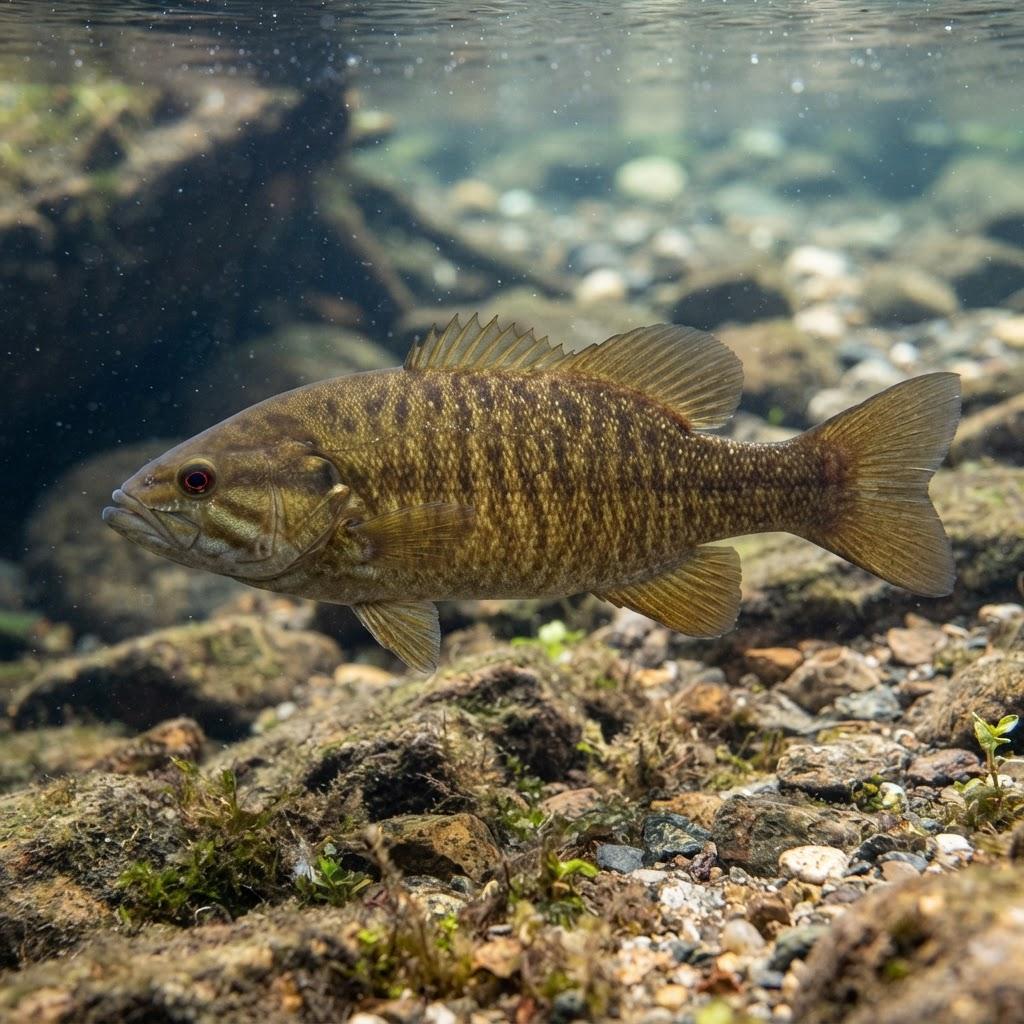
Micropterus dolomieu
Smallmouth Bass
Meet the Smallmouth Bass, the underwater world's most aggressive overachiever and pound-for-pound champion. This fish isn't just looking for a snack; it is looking for a wrestling match in every riffle and rock pile it calls home.
Meet the Fish
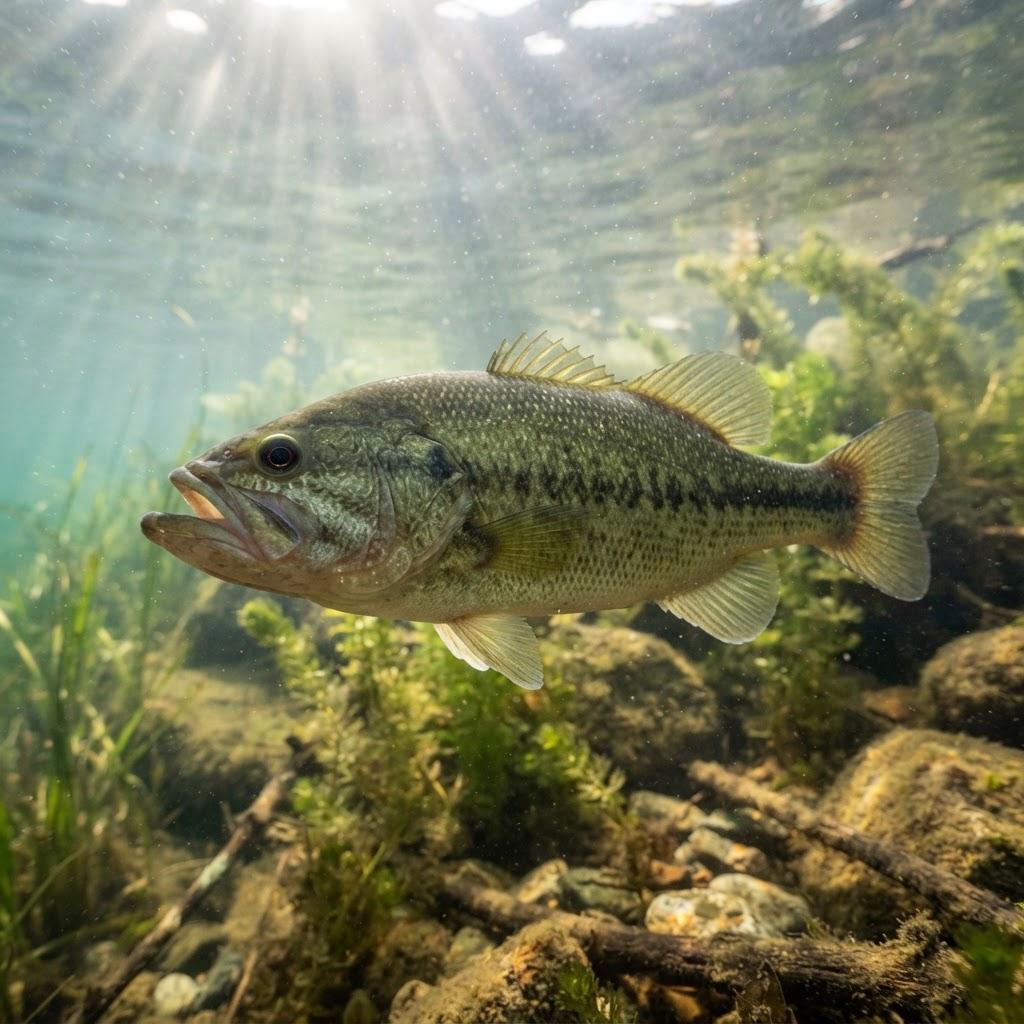
Picture a professional wrestler trapped in the body of a sleek, muscular, bronze-colored torpedo, and you have the Smallmouth Bass. If the largemouth bass is the suburban linebacker of the lake, the smallmouth is the high-energy, caffeinated martial artist who never stops moving. They do not just swim; they patrol their rocky domains with a swagger that says they own the place. Their bodies are painted in beautiful, vertical bronze tiger stripes that serve as the perfect camouflage against the jagged rocks they love to call home. When you hook one, it does not just swim away; it executes a series of aerial acrobatics that would make a trapeze artist jealous. They are the scrappy underdogs of the freshwater world, always ready to punch above their weight class. Whether it is darting through a rushing current or holding position in a quiet eddy, the smallmouth carries an aura of unbothered confidence that sets them apart from every other fish in the neighborhood.
Weird Biological Superpowers Explained Simply
The secret to the smallmouth’s success is its Lateral Line system, which acts like a built-in sonar and surveillance array. Think of this as a series of tiny sensors running along their sides that detect the faintest vibrations in the water. While humans use eyes to see, these fish literally 'feel' the world in high definition. They can sense the tiny wiggle of a crayfish tail from yards away, even in murky, churning water that would blind a human diver. This superpower is coupled with their incredible jaw mechanism. They possess a jaw structure that can project forward with the precision of a mechanical claw, allowing them to suck prey directly into their gullet before the target even realizes what happened. It is basically the aquatic version of a vacuum cleaner that is sentient, muscular, and has a personal vendetta against anything that moves. They process sensory input so fast that they can react to a strike in milliseconds, making them the ultimate quick-draw gunslingers of the creek.
Absurd Self-Defense Mechanisms
You might think a predator would have an easy time with a fish, but the Smallmouth Bass treats the concept of being eaten as a personal insult. When threatened, they don't hide; they deploy a combination of speed, armor, and pure attitude. Their spiny dorsal fins are effectively a wall of switchblades that they can lock into place the moment a predator tries to grab them. Trying to swallow a smallmouth is like trying to swallow a cactus that is actively fighting back. Furthermore, their skin is coated in a specialized mucus that isn't just slippery; it is essentially a biological bouncer. It makes them difficult to grip and helps prevent bacterial infections from the scrapes and bruises they acquire while constantly bumping into jagged rocks. They also utilize their environment as a weapon, darting into thick, sharp, or tangled cover that would shred the fins of any fish foolish enough to follow them. They are the masters of the 'not worth the trouble' defense strategy.
Fish Drama and Gossip
If you installed a security camera in a river eddy, you would be watching the highest-stakes soap opera on television. Smallmouth Bass are incredibly territorial, and they do not tolerate squatters. The local hierarchy is determined by size, attitude, and how long you have held your 'home' rock. You will often see males posturing—flaring their gills and turning dark to signal their dominance—before a full-on scrap erupts. It is essentially a high-school hallway brawl that lasts for years. They guard their favorite hunting grounds with a ferocity that would make a golden retriever guarding a bone look lazy. If a younger fish drifts into the wrong part of the pool, the neighborhood bully will launch a lightning-fast charge to remind them who runs the show. It is a world of constant brinkmanship where one wrong turn means you are being chased out of the best dining spot in the entire stream, forced to settle for a lower-quality rock in the shadows.
The "Wait, That's Real?!" Deep-Sea Oddities
While the Smallmouth Bass lives in the sun-drenched, oxygen-rich world of rivers, it is fun to look at their deep-sea cousins who live in the 'Twilight Zone' where sunlight goes to die. Deep-sea fish, like the fangtooth or the barreleye, have to be weird because their environment is so extreme. While the Smallmouth is built for speed and power, deep-sea fish are often built for efficiency, because finding a meal at 3,000 meters is rare. Some deep-sea fish have eyes that look upward like telescopes to catch the silhouette of prey above them, or they have glowing lures hanging off their faces to trick curious snacks. If a Smallmouth Bass were dropped into the abyss, it would be hopelessly out of its element. It doesn't need to glow in the dark or have transparent skin because its survival strategy is based on out-maneuvering prey in current, not waiting years for a piece of falling food in the silent, freezing dark.
Myth Busting
There is a long-standing myth among casual observers that fish are mindless automatons that react only to movement. If you spend any time observing a Smallmouth Bass, you will quickly realize that is absolute nonsense. These fish are actually quite clever, possessing a form of 'latent learning' that allows them to remember where the best food sources are located and even recognize the silhouettes of different predators. People often think they are just mindless eating machines, but they are actually very cautious. If a smallmouth is spooked by a loud splash or a shadow on the bank, it won't just swim away; it will often abandon that section of the river for the rest of the day. They are not mindless; they are highly observant, calculated, and distinctly suspicious of anything that looks out of place. The idea that they are 'dumb' is just an excuse for humans who haven't successfully outsmarted them yet.
Humorous Historical Tales or Folklore
Smallmouth Bass have played a surprisingly large role in the history of North American sport fishing. In the 19th century, they were considered the 'royal' fish of the frontier. Historical journals describe settlers and explorers being genuinely shocked by their fighting spirit. One famous 1800s account describes a group of weary pioneers catching a smallmouth in a rocky stream and being so amazed by its power that they supposedly gave it a 'warrior’s name' before releasing it back into the wild. Folklore around these fish often centers on their stubbornness—old-timers used to claim that if you didn't catch a smallmouth the first time it bit, it would go tell all its friends to avoid your lure. It is a testament to how iconic this species has become; they are so tough that they have earned the respect of generations of people who have spent their lives trying to match wits with them in the backcountry.
Underwater Love Stories and Bizarre Romances
When spring arrives, the Smallmouth Bass switches from 'aggressive warrior' to 'determined romantic.' The males spend weeks cleaning off a perfectly flat rock, scrubbing away algae and debris with their tails until the surface is sparkling clean. They are essentially the ultimate 'fixer-upper' homeowners. Once the stage is set, they begin a display ritual that is part dance, part intimidation. They swim in tight, elegant circles to signal their readiness and use their fins to produce rhythmic pulses of water to catch the eye of a passing female. It is an elaborate, high-stakes performance art piece. If a female finds the rock (and the male) acceptable, the pair will engage in a synchronized swimming routine that looks like a slow-motion ballet. It is a far cry from their usual life of high-speed chases and territorial brawls, proving that even the grumpiest fish has a soft side when it comes to securing the next generation.
Underwater Architecture and DIY Nesting
The nesting site of a Smallmouth Bass is an architectural marvel of the freshwater world. By fanning their tails with intense force, they create a 'nest' or a depression in the gravel that is perfectly shaped to cradle their eggs. This isn't just a haphazard pile of rocks; it is a carefully engineered fortress. The gravel is cleared of all silt to ensure there is high water flow over the eggs, which is essential to keep them oxygenated. Think of it like an underwater ventilation system. They are incredibly picky about the size of the gravel, too—if the stones are too big or too small, they will abandon the site and find somewhere else. This level of meticulous planning is impressive for a creature that doesn't have thumbs or blueprints. They are essentially the master contractors of the riverbed, ensuring that every egg has the best possible chance of survival against the currents.
The Chaos of Raising Tiny Swimmers
Once the eggs are laid, the male Smallmouth Bass becomes the most intense helicopter parent in the entire ecosystem. He stays over the nest, patrolling the perimeter and fending off anything that dares to swim within five feet of his precious cargo. We are talking about a fish that will charge at a turtle ten times its size if it gets too close. This is a round-the-clock commitment. He doesn't sleep; he doesn't eat. He is pure, vibrating vigilance. When the fry finally hatch, they aren't left to fend for themselves immediately. They stay in a tight, swirling cloud near the nest while the father continues to keep the local 'neighborhood' in check. Watching a swarm of thousands of tiny, translucent fish follow their father's lead is both adorable and terrifyingly chaotic. It is the ultimate test of dedication, where one slip-up could mean the entire generation is lost to a passing school of hungry minnows.
How to Spot One & How It Is Doing
If you want to catch a glimpse of this bronze warrior, look for clear, fast-moving rivers with lots of large boulders. You won't find them in the murky, soft-bottomed swamps; they demand high-quality, oxygen-rich water. Look for the 'current breaks'—spots behind large rocks where the water slows down. That is where they sit, waiting for the current to deliver their breakfast. In terms of conservation, the Smallmouth Bass is doing remarkably well. They are considered a species of 'Least Concern,' largely because they are as adaptable as they are tough. However, they are sensitive to water quality and sedimentation, so the best thing you can do to help is to support local watershed protection programs. Keep the rivers clean, respect the habitats, and protect the forests along the banks. When the water stays clear and cool, the smallmouth thrives, and that is a victory for everyone who loves the wild beauty of a running stream.