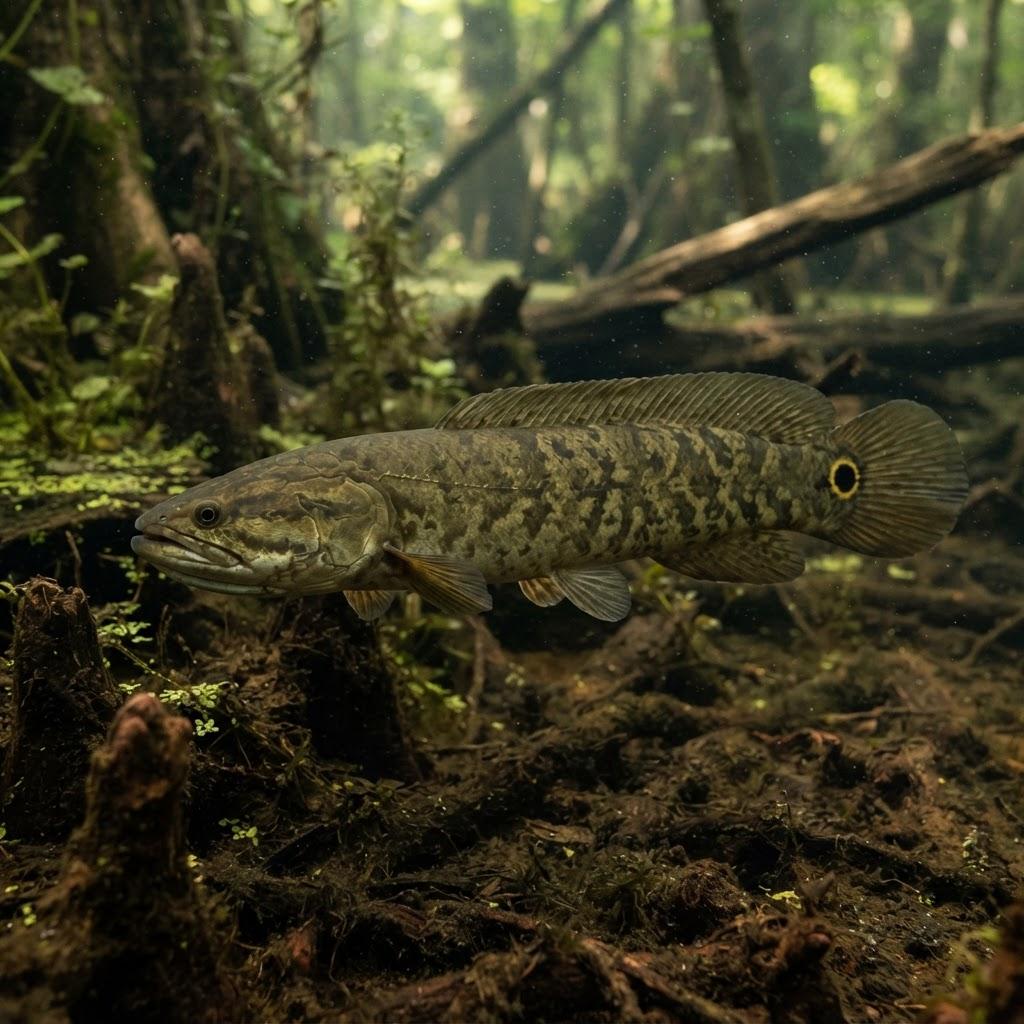
Amia calva
Bowfin (Mudfish)
Meet the Bowfin, a living fossil that looks like it crawled straight out of the Jurassic period. This tough-as-nails swamp dweller breathes air, ignores bad water quality, and treats parenting like a high-stakes action movie.
Meet the Fish
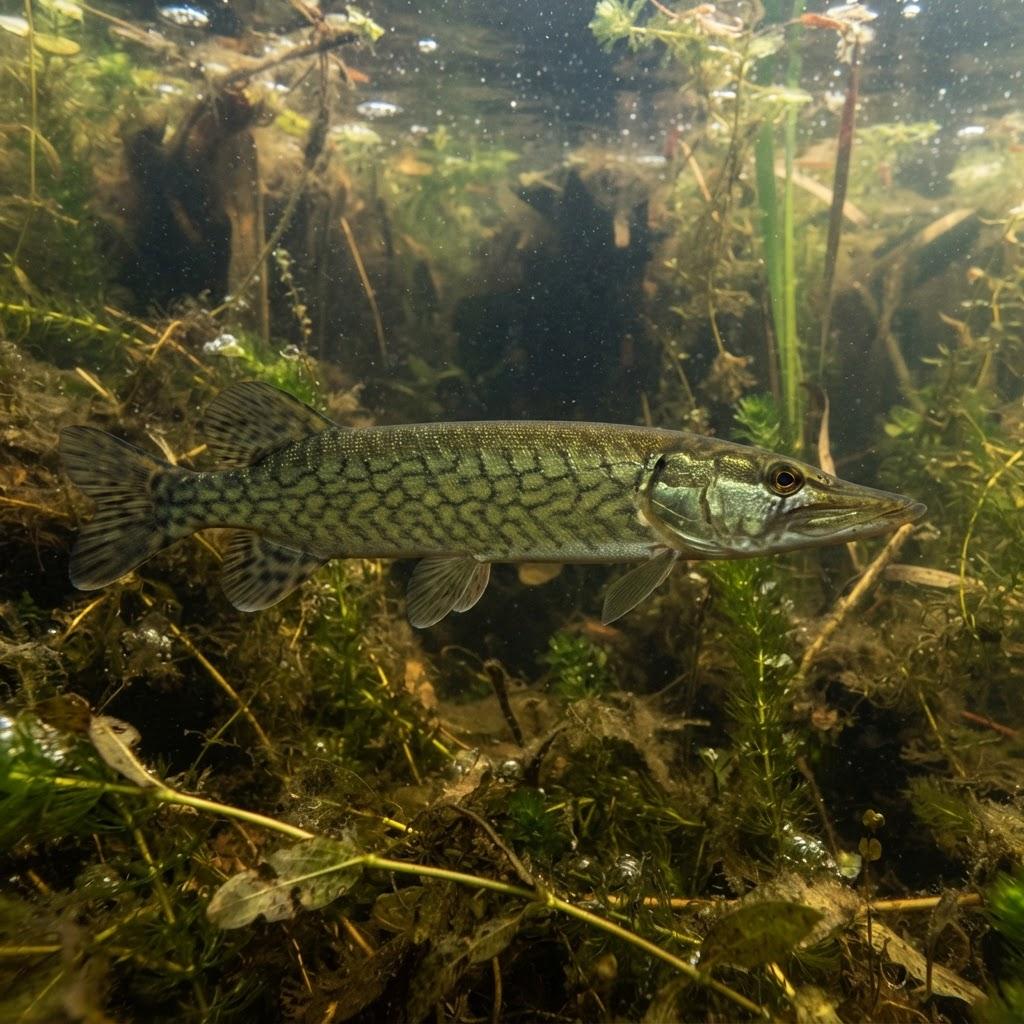
Imagine you are cruising through a murky, swampy bayou on a humid afternoon. Suddenly, a shadow ripples through the lily pads—a prehistoric gangster wearing a mottled coat of olive green. This is the Bowfin, or as the locals call it, the Mudfish, and it is essentially the Keith Richards of the freshwater world: somehow ancient, incredibly resilient, and absolutely not to be trifled with. While other fish are busy being streamlined, flashy, or delicate, the Bowfin looks like it was designed by a committee that couldn't agree on a final shape and just settled on a sturdy tube of attitude. With its long, rippling dorsal fin that stretches across its back like a fancy mohawk, the Bowfin doesn't just swim; it prowls. It is a living fossil, a fish that hasn't changed much in millions of years because, let's face it, when you are already a perfect apex predator of the pond, you don't really need a design update. It is the type of fish that would walk into a bar, order a glass of swamp water, and stare at everyone until they looked away. Its vibe is pure, unadulterated swamp royalty, and it demands your respect simply by existing while everything else around it evolves.
Weird Biological Superpowers Explained Simply
If you ever find yourself wondering how a fish manages to survive in the stagnant, oxygen-poor water of a swamp that smells like a damp basement, the answer is that the Bowfin just cheats. Most fish rely entirely on gills, which are great when there is plenty of oxygen zipping through the water. But when the heat rises and the oxygen drops, the Bowfin doesn't panic. Instead, it hits the surface and gulps down a lungful of air, sending it to its primitive swim bladder, which acts like a backup respiratory system. Think of it like a hybrid car: it runs on the efficient gills for the highway, but when traffic stalls, it switches over to the gasoline engine. This isn't just a quirky habit; it is a full-blown superpower that allows it to survive in water that would make a goldfish faint from exhaustion within minutes. It is essentially an underwater scuba diver that refuses to be limited by the laws of physics that govern its peers. While other fish are desperately gasping for breath as the water gets warm and gross, the Bowfin is just hanging out, taking sips of air, and waiting for its next meal to swim by.
Absurd Self-Defense Mechanisms
If you were thinking that a fish with a mouth full of needle-sharp teeth and a prehistoric attitude would be a pushover, you are in for a rude awakening. When a predator decides to mess with a Bowfin, it quickly realizes it made a grave tactical error. The Bowfin has scales that are essentially natural armor, but its real secret weapon is its sheer, unrelenting stubbornness. If you try to catch one, they do not just give up and lie there; they thrash with the intensity of a breakdancer on a sugar high. Beyond the physical fight, they are masters of the 'swamp invisibility cloak.' Their mottled, camouflage-patterned skin blends perfectly into the light-dappled, vegetation-filled mess of a swamp floor, meaning you won't even see the threat until it is too late. Furthermore, if they decide you are the problem, they will not hesitate to clamp those jaws shut with enough force to turn your lure—or your finger—into confetti. It is a defensive strategy based entirely on being too tough, too sharp, and too ornery to be considered a viable lunch by anything with a lick of sense.
Fish Drama and Gossip
Welcome to the mud-bottomed soap opera of the swamp, where the Bowfin plays the role of the neighborhood bully. These fish are not exactly known for their social skills; in fact, they are intensely solitary and territorial. If another Bowfin dares to enter their favorite patch of lily pads, the response is not a polite handshake, but a full-scale territorial dispute. You can imagine the scene: one Bowfin spots another, flares its fins, and does that classic 'move along, buddy' posture that implies a serious beatdown is incoming. They do not do 'friendship' or 'schooling' because when you are a boss, you don't share your corner of the swamp with anybody. Their social life is limited to two things: avoiding other Bowfins and finding the next best ambush spot. It is the aquatic equivalent of an introverted billionaire who builds a giant, walled estate and only comes out to stare judgmentally at the neighbors. The sheer drama of a territorial standoff in a quiet, stagnant pond is enough to make any reality TV producer reach for their camera.
The "Wait, That's Real?!" Deep-Sea Oddities
While the Bowfin is sticking to the shallows of the river, its cousins and other fish in the deep ocean are out there throwing a rave. Down in the twilight zone, things get weird. While the Bowfin uses its air-gulping ability to stay in the swamp, deep-sea residents have evolved bioluminescence—essentially internal neon signs—to attract mates or confuse prey in the crushing, absolute darkness. Compare the Bowfin’s sturdy, prehistoric armor to the terrifying, translucent skin of a dragonfish, or the bulbous, light-up fishing rod of an anglerfish. The deep sea is a place where biological rules go to die; you have creatures that look like living glass, creatures with heads that are transparent domes, and creatures that can expand their stomachs to swallow prey larger than themselves. The Bowfin represents the tough, practical survivor of the shallows, while the deep-sea abyss is the testing ground for evolution's most creative, nightmarish, and absolutely fascinating experiments. It is the difference between a reliable, vintage muscle car and a spaceship that runs on bioluminescent jelly and sheer audacity.
Myth Busting
There is a long-standing myth that the Bowfin is just a 'trash fish'—a useless, aggressive pest that ruins fishing for 'good' game fish like Bass. People say they are ugly, they destroy gear, and they have no value. Let's set the record straight: the Bowfin is an ecological powerhouse. Calling it a trash fish is like calling a shark a nuisance because it eats the fish you wanted to catch. They are a critical part of the swamp ecosystem, keeping populations of smaller fish in check and serving as a vital link in the food web. Another myth is that they are slow and dim-witted because they live in stagnant water. In reality, they are cunning hunters with incredible reflexes. Their reputation as monsters is largely due to their strength and their refusal to play nice with sport fishermen. They aren't 'trash'; they are top-tier survivors that have survived ice ages, shifting continents, and human development. It is time we stop listening to grumpy anglers and start respecting the Bowfin for the ancient, swamp-dwelling, iron-willed survivors that they actually are.
Humorous Historical Tales or Folklore
For centuries, people have viewed the Bowfin with a mixture of fear and bewilderment. Indigenous cultures often recognized the strength and endurance of the Mudfish, weaving it into stories of resilience and the mysterious nature of the swamp. In more modern history, the folklore surrounding the Bowfin often involves tall tales from bayou locals about 'the beast that wouldn't quit.' One classic story involves an old-timer who allegedly caught a Bowfin so strong it dragged his small skiff halfway across the lake before snapping the line and splashing him with water as a parting insult. Whether true or not, these stories feed into the legend that the Bowfin isn't just a fish—it is a force of nature. There were even older, bizarre beliefs that the Bowfin could predict the weather because they would become more active before a thunderstorm, sensing changes in atmospheric pressure. While it sounds like superstition, they were probably just reacting to the dropping oxygen levels, but we prefer the version where the fish is an aquatic psychic, letting us know a downpour is on the way.
Underwater Love Stories and Bizarre Romances
When a male Bowfin decides it is time to find a partner, things get oddly domestic. Forget the flashy, chaotic mating dances you see in tropical reef movies. The Bowfin is a traditionalist. The male builds a nest—basically a hole in the vegetation—and then waits for a female to drop by. Once the eggs are laid, the male doesn't just swim off to find the next party; he takes his job seriously. He turns a bright, almost neon-green color on his fins, which is basically the fish version of putting on your best tuxedo. It is a surprisingly sweet, albeit intense, display of commitment. He stands guard over the nest, patrolling the perimeter like a secret service agent, making sure no egg-thief gets anywhere near his future offspring. It is a rare moment of tenderness in the life of a creature otherwise known for its grumpiness, showing that even the toughest prehistoric swamp monster has a soft spot for family values.
Underwater Architecture and DIY Nesting
The construction skills of a male Bowfin are surprisingly impressive for a fish that basically lives in the mud. He doesn't just dig a hole; he creates an architectural masterpiece of vegetation clearance. Using his snout and his fins, he clears a circular space in the tangled roots of the swamp floor, ripping out weeds and tidying up the debris until he has a pristine, circular nursery. It is the underwater version of remodeling a room to make it look perfect for a guest. This nest has to be sturdy enough to handle the chaotic environment of a swamp, where currents, predators, and debris are constant threats. He puts an incredible amount of effort into maintaining the nest's integrity, constantly moving things around to ensure the eggs are hidden, safe, and well-oxygenated. It is a testament to his dedication; he is essentially the Bob Vila of the marsh, ensuring that his home improvement project meets the highest possible standards for his growing family.
The Chaos of Raising Tiny Swimmers
Once the eggs hatch, the real fun—and the real chaos—begins. The male Bowfin doesn't just wish the babies good luck and swim away; he becomes the most dedicated, terrifying parent in the swamp. The young fry stick together in a massive, swarming cloud that follows the father around everywhere. Imagine being a miniature fish trying to keep up with your giant, armored, grumpy dad while dodging hungry predators. The father is constantly on edge, herding this cloud of kids like a sheepdog with a very sharp set of teeth. If a predator gets too close, the dad goes into full protective rage mode. He is essentially a school bus driver with the temper of a bodyguard, ensuring that his brood stays in the safe zone. This 'schooling' behavior is a hilarious contrast to the solitary, antisocial life he lived before the kids came along. It is a high-stakes, stressful, and honestly pretty admirable display of parental grit in a world that wants to eat his children for a mid-morning snack.
How to Spot One & How It Is Doing
If you want to see a Bowfin, you have to go where the water is thick, warm, and full of character. Look for slow-moving, heavily vegetated areas, like the back edges of swamps or shallow, weedy lake margins. Keep an eye out for bubbles rising to the surface—that's the Bowfin taking a breath. Their long dorsal fin is the dead giveaway; you will see it rippling like a flag in a light breeze before you see the rest of the body. As for how they are doing, the good news is that the Bowfin is thriving. Because they are tough, air-breathing survivors that can handle low-quality water, they have managed to stay stable while other species struggle with pollution or habitat degradation. To help them out, focus on protecting wetlands and keeping swamps clean. If you ever encounter one, appreciate the prehistoric wonder in front of you. They have been around since the dinosaurs; the least we can do is let them keep their swampy kingdom in peace. You don't have to love them, but you definitely have to admire the fact that they have mastered life in the slow lane for a hundred million years.